Do Dogs Recognize Themselves in Mirrors?
Watching a dog discover a mirror is always a laugh riot. When my first German Shepherd saw himself in the mirror for the first time, he spent ten minutes barking at his twin in the glass and trying to attack the “intruder.” As I have learned over the years, this behavior is not uncommon. Dogs respond to their reflections in ways that seem endearing and quizzical, from pawing at the mirror, to attempting play bows or even ignoring it altogether. These reactions fuel a long‑standing question in animal behaviour: do dogs recognize themselves in mirrors?
As a curious pet parent, I’ve explored the concept of self-awareness in dogs, which I share with you in this article on how dogs perceive and respond to mirrors and reflections. We’ll explore what science says, common mirror behaviors and what it all means for your relationship with your pup. By the end, you’ll have a nuanced picture of canine cognition and a few ideas for using mirrors in training and play.
What Does Mirror Recognition Mean?
To understand whether dogs recognize themselves in mirrors, first, let’s talk about the mirror test in animals. Psychologist Gordon Gallup Jr. devised this self‑recognition test in the 1970s. An animal is marked with an odourless dye on a body part they cannot see without aid. When given a mirror, if the animal touches or examines the mark, researchers interpret that as evidence of self‑recognition. Great apes, dolphins, elephants, magpies and even manta rays have passed this mirror test.
Our canine companions, however, did not. Now, it’s worth noting that failing the self-recognition test does not automatically mean a species lacks self‑awareness. It may simply indicate the test doesn’t fit the animal’s sensory world.
You see, from a human perspective, recognizing yourself means seeing an image and knowing it’s you. But for animals who rely heavily on smell or sound, mirrors may be irrelevant. The mirror test also assumes an animal is motivated to investigate an unusual mark, which isn’t always true.
While the mirror test is a useful tool for studying primate cognition, it may not capture the full spectrum of self‑awareness across species. Many mammals, birds and fish fail the visual test yet demonstrate other forms of self‑representation, suggesting there are multiple pathways to self-awareness.
Do Dogs Pass the Mirror Test?
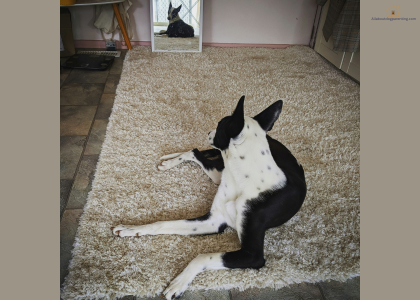
Scientific studies consistently show that dogs do not pass the classic mirror test. When researchers placed dye marks on dogs and gave them mirrors, the dogs barked, sniffed or ignored their reflection. None tried to wipe off or examine the mark. If you notice the dog mirror behavior closely, you’ll find that they initially react strongly to the reflection they see. Excitement, fear or aggression are common responses, but they also quickly desensitise and go about their business.
With all of my dogs, I’ve seen that after the first few encounters with the mirror, they simply pay no mind to it. Their behaviour fits what researchers observe: dogs fail the mirror test not because they are simple‑minded, but because a vision‑based test doesn’t align with how dogs navigate the world.
Dr. Wailani Sung, a veterinary behaviorist, explains, “I don’t think dogs are 100% fully self-aware, but I do think there’s some degree of awareness.” She emphasises that self-awareness isn’t binary. Dogs might understand their bodies differently than we expect. Recent research supports this nuance. Dogs excel in olfactory self‑recognition and body awareness tasks that don’t rely on vision.
How Dogs Actually Perceive Mirrors
If dogs don’t necessarily recognize themselves in the mirror, how do they perceive it? Here are the different factors that impact how dogs see mirrors:
Vision in Dogs
Dogs experience the world differently from us. While humans are visually oriented, canines rely less on sight and more on smell. Their eyesight has a wider field of view and better low‑light performance, but poor colour perception and limited ability to focus on details. When they see a dog vision in the mirror, they see a two‑dimensional moving image without any accompanying scent cues. That mismatch can be confusing. There’s a dog in front of them, but it doesn’t smell like anything.
Role of Smell Over Sight
For dogs, smell is the primary sense. Their olfactory receptors are vastly more sensitive than ours and allow them to identify individuals, emotions and even medical conditions. Because dogs recognize and navigate the world around them using scent, not sight, the visual mirror test doesn’t truly align with their true self‑awareness.
The sniff test of self-recognition, on the other hand, provides evidence of canine olfactory self‑awareness. In this experiment, dogs were presented with canisters containing their own urine, their own urine mixed with another dog’s, and unfamiliar dogs’ urine. Dogs spent more time investigating the canisters with their own modified urine, indicating they could distinguish their scent from that of others.
Alexandra Horowitz, the researcher who pioneered this test, wrote that olfactory stimuli are more relevant than visual stimuli for dogs. A poor performance in the mirror test may reflect a mismatch between the test and canine sensory priorities.
Learning Through Experience
Like people, dogs learn as they grow. Puppies often react more strongly than adults, lunging at the mirror or barking because they perceive the reflection as another dog. That’s why the first, or even the first few times, your puppy sees their reflection, they may bark, paw, or sniff behind the mirror in an attempt to locate the “other dog”.
However, they quickly realise that the other dog isn’t real and subsequently lose interest. Older dogs tend to be calmer around mirrors because they’ve learned the mirror image doesn’t interact or produce odors. Yet some dogs never generalise the learning. Some dogs continue to bark at their reflections during grooming sessions or when a new mirror appears.
Common Reactions Dogs Have to Mirrors
Dogs exhibit a range of behaviors around mirrors. Understanding these reactions can help you respond appropriately:
- Barking or growling: Many dogs bark or growl at their reflection initially, thinking it’s another dog. This may be accompanied by raised hackles or “guarding” posture. Once they realize there’s no scent or response, they often stop
- Pawing or play bowing: Some dogs treat the reflected image as a potential playmate. They might wag, bow or run back and forth in front of the mirror. This playful reaction is common in puppies and high‑energy dogs
- Sniffing behind the mirror: After interacting with the reflection, dogs sometimes walk behind the mirror to investigate. When they sniff around and find nothing, they tend to lose interest
- Ignoring completely: After a few exposures, many dogs simply ignore mirrors. They’ve learned that the image has no smell or consequence, so it’s not worth their attention. In my household, the full‑length mirror is now just part of the furniture
Recognizing these behaviors allows you to tailor your response. There’s usually no need to correct mirror barking unless it becomes obsessive. In that case, too, redirection and calm reassurance are more effective than scolding.
What Does This Say About Dog Intelligence?
One might conclude from the mirror test that dogs lack self-awareness. That view is far too simplistic. Failing the mirror test doesn’t equate to low intelligence. Dogs excel at tasks humans struggle with: reading body language, detecting scents and making nuanced social decisions. Dr. Sung notes, “Self-awareness may exist on a spectrum and dogs show some degree of awareness.” Research supports this. Dogs recognise their own scent, demonstrate body awareness by moving off mats to retrieve attached toys, and understand where their paws end and the world begins.
The Smithsonian summarised a 2021 study where dogs stepped off a mat to retrieve a toy attached to it, showing they knew their bodies were an obstacle. These abilities reveal forms of self-representation, intelligence, and cognition, even if dogs don’t recognise themselves visually.
From my experience, dogs possess a sophisticated social intelligence. They read our moods, comfort us when we’re sad and learn our routines with uncanny precision. They may never stare into a mirror and think, “That’s me,” but they have their own rich understanding of self within a social and olfactory context.
How Pet Owners Can Use Mirrors in Play & Training
Mirrors can be used thoughtfully in enrichment and training. Here are some ideas, drawn from research and my personal experience:
- Curiosity games for puppies: Let young pups explore a mirror under supervision. Encourage them to sniff and observe, and reward calm behaviour. Puppies often find it novel, and exploring helps build confidence
- Desensitisation training: If your dog barks or growls at reflections, use gradual exposure. Stand near the mirror with your dog on a leash, calmly reward them for looking and not reacting. Over time, they’ll learn the mirror isn’t a threat. This technique aligns with positive reinforcement principles rather than punishment
- Hide‑and‑seek or shaping games: Use the mirror’s reflection to teach your dog to find hidden treats or toys. For example, place a treat behind them and encourage them to find it by looking in the mirror. This can improve body awareness and add novelty to playtime
- Don’t force anxious dogs: Some dogs may find mirrors stressful. If your dog cowers, avoids the area or shows signs of anxiety, remove the mirror from their environment. There is no benefit in forcing exposure; plenty of other enrichment activities exist.
Remember that each dog has a unique personality. What delights one may scare another. Use mirrors as one tool among many to engage your dog’s curiosity.
FAQs About Dogs and Mirrors
- Can dogs learn to recognize mirrors?
Dogs don’t really see themselves the way we do in a mirror. At best, they figure out that the reflection isn’t another dog after a little sniffing and staring. Since mirrors don’t have a smell, sound, or any real consequence, most dogs eventually stop paying attention. For them, it’s just another shiny surface, not a tool for self-recognition. - Why do puppies react differently than adult dogs?
Puppies are curious about everything, so a mirror can seem like an exciting discovery. They may bark, paw, or even try to play with the “other dog” they see. As they grow older, though, they rely less on sight and more on smell and memory. Adult dogs usually figure out the reflection doesn’t matter and lose interest quickly. - Are mirrors stressful for dogs?
For most dogs, mirrors are harmless and quickly ignored. But some pups may see their reflection as a stranger and get nervous. If you notice signs like cowering, tucked tails, or avoidance, it’s best not to push them. Removing the mirror and offering toys, puzzles, or playtime is a much better way to keep them engaged and happy. - Does the mirror test determine dog intelligence?
Not really. The mirror test was designed for animals that depend on sight, like primates, but dogs experience the world mainly through smell. They show self-awareness by recognizing their own scent and navigating spaces with their bodies, not by staring in mirrors. So while they might “fail” the mirror test, it doesn’t mean they aren’t smart. It just means they think differently.
Final Takeaway
So, do dogs recognize themselves in mirrors? By human standards, no. They don’t pass the visual mirror test, and most dogs bark, paw or ignore their reflection. But dogs recognize themselves in ways that matter to them, through scent and body awareness. Their noses are their mirrors, and they navigate the world with a rich understanding of their own bodies and relationships. Mirror play can be a fun enrichment tool, especially for puppies, but it’s not a measure of self-awareness. As a fellow dog parent, I find solace in knowing our dogs’ intelligence isn’t defined by a human‑centred test. It’s woven into every wag, sniff and gaze they share with us.