How Much to Feed a Puppy: Charts by Age, Weight, and Breed Size
🐾 Overview
A puppy’s food amount depends on their age, expected adult weight, and their food’s calorie density. As a starting guide, small breed puppies need ¼–¾ cup per meal, medium breeds ½–1.25 cups, and large breeds ¾–2 cups, and need to be fed 3–4 times daily depending on age. If you’re looking for the complete picture of puppy nutrition beyond portions, and need insights on food types, toxic foods, and switching timelines.
Figuring out how much to feed a puppy sounds simple until you’re actually standing in front of a food bowl, second-guessing yourself. Too little and you’re worried about their growth. Too much and you’re risking the joint damage that overfeeding causes in developing bones. The bag says one thing, the internet says another, and your puppy is looking at you like you’ve personally wronged them, regardless of what you put down.
Here’s the honest answer: the right amount depends on your puppy’s age, expected adult weight, and your specific food’s calorie density, not a single universal number. This guide, part of our Complete Guide to Puppy Nutrition, gives you a breed-size feeding chart, a simple calculation method that works for any food, and a hands-on body condition check you can do tonight to confirm whether the amount is actually right.
The Quick-Reference Puppy Feeding Chart
Use the chart below as a starting point, then adjust based on your puppy’s body condition. These amounts assume a standard dry kibble at 350–400 calories per cup. Higher-calorie foods require smaller portions. Likewise, lower-calorie foods require more. So, you see, there is no one-size-fits-all answer to how much food should a puppy eat, but the following chart will help you start off on a solid footing:
Master Puppy Feeding Chart (Dry Kibble, Per Meal)
| Expected Adult Weight | 6–12 Weeks | 3–6 Months | 6–9 Months | 9–12 Months | 12–18 Months |
|---|---|---|---|---|---|
| Toy (1–5 kg / 2–10 lbs) | ¼ cup × 4/day | ¼ cup × 3/day | ⅓ cup × 2/day | ⅓ cup × 2/day | Switch to adult |
| Small (5–10 kg / 10–22 lbs) | ⅓ cup × 4/day | ½ cup × 3/day | ½ cup × 2/day | ½ cup × 2/day | Switch to adult |
| Medium (10–25 kg / 22–55 lbs) | ½ cup × 4/day | ¾ cup × 3/day | 1 cup × 2/day | 1 cup × 2/day | Switch to adult |
| Large (25–40 kg / 55–88 lbs) | ¾ cup × 4/day | 1 cup × 3/day | 1.5 cups × 2/day | 1.5 cups × 2/day | Continue puppy food |
| Giant (40+ kg / 88+ lbs) | 1 cup × 4/day | 1.5 cups × 3/day | 2 cups × 2/day | 2–2.5 cups × 2/day | Continue puppy food |
All amounts are per meal, not per day. Based on standard kibble at approximately 375 kcal/cup. Adjust up for lower-calorie foods, down for higher-calorie foods. Verify with your specific food’s label.
Want it on your fridge? Download our printable puppy feeding chart. If this chart makes you anxious, relax. It’s a starting point, not a prescription. The section below shows you exactly how to tell whether the amount is actually right for your puppy right now.
How to Calculate the Right Portion for Your Specific Food
A 4-month-old medium-breed puppy needs roughly 750 calories per day. If your food has 375 kcal/cup, that’s about 2 cups daily, split across 3 meals. A good rule of thumb to figure out puppy portion sizes is this: find the calories per cup on your food bag, then divide your puppy’s daily calorie target by that number.
This is the step that matters most, and the one most puppy feeding guides skip entirely. Bag charts are brand-specific and based on averages. If you’re using a different food from the one the chart was designed for, which is almost everyone, the portions will be off. Here’s how to calculate the right puppy portion sizes for whatever you’re actually feeding.
Step 1: Find your food’s calorie density
Look at the back of the bag, usually near the guaranteed analysis or nutrition facts panel. You’re looking for a number listed as kcal/cup or kcal/kg. This is the single most important number on the bag, and most owners never look at it. If it’s listed per kilogram only, multiply it by the weight of one cup of that food in kilograms. A standard cup of kibble usually weighs around 100–120g (0.1–0.12 kg). For example, a food with 3,800 kcal/kg and a cup weighing 110g works out to 3,800 × 0.11 = 418 kcal per cup.
Step 2: Find your puppy’s daily calorie target
How much food should a puppy eat? The answer is closely tied to their daily calorie target:
| Puppy’s Current Weight | Daily Calories (Growth Phase) |
|---|---|
| 2 kg (4 lbs) | 275–350 kcal |
| 5 kg (11 lbs) | 500–625 kcal |
| 10 kg (22 lbs) | 750–950 kcal |
| 15 kg (33 lbs) | 950–1,200 kcal |
| 20 kg (44 lbs) | 1,100–1,400 kcal |
| 30 kg (66 lbs) | 1,400–1,800 kcal |
These ranges cover moderate to active puppies during peak growth. Less active puppies and those in lower-temperature environments trend toward the lower end.
Step 3: Divide daily calories by kcal/cup
This gives you the total cups per day.
Step 4: Divide by the number of meals
This gives you the portion size per meal.
Prefer to skip the maths? Our free puppy food calculator does all four steps for you.
Real-life example of how I calculated portion size when my GSD was 4 months
At four months, my German Shepherd weighed around 12 kg. His food at the time listed 380 kcal/cup. Daily calorie target for a 12 kg puppy in peak growth: approximately 950 kcal. That calculation looked like this: 950 ÷ 380 = 2.5 cups per day. Split across 3 meals = about 0.83 cups per meal. Because I weighed his kibble instead of using a measuring cup, I didn’t need to round: I worked out what 0.83 cups of his food weighed and fed exactly that. Then I watched his body condition weekly. He stayed lean but not thin, with ribs easily palpable and a clear waist from above, which is exactly where he needed to be.
One practical tip worth stealing: I weighed the kibble rather than measuring by cup, because different kibbles have different densities. A kitchen scale costing less than $10 is the most useful tool in your puppy feeding kit. Once you’ve weighed out one cup of your specific food, you know exactly what the number means, and you stop guessing.
How to Tell If You’re Feeding the Right Amount
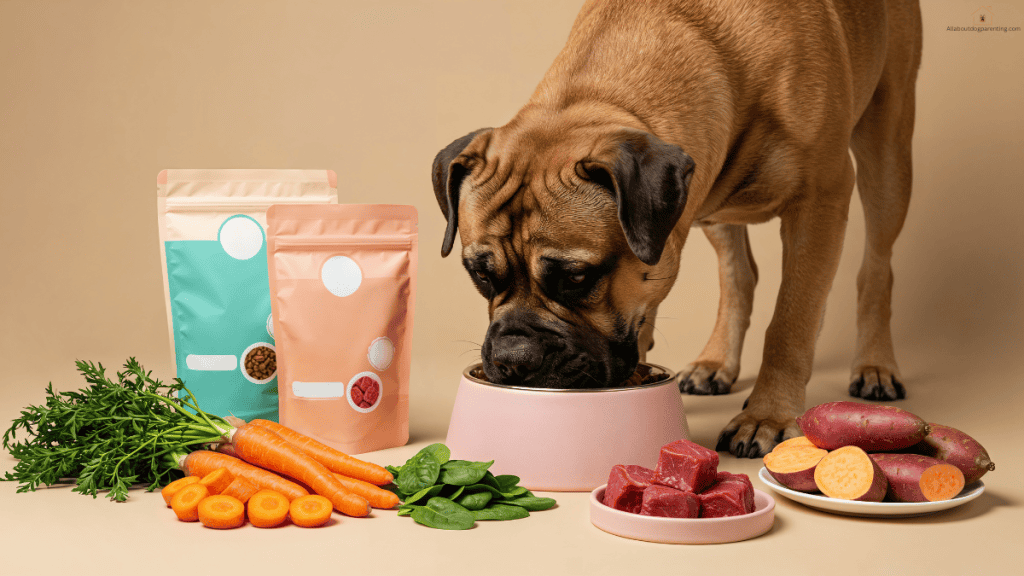
Run your hands along your puppy’s ribcage. You should feel their ribs easily with light pressure, but not see them prominently. From above, there should be a visible waist behind the ribs. From the side, the belly should slope upward toward the hindquarters rather than hang flat.
This is the body condition score (BCS) check, and it’s what your vet does at every appointment. According to VCA Animal Hospitals, the ideal BCS on a 9-point scale is 4–5. It takes about two minutes and tells you more than any scale reading. Here’s how to do it at home, right now.
Check 1: Ribs—the most important indicator
Place your thumbs on your puppy’s spine and spread your fingers across the ribcage. Press gently with flat fingers, not your fingertips. You should feel each rib distinctly, with just a slight cushion of muscle over them. Think of running your fingers over your knuckles with your hand flat. That’s what ribs with a healthy fat covering feel like. If the ribs feel like the backs of your knuckles when you make a fist, sharp and prominent with no give, your puppy is too lean. If you have to press with real pressure to feel anything at all, they’re carrying too much fat.
Check 2: View of the waist from above
Stand directly over your puppy and look down at their back. Behind the ribcage, their body should curve inward toward the hips. A gentle hourglass shape. If the line from ribcage to hips is straight or, worse, curves outward, they’re overweight. If the waist tuck is dramatically pronounced and the hip bones are visible, they’re underweight.
Check 3: Abdominal tuck view from the side
Stand or sit beside your puppy and look at their profile. The belly should slope upward between the ribcage and the hind legs, not hang flat, and certainly not droop downward. A gentle upward slope is correct. A belly that hangs level or below the ribcage on a young puppy almost always means overfeeding.
What To Do with the Results
If any of these checks suggest your puppy is too thin or too heavy, adjust portions by 10% in the appropriate direction and recheck after one week. Don’t make drastic changes to the diet suddenly. Small adjustments compound quickly with a growing puppy. During active growth spurts, check weekly. Once growth slows after six months, every two to three weeks is enough.
I’ve seen it work firsthand. Around five months, my current GSD started looking a little rounder than I wanted. The ribs were there but required more pressure to be felt than they should. I reduced his portions by about 10% and increased his structured play. Within two weeks, the rib check was back where it needed to be.
How Feeding Amounts Change as Your Puppy Grows
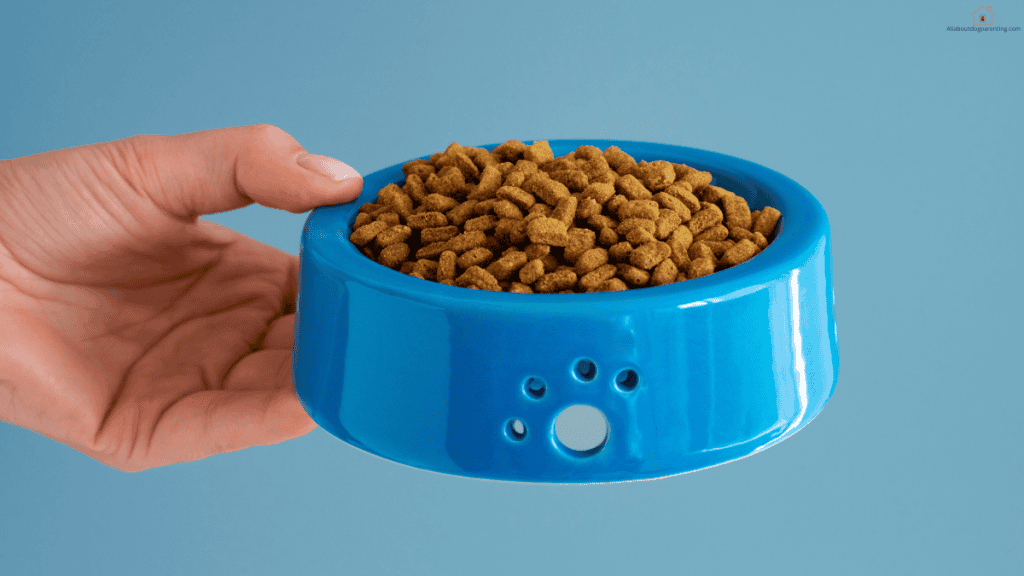
Puppies eat the most relative to their body weight between 2–6 months during peak growth. After this, the portion size needs to gradually decrease as growth slows. Most puppies shift from 4 meals to 3 meals around 12 weeks, and from 3 meals to 2 meals around 6 months.
This is the part of the puppy feeding guide by age that actually helps you anticipate what’s coming, rather than scrambling to react after your puppy’s appetite suddenly doubles.
6–12 weeks: Maximum calorie needs, four meals a day
This is the stage where your puppy seems hungry all the time because they basically are. Their calorie requirements relative to body weight are higher now than at any other point in their lives. Four meals spread through the day keep blood sugar stable, which matters particularly for toy breeds where hypoglycaemia is a genuine risk if meals are skipped. Very young puppies, under 10 weeks, may benefit from moistening dry kibble slightly with warm water or broth to soften it.
3–6 months: Peak growth velocity, three meals a day
Appetite during this window can seem enormous, particularly in large breeds going through visible growth spurts. Drop to three meals around 12 weeks. Large breed owners especially need to resist the temptation to keep increasing portions because the puppy always seems hungry. Monitoring body condition is more reliable than appetite as a guide to whether portions are correct. Our puppy growth spurts guide explains what’s happening physically during these phases and why controlled growth protects developing joints.
6–9 months: Growth slowing for small and medium breeds, two meals a day
Drop to two meals around six months. You may notice your puppy occasionally leaving food in the bowl. This is your cue to reduce portions slightly, not a sign they dislike the food. Small and medium breeds are approaching adult size; their calorie needs are decreasing toward adult levels. Large breeds are still actively growing and should remain on large-breed puppy food with controlled calcium.
9–12 months: Small and medium breeds approaching adult feeding
Portions for small and medium breeds are now close to adult amounts. If your puppy’s growth has visibly slowed and their weight has stabilised, start the conversation with your vet about transitioning to adult food. Large breeds continue on puppy food. Giant breeds are still in peak growth. Here’s how to tell the right time to switch to adult food.
12–18+ months: The transition zone
Small and medium breeds switch to adult food. Make that change gradually, not overnight. Here’s how to transition puppy food without upsetting their stomach. Large and giant breeds stay on puppy food until growth plates close, which your vet can confirm with an X-ray if you want certainty. My GSD didn’t move to adult food until around 14 months. Our vet wanted him on the controlled-calcium large-breed formula until skeletal development was complete. That extra few months on puppy food cost nothing and protected his joint development during the final stretch of growth.
Breed-Size Feeding Examples: Real Numbers
Breed size is the single biggest factor in how much to feed your puppy, and it matters more than age, activity level, or food brand. A 4-month-old Labrador needs roughly 900–1,100 calories per day. A 4-month-old Chihuahua needs only 200–300. The puppy feeding chart works across breeds, but here’s what those numbers look like with real breeds.
Toy breeds
- Expected adult weight: 2–3 kg.
- At 4 months: approximately 250 kcal/day = about ⅔ cup of standard kibble, split into 3 meals (roughly ¼ cup each)
- Meal frequency drops to 2 daily after 6 months
- Switch to adult food: 7–9 months.
- Important caveat: toy breeds need small, frequent meals. Skipping any meal risks hypoglycaemia. Keep snacks on hand during the teething months when appetite can be unpredictable.
Medium breeds
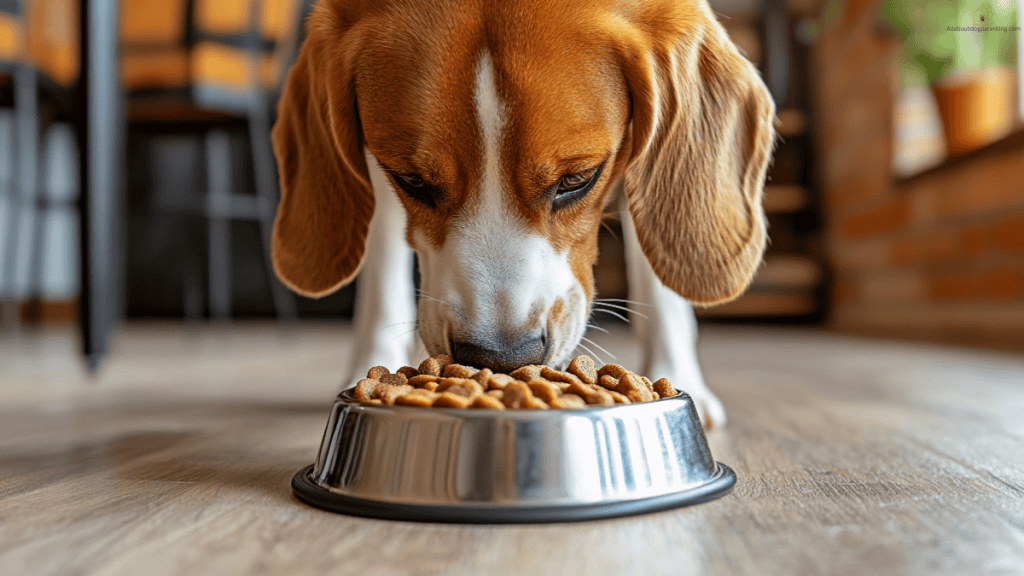
- Expected adult weight: 10–12 kg
- At 4 months: approximately 750 kcal/day = about 2 cups of standard kibble at 375 kcal/cup, split into 3 meals
- At 6 months, drop to 2 meals and reduce slightly as growth slows
- Switch to adult food: 10–12 months
Large breeds
- Expected adult weight: 30–40 kg
- At 4 months: approximately 950–1,200 kcal/day = 2.5–3 cups of standard kibble, split into 3 meals
- Must use large-breed puppy food with controlled calcium. A lot of large-breed dogs are predisposed to hip and elbow dysplasia, and the nutrition during the growth window directly influences risk
- Switch to adult food: 12–15 months, confirmed with vet
- My boy’s daily amount at 4 months was 2.5 cups split three ways, a little over ¾ cup per meal. I weighed rather than measured by cup, which I’d recommend to anyone feeding a large breed
Giant breeds
- Expected adult weight: 50–70 kg
- At 4 months: approximately 1,200–1,600 kcal/day = 3–4 cups of standard kibble, split into 3 meals
- Must use a formula specifically labelled for giant-breed growth with controlled calcium and phosphorus levels
- Switch to adult food: 18–24 months, and only when confirmed by a vet familiar with giant breed development
- Of all the breed categories, giant breeds have the longest and most critical window of nutritional vulnerability. Overfeeding during this period causes skeletal damage that no amount of correct feeding later can undo
Puppy Feeding Chart by Weight (Pounds and Kilograms)
🐾 Overview
Don’t know your puppy’s expected adult weight? Use this quick lookup by their current weight instead. Find your puppy’s weight below for an estimated daily calorie need, then use Step 3 above to convert that into cups for your specific food.
If you landed here because you searched something like “how much should a 10 pound puppy eat,” you’re in the right spot, and you’re definitely not the only one Googling this at 11 pm with a hungry puppy staring you down. Not every puppy owner knows their dog’s expected adult weight, especially with mixed breeds or a rescue of unknown parentage, so this table works off what’s easiest to measure: the number on the scale right now. For purebreds, our puppy weight chart by breed can estimate their expected adult size
These estimates use the same resting energy requirement formula veterinarians rely on, scaled up for a typical growing puppy rather than a resting adult dog. Younger puppies, under 4 months, run toward the higher end of this range, since growth itself burns calories. Puppies approaching adult size can run slightly lower. For an exact number based on your puppy’s age and your specific food, our puppy food calculator will get you closer. Think of this table as the fast version.
| Current Weight (lb) | Current Weight (kg) | Estimated Daily Calories |
|---|---|---|
| 2 lb | 0.9 kg | ~160 kcal/day |
| 3 lb | 1.4 kg | ~220 kcal/day |
| 4 lb | 1.8 kg | ~275 kcal/day |
| 5 lb | 2.3 kg | ~325 kcal/day |
| 6 lb | 2.7 kg | ~370 kcal/day |
| 8 lb | 3.6 kg | ~460 kcal/day |
| 10 lb | 4.5 kg | ~545 kcal/day |
| 12 lb | 5.4 kg | ~625 kcal/day |
| 13 lb | 5.9 kg | ~660 kcal/day |
| 15 lb | 6.8 kg | ~735 kcal/day |
| 20 lb | 9.1 kg | ~915 kcal/day |
| 25 lb | 11.3 kg | ~1,080 kcal/day |
| 30 lb | 13.6 kg | ~1,240 kcal/day |
These numbers assume an average-activity puppy in mid-growth. A very young puppy, 8 to 12 weeks, may need up to 15% more. A puppy nearing adult size may need slightly less. Always cross-check against your food’s own feeding guidelines, and adjust based on body condition. Your puppy’s ribs, waist, and energy level tell you if you’re actually there.
5 Signs You’re Feeding Too Much or Too Little
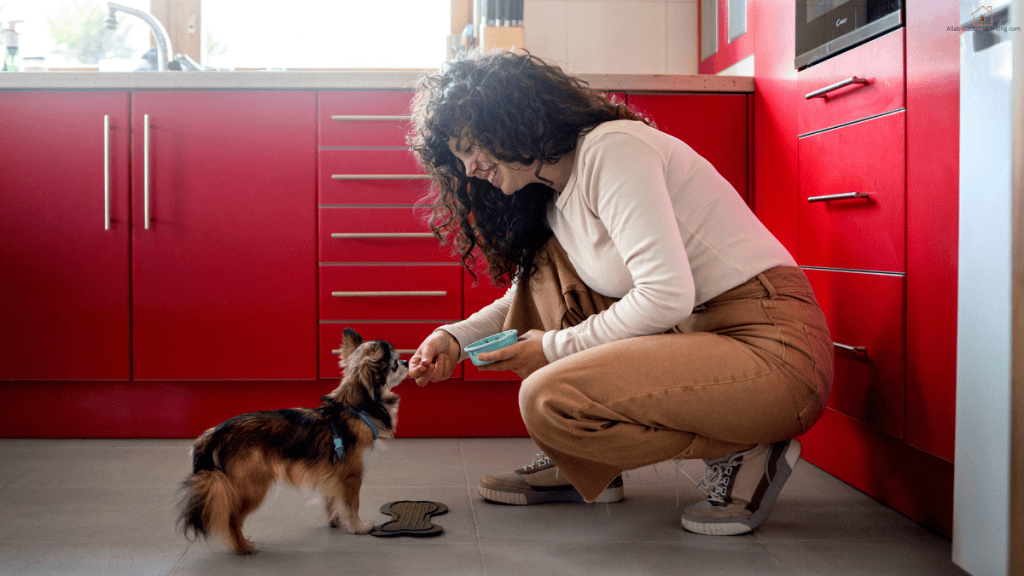
Signs of overfeeding include a persistently round belly, loose stools, rapid weight gain, and ribs you can’t feel without pressing hard. Signs of underfeeding include visible ribs without touching, low energy, a dull coat, and constantly searching for food between meals. If you’re seeing any of the signs below, adjust portions by 10–15% in the appropriate direction and reassess after one week.
Signs you’re feeding too much
- Round belly that persists throughout the day, not just immediately after eating, but hours later. Post-meal fullness is normal; a puppy that looks rounded all the time is not
- Consistently soft or loose stools. Overfeeding is one of the most common and underappreciated causes of digestive problems in puppies
- Weight gain that outpaces breed growth charts. If your large-breed puppy is gaining more than expected, they’re likely getting too many calories, and rapid growth in large breeds directly increases orthopedic risk
- Rib check fails. You can only feel ribs with firm pressure, or not at all. This is the clearest physical sign that portions need reducing
- Lethargy after meals. A puppy who consistently seems heavy and slow after eating is probably overfull
Seeing two or more of these? Our guide on how to tell if your puppy is overweight covers what to do next.
Signs you’re feeding too little
- Ribs, spine, or hip bones are visible without touching. In short-coated breeds, this is easy to see. In longer-coated breeds, you’ll need to feel for it
- Lower energy than expected for age. A puppy that seems genuinely tired rather than just post-nap sleep may not be getting enough fuel
- Dull, sparse coat. Adequate nutrition is reflected directly in coat quality.
- Frantic food-seeking behavior. Eating anything available, gulping meals in seconds, and showing intense interest in other dogs’ bowls. Normal enthusiasm is one thing; desperation is another
- Growth tracking below the expected range for the breed. If your puppy is consistently smaller than breed growth charts predict and the rib check confirms leanness, an increase is warranted
FAQs
1. Should I follow the feeding guide on the puppy food bag?
Use it as a starting point in figuring out how much to feed a puppy. Bag guidelines are calculated for average puppies on average activity levels with average metabolisms. Your puppy is more than that. They’re an individual. Adjust based on what you see and feel during weekly body condition checks, and let your vet course-correct at appointments.
2. Can I mix wet and dry food? How do I calculate portions?
Yes, combination feeding works well. The key is balancing total daily calories. If you’re adding half a can of wet food (typically around 200 kcal), reduce your kibble by approximately half a cup to keep total daily calories consistent. Calculate wet food calories the same way as dry. Find the kcal per can or per 100g on the label, then do the maths.
3. My puppy always seems hungry. Should I feed more?
Not necessarily. Puppies are enthusiastic about food as a rule, and hunger cues are not reliable guides to whether they need more. If their body condition check is healthy, for example, ribs easily palpable, visible waist, or abdominal tuck present, the portions are correct. Constant hunger with ribs that are genuinely too prominent, or with low energy, is a different signal and warrants an increase or a vet visit.
4. How much water should a puppy drink per day?
Puppies generally need approximately 30–60 ml of water per kilogram of body weight daily. A 10 kg puppy should drink roughly 300–600 ml. Always provide fresh water freely. Never restrict access. Dehydration compounds quickly in puppies, especially during warm weather or active play.
5. What if my puppy skips a meal?
One skipped meal is generally not a concern, particularly during teething (3–6 months) when gum discomfort can temporarily suppress appetite, or during the first few days in a new home when stress reduces hunger. If your puppy refuses food for more than 24 hours, or if food refusal comes with lethargy, vomiting, or diarrhoea, contact your vet. Don’t try to entice skipped-meal eating by adding variety or wet food. This quickly trains a puppy to hold out for something better.
6. How much should a 10-pound puppy eat?
A 10-pound (4.5 kg) puppy typically needs around 545 calories a day, split across 3 meals if under 6 months. Convert that to cups using your food’s calorie density from the calculation steps above, since cup amounts vary by brand.
7. How much should a 20-pound puppy eat?
A 20-pound (9.1 kg) puppy needs roughly 915 calories a day. Divide by your food’s kcal-per-cup value to get the exact cup amount, and adjust based on body condition if your puppy seems too thin or too heavy.
8. How much should a 5-pound puppy eat?
A 5-pound (2.3 kg) puppy needs approximately 325 calories daily, typically split into 3 to 4 small meals. Toy and small-breed puppies this size often do best with measured meals rather than free-feeding, since their stomachs are genuinely tiny and free access tends to lead to grazing rather than proper meals.
The Bottom Line
Knowing how much to feed a puppy comes down to three things: a breed-size appropriate starting point from the chart, a calculation that matches your specific food’s calorie density to your puppy’s actual needs, and a weekly body condition check that tells you whether the amount is working. Get those three things right, and you don’t need to agonise over every cup. The puppy feeding guide by age gives you the framework. Your puppy’s body confirms whether it’s right. Start with the chart. Calculate the food. Check body condition weekly. Adjust by 10% when needed. Your puppy is more forgiving than you think, and the weekly hands-on check means you’ll catch any drift well before it becomes a problem.