Best Puppy Food for Allergies: 6 Hypoallergenic Picks for 2026
Overview:
The best puppy food for allergies uses novel proteins like salmon, duck, or venison, or hydrolysed proteins the immune system cannot recognise. Top picks: Natural Balance L.I.D., CANIDAE Pure Puppy, Hill’s Science Diet Sensitive Stomach, Royal Canin Hydrolyzed Protein Puppy, Purina HA, and The Farmer’s Dog.
If your puppy is scratching constantly, dealing with recurring ear infections, or has chronic loose stools that won’t resolve despite food changes, you’re in the right place. Most puppy owners searching for the best puppy food for allergies have already tried switching foods at least once without clear improvement.
This article, part of our Complete Guide to Puppy Nutrition, cuts through that confusion by starting where every other guide should but doesn’t: figuring out what your puppy actually has before recommending anything to buy.
Allergy vs Sensitivity vs Intolerance: What Does Your Puppy Actually Have?
Overview:
A true food allergy causes immune-driven itching and ear infections. A sensitivity causes digestive upset without immune involvement. Most puppies labelled “allergic” actually have a sensitivity or intolerance, both of which are easier and cheaper to manage.
| True Food Allergy | Food Sensitivity | Food Intolerance | |
| Mechanism | Immune system produces antibodies against a food protein | Digestive irritation without immune response | Inability to digest a specific ingredient |
| Common symptoms | Itchy skin (face, ears, paws), chronic ear infections, skin redness | Loose stools, gas, vomiting | Gas, bloating, diarrhoea, stomach gurgling |
| Timing after eating | Hours to days | Within hours | Within 30 minutes to a few hours |
| Most common triggers | Proteins: beef, dairy, chicken, wheat, egg | Varies, often specific ingredients | Lactose, certain fibres, high-fat foods |
| Prevalence in puppies | Rare, around 1 to 2% of dogs | Common, especially under 6 months | Common |
| Dietary solution | Novel protein or hydrolysed protein diet | Limited-ingredient diet, different protein source | Remove the specific ingredient |
A puppy with a true allergy may need a prescription hydrolysed diet and veterinary dermatologist involvement. A puppy with a sensitivity usually responds to a well-chosen over-the-counter puppy food for allergies. Getting the category right before you buy anything saves months of wasted effort and money.
The Most Common Allergens for Puppies (Ranked)
Overview:
The top allergens for dogs are proteins. Beef is the most common at 34% of confirmed cases, followed by dairy at 17% and chicken at 15%. Grains are rarely the true allergen.
A 2016 systematic review published in BMC Veterinary Research, led by Professor Dr. Ralf Mueller of the European Board of Veterinary Specialists, confirmed this ranking across hundreds of dogs with confirmed food allergies. The Merck Veterinary Manual independently corroborates it: “In dogs, the most common food allergens are beef, dairy products, chicken, wheat, and lamb.”
| Allergen | Frequency | Notes |
| Beef | 34% of confirmed cases | Single most reported food allergen in dogs |
| Dairy | 17% | Lactose intolerance is common; true dairy allergy is less so |
| Chicken | 15% | Very common in puppy food. High exposure increases allergy risk |
| Wheat | 13% | Often blamed but less common than proteins |
| Lamb | 5% | Was once considered novel but is now widely used |
| Egg | Under 5% | Less common but worth including in elimination trials |
| Soy | Under 6% | Found in many commercial foods as a protein filler |
| Salmon or fish | Very rare | One of the safest proteins for allergic dogs |
| Duck, venison, rabbit | Very rare | Truly novel proteins most puppies have never encountered |
This ranking matters because allergies develop through repeated exposure. A protein a puppy has never eaten cannot have triggered an immune response yet. Salmon, duck, venison, and rabbit remain the most reliably novel proteins for most puppies because they are rarely used in standard puppy food. Lamb was once considered a safe novel option but has become common enough in commercial diets that many dogs already have prior exposure, reducing its value as an elimination protein.
Don’t Waste Money on Unreliable Allergy Tests
Overview:
Blood tests, saliva tests, and hair tests for pet food allergies are not reliable and are not recommended by veterinary dermatologists. The only accurate diagnostic tool is an 8 to 12 week elimination diet trial under veterinary supervision.
The Animal Dermatology Group states, “There are a number of blood tests, and even tests on hair and saliva that claim to test for food reactions. None of these have been shown to provide reliable, repeatable, or useful information regarding food allergy.”
The Canadian Academy of Veterinary Dermatology also echoes the same logic, saying, “There is no accurate skin or laboratory test for food allergies in pets. Currently, the only way to diagnose a food allergy is using an elimination diet trial.”

These tests cost between $100 and $300. They frequently produce false positives that lead owners to unnecessarily restrict their puppy’s diet based on inaccurate results, removing proteins that weren’t causing the problem and sometimes eliminating nutritionally important ingredients during the growth phase when complete nutrition matters most.
I know this isn’t the quick answer people want. A blood test that produces a neat allergen list feels more actionable than 12 weeks of strict dietary management. But acting on inaccurate results wastes months and can genuinely harm a growing puppy’s development. The elimination diet is slower and harder. It is also the only method that works.
The 3 Types of Allergy-Friendly Puppy Food
Overview:
Three categories exist: limited-ingredient diets, hydrolysed protein diets, and novel protein diets. Start with a limited-ingredient puppy food from the OTC category. Escalate to a prescription hydrolysed diet if symptoms don’t resolve in 6 to 8 weeks.
| Type | How It Works | Best For | OTC or Prescription |
| Limited Ingredient Diet | Single protein and carbohydrate, minimal added ingredients | First-line approach for suspected sensitivity or mild allergy | Over-the-counter |
| Hydrolysed Protein Diet | Proteins broken into fragments too small for immune recognition | Confirmed severe allergies, elimination diet trials | Prescription (from vet) |
| Novel Protein Diet | Uses a protein the puppy has never eaten (duck, venison, rabbit) | Puppies who’ve reacted to common proteins | Both OTC and prescription |
According to veterinary dermatologists, if a puppy’s diet history is incomplete and you cannot reliably identify a truly novel protein, a hydrolysed protein diet is often the better choice for an elimination trial. The success of a novel-ingredient elimination diet depends entirely on an accurate, exhaustive diet history, which can be difficult to establish for adopted puppies or those who’ve been fed multiple foods.
The distinction between OTC limited-ingredient puppy food and prescription hydrolysed diets also matters for contamination control. As VCA Animal Hospitals notes, prescription diets are manufactured in facilities specifically designed for each special allergy food, whereas over-the-counter limited-ingredient diets are often processed in facilities that also produce other formulas, raising the risk of cross-contamination with undeclared proteins.
The 6 Best Puppy Foods for Allergies (2026)
Overview:
Top 6: Natural Balance L.I.D. (best first-line LID), CANIDAE Pure (best OTC novel protein), Hill’s Sensitive Stomach (best mild sensitivity), Royal Canin HP Puppy (best prescription), Purina HA (best elimination trial), The Farmer’s Dog (best fresh option).
Let’s take a look at why these make the cut for the best puppy food for allergies:
Pick 1: Natural Balance L.I.D. Puppy (Salmon and Brown Rice) — Best First-Line Limited Ingredient
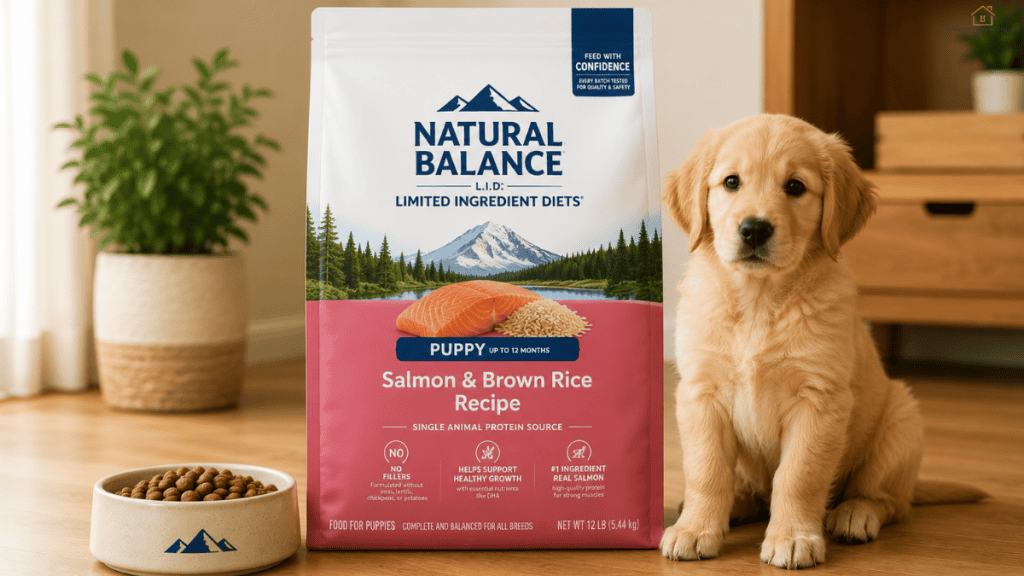
Single animal protein (salmon, which is genuinely novel for most puppies), paired with brown rice and minimal additional ingredients. The simplicity makes it the clearest first diagnostic step for any puppy suspected of having a food sensitivity. No artificial colours, flavours, or preservatives. If you’re looking for the best food for puppy with food allergy symptoms at the lowest OTC price point, this is the logical starting point before escalating to a prescription diet.
| Spec | Value |
| Primary protein | Salmon |
| Protein | 24% min |
| Fat | 10% min |
| Ingredient count | ~15 (very limited) |
| Kcal/cup | ~360 |
| Price estimate | ~$45–55 per 22 lb bag |
| AAFCO | Growth (all breeds) |
| Availability | OTC |
Best for: Puppies with suspected food sensitivity on chicken or beef-based foods. Owners beginning a vet-guided elimination trial who want an affordable OTC limited ingredient puppy food starting point.
Drawback: Lower protein and fat than standard puppy food. Not ideal long-term for very active or large-breed puppies who need higher calorie density.
Pick 2: CANIDAE Pure Puppy (Salmon and Sweet Potato) — Best OTC Novel Protein Option
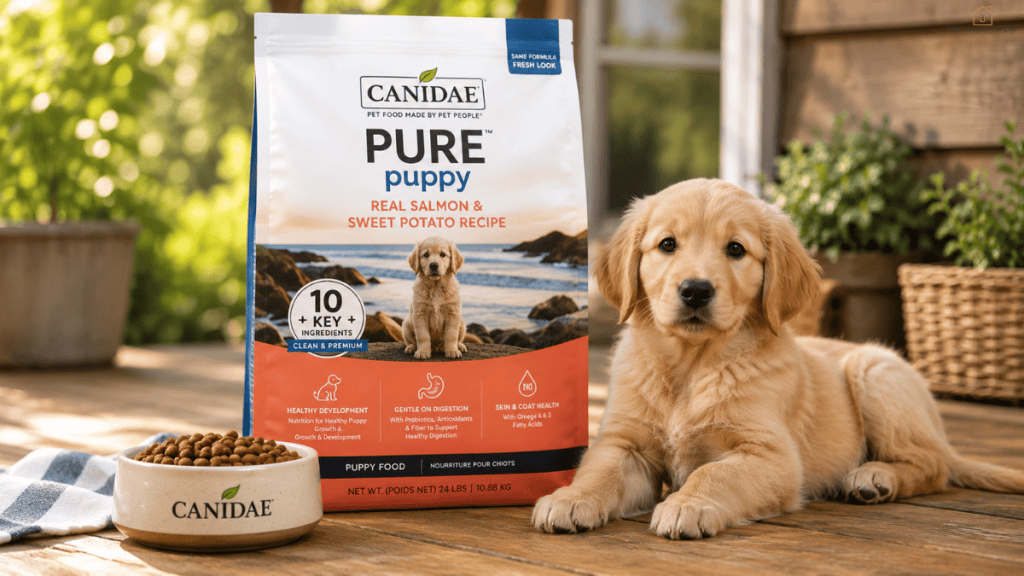
Eight core ingredients. Salmon as the sole animal protein, sweet potato as the carbohydrate. Grain-free but uses sweet potato rather than peas or lentils, which sidesteps the legume-related DCM concern that affects most grain-free formulas. Higher calorie density than Natural Balance makes it more suitable for active puppies who need greater energy intake during the growth phase.
| Spec | Value |
| Primary protein | Salmon |
| Protein | 28% min |
| Fat | 14% min |
| Ingredient count | ~8 core ingredients |
| Kcal/cup | ~460 |
| Price estimate | ~$55–65 per 22 lb bag |
| AAFCO | Growth (all breeds) |
| Availability | OTC |
Best for: Active puppies needing a novel protein with higher calorie density. A strong hypoallergenic puppy food option for owners who want fewer ingredients than Hill’s without going to a prescription formula.
Drawback: Grain-free formula. Despite using sweet potato rather than legumes, monitoring for DCM-related concerns in large breeds remains prudent. Higher price than Natural Balance.
Pick 3: Hill’s Science Diet Puppy Sensitive Stomach and Skin (Salmon) — Best for Mild Sensitivities
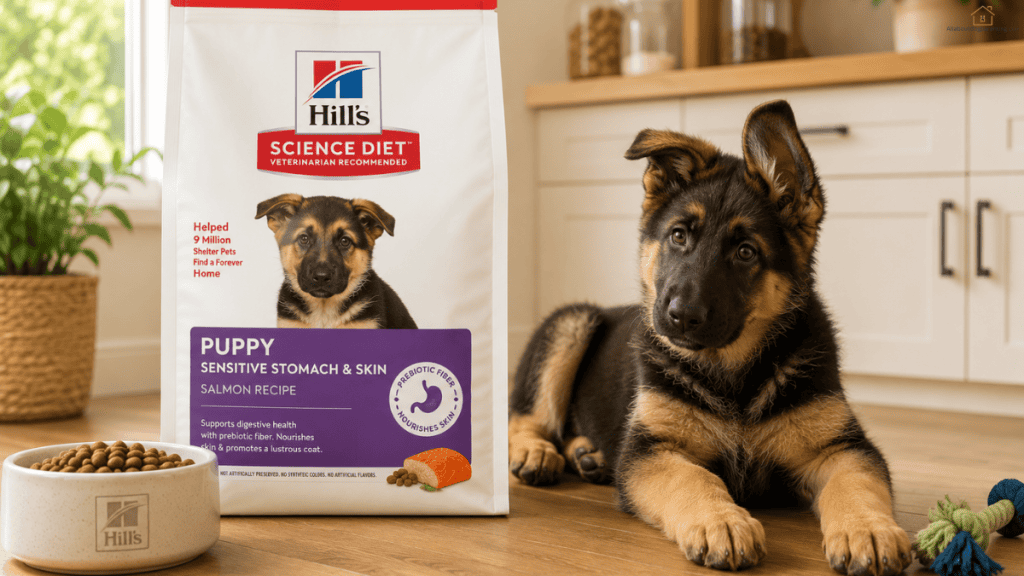
Not a limited-ingredient diet, but uses salmon as the primary protein alongside prebiotic fibre for digestive support. Over 200 veterinary nutritionists and scientists are behind this formulation. Useful where both skin and digestive symptoms are present simultaneously, which is common in puppies with food sensitivities. Consistently recommended across multiple veterinary nutrition sources as a first-line sensitive stomach puppy food vet recommended option.
| Spec | Value |
| Primary protein | Salmon meal |
| Protein | 24.5% min |
| Fat | 15% min |
| Key features | Prebiotic fibre, vitamin E, omega-6 fatty acids |
| Kcal/cup | ~392 |
| Price estimate | ~$55–65 per 30 lb bag |
| AAFCO | Growth (all breeds) |
| Availability | OTC |
Best for: Puppies with mild digestive sensitivity alongside skin issues. When the problem appears to be sensitivity rather than a confirmed allergy requiring a true elimination diet.
Drawback: Not a true limited-ingredient diet. The broader ingredient list makes it less useful for identifying specific triggers through elimination.
Pick 4: Royal Canin Veterinary Diet Hydrolyzed Protein Puppy — Best Prescription Option
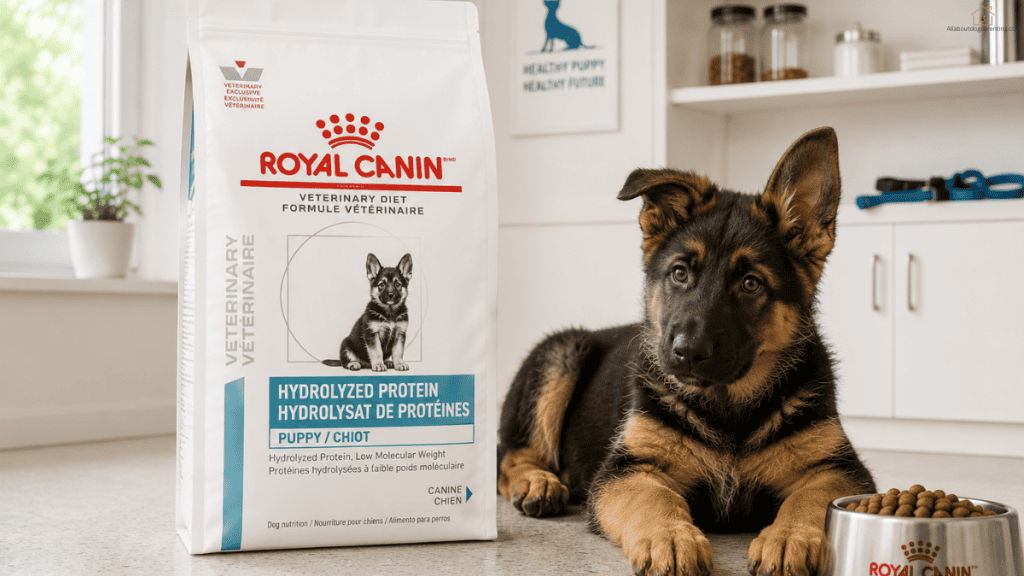
The gold standard for puppies with confirmed severe food allergies. Uses hydrolysed soy protein, broken down so completely that the immune system cannot recognise or react to it. It is specifically formulated for growing puppies, which is a meaningful distinction because most adult hydrolysed formulas do not meet the nutritional requirements of a puppy still in the growth phase. As the best food for puppy with food allergy that has failed OTC options, this is typically what veterinary dermatologists reach for first.
| Spec | Value |
| Primary protein | Hydrolysed soy protein |
| Protein | 24% min |
| Fat | 14% min |
| Key features | Hydrolysed proteins, controlled minerals for growth, EPA and DHA |
| Kcal/cup | ~350 |
| Price estimate | ~$85–100 per 22 lb bag |
| AAFCO | Growth (all breeds including large breed) |
| Availability | Prescription only |
Best for: Puppies with confirmed food allergies who haven’t responded to OTC limited ingredient puppy food options. The preferred choice for elimination diet trials where diet history is incomplete.
Drawback: Expensive. Requires vet prescription. Uses hydrolysed soy as the protein base, which some owners find philosophically uncomfortable, though it is nutritionally effective and extensively studied.
Pick 5: Purina Pro Plan Veterinary Diets HA — Best for Elimination Diet Trials
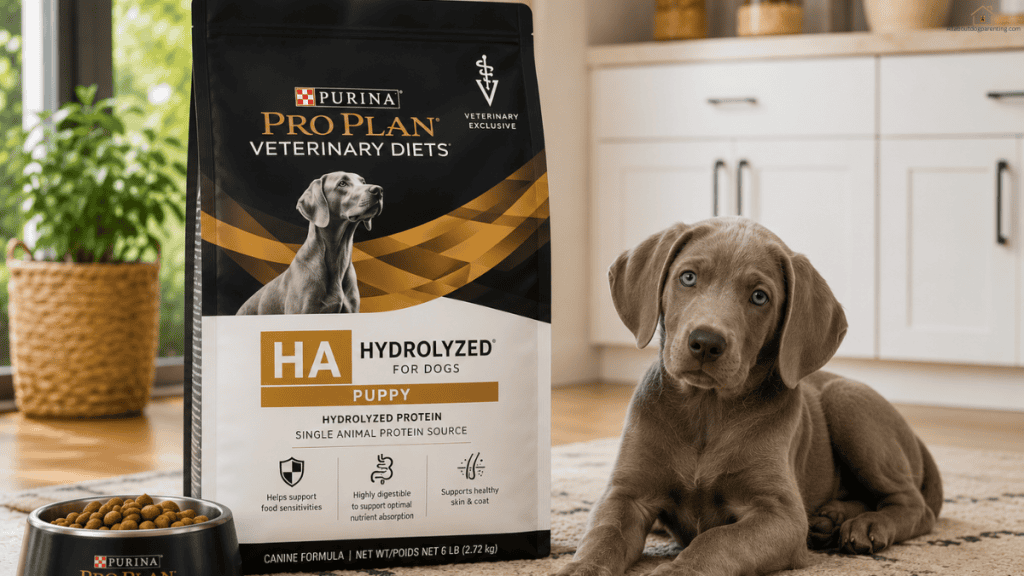
Another prescription hydrolysed protein option with strong clinical validation. Purina’s research backing and feeding trial data make this one of the most widely used foods in veterinary dermatology for formal elimination diet trials. Dr. Laura Wilson, DVM, DACVD, a board-certified veterinary dermatologist, notes that elimination diet trials are complex undertakings requiring veterinary guidance throughout, and that the selection of an appropriate elimination diet is critical to getting results that are actually diagnostic. Purina HA is among the formulas most commonly selected for that purpose.
| Spec | Value |
| Primary protein | Hydrolysed soy protein isolate |
| Protein | 18% min |
| Fat | 8% min |
| Key features | Single hydrolysed source, highly purified, minimal ingredients |
| Kcal/cup | ~301 |
| Price estimate | ~$70–90 per 16.5 lb bag |
| AAFCO | All life stages |
| Availability | Prescription only |
Best for: Veterinary-supervised elimination diet trials. Puppies with severe multi-protein allergies who need the most controlled diagnostic environment possible.
Drawback: Lower protein and fat than standard puppy food, making it unsuitable as a permanent growth-phase diet without veterinary oversight. Very expensive per pound. Always discuss long-term suitability with your vet.
Pick 6: The Farmer’s Dog (Turkey or Pork Recipe) — Best Fresh Hypoallergenic Option
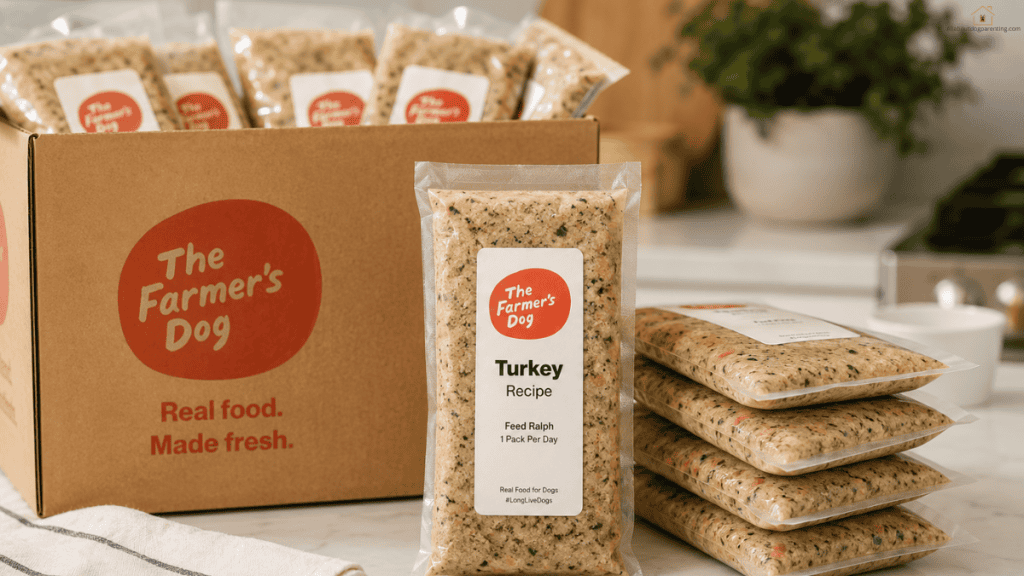
Single-protein fresh food recipes with minimal visible ingredients. Turkey and pork are among the least commonly reported allergens in dogs, making them useful novel protein sources when chicken and beef have already been ruled out. Human-grade, gently cooked, pre-portioned, and AAFCO certified for all life stages. Among fresh food options, this is the most transparent in terms of ingredient control, making it the closest OTC equivalent to a prescription diet for owners who want maximum visibility over what goes into the bowl.
| Spec | Value |
| Primary protein | Turkey or pork (single source per recipe) |
| Protein | ~38–42% dry matter |
| Fat | ~20–27% dry matter |
| Key features | Single protein, human-grade, minimal ingredients, pre-portioned |
| Price estimate | ~$3–12/day depending on breed size |
| AAFCO | All life stages |
| Availability | OTC subscription |
Best for: Puppies who haven’t responded to kibble-based limited ingredient puppy food options. Picky eaters who’ve gone off eating during a period of digestive distress since fresh food’s aroma and palatability usually resolves refusal quickly.
Drawback: Significantly more expensive than kibble. Requires freezer space. Better suited as a temporary diagnostic tool or topper than a permanent large-breed diet.
Side-by-Side Comparison Table
All six picks compared on type, primary protein, nutritional specs, prescription status, and best use case.
| Brand | Type | Primary Protein | Protein | Fat | Kcal/Cup | Price | OTC or Rx | Best For |
| Natural Balance L.I.D. | LID | Salmon | 24% | 10% | 360 | ~$50 | OTC | First-line LID |
| CANIDAE Pure Puppy | Novel protein | Salmon | 28% | 14% | 460 | ~$60 | OTC | Active puppies, novel protein |
| Hill’s Sensitive Stomach | Sensitive formula | Salmon | 24.5% | 15% | 392 | ~$60 | OTC | Mild sensitivity and skin issues |
| Royal Canin HP Puppy | Hydrolysed | Hydrolysed soy | 24% | 14% | 350 | ~$90 | Rx | Confirmed severe allergy |
| Purina HA | Hydrolysed | Hydrolysed soy | 18% | 8% | 301 | ~$80 | Rx | Elimination diet trial |
| The Farmer’s Dog | Fresh LID | Turkey or pork | ~40% DM | ~24% DM | Custom | ~$3–12/day | OTC | Fresh, maximum transparency |
How to Run an Elimination Diet for Your Puppy
Overview:
Feed a single novel protein or hydrolysed diet exclusively for 8 to 12 weeks. No treats, table scraps, or flavoured medications during the entire trial. If symptoms improve, reintroduce suspected ingredients one at a time every 2 weeks.
Dr. Tham, clinical associate professor and dermatology service chief at the Virginia-Maryland College of Veterinary Medicine, states, “An elimination diet trial remains the most reliable diagnostic tool for food allergy in dogs and cats. Client education is one of the most important factors in increasing the chances of success.”
Dr. Laura Wilson, DVM, DACVD, says, “Dog food diet trials are a pain in the bottom. It’s not something you can just say, ‘Buy this bag of food or go home, prepare this diet, and come back in eight weeks,’ because you’re pretty much going to guarantee failure.”
| Phase | Duration | What to Do | What to Expect |
| Phase 1: Switch | Days 1 to 10 | Transition to elimination diet using the 10-day plan | Normal adjustment. Don’t judge results yet |
| Phase 2: Strict elimination | Weeks 2 to 8 | Feed ONLY the elimination diet. No treats, scraps, flavoured chews, or flavoured medications. | Symptoms should gradually improve. Skin issues take 6 to 8 weeks minimum. |
| Phase 3: Evaluate | Weeks 8 to 10 | Assess whether symptoms have resolved or significantly improved | If yes, move to reintroduction. If not, consult a vet. |
| Phase 4: Reintroduce | Week 10 onward | Add ONE suspected ingredient back for 2 weeks. Monitor for reaction. | Symptoms returning confirm a trigger. No reaction confirms that the ingredient is safe. |
| Phase 5: Build safe diet | Ongoing | Gradually establish a list of confirmed-safe ingredients | May take 2 to 4 months to test multiple ingredients |
The hardest part is discipline. Every family member, dog walker, and visitor needs to know that nothing goes into the puppy’s mouth except the elimination diet food and water. VCA Animal Hospitals is explicit: “Other potential allergens to avoid during a diet trial include toothpastes, medications given by mouth (which often have flavours with protein), and supplements. If your dog eats these items and they cause an allergic response, it may complicate the diet trial.”
For the transition into any new elimination food, our 10-day transition guide covers the daily ratios so the switch itself doesn’t confuse the diagnostic picture.
Puppy-Specific Allergy Challenges
Diagnosing food allergies in puppies is harder than in adults because immature digestive systems mimic allergy symptoms. Soft stools and coat changes under 6 months may be normal development. Involve your vet before restricting a growing puppy’s diet.
Challenge 1: Is it an allergy or just a puppy?
Puppies under 6 months commonly have soft stools, gas, and minor skin changes simply because their gut and immune system are still developing. These symptoms overlap almost precisely with food allergy symptoms, making early diagnosis genuinely difficult. Restricting a puppy’s diet during the critical growth phase can cause nutritional deficiencies at exactly the time when complete nutrition matters most.

My GSDs have all had some degree of digestive sensitivity as young puppies, manifesting as soft stools, a coat that looked dull for a few weeks, or recurring ear infections. In every case, my vet ran a stool sample first and confirmed no parasites before we discussed diet. That step saved me from chasing a food allergy that didn’t exist. German Shepherds are particularly prone to digestive sensitivity as a breed, which makes the temptation to assume a food allergy stronger, but it also makes ruling out parasites and other causes more important before you start eliminating food groups.
Challenge 2: Maintaining nutrition during elimination diets
Growing puppies need complete, balanced nutrition for bone development, organ maturation, and immune system development. A nutritionally incomplete elimination diet can harm development even while resolving allergy symptoms. Always use an AAFCO-certified food for any elimination trial. As VCA Animal Hospitals advises, puppies should be on a diet that has been formulated or has undergone feeding trials to confirm it is complete and balanced specifically for puppies, not just for adult dogs.
This is one reason the prescription hydrolysed options like Royal Canin HP Puppy are specifically formulated for growing puppies rather than being adult formulas used off-label. The nutritional profile is calibrated for growth, not just allergen elimination.
Challenge 3: The treat problem
Puppies are in active training during the elimination period. Standard treats contain unknown protein sources that can contaminate the entire trial and require starting from week one again. The solution: use the elimination diet kibble as training rewards. The pieces are small, the calories are already accounted for in the daily total, and the trial remains uncontaminated.
FAQs
1. What is the most common food allergy in puppies?
Beef is the most commonly reported food allergen in dogs, affecting approximately 34% of dogs with confirmed food allergies according to the 2016 BMC Veterinary Research systematic review. Dairy (17%) and chicken (15%) follow. Grains are rarely the true allergen despite their common reputation. The best puppy food for allergies to common proteins uses novel sources like salmon, duck, or venison that most puppies have never been exposed to.
2. Are blood tests for food allergies accurate for dogs?
No, commercially available blood tests (IgE and IgG), saliva tests, and hair tests have been consistently shown to have poor accuracy and are not recommended by the American College of Veterinary Dermatology. The only diagnostic method that works is an 8 to 12 week elimination diet trial under veterinary supervision. Save the $200 and use it toward the right hypoallergenic puppy food instead.
3. Can puppies outgrow food allergies?
Sometimes food sensitivities and intolerances related to digestive immaturity often improve as the puppy’s gut matures, typically by 8 to 12 months. True immune-mediated food allergies are more likely to persist. Puppies diagnosed with allergies should be reassessed periodically to determine whether the dietary restriction is still necessary as the immune system develops.
4. Is hydrolysed protein food better than limited ingredient puppy food for allergies?
They serve different purposes. Limited ingredient puppy food is the right starting point for suspected sensitivities. Hydrolysed protein diets are the more targeted option for confirmed severe allergies, where proteins are broken down too small for immune recognition. Start OTC, escalate to prescription hydrolysed if OTC options don’t resolve symptoms within 6 to 8 weeks.
5. Can I use grain-free food as the best food for puppy with food allergy?
Only if grains are the confirmed trigger, which is rare. Most food allergies are protein-driven. Grain-free formulas often replace grains with legumes like peas and lentils, which carry their own concerns related to the FDA’s DCM investigation. Unless grains are the confirmed allergen, grain-inclusive food is the safer default. Our grain-free vs grain-inclusive guide covers the full evidence.
The Bottom Line
Finding the best puppy food for allergies starts with understanding what your puppy actually has. True immune-mediated food allergy, dietary sensitivity, and digestive intolerance all look similar on the surface but require different approaches. Skip the unreliable allergy tests. Start with a limited ingredient puppy food from the OTC category. Run any elimination trial under veterinary supervision so the results are actually diagnostic. And escalate to a prescription hydrolysed diet if OTC options don’t produce improvement within 6 to 8 weeks.
Every food on this list meets AAFCO growth standards, which means your puppy gets complete nutrition even while you’re narrowing down what is causing the problem. That combination of allergen elimination alongside nutritional completeness makes these picks genuinely useful. A hypoallergenic puppy food that compromises growth to eliminate allergens isn’t actually serving the puppy. The goal is both, and every product above achieves it.