
Best Puppy Food for Sensitive Stomachs: 6 Picks Compared
🐾 Overview
The best puppy food for sensitive stomachs uses highly digestible protein, adds prebiotic fiber and avoids common irritants. Top picks: Hill’s Sensitive Stomach & Skin, Purina Pro Plan Sensitive Skin & Stomach, and Royal Canin Gastrointestinal Puppy.
Your puppy has loose stools, gas, or keeps vomiting after meals, and you want a solution fast. That’s the most common reason people search for the best puppy food for sensitive stomachs, and it’s exactly where this article starts. Before you spend money on a new food, though, there’s a more important step: figuring out whether food is actually the problem. This article earns nothing from any product listed here. It is part of our Complete Guide to Puppy Nutrition.
First Question: Is It Actually a Food Problem?
🐾 Overview
Rule out medical causes before switching food. Persistent vomiting, bloody diarrhea or lethargy lasting more than 48 hours needs a vet visit. Puppy food for sensitive stomach issues fixes dietary causes, never parasites, infections or disease.
Dr. Vincent Michels, DVM, residency trained in small animal veterinary nutrition, puts it well: “A sensitive stomach encompasses multiple potential issues pertaining to a dog’s tolerance to the properties of food they eat. These include the digestibility of the diet, sensitivity to dietary fat, intolerances and allergies to individual food items, and the amount and types of dietary fiber the food provides. No single property of a diet necessarily makes food ideal for the needs of each dog as an individual, and working through the different variables with a veterinarian is the best way to assess what your dog needs to best maintain their gut health.”
That distinction matters because a sensitive stomach is a symptom, not a diagnosis. The cause could be a too-fast food transition, a specific ingredient intolerance, intestinal parasites, a bacterial infection, stress, or underlying gastrointestinal disease. A different bag of kibble fixes the first two. It does nothing for the rest.

When it’s probably a food issue
- Loose stools or gas started after a recent food change or new treat
- Symptoms are mild and consistent rather than sudden or severe
- Puppy is otherwise playful, alert, and drinking water normally
- A few days of plain boiled chicken and rice settle things down
When to see the vet first
- Bloody or black stools at any age
- Vomiting more than twice in 24 hours
- Lethargy, refusal to drink, or visible signs of dehydration
- Symptoms in an unvaccinated or recently adopted puppy, where parvovirus must be ruled out
- Diarrhoea lasting more than 48 hours in a puppy under six months
- Any digestive symptoms in a toy breed puppy, where hypoglycaemia risk compounds quickly
| Symptom Pattern | Likely Cause | Next Step |
|---|---|---|
| Loose stools after a food switch | Transition too fast | Slow the transition, add plain pumpkin |
| Chronic soft stools on current food | Food intolerance or ingredient sensitivity | Try a limited-ingredient diet |
| Gas and bloating after meals | Hard-to-digest ingredients (high fat, soy) | Switch to a sensitive-stomach formula |
| Vomiting plus diarrhea plus lethargy | Possible infection, parasites or illness | Vet visit: don’t try to fix this with food |
| Symptoms in a puppy under 12 weeks | Immature digestive system (common) | Easy-to-digest puppy food, ask your vet about a probiotic |
When my German Shepherd had persistent soft stools at four months old, my first instinct was to switch his food. My vet told me to bring a stool sample first. The result came back positive for Giardia, a parasite that no food change would have addressed. A week of antibiotics cleared it completely. The lesson: diagnose before you shop.
What Makes a Puppy Food Sensitive Stomach Friendly?
🐾 Overview
Sensitive stomach puppy food uses highly digestible proteins, adds prebiotic fiber, avoids soy and artificial additives, and is complete for growth. Fat-sensitive puppies do better below 15%, though many vet-recommended formulas run 15 to 20%.
Puppy guts are not simply smaller versions of adult guts. The microbiome is still developing, enzyme production isn’t fully mature, and food transitions hit them harder than they would an adult dog. This is why the best food for puppy with diarrhea isn’t just any sensitive-stomach dog food; it needs to be specifically calibrated for a developing digestive system.
According to the World Small Animal Veterinary Association (WSAVA), puppies should be fed nutritionally complete, highly digestible diets to support both healthy growth and sensitive digestion. These two requirements together, complete nutrition and high digestibility, rule out most generic sensitive-stomach formulas that are designed for adult dogs.
| Feature | Why It Matters | What to Look For |
|---|---|---|
| Highly digestible protein | Less work for an immature gut | Salmon, turkey, lamb, egg. Beef and dairy are common triggers |
| Prebiotic fiber | Feeds beneficial gut bacteria | Beet pulp, chicory root (inulin), FOS (fructooligosaccharides) |
| Fat matched to your puppy | Fat triggers loose stools in some puppies | Fat-sensitive puppies do better below 15%; many vet-recommended formulas run 15 to 20%, so check the guaranteed analysis if fat seems to be the trigger |
| No artificial additives | They add nothing nutritionally | No BHA, BHT, ethoxyquin or artificial colors |
| Single or limited protein source | Makes triggers easier to identify | One animal protein, not a mix |
| AAFCO statement for growth | Confirms complete nutrition despite limited ingredients | “Growth” or “all life stages” on the label; “including growth of large size dogs” if your puppy will top 70 lb |
Ingredients That Commonly Upset Sensitive Puppies
Every puppy reacts differently, but these are the usual suspects when a sensitive stomach flares up:
| Ingredient | Why It Can Cause Trouble |
|---|---|
| High-fat meats and fatty treats | Fat is one of the most common triggers for loose stools in an immature gut |
| Dairy | Many dogs don’t digest lactose well |
| Beef and chicken | Among the most commonly reported protein allergens in dogs |
| Soy | Can cause gas and bloating in some puppies |
| Artificial colors and preservatives (BHA, BHT, ethoxyquin) | Add nothing nutritionally and can irritate a sensitive gut |
Corn and wheat aren’t a problem for every puppy. Treat them as suspects only if your puppy reacts to foods that contain them.
Limited Ingredient vs Standard Sensitive-Stomach Formulas
🐾 Overview
Limited-ingredient diets strip back to one animal protein and few carbohydrates. Standard sensitive-stomach formulas keep regular proteins and add gentle fiber. Choose limited ingredients for suspected intolerance, and a standard formula for a young puppy’s immature gut.
| Factor | Limited Ingredient Diet | Standard Sensitive-Stomach Formula |
|---|---|---|
| Approach | Removes potential triggers | Adds digestive support |
| Protein sources | One animal protein (salmon, turkey, duck) | Standard proteins, often more than one |
| Best for | Suspected food allergy or intolerance | General sensitivity, immature puppy gut |
| Examples | Natural Balance L.I.D., BLUE Basics | Hill’s Sensitive Stomach & Skin, Purina Pro Plan Sensitive |
| Diagnostic value | High: helps identify trigger ingredients | Low: doesn’t reveal the cause |
| Nutritional variety | Lower by design | Higher |
If your puppy has soft stools on several different foods, limited ingredient puppy food helps narrow down the trigger. If your puppy is under six months and their digestive system is simply still maturing, a standard vet-recommended sensitive stomach puppy food is usually the right starting point.
The 6 Best Puppy Foods for Sensitive Stomachs (2026)
🐾 Overview
Top 6: Hill’s Sensitive Stomach & Skin (best overall), Purina Pro Plan Sensitive (best for active puppies), Royal Canin Gastrointestinal Puppy (chronic issues), Natural Balance L.I.D. (limited ingredient), BLUE Basics (chicken-free), The Farmer’s Dog Turkey (fresh).
These are my picks for the best puppy food for sensitive stomachs, and every specification below was checked against manufacturer or retailer labels on October 3, 2026. Formulas change, so read the bag in front of you before you buy.
Pick 1: Hill’s Science Diet Puppy Sensitive Stomach & Skin, Salmon & Brown Rice (Best Overall)
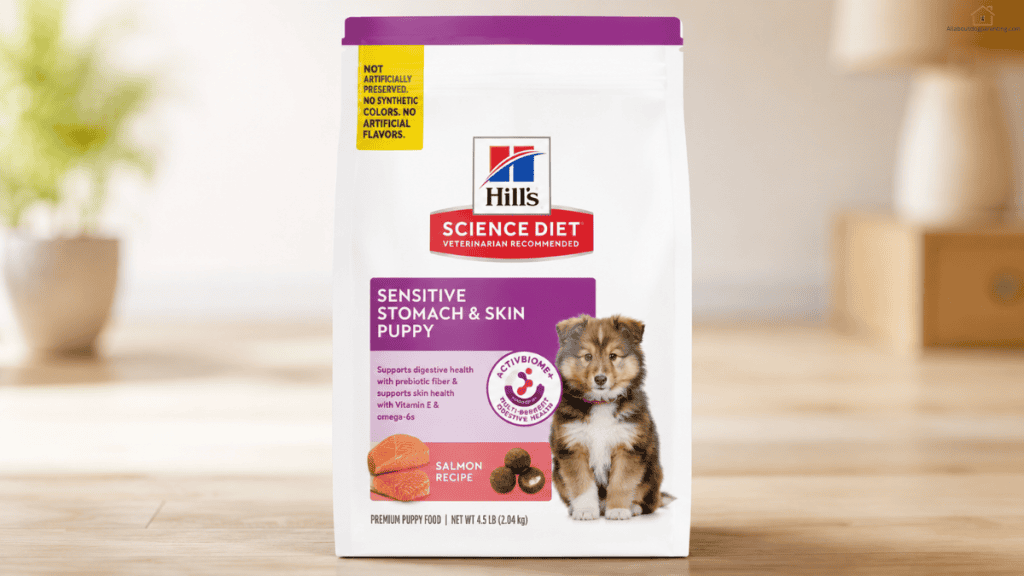
Hill’s is the brand vets name most often for digestive trouble, and this puppy formula backs that up with feeding-trial testing. Salmon is the first ingredient, prebiotic fiber feeds the good gut bacteria, and there are no artificial colors. Hill’s employs a large team of veterinarians and nutritionists, and the label reads like a food built by people who expect vets to check it.
| Spec | Value |
|---|---|
| Primary protein | Salmon (chicken meal second) |
| Protein | 25% min |
| Fat | 15.5% min |
| Key digestive features | Prebiotic fiber, no artificial colors, highly digestible |
| Kcal/cup | 405 |
| Price | Check current price |
| AAFCO | Growth, feeding-trial tested, including large breeds |
Best for: Puppies with ongoing soft stools, gas, or skin issues alongside digestive problems, since the two symptoms often co-occur. A consistently cited sensitive stomach puppy food vet-recommended option across multiple veterinary nutrition sources.
Drawback: Fat content sits at 15%, the upper end for sensitive stomachs. Slightly higher price point than Purina.
Pick 2: Purina Pro Plan Puppy Sensitive Skin & Stomach, Salmon & Rice (Best for Active Puppies)
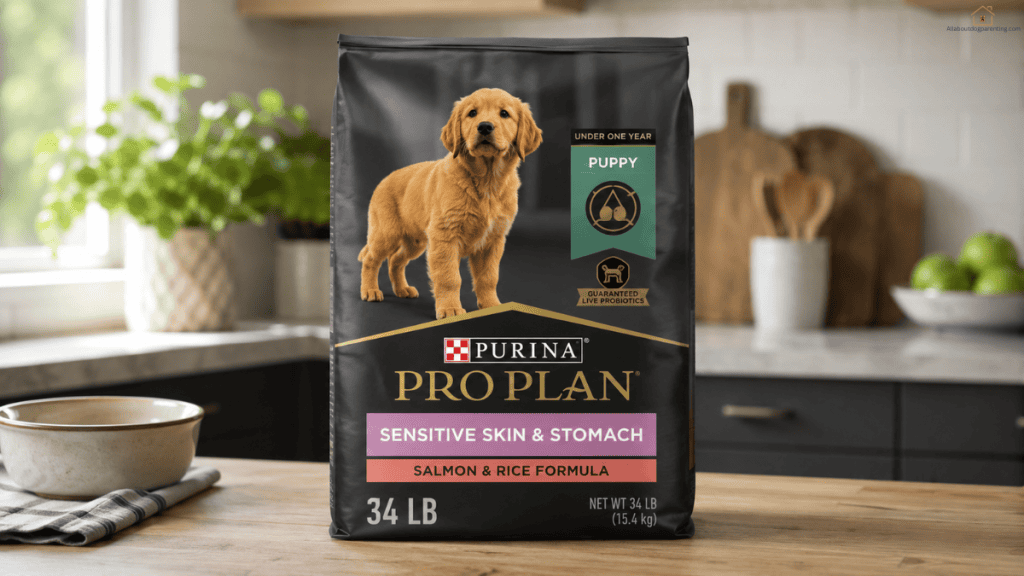
Salmon comes first, followed by rice, barley and oat meal, with chicory root for prebiotic fiber. There’s no corn, wheat or soy anywhere on the current label. Purina’s feeding trials and veterinary nutritionist team make this one of the most evidence-backed sensitive-stomach options you can buy without a prescription.
I’m a long-time Purina Pro Plan fan. My dogs have never been keen on packaged food, but this is the one they’ll reliably eat, and during their puppy months it made up about half of their meals.
| Spec | Value |
|---|---|
| Primary protein | Salmon |
| Protein | 28% min |
| Fat | 18% min |
| Key digestive features | Prebiotic fiber (chicory root), rice and oat meal, fish oil |
| Kcal/cup | 479 |
| Price | Check current price |
| AAFCO | All life stages, including growth of large size dogs (70 lb or more) |
Best for: Budget-conscious owners who want proven digestive support with live probiotics included. Among the most reliable easy-to-digest puppy food options at mid-range pricing.
Drawback: Contains corn gluten meal, which some owners prefer to avoid. Higher calorie density means precise portioning is important, particularly for less active puppies.
Pick 3: Royal Canin Veterinary Diet Gastrointestinal Puppy (Best for Chronic Issues)
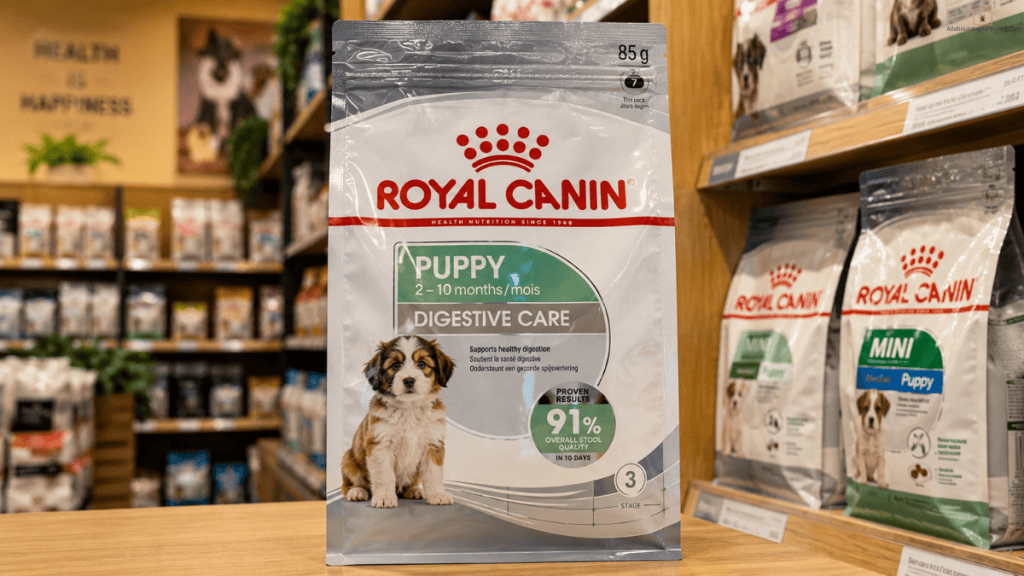
This is a prescription diet built for puppies whose digestive problems haven’t settled on over-the-counter food. It’s energy-dense, which helps puppies who struggle to hold weight, and it uses a fiber blend designed to support gut bacteria and stool quality. Vets reach for it with puppies who have recurring diarrhea or are recovering from a gastrointestinal illness.
| Spec | Value |
|---|---|
| Primary protein | Chicken by-product meal |
| Protein | 27% min |
| Fat | 20% min |
| Key digestive features | Highly digestible proteins, fiber blend, high energy density |
| Kcal/cup | 426 |
| Price | Check current price |
| AAFCO | Puppy growth; prescription diet |
Best for: Puppies with chronic digestive issues that haven’t resolved on other foods. Breeds with documented digestive predispositions, including German Shepherds, French Bulldogs, and Boxers.
Drawback: Premium price. Ingredient list includes by-product meal and corn, which prioritises digestive function over ingredient optics. Worth knowing before you buy.
Pick 4: Natural Balance Limited Ingredient Salmon & Brown Rice Puppy Recipe (Best Limited Ingredient)
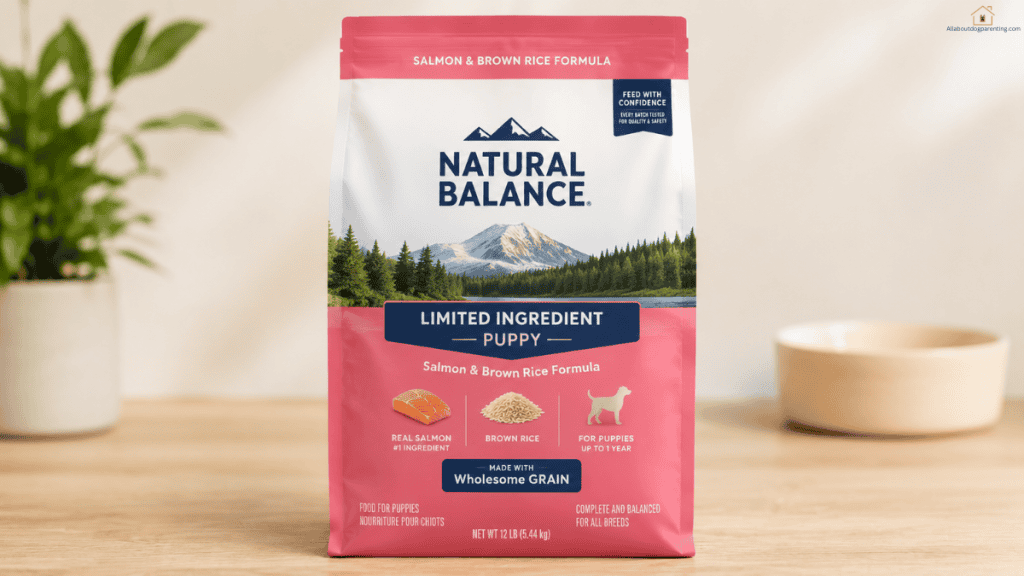
One animal protein, salmon, paired with brown rice and a short ingredient list. That simplicity makes it the clearest first step when you suspect a specific ingredient intolerance. No artificial flavors, colors or preservatives.
| Spec | Value |
|---|---|
| Primary protein | Salmon |
| Protein | 24% min |
| Fat | 12% min |
| Key digestive features | Single animal protein, limited ingredients, no artificial additives |
| Kcal/cup | 385 |
| Price | Check current price |
| AAFCO | All life stages, including growth of large dogs (70 lb or more) |
Best for: Puppies where a specific protein intolerance is suspected and you need to isolate the trigger. First step in a vet-guided elimination diet. Among the most useful limited-ingredient puppy food options for diagnostic purposes.
Drawback: Lower protein and fat than competitors. Not ideal as a permanent solution for very active or large-breed puppies who need higher calorie density.
Pick 5: Blue Buffalo Basics Puppy (Turkey and Potato) — Best Single Protein
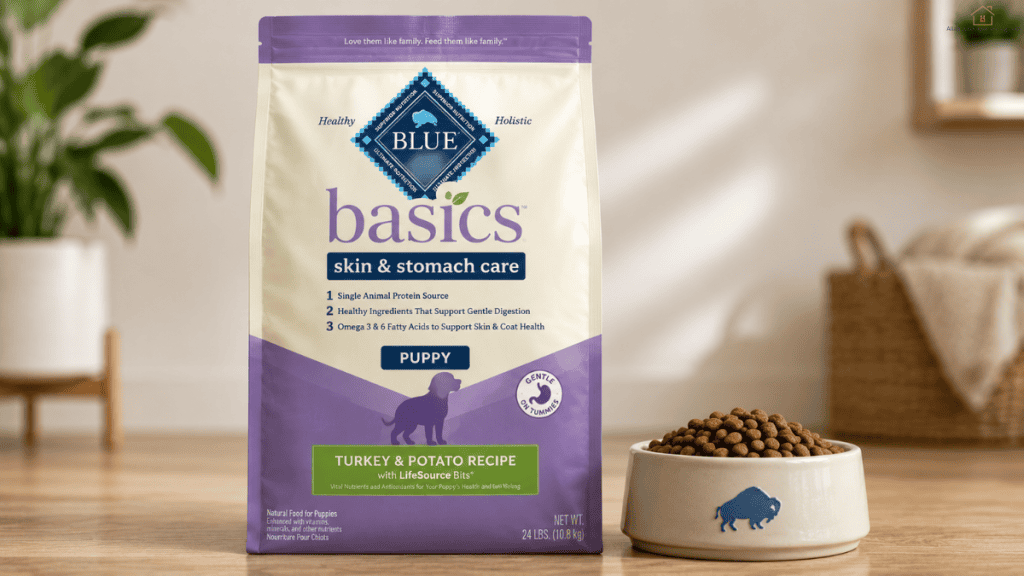
Turkey is the only animal protein, and most puppies have already eaten plenty of chicken by the time they reach you. The recipe leans on gentle carbohydrates (oatmeal, brown rice, potatoes and peas) and includes pumpkin. No chicken, corn, wheat or soy.
| Spec | Value |
|---|---|
| Primary protein | Deboned turkey, turkey meal |
| Protein | 26% min |
| Fat | 15% min |
| Key digestive features | Single animal protein, no chicken, corn, wheat or soy, pumpkin |
| Kcal/cup | 394 |
| Price | Check current price |
| AAFCO | Growth (not labeled for large-breed growth) |
Best for: Puppies who’ve had digestive issues on chicken-based formulas. Owners who want to avoid both grains and legumes at the same time.
Drawback: Potato as primary carbohydrate has a higher glycaemic index than rice or oats. Blue Buffalo employs fewer board-certified veterinary nutritionists than Purina or Hill’s.
Pick 6: The Farmer’s Dog (Turkey Recipe) — Best Fresh Option
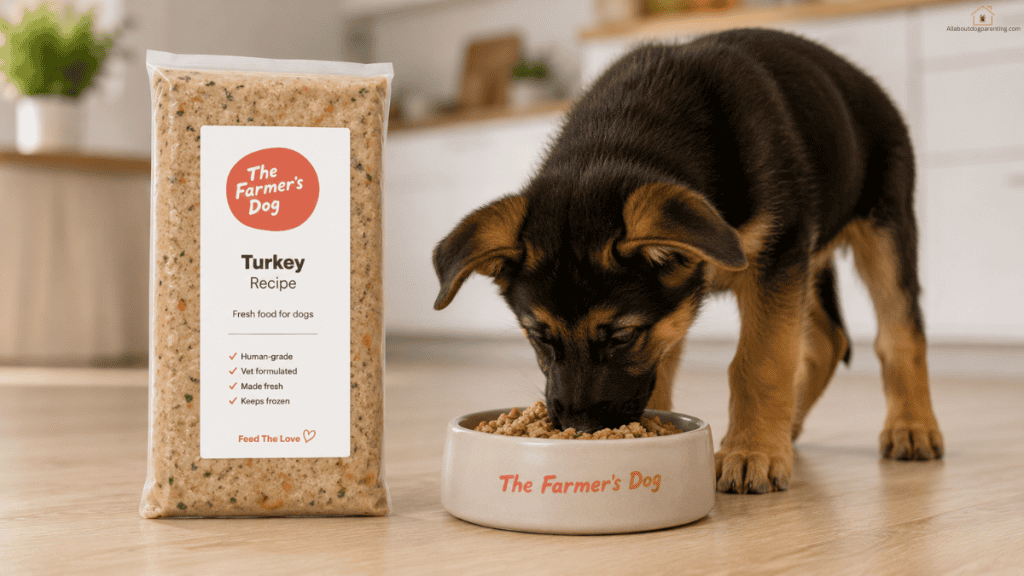
Gently cooked USDA turkey with chickpeas, carrot, broccoli, parsnip and spinach, plus fish oil and a vitamin-mineral blend. It’s less processed than kibble and arrives pre-portioned for your puppy’s calorie needs. The smell alone gets many off-their-food puppies eating again.
| Spec | Value |
|---|---|
| Primary protein | USDA turkey |
| Protein | 8% min as fed (about 33% dry matter) |
| Fat | 4.5% min as fed (about 19% dry matter) |
| Key digestive features | Minimally processed, human-grade, single animal protein, pre-portioned |
| Price | Check current price |
| AAFCO | All life stages |
Dry-matter figures are calculated from the as-fed guaranteed analysis (76% moisture).
Best for: Puppies with severe sensitivity who haven’t responded to any kibble option. Picky eaters with digestive issues who refuse dry food.
Drawback: Significantly more expensive than kibble. Requires freezer space. Not a sustainable long-term option for large-breed budgets. Better used as a temporary solution or topper while the puppy’s gut stabilises.
Side-by-Side Comparison Table
All six picks compared on primary protein, fat, probiotics, limited ingredient status, calories, and price.
| Brand | Primary Protein | Protein | Fat | Probiotics | Limited Ingredient | Kcal/Cup | Price | Best For |
|---|---|---|---|---|---|---|---|---|
| Hill’s Sensitive Stomach & Skin | Salmon | 25% | 15.5% | No (prebiotic fiber) | No | 405 | Check current price | Best overall |
| Purina Pro Plan Sensitive | Salmon | 28% | 18% | No (prebiotic fiber) | No | 479 | Check current price | Active puppies |
| Royal Canin GI Puppy | Chicken by-product meal | 27% | 20% | No | No | 426 | Check current price | Chronic issues (Rx) |
| Natural Balance L.I.D. | Salmon | 24% | 12% | No | Yes | 385 | Check current price | Elimination diet, fat-sensitive |
| BLUE Basics Skin & Stomach | Turkey | 26% | 15% | No | Yes | 394 | Check current price | Chicken-free |
| The Farmer’s Dog Turkey | Turkey | ~33% DM | ~19% DM | No | Yes (by nature) | Custom | Check current price | Fresh, picky eaters |
For large breeds like German Shepherds, cross-check any pick against our best puppy food for large breeds guide. For Yorkies, Frenchies, and other little ones, the best puppy food for small breeds guide covers kibble size and calorie density.
Sensitive Stomach and Diarrhea: What to Feed in the Short Term
🐾 Overview
For mild diarrhea in an otherwise bright puppy, two to three days of boiled lean protein and white rice in small meals can settle things. Diarrhea past 48 hours, blood, vomiting or lethargy needs a vet.
If your puppy has a mild bout of diarrhea but is otherwise playful and drinking normally, a bland diet for two to three days can calm things while you work out the cause. Here’s what tends to work when you’re dealing with a sensitive stomach and diarrhea at the same time:
- Boiled lean protein and white rice: skinless chicken breast or lean turkey, boiled with no seasoning, mixed with plain cooked white rice at roughly one part protein to two parts rice. Use turkey if chicken is a suspected trigger.
- Small, frequent meals: split the day’s food into four or five small portions so the gut isn’t overloaded.
- Plain pumpkin: a teaspoon of plain canned pumpkin (not pie filling) per 10 pounds of body weight adds gentle fiber.
A bland diet is a short-term reset. It isn’t nutritionally complete for a growing puppy. Once stools firm up, mix your puppy’s regular food back in over three to four days. If diarrhea lasts more than 48 hours, or you see blood, vomiting or lethargy, skip the bland diet and call your vet. Once you’re past the emergency stage, the best food for puppy with diarrhea that keeps coming back is usually one of the six picks above, chosen to match the trigger.
Homemade Food for Puppies with Sensitive Stomachs
🐾 Overview
Homemade recipes can fall short for growing puppies. If you want to cook, have a board-certified veterinary nutritionist write the recipe, or keep home-cooked food as a topper under 10% of daily calories.
I understand the pull of cooking for a puppy whose stomach keeps rebelling. You control every ingredient, there’s no mystery on the label, and a pot of boiled turkey feels like care in a way a scoop of kibble doesn’t. The trouble is that balancing a diet for a growing puppy is harder than it looks.
When UC Davis researchers analyzed 200 homemade dog food recipes from websites, books and even veterinary textbooks, 95% were short on at least one essential nutrient and only nine met AAFCO minimums. The only recipes that consistently passed were the ones written by board-certified veterinary nutritionists. A larger 2025 Texas A&M study of 1,726 homemade diets found only 6% were potentially complete, and flagged calcium and phosphorus imbalances as a particular worry. Those are adult-dog numbers. For a puppy that’s still building bone, a calcium shortfall does more damage, and large-breed puppies have the least room for error.
So there are two safe ways to bring homemade food for a puppy with a sensitive stomach into the picture.
1. A vet-formulated recipe
A board-certified veterinary nutritionist (a DACVN, or a specialist your vet refers you to) can write a recipe around your puppy’s age, expected adult size and known triggers. A typical sensitive-stomach recipe from a nutritionist is built on:
- One lean protein your puppy tolerates, such as turkey, white fish or egg
- A digestible carbohydrate like white rice, potato or oats
- A measured fat source, often including fish oil for omega-3s
- A calcium source in an exact amount
- A vitamin and mineral supplement made for growing dogs
Follow it exactly. Swapping the protein, dropping the oil or skipping the supplement is how a balanced recipe turns into an unbalanced one.
2. Toppers on a complete food
This was my preferred option with my own puppies. Keep a complete and balanced puppy food as the base, and add home-cooked extras that make up no more than 10% of daily calories. Gentle options:
- Plain boiled turkey or skinless chicken breast (if chicken isn’t a trigger)
- A spoonful of plain canned pumpkin
- Plain cooked white rice or mashed sweet potato
- Plain scrambled or boiled egg, cooked without butter or milk
Keep the extras plain and lean. That rules out fatty mince, lamb with the fat left on, cottage cheese and other dairy, seasonings, onion and garlic, and cooked bones. When my boy’s stomach was off as a puppy, a spoonful of pumpkin and some boiled turkey over his kibble was as far as I went, and it was enough. Our homemade puppy food guide covers full recipes and how to work with a nutritionist.
How Quickly Will You See Improvement?
🐾 Overview
Most puppies show firmer stools within 5 to 10 days of switching, after a proper transition. Gas often improves within 3 to 5 days. No improvement after 3 weeks suggests the problem isn’t the food.
Dr. Crow, a veterinarian quoted by Forbes Vetted, makes an important point on timing: “Early intervention is key in managing sensitive stomachs. As a veterinarian, I’ve seen the transformative power of targeted care and nutrition.” That intervention works best when you’re also transitioning the food correctly. Our 10-day food transition guide covers the daily ratios so the switch itself doesn’t create additional digestive disruption on top of what you’re already managing.
| Symptom | When to Expect Improvement | If No Improvement |
|---|---|---|
| Excessive gas | 3 to 5 days | Try a different protein source |
| Loose or soft stools | 5 to 10 days | Switch to a limited-ingredient diet to isolate the trigger |
| Vomiting after meals | 3 to 7 days (should stop) | Vet visit: may point to something beyond food sensitivity |
| Low appetite | 5 to 7 days (should normalize) | Try a different protein or add wet food for palatability |
| Skin issues alongside digestive symptoms | 4 to 8 weeks | Food allergies take longer to resolve. Discuss with your vet |
With my GSD, the change was visible within a week of moving to a sensitive-stomach formula. Stools firmed up by Day 5, and the gas that had been a constant companion was gone by Day 7. If you see no meaningful change after two full weeks on the new food, with a proper transition behind you, the food probably isn’t the problem.
Breeds Most Prone to Sensitive Stomachs
🐾 Overview
German Shepherds, French Bulldogs, Boxers, Great Danes, Irish Setters and Yorkshire Terriers are among the breeds most often affected by digestive sensitivity, through a mix of genetics, anatomy and breed-specific conditions.
| Breed | Common Digestive Issue | Recommended Approach |
|---|---|---|
| German Shepherd | Chronic soft stools, EPI risk, food sensitivities | Highly digestible formula, moderate fat, vet check for persistent diarrhea |
| French Bulldog | Gas, bloating, food allergies | Limited ingredient, novel protein, slow feeder |
| Boxer | Colitis and IBD susceptibility | Sensitive-stomach formula, higher fiber |
| Great Dane | Bloat risk, fast eating | Slow feeder, smaller meals, easily digestible food |
| Irish Setter | Gluten-sensitive enteropathy (genetic) | Gluten-free diet (grain-inclusive options exist) |
| Yorkshire Terrier | Pancreatitis risk, picky eating | Lower-fat formula, small kibble |
German Shepherds are known for touchy digestion, and they’re also predisposed to exocrine pancreatic insufficiency (EPI), where the pancreas doesn’t make enough digestive enzymes. A GSD puppy with greasy, bulky stools and weight loss despite a big appetite needs a vet test, not another food switch. If you’re raising one, starting on an easy-to-digest puppy food is a sensible move rather than waiting for trouble. Calorie targets and portion sizes during any diet change are covered in our puppy feeding chart.
FAQs
1. Can I fix my puppy’s sensitive stomach with probiotics alone?
Probiotics can help, but they’re rarely sufficient on their own. If the digestive issue comes from an ingredient intolerance, probiotics improve gut bacteria balance without addressing the root cause. The best results come from combining a probiotic-enriched food like Purina Pro Plan Sensitive with ingredient elimination to identify what’s triggering the problem.
2. Is chicken bad for puppies with sensitive stomachs?
Chicken is one of the most commonly reported protein allergens in dogs, second only to beef. If your puppy has digestive issues on a chicken-based food, trying a formula based on salmon, turkey, lamb, or duck is worth doing before assuming the issue is unresolvable. Most puppies tolerate chicken without any problem. For those who don’t, the improvement after switching protein sources is usually apparent within a week.
3. How long should I try a sensitive-stomach food before deciding it’s not working?
Give the new food a full three weeks after completing the 10-day transition. Digestive systems need time to adjust, and some puppies experience a brief worsening around Days 4 and 5 before improving. Three weeks gives you a reliable picture. If there’s no change after that window, try a different protein source or consult your vet.
4. Should I feed wet or dry food for a puppy with a sensitive stomach?
Both can work. Wet food is more palatable and easier to eat for puppies who’ve lost appetite from digestive discomfort. Dry kibble formulated for sensitive stomachs is more practical for daily feeding. Many owners find success mixing a spoonful of wet food into dry kibble. Our wet vs dry puppy food guide covers how to calculate calories when mixing formats so total intake stays accurate.
5. Can puppies grow out of a sensitive stomach?
Often yes. Many puppies have digestive sensitivity simply because their gut microbiome is still developing. By 8 to 12 months, the digestive system matures and tolerance tends to improve. Some puppies transition successfully to a standard food at that point. Breed-specific sensitivities in GSDs and French Bulldogs tend to persist into adulthood and require ongoing dietary management rather than resolving with age.
6. What can I give my puppy for an upset stomach?
For a mild upset in an otherwise healthy puppy, a few days of boiled chicken or turkey with white rice, plus a little plain pumpkin, usually helps. Anything lasting more than 48 hours, or with blood, vomiting or lethargy, needs a vet rather than a diet change.
The Bottom Line
Finding the best puppy food for sensitive stomach issues comes down to three things: ruling out medical causes before you switch anything, choosing the right category of food (standard sensitive-stomach formula versus limited-ingredient diet), and giving the new food enough time to work with a proper transition behind it.
Every pick on this list meets AAFCO growth standards, carries digestive-specific formulation features, and comes from brands with veterinary nutritionist involvement. The puppy food for sensitive stomach that’s right for your dog depends on whether you’re managing a general immaturity of the gut, a specific ingredient intolerance, or a chronic condition that hasn’t responded to over-the-counter options. Start with the right category, follow the transition correctly, and give it three weeks before drawing conclusions.