How to Read Puppy Food Labels: The 5 Things That Actually Matter
Overview:
When figuring out how to read puppy food labels, 5 things matter the most: the AAFCO nutritional adequacy statement (must say “growth”), the ingredient list (named protein first), the guaranteed analysis showing protein, fat, and calcium, calorie content, and the manufacturer’s contact information.
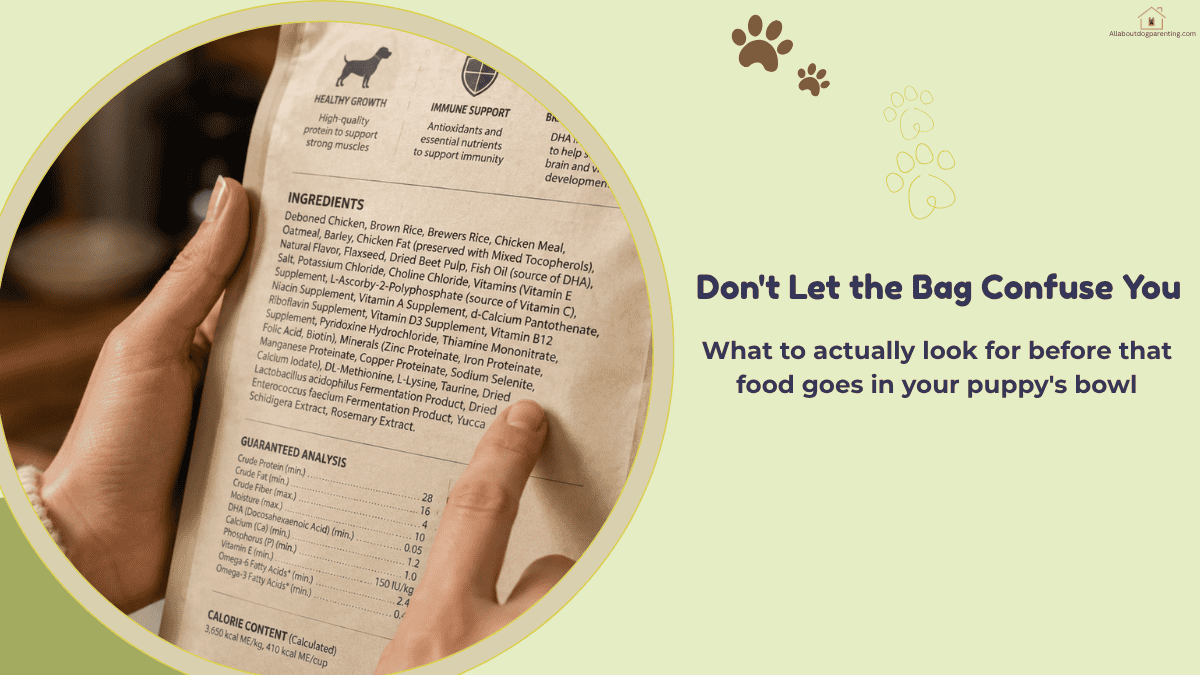
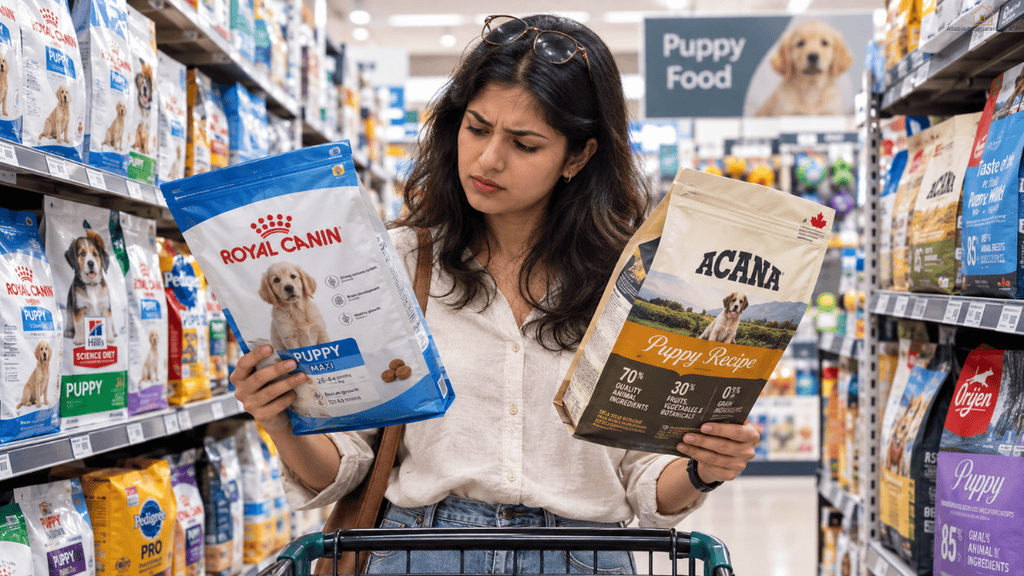
Every puppy food bag has two faces. The front is a marketing document. The back is a nutrition document. Most owners spend their time on the wrong one. “Natural,” “holistic,” “superfood,” “premium.” These words fill the front of every bag regardless of what’s inside. None of them have a legal definition that protects your puppy. The information that tells you whether a food is appropriate, complete, and safe for a growing dog is on the back, written in a specific format, and once you know how to read puppy food labels, you can evaluate any food in under two minutes standing in the pet store aisle.
This guide, part of our Complete Guide to Puppy Nutrition, teaches you what to look for on puppy food labels, step by step, including the AAFCO labelling changes rolling out between 2024 and 2030 that will change how labels look without changing the nutritional content.
The 5-Second Label Check (Before You Read Anything Else)
Overview:
Before reading the full label, check two things. Does the AAFCO statement say “complete and balanced for growth” or “all life stages”? Is a named animal protein the first ingredient? If either answer is no, put the bag back. If both are yes, read on.
Two questions screen out the worst options immediately.
Question 1: Find the AAFCO puppy food label. It lives on the back or side panel, usually near the guaranteed analysis. Does it say “complete and balanced for growth” or “all life stages”? If it says “adult maintenance” or “for intermittent or supplemental feeding,” this food is not appropriate as a puppy’s sole diet. Put it back.
Question 2: Look at the first ingredient on the ingredient list. Is it a named animal protein? Chicken, beef, salmon, turkey, and lamb all pass. “Meat and bone meal,” “animal by-products,” or a grain as the first ingredient are red flags. Put it back.
If a puppy food passes muster on both these questions, read the full label. The five sections below tell you exactly what to look for in each.
Part 1: The AAFCO Nutritional Adequacy Statement
Overview:
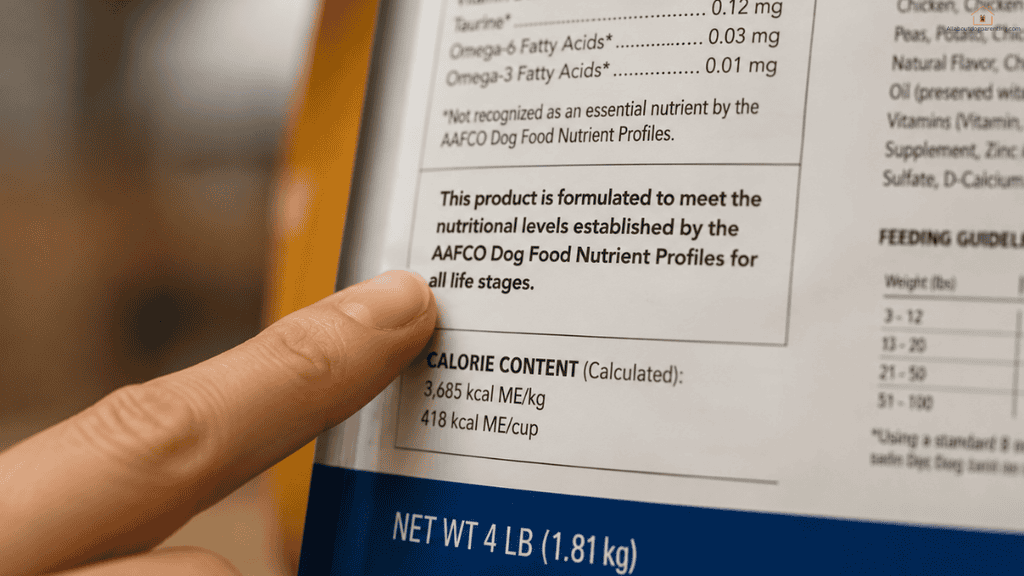
This is the single most important line on any puppy food label. It tells you whether the food is complete and balanced for growing puppies, and whether that claim is based on feeding trials or formulation alone. For large breeds, look specifically for “including growth of large-size dogs.”
This is where understanding how to read puppy food labels starts and ends for many buying decisions. I look for this statement first on every bag I pick up. If it’s missing, if it says “adult maintenance,” or if it says “for intermittent or supplemental feeding only,” the food goes back on the shelf regardless of how appealing the front looks.
Where to find it: Back or side panel, near the guaranteed analysis. It is a required statement on all complete pet food products sold in the US.
The exact wording to look for
Option A (gold standard): “Animal feeding tests using AAFCO procedures substantiate that [product name] provides complete and balanced nutrition for growth.” This means the food was tested on actual dogs over time, not just calculated on paper.
Option B (acceptable): “Formulated to meet the nutritional levels established by AAFCO nutrient profiles for growth.” This means the food meets AAFCO’s requirements mathematically. It’s a valid approach, but feeding trials provide a higher level of real-world validation.
The difference between life stage claims
| AAFCO Wording | What It Means | Suitable for Puppies? |
| “Complete and balanced for growth” | Meets all puppy nutritional requirements | Yes |
| “Growth of large-size dogs (70 lbs or more as an adult)” | Meets stricter calcium and phosphorus limits | Yes, required for large breeds |
| “All life stages” | Meets growth requirements (highest standard) | Yes, but may be too calorie-dense for some adults |
| “Adult maintenance” | Meets adult requirements only | No, not for puppies |
| “Intermittent or supplemental feeding” | Not a complete diet | No, never as sole food |
| “Feeding tests using AAFCO procedures” | Validated through actual feeding trials | Best option |
| “Formulated to meet AAFCO nutrient profiles” | Met on paper, not tested on dogs | Acceptable |
Critical note for large-breed owners: The phrase “including growth of large-size dogs” is critical. This specific statement triggers the requirement for stricter calcium and phosphorus limits on the label. If you have a puppy that will exceed 70 lbs as an adult, this phrase is what you are looking for. A generic “for growth” statement does not carry the same calcium controls.
The new AAFCO labels you’ll start seeing: AAFCO’s label modernisation regulations went into effect in 2024, with full implementation required by 2030. Under the new format, a prominently displayed “intended use” or “purpose” statement appears on the front of the package, making life stage clearer at a glance. The new format includes an “intended use” statement required on the front of the package, where consumers can easily locate it. During the 2024 to 2030 transition, you’ll see both old and new format labels. The nutritional content requirements haven’t changed. Only the presentation has.
Part 2: The Ingredient List (What’s Real and What’s Marketing)
Overview:
Ingredients are listed in descending order by weight before processing. Fresh chicken, which is 70% water, appears higher than chicken meal, which has already been dehydrated, even though the meal often delivers more protein per pound. Understanding this changes how you read every list.
The ingredient list is where the puppy food label, explained properly, reveals things that seem counterintuitive at first.
The pre-processing weight rule: Ingredients are listed by weight as they enter the factory, not as they exist in the finished food. Fresh chicken contains roughly 70% water. After cooking, that weight drops by two-thirds. Chicken meal is already dehydrated and concentrated before it goes into the list. This means fresh chicken can appear first on the ingredient list while contributing less protein to the finished product than chicken meal listed third or fourth.
Neither fresh chicken nor chicken meal is inherently superior. Both are legitimate protein sources. The important thing is knowing that “chicken first” doesn’t automatically mean “most protein.”
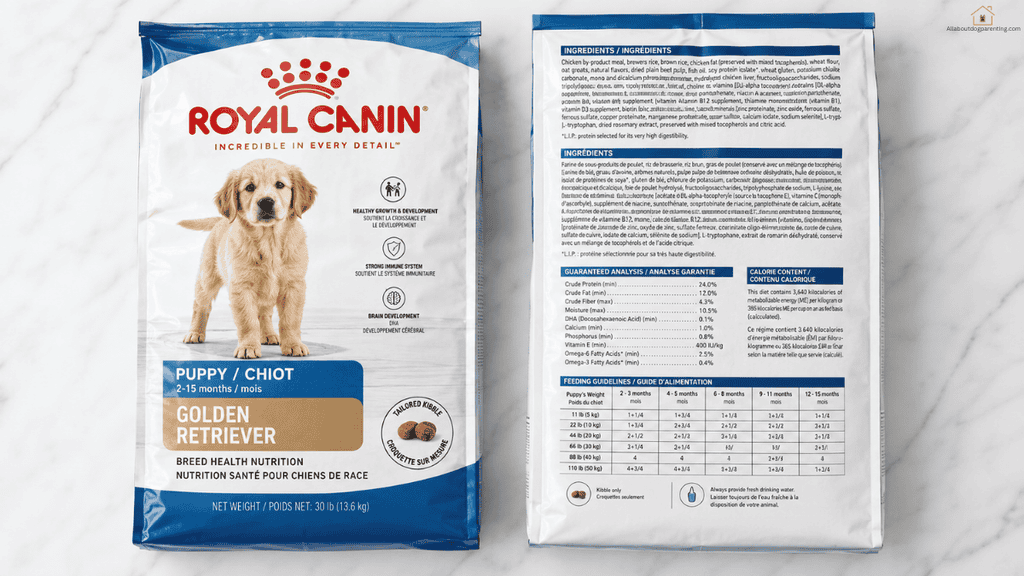
The ingredient splitting trick: This is the one manufacturers don’t advertise. If corn appears on the label as “ground corn,” “corn gluten meal,” and “corn bran” separately, each one appears lower on the ingredient list individually. Add them together, and corn may actually be the dominant ingredient by weight. This is ingredient splitting, which is legal and specifically designed to push an ingredient further down the list than its true proportion warrants.
Named protein vs vague protein: “Chicken” is a named protein. “Poultry” is acceptable but less specific. “Meat and bone meal” is vague and lower quality because the source can vary between batches. “Animal by-products” without a named animal is a red flag. Named by-products like “chicken by-product meal” are different. These include organ meats such as liver and kidney, which are genuinely nutrient-dense. The name matters more than the “by-product” label.
| Green Flags | Red Flags |
| Named protein first (chicken, beef, salmon) | Unnamed protein (“meat meal,” “animal by-products”) |
| Whole grains (brown rice, oats, barley) | Ingredient splitting (corn appearing 3 times in different forms) |
| Named fats (chicken fat, salmon oil) | Generic fats (“animal fat”) |
| Natural preservatives (tocopherols, rosemary) | Artificial preservatives (BHT, BHA, ethoxyquin) |
| Specific carb sources (sweet potato, oats) | Artificial colours (Red 40, Yellow 5, Blue 2) |
| DHA/EPA source listed (fish oil, DHA-rich fish meal) | Sugar, corn syrup, or sweeteners |
Part 3: The Guaranteed Analysis (The Numbers That Matter)
Overview:
The guaranteed analysis shows minimum protein and fat, and maximum fibre and moisture. For puppy food, look for protein above 22% (ideally 25 to 30%), fat above 8% (ideally 12 to 18%), and for large breeds, calcium between 1.2 and 1.8%. If calcium isn’t listed, contact the manufacturer.
This section is what most owners skip. It’s also where the most important information lives when you’re learning what to look for on puppy food labels.
What “crude” means: The word crude in “crude protein” and “crude fat” refers to the lab measurement method, not the quality of the ingredient. It is a technical term, not a value judgment.
The 4 required guarantees: According to AAFCO’s nutritional labelling guidelines, all pet food must declare minimum percentages of crude protein and crude fat, and maximum percentages of crude fibre and moisture. These four are non-negotiable on current labels.
Optional guarantees that good brands include: Calcium, phosphorus, DHA, omega-3 and omega-6 fatty acids, and glucosamine.
The puppy-specific numbers
| Nutrient | AAFCO Minimum for Puppies | Ideal Range | Large-Breed Puppy Limit |
| Protein | 22.5% | 25 to 32% | Same |
| Fat | 8.5% | 12 to 18% | 8.5 to 16% moderate |
| Calcium | 1.2% | 1.2 to 1.8% | 1.2 to 1.8% strict upper limit |
| Phosphorus | 1.0% | 1.0 to 1.6% | 1.0 to 1.6% |
| DHA | Not required | 0.05 to 0.1% | Same |
| Calcium to Phosphorus ratio | 1:1 minimum | 1.2:1 to 1.5:1 | 1:1 to 2:1 |
What’s changing under new AAFCO labels: The new label format requires the addition of total carbohydrate and a change from crude fibre to dietary fibre. Guaranteed analyses will include per-cup measures reported on an as-fed basis, and fibre will be listed as total dietary fibre rather than crude fibre. This is genuinely useful for puppy owners. Instead of calculating how much calcium is in a cup from a percentage, the new labels will show it directly. During the transition period, if you see both formats, the information is equivalent. Only the presentation differs.
For our specific food recommendations by breed size and nutritional needs, our best puppy food for large breeds guide walks through which brands meet these thresholds and why.
Part 4: Calorie Content (The Hidden Math)
Overview:
Calorie content, listed as kcal per cup or per kg, is how you convert “cups of food” into actual nutrition. Two foods can have identical guaranteed analyses but dramatically different calorie densities, meaning the same scoop delivers different amounts of actual nutrition.
Calorie content is the number most owners never look at. It’s also the number that explains why a feeding guide says “2 cups per day” for one food and “3.5 cups per day” for another, even though both claim to be puppy foods with similar protein and fat percentages.
Where to find it: Usually listed near the guaranteed analysis as “Calorie Content” or “ME (Metabolizable Energy),” followed by a figure in kcal/cup or kcal/kg.
How to use it: Your puppy needs a specific number of calories per day based on their age, weight, and breed size. Our puppy feeding chart covers these targets precisely. Once you have your puppy’s daily calorie target, divide it by the kcal per cup figure on the label to get the number of cups per day.
Why it matters more than most people realise: A food at 300 kcal/cup requires approximately 4 cups per day for a large-breed puppy needing 1,200 calories. A food at 420 kcal/cup requires approximately 2.9 cups. The second food costs less per day, stores better, and means you’re working with smaller portions that are easier to measure accurately. Calorie density is a practical consideration that directly affects both cost and precision.
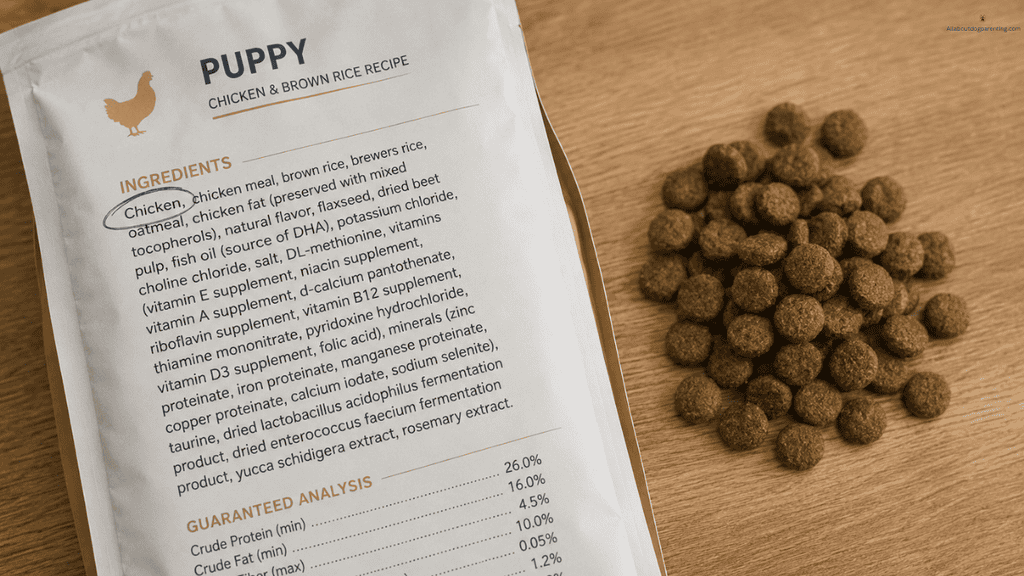
Part 5: Manufacturer Information (The Trust Signal Nobody Checks)
Overview:
Reputable manufacturers list full contact information, including phone and address, employ veterinary nutritionists, and respond to nutrient questions. A manufacturer who hides behind a PO box with no phone number is a transparency red flag worth taking seriously.
The World Small Animal Veterinary Association (WSAVA) recommends choosing brands that employ board-certified veterinary nutritionists, conduct feeding trials, and provide full nutrient analysis on request. These three criteria are not visible on the label itself. But the manufacturer’s contact information tells you whether you can even ask.
What to look for: Company name, street address (not just a PO box), phone number, and a website with actual nutritional resources. The minimum legally required is a manufacturer name and address. Brands that provide more than the minimum tend to be the ones with more to be proud of.
The AAFCO puppy food label explained properly includes this context: what’s on the label is the baseline. What the manufacturer will tell you when you ask is the fuller picture. If a company can’t or won’t tell you the precise calcium content of their large-breed puppy formula, that’s information too.
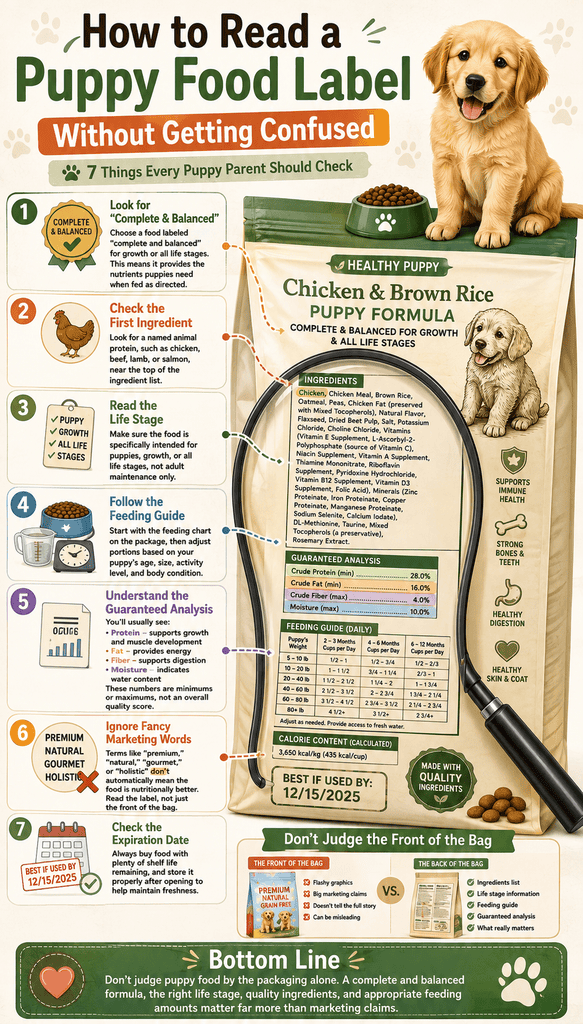
6 Front-of-Bag Claims You Can Safely Ignore
Overview:
“Natural,” “holistic,” “human-grade,” “premium,” “superfood,” and “ancestral” are marketing terms with little to no regulatory meaning. The only front-of-bag claims that carry real nutritional weight are AAFCO certification, the named protein, and the life-stage designation.
When figuring out how to read puppy food labels, it’s also important to know the marketing fluff you must ignore:
| Claim | What You Think It Means | What It Actually Means |
| “Natural” | Minimally processed, no chemicals | AAFCO defines it loosely and allows many processed ingredients under this label |
| “Holistic” | Whole-body health approach | No legal definition whatsoever. Pure marketing. |
| “Human-grade” | Ingredients fit for human consumption | This one is actually regulated. It means made in a human-food-grade facility. Legitimate, but not a nutrition indicator. |
| “Premium” or “Super-Premium” | Better quality | No legal definition. Any brand can use these words. |
| “With Superfoods” | Contains health-boosting ingredients | Usually trace amounts of kale or blueberries added for label appeal |
| “Ancestral” or “Wild” | Closer to a dog’s evolutionary diet | A marketing narrative, not a nutritional standard |
The one front-of-bag claim that does matter in learning how to read puppy food labels: the life-stage designation. Some brands now print “Puppy” or “For Growing Dogs” prominently on the front under the new AAFCO intended-use requirements. This is useful because it tells you immediately that the back label should confirm a growth AAFCO statement. But it still needs verifying on the back panel because front-of-bag text alone is not the legal adequacy claim.
How to Compare Wet and Dry Food Labels (Dry-Matter Conversion)
Overview:
Wet food at 10% protein and dry food at 25% protein are not directly comparable because wet food is 78% water. Converting to dry matter: wet food at 10% protein with 78% moisture equals 10 divided by (100 minus 78) multiplied by 100, which equals 45% protein on a dry-matter basis, actually higher than the kibble.
This calculation is at the very core of a guaranteed analysis of puppy food. Here is how to get it right:
The formula: Dry matter percentage = (Nutrient % on label) divided by (100 minus Moisture %) multiplied by 100
Worked example: You’re comparing a wet food at 10% crude protein and 78% moisture against a dry kibble at 25% crude protein and 10% moisture.
Wet food dry matter protein = 10 divided by (100 minus 78) multiplied by 100 = 10 divided by 22 multiplied by 100 = 45.5%
Dry kibble dry matter protein = 25 divided by (100 minus 10) multiplied by 100 = 25 divided by 90 multiplied by 100 = 27.8%
The wet food, which looked lower in protein on the label, is actually considerably higher when measured on the same moisture-free basis. This is why you cannot compare wet and dry food percentages directly from the label numbers. You have to convert first.
Conversion table for quick reference
| As-Fed % | At 10% Moisture (kibble) | At 78% Moisture (wet food) |
| 10% | 11.1% dry matter | 45.5% dry matter |
| 15% | 16.7% dry matter | 68.2% dry matter |
| 25% | 27.8% dry matter | 113.6% dry matter |
| 30% | 33.3% dry matter | Not applicable at this moisture |
Under the new AAFCO label format, calorie content is broken down into calories from protein, fat, and carbohydrates, and nutrient information is listed in common household measurements like cups instead of only a guaranteed analysis percentage. This will make comparing foods considerably more practical without requiring the dry-matter calculation for basic comparisons.
For the full breakdown of how wet and dry food options compare beyond their labels, our wet vs dry puppy food guide covers palatability, cost, and practical differences.
FAQs
1. What is the most important thing to look for on a puppy food label?
The AAFCO nutritional adequacy statement. It must say “complete and balanced for growth.” For large-breed puppies, look specifically for “including growth of large-size dogs.” This single line tells you whether the food meets all nutritional requirements for a growing puppy, and whether that claim was verified through feeding trials or formulation alone.
2. What does “by-product meal” mean in puppy food?
By-product meals include organ meats such as liver, kidney, and heart, which are nutrient-dense. Named by-products like “chicken by-product meal” are fine nutritionally. Unnamed by-products listed simply as “animal by-product meal” are a quality concern because the protein source is unspecified and may vary between production batches.
3. Is “chicken meal” worse than “real chicken” in puppy food?
No, in fact, it may actually be better. Fresh chicken contains about 70% water. After cooking, the actual protein contribution is much lower than its label position suggests. Chicken meal has already been dehydrated and concentrated, delivering more protein per gram of ingredient. Both are legitimate protein sources and neither is inherently superior.
4. What should the protein percentage be in puppy food?
AAFCO requires a minimum of 22.5% crude protein for puppy food. Most quality puppy foods range from 25 to 32%. Higher protein isn’t automatically better. What matters is the protein source (named animal protein rather than plant-based filler protein) and the overall nutrient balance alongside fat and calcium.
5. How will the new AAFCO label changes affect what I see on puppy food bags?
AAFCO’s label modernisation regulations went into effect in 2024 with full implementation required by 2030. A pet nutrition facts box resembling human food nutrition labels will show nutrient quantities in common household measurements like cups. The new label will add total carbohydrate and replace crude fibre with dietary fibre. The nutritional content requirements haven’t changed. Only the presentation format has. During the transition period through 2030, both old- and new-format labels will be on shelves simultaneously.
The Bottom Line
Knowing how to read puppy food labels is a skill that takes about ten minutes to learn and pays off every time you buy food for the next ten to fifteen years of your dog’s life. The back of the bag is where the nutrition lives. The AAFCO statement, ingredient list, guaranteed analysis, calorie content, and manufacturer information are the five areas that matter. Everything on the front is a conversation starter at best.
Flip the bag first. Check the AAFCO statement. Confirm the first ingredient. Then use the guaranteed analysis puppy food benchmarks in this guide to verify the numbers match what a growing puppy actually needs. That process takes under two minutes and eliminates most foods that shouldn’t be in a puppy’s bowl.
For breed-specific food recommendations that apply these criteria directly, our best puppy food for sensitive stomachs guide and best puppy food for allergies guide both reference the label criteria covered here as selection benchmarks.