German Shepherd Puppy Food: Complete Feeding Guide from a GSD Owner
Overview:
German Shepherd puppies need large-breed-specific food with controlled calcium, moderate fat, and highly digestible protein to support 18 months of growth while protecting joints. Feed 3 to 4 times daily until 6 months, then twice daily. Budget $50 to $80 per month.
Feeding a German Shepherd puppy well is genuinely different from feeding most other breeds. The hip dysplasia risk is real and nutrition-dependent. The digestive sensitivity is breed-wide. When I started researching German Shepherd puppy food for my first GSD, I found that this breed has specific nutritional needs that generic large-breed guides either miss entirely or address in a single paragraph.
This guide covers everything that actually matters: why calcium control is the most important label check you’ll make, what the GSD growth curve looks like month by month, ho
w much to feed at each stage with a GSD-specific chart, which formulas are worth buying, and the body condition check that will save you from the anxiety of wondering whether your puppy’s growth is on track.
I’ve fed GSDs through every stage covered in this article. The research, the vet conversations, the mistakes, and the outcomes are all mine. I decided to compile all of that knowledge for the benefit of other GSD lovers, as part of our Complete Guide to Puppy Nutrition.
What Makes Feeding a German Shepherd Puppy Different
Overview:
GSDs face three specific nutritional challenges: genetic predisposition to hip and elbow dysplasia making calcium control critical, notoriously sensitive stomachs requiring highly digestible formulas, and an 18-month growth period, which is longer than most breeds. Generic puppy food addresses none of these specifically.
Understanding these three challenges before you buy anything is the most useful thing this article can offer.
Challenge 1: Joint health and the calcium equation
Studies show that approximately 19% of German Shepherds are affected by hip dysplasia. That’s nearly one in five dogs in the breed. The nutritional connection is well-established. Controlled feeding targeting lean body condition reduces dysplasia severity by up to 40%, making nutrition and diet your most powerful prevention tool.
The mechanism matters for understanding why. Puppies under six months cannot regulate calcium absorption. Their bodies absorb essentially everything in the food. Increased calcium intake during growth has been shown to increase the risk of developing hip dysplasia due to delayed maturation of the skeleton. AAFCO limits calcium in large-breed puppy food to 1.2 to 1.8% on a dry matter basis. Standard puppy food can contain up to 2.5%, far too high for a developing GSD.
As the Purina Institute states: “Feeding your puppy an appropriate diet at a level which maintains lean body condition can help lessen the risk or severity of hip dysplasia. Puppies fed to safely grow at a slower, more controlled rate will still reach their same adult body size. It will just take a little longer.”
Challenge 2: The GSD sensitive stomach
German Shepherds are among the breeds most consistently associated with digestive sensitivity. Some research links this to differences in intestinal permeability and gut microbiome composition compared to other breeds. Symptoms range from chronic soft stools and gas to occasional vomiting and protein sensitivities, particularly to chicken in some individuals.

My GSD had soft stools for the first three weeks I had him. I thought something was wrong and kept changing his food to fix it. My vet said to stop changing the food, bring a stool sample, and let her rule out medical causes first. She was right on both counts. The issue was partly stress from a new environment, partly his breed’s typical digestive sensitivity, and partly the fact that I had switched his food three times in three weeks, which made everything worse. Once I settled on one highly digestible large-breed formula and stopped changing it, his digestion normalised within a week.
For GSD owners, the 10-day food transition is not optional. It is essential. Every food change needs to be gradual. Our 10-day food transition guide covers the daily ratios specifically because GSD stomachs are more sensitive to abrupt changes than most breeds.
Challenge 3: Extended growth period
GSDs grow rapidly in height until 8 to 10 months, then fill out in chest, shoulder muscle, and overall body mass until 18 to 24 months. This growth period is significantly longer than the 7 to 10 months of small breeds and the 12 to 15 months of medium breeds. It means more months of precision nutrition, more months when errors compound, and a longer window in which the wrong food can cause lasting damage.
Switching to adult food at 10 or 12 months, as some generic large-breed guides suggest, cuts this growth window short. A GSD puppy at 12 months may look adult-sized but still has growth plates open and months of fill-out ahead. The right German Shepherd puppy food needs to carry through to 14 to 18 months.
Feeding Chart: How Much to Feed German Shepherd Puppy
Overview:
A German Shepherd puppy needs roughly 900 to 1,800 calories per day depending on age. Feed approximately three-quarters to one cup per meal at 8 weeks, increasing to 1.5 to 2 cups per meal by 6 months. Always adjust based on body condition, not just the chart.
These figures are based on a typical male GSD with an expected adult weight of 34 to 40 kg (75 to 88 lbs) eating kibble at approximately 380 kcal per cup. Female GSDs trend toward the lower end of each range. Let’s take a look at the specifics of how much to feed a German Shepherd puppy:
| Age | Weight Range | Daily Calories | Cups Per Day | Meals Per Day | Per Meal |
| 8 to 10 weeks | 5 to 9 kg | 600 to 900 kcal | 1.5 to 2.5 cups | 4 | ~½ cup |
| 3 months | 10 to 14 kg | 800 to 1,100 kcal | 2 to 3 cups | 3 | ~¾ cup |
| 4 months | 14 to 20 kg | 1,000 to 1,300 kcal | 2.5 to 3.5 cups | 3 | ~1 cup |
| 5 months | 18 to 25 kg | 1,100 to 1,500 kcal | 3 to 4 cups | 3 moving to 2 | ~1 to 1.5 cups |
| 6 months | 22 to 30 kg | 1,200 to 1,600 kcal | 3 to 4 cups | 2 | ~1.5 to 2 cups |
| 8 months | 27 to 34 kg | 1,300 to 1,700 kcal | 3.5 to 4.5 cups | 2 | ~1.75 to 2.25 cups |
| 10 months | 30 to 37 kg | 1,200 to 1,600 kcal | 3 to 4 cups | 2 | ~1.5 to 2 cups |
| 12 months | 32 to 40 kg | 1,100 to 1,500 kcal | 3 to 4 cups | 2 | ~1.5 to 2 cups |
| 14 to 18 months | 34 to 43 kg | Transition to adult food | Adjust down | 2 | Per adult guidelines |
Notice the slight dip at 10 months. Calorie needs decrease as height growth slows. This is when many GSD owners accidentally overfeed because they keep increasing portions to match appetite without checking whether the growth rate still warrants it.
My actual log from my GSD: at 4 months he was eating about 2.75 cups per day across 3 meals. By 6 months, he was at 3.5 cups across 2 meals. At 10 months, he started leaving food in the bowl at breakfast for the first time. When I dropped to 3 cups per day, he ate everything, and his body condition held steady. If I had kept pushing food even when he was leaving it, I would have been feeding a growing dog who had slowed down as though he was still at peak velocity.
For the universal calorie calculation method that works regardless of which food you choose, see our how much to feed a puppy guide.
German Shepherd Puppy Feeding Schedule
Overview:
Feed your GSD puppy 4 times daily from 8 to 12 weeks, 3 times from 3 to 5 months, and twice daily from 6 months onward. GSD stomachs do better with predictable routines. Allow 15 to 20 minutes per meal and pick up the bowl.
Let’s take a look at when to feed a German Shepherd puppy, based on their age:
| Age | Meals Per Day | Sample Schedule | Notes |
| 8 to 12 weeks | 4 | 7 am, 11 am, 3 pm, 7 pm | Soak kibble in warm water for the first week or two |
| 3 to 5 months | 3 | 7am, 12:30pm, 6pm | Biggest appetite phase: growth is rapid |
| 6 to 18 months | 2 | 7:30am, 6:30pm | This is the adult pattern: maintain it long-term |
Here are two other important things to bear in mind:
First, do not feed within one hour of vigorous exercise. Large breeds including GSDs are at elevated risk of bloat (gastric dilatation-volvulus, or GDV), a life-threatening condition where the stomach fills with gas and rotates. Feeding immediately before or after intense activity increases this risk meaningfully. Walk first, wait 30 minutes, then feed. Or feed first, wait 60 minutes before any activity.
Second, use a slow-feeder bowl if your GSD eats fast. Gulping air while eating is a contributing factor to bloat risk. Most GSDs eat with considerable enthusiasm, particularly during the 3 to 6 month peak growth phase.
For the full daily routine including potty break timing, see our puppy feeding schedule guide.
The GSD Growth Curve: What to Expect Month by Month
Overview:
German Shepherds grow rapidly in height until 8 to 10 months, reaching approximately 90% of adult height. They then fill out in the chest and muscle until 18 to 24 months. Males typically reach 30 to 40 kg; females 22 to 32 kg.
| Age | Male Weight (typical) | Female Weight (typical) | Growth Phase | What’s Happening |
| 8 weeks | 5 to 7 kg | 4 to 6 kg | Rapid growth begins | Just arrived home |
| 3 months | 11 to 14 kg | 9 to 12 kg | Peak growth velocity | Gaining 1 to 2 kg per week |
| 5 months | 19 to 25 kg | 16 to 21 kg | Height growth continues | Looks lanky: legs outpace body |
| 7 months | 26 to 32 kg | 21 to 27 kg | Height approaching adult | May look fully grown but isn’t |
| 10 months | 30 to 37 kg | 25 to 31 kg | Growth slowing | Filling out in chest and shoulders |
| 12 months | 32 to 40 kg | 27 to 32 kg | Approaching maturity | Looks adult but growth plates may still be open |
| 18 months | 34 to 43 kg | 28 to 34 kg | Full maturity | Growth plates closed, ready for adult food |
During peak growth between 3 and 6 months, a GSD puppy’s appetite can seem limitless. This is normal and reflects genuine biological demand. The “lanky adolescent” phase between 5 and 8 months worries almost every GSD owner because their puppy looks too thin. If ribs are palpable with light pressure but not visually prominent, the weight is correct. Lean growth during this phase is protective for joints, not a sign of underfeeding.
My GSD looked genuinely skinny at 6 months, and I had multiple people tell me he needed more food. I almost listened. My vet showed me the body condition chart, confirmed he was a perfect 4 out of 9, and said something I still quote to other GSD owners: “Lean is the goal. You’ll thank this diet when he’s seven, and his hips are still solid.” That reframe changed how I managed the rest of his puppyhood.
Best German Shepherd Puppy Food Picks (2026)
Overview:
The best German Shepherd puppy food options are large-breed formulas with controlled calcium, digestive support, and DHA. Top picks: Royal Canin German Shepherd Puppy, Purina Pro Plan Large Breed Puppy, Hill’s Science Diet Large Breed Puppy, Eukanuba, and Iams.
Here are some solid choices for a German Shepherd puppy diet:
Pick 1: Royal Canin German Shepherd Puppy — Best Breed-Specific
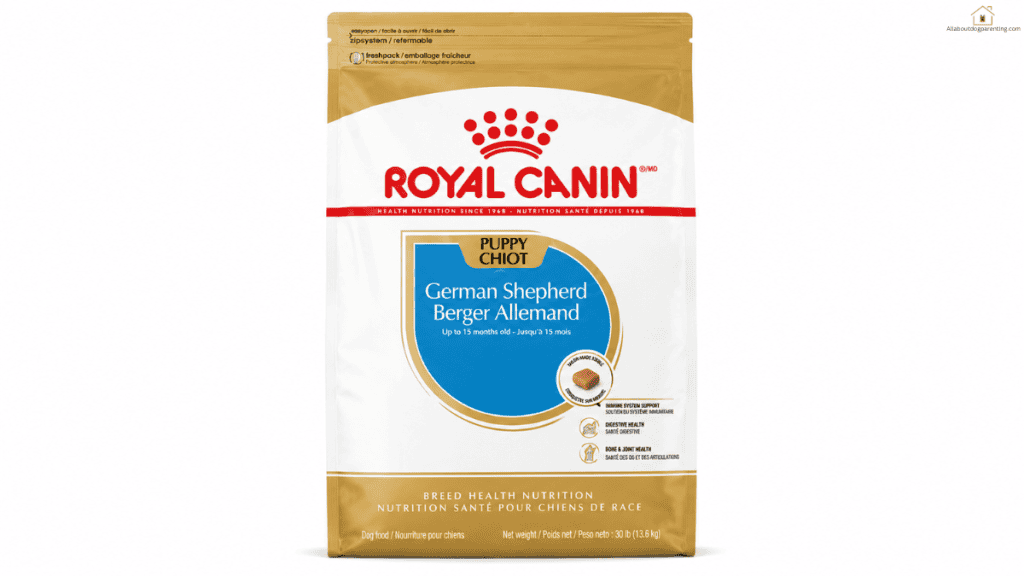
The only formula on the market designed exclusively for GSD puppies. The kibble shape is engineered for the breed’s longer muzzle, encouraging proper chewing rather than gulping. L.I.P. proteins (Low Indigestible Proteins) are used specifically to address the breed’s documented digestive sensitivity. Prebiotics support gut bacteria balance. Controlled calcium sits at approximately 1.32% dry matter. Formulated to feed from 8 weeks to 15 months.
| Spec | Value |
| Protein | 28% min |
| Fat | 14% min |
| Calcium | ~1.32% (controlled) |
| Kcal/cup | ~346 |
| Key GSD features | Breed-specific kibble shape, L.I.P. digestive proteins, prebiotics |
| Price estimate | ~$65–80 per 30 lb bag |
| AAFCO | Growth including large-size dogs |
Best for: GSD owners who want the most breed-tailored option. Particularly relevant for GSDs with established digestive sensitivity. Among the clearest examples of best food for German Shepherd puppy based on breed-specific formulation rather than generic large-breed design.
Drawback: The most expensive kibble on this list. Contains corn and by-product meal. The breed-specific kibble shape is a genuine convenience but not a nutritional necessity. Pro Plan and Hill’s are equally valid choices.
Pick 2: Purina Pro Plan Large Breed Puppy — Best Overall
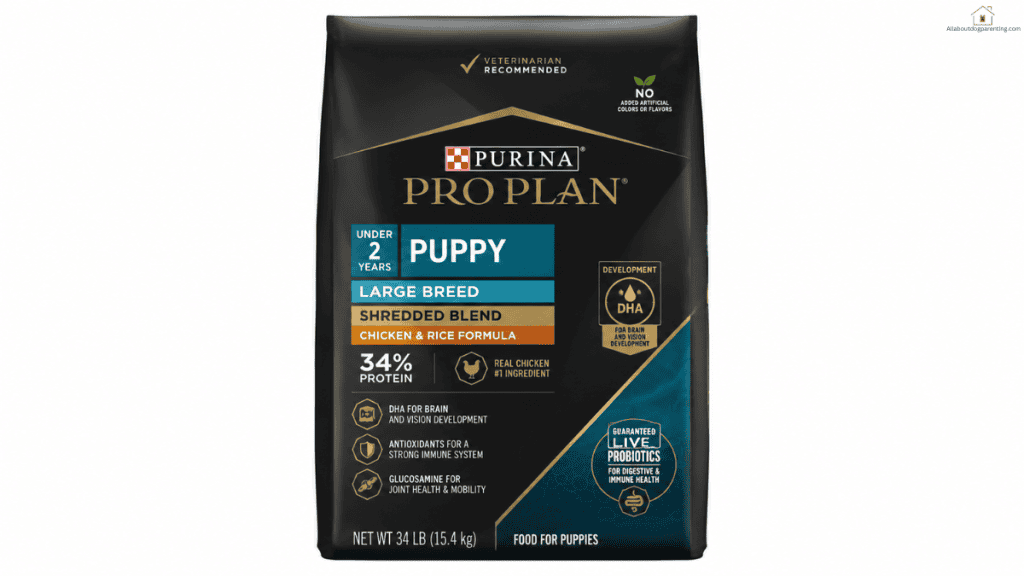
The most frequently recommended large-breed puppy food by veterinarians in the US, and the one I currently feed. Live Lactobacillus probiotics in every serving address the GSD’s digestive tendency directly. Controlled calcium at approximately 1.3%, DHA from fish oil for brain development, and glucosamine for joint support. Available in both chicken-based and sensitive skin and stomach salmon variants, the second of which is worth considering for GSDs with chicken sensitivity.
| Spec | Value |
| Protein | 28% min |
| Fat | 13% min |
| Calcium | ~1.3% (controlled) |
| Kcal/cup | ~393 |
| Key GSD features | Live probiotics, sensitive stomach variant available, glucosamine |
| Price estimate | ~$55–65 per 34 lb bag |
| AAFCO | Growth including large-size dogs |
Best for: Most GSD owners. The evidence-backed default with live probiotics that directly address what makes GSD digestion challenging. If your GSD has stomach sensitivity, the Sensitive Skin and Stomach variant using salmon as the primary protein is worth choosing over the standard chicken formula.
Drawback: Contains chicken by-product meal and corn. Some owners prefer to avoid these despite both being nutritionally adequate.
Pick 3: Hill’s Science Diet Large Breed Puppy — Best for Sensitive Stomachs
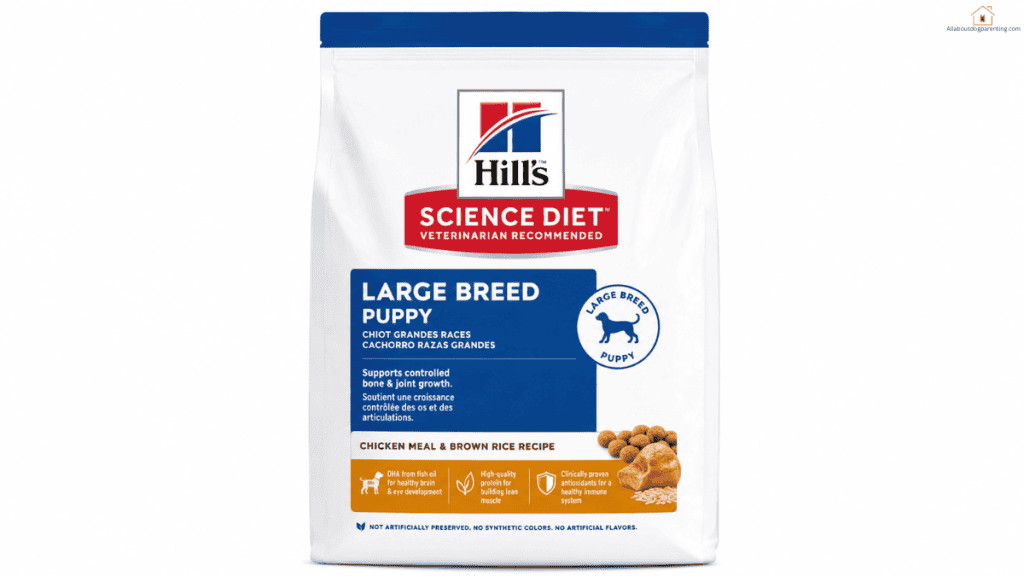
Hill’s has the most tightly controlled calcium figure on this list at approximately 1.25% dry matter, the most conservative option for maximum joint protection. Clinically proven antioxidants, glucosamine, and chondroitin for joint support during the growth phase. Their sensitive stomach salmon variant is particularly well-suited to GSDs with known digestive issues.
| Spec | Value |
| Protein | 24.5% min |
| Fat | 12% min |
| Calcium | ~1.25% (tightest control) |
| Kcal/cup | ~363 |
| Key GSD features | Tightest calcium control, glucosamine/chondroitin, gentle digestion |
| Price estimate | ~$60–75 per 30 lb bag |
| AAFCO | Growth including large-size dogs |
Best for: GSDs with chronic digestive issues or owners who want the most conservative calcium level for maximum joint protection. Consistently cited as a sensitive stomach puppy food vet-recommended option.
Drawback: Lower protein than most competitors. Premium price per pound. Fat content at 12% is the lowest on the list, which may be insufficient for very active working-line GSDs.
Pick 4: Eukanuba Large Breed Puppy — Best for Active GSDs
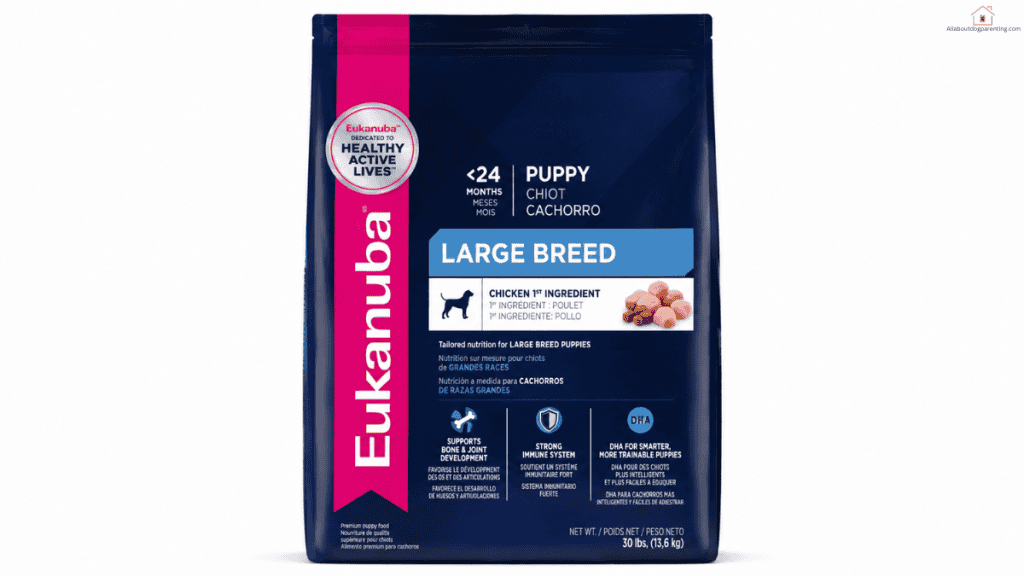
Higher protein and fat content makes this a better match for working-line or highly active GSD puppies who genuinely burn more calories daily. DHA for brain development, controlled calcium at approximately 1.4% (within range but at the higher end), and Mars Petcare’s veterinary nutritionist involvement and feeding trial data.
| Spec | Value |
| Protein | 27% min |
| Fat | 15% min |
| Calcium | ~1.4% (within range) |
| Kcal/cup | ~392 |
| Key GSD features | Higher calorie density for active dogs, DHA, dental support |
| Price estimate | ~$50–60 per 33 lb bag |
| AAFCO | Growth including large-size dogs |
Best for: Working-line or highly active GSD puppies who need more fuel. GSDs in regular obedience or Schutzhund training from an early age.
Drawback: Calcium at 1.4% is within the AAFCO range but higher than Hill’s or Pro Plan. Less widely available in most markets than the top two picks.
Pick 5: Iams Large Breed Puppy — Best Budget GSD Option
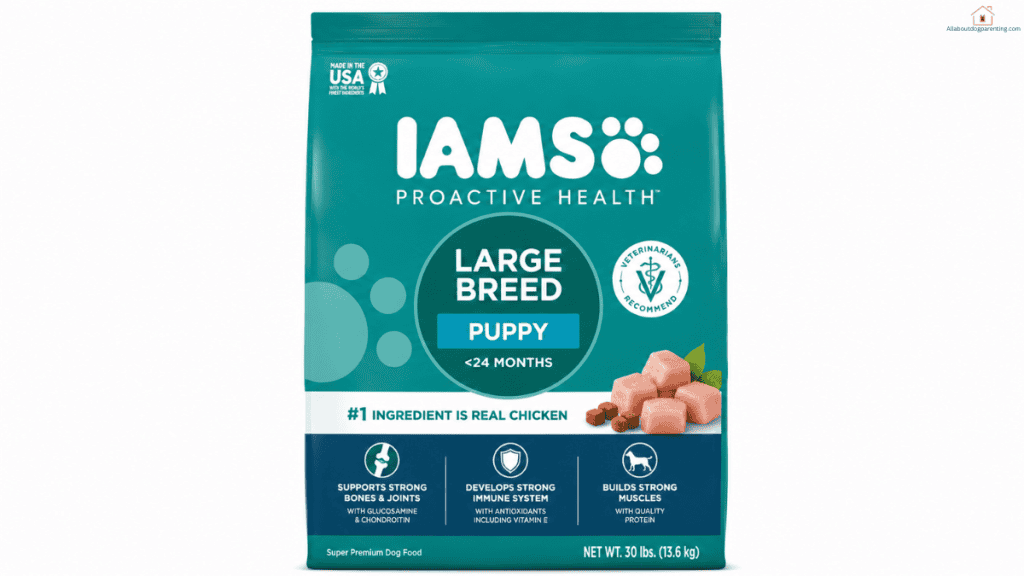
Farm-raised chicken as the first ingredient, controlled calcium, DHA from fish oil, and AAFCO certified specifically for growth of large-sized dogs. Mars Petcare employs veterinary nutritionists and conducts feeding trials across Iams formulas. This pick proves that the German Shepherd puppy diet doesn’t require a $70 per bag investment to be nutritionally sound.
| Spec | Value |
| Protein | 25.5% min |
| Fat | 13.5% min |
| Calcium | ~1.3% (controlled) |
| Kcal/cup | ~354 |
| Key GSD features | Affordable, controlled calcium, DHA, feeding trial validated |
| Price estimate | ~$35–45 per 30 lb bag |
| AAFCO | Growth including large-size dogs |
Best for: Budget-conscious GSD owners who want nutritionally complete food without premium pricing. See our best affordable puppy food guide for a full breakdown of budget options across all breed sizes.
Drawback: Lower protein than other picks. Contains corn and chicken by-products.
Side-by-Side Comparison Table
All five picks compared on protein, fat, calcium, calories, price, GSD-specific features, and best use case for the breed.
| Brand | Protein | Fat | Calcium | Kcal/Cup | Price Per Bag | GSD-Specific Feature | Best For |
| Royal Canin GSD Puppy | 28% | 14% | ~1.32% | 346 | ~$72 | Breed-specific kibble shape, L.I.P. digestion | Breed-tailored option |
| Purina Pro Plan LB | 28% | 13% | ~1.3% | 393 | ~$60 | Live probiotics, sensitive stomach variant | Best overall |
| Hill’s Science Diet LB | 24.5% | 12% | ~1.25% | 363 | ~$68 | Tightest calcium control, glucosamine | Sensitive stomachs |
| Eukanuba LB Puppy | 27% | 15% | ~1.4% | 392 | ~$55 | Higher calorie density for active dogs | Active/working-line |
| Iams LB Puppy | 25.5% | 13.5% | ~1.3% | 354 | ~$40 | Most affordable large-breed option | Budget-friendly |
The Body Condition Check: How to Know If You’re Feeding the Right Amount
Overview:
Run your hands along your GSD’s ribcage weekly. You should feel ribs easily with light pressure but not see them prominently. From above, a visible waist should be clear behind the ribs. A lean GSD during growth is healthier than an overfed one.
| Check | What to Look For | Too Thin | Just Right | Too Heavy |
| Ribs (touch) | Run fingers along ribcage | Ribs sharp and prominent with no pressure | Ribs felt easily with light pressure, thin fat covering | Ribs difficult to feel under fat layer |
| Waist (view from above) | Look down at standing GSD | Waist dramatically narrowed, hip bones visible | Clear hourglass shape visible behind ribs | No waist definition, rectangular or oval silhouette |
| Tummy (view from side) | Look at GSD profile | Severe abdominal tuck | Slight upward tuck from chest to belly | Belly level with or hanging below chest |
I’ve made it a habit to check my dogs’ body condition every Sunday morning. At 5 months, I could see a faint outline of ribs. To my eye, he looked too thin. My vet showed me the Purina Body Condition System, confirmed he was a perfect 4 out of 9, and told me lean is exactly where a growing large-breed puppy should sit. A GSD who looks “too thin” to casual observers at six months is often at the ideal weight by veterinary standards, particularly given the breed’s coat, which hides body shape more than shorter-coated breeds.
When to Switch Your GSD to Adult Food
Overview:
Most German Shepherds should switch to adult food between 14 and 18 months, when growth has visibly slowed, and they’ve reached approximately 80% of expected adult weight. Don’t switch before 12 months: GSD growth plates may still be open even if the dog looks fully grown.
I switched my GSD at 14 months. His weight had plateaued around 34 kg, he started leaving food in his bowl at breakfast, and our vet confirmed at his checkup that growth was complete and growth plate closure was underway. The 10-day transition to adult food produced zero digestive issues. If I’d switched at 10 or 11 months as some generic guides suggest, he’d have missed three to four months of growth-phase nutrition during the final fill-out stage.
For the full timing guide covering readiness signs, breed-size windows, and the transition process, see our when to switch to adult food guide.
Common GSD Puppy Feeding Mistakes
Overview:
The most common GSD feeding mistakes are using standard puppy food instead of large-breed-specific, overfeeding during the lanky adolescent phase, switching to adult food too early, ignoring digestive sensitivity, and adding calcium supplements without veterinary guidance.
| Mistake | Why It’s a Problem | What to Do Instead |
| Standard puppy food (not large-breed) | Calcium too high for GSD skeletal development | Always choose food labelled “growth of large-size dogs” |
| Overfeeding at 5 to 8 months (“he looks too thin”) | Excess weight damages developing joints | Trust the body condition check, not visual impression |
| Switching to adult food before 12 months | Growth plates may still be open | Wait until 14 to 18 months, confirmed by vet |
| Ignoring soft stools as “normal” | Could be food sensitivity, parasites, or dietary issue | Consult vet before changing food |
| Adding calcium supplements | Excess calcium causes skeletal deformities in growing large breeds | Never supplement calcium without vet instruction |
| Free-feeding (food available all day) | Can’t monitor intake, promotes overeating, increases bloat risk | Measured meals, set times, pick up bowl after 15 minutes |
| Switching food every time stools are soft | Constant transitions upset the GSD stomach further | Commit to one food for at least three weeks before evaluating |
What I Fed My GSD Puppy (The Full Story)
Overview:
I fed my GSD Purina Pro Plan Large Breed Puppy. This section covers the full decision-making process: what the breeder fed, the transition, the calcium discovery, the sensitive stomach phase, the body condition anxiety, and what I’d do differently from day one.
My breeder had him on this food, and after a consultation with the vet, we decided to continue. The calcium research came about three weeks in, and I found the AAFCO standards for large-breed puppy food, which reinforced my decision to continue with the food he was on.
The body condition anxiety I’ve already described. Six months, faint ribs when running, multiple people suggesting he needed more food. My vet’s body condition assessment, confirmed as a 4 out of 9, was the only opinion that mattered. I kept his portions steady.
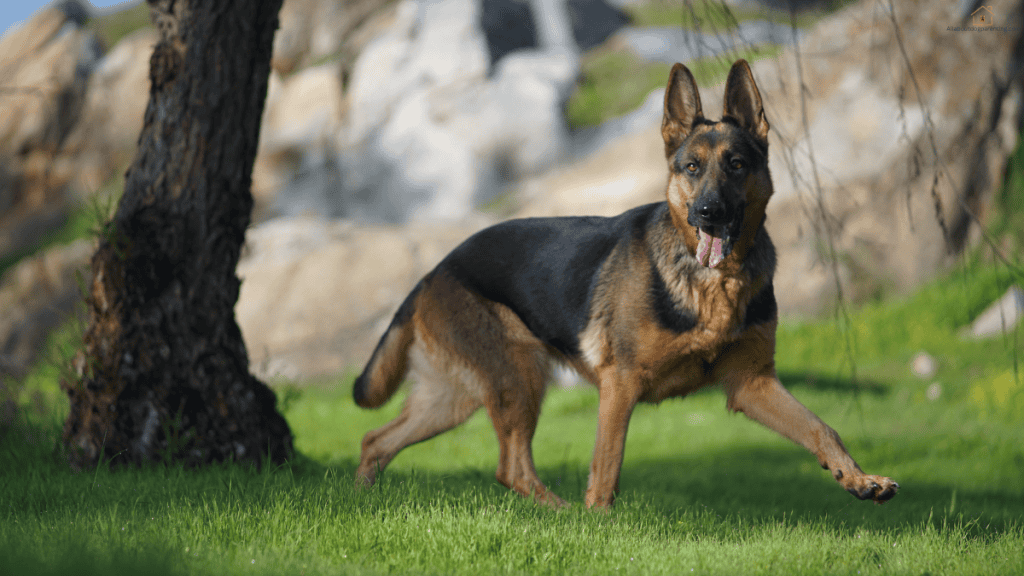
As he matured to an adult dog, I slowly weaned him off packaged food and transitioned him to nutritionally balanced homecooked meals. He is now 4.5 year and in excellent health. His coat is thick and even, his energy is consistent, and his vet confirms good body condition and healthy joint movement at every checkup.
This isn’t a sponsored recommendation. Nobody paid me to choose Pro Plan. I chose it because it has the feeding trial data, the live probiotics, the calcium control, and the veterinary recommendation history that made it the lowest-risk choice for my breed. Any of the five picks on this list would serve a GSD puppy well. The choice between them should come down to your budget, your dog’s specific digestive history, and whether your GSD’s activity level warrants the higher calorie density of the Eukanuba formula.
FAQs
1. How much should I feed my German Shepherd puppy?
A GSD puppy typically needs 1.5 to 4.5 cups of dry kibble per day depending on age, split across 2 to 4 meals. At 8 weeks, start with approximately 2 cups per day across 4 meals. By 6 months, most GSDs eat 3 to 4 cups per day across 2 meals. Always use a large-breed-specific formula and adjust based on body condition rather than the bag’s feeding guide alone. The feeding chart in this article is calibrated specifically to GSD growth trajectories.
2. What is the best food for a German Shepherd puppy?
The most consistently recommended options for the best food for German Shepherd puppy are Purina Pro Plan Large Breed Puppy, Royal Canin German Shepherd Puppy, and Hill’s Science Diet Large Breed Puppy. All three employ veterinary nutritionists, control calcium within AAFCO large-breed limits, and are validated through feeding trials. Royal Canin is the only brand offering a GSD-specific formula with kibble shaped for the breed’s longer muzzle.
3. Do German Shepherds have sensitive stomachs?
Yes, GSDs are among the breeds most consistently affected by digestive sensitivity, possibly linked to differences in intestinal permeability and gut microbiome composition. Symptoms include chronic soft stools, gas, and protein sensitivities. Choosing a highly digestible formula with probiotics or prebiotics, and following a strict 10-day transition for any food change, significantly reduces digestive issues. Our best puppy food for sensitive stomachs guide covers the full diagnostic framework.
4. When should a German Shepherd puppy switch to adult food?
Between 14 and 18 months, when growth has visibly slowed, and your GSD has reached approximately 80% of their expected adult weight. Don’t switch before 12 months because GSD growth plates may still be open even if the dog appears fully grown. Your vet can confirm readiness at a regular checkup.
5. Should I feed my German Shepherd puppy grain-free food?
Most veterinary nutritionists recommend grain-inclusive food as the default for GSDs. The FDA investigated a potential link between grain-free diets high in legumes and dilated cardiomyopathy in dogs, and the question remains unresolved. Unless your GSD has a confirmed grain allergy, which is rare since most food allergies in dogs are protein-triggered, grain-inclusive large-breed puppy food is the safer default. Our grain-free vs grain-inclusive guide covers the complete evidence.
The Bottom Line
German shepherd puppy food decisions carry more weight than they do for most other breeds. The hip dysplasia risk is real, the digestive sensitivity is well-documented, and the 18-month growth period is longer than almost any other commonly kept breed. Getting the calcium control right, choosing a highly digestible formula, and feeding measured portions to maintain lean body condition aren’t premium considerations. They’re the baseline for responsible GSD puppy ownership.
The five picks in this guide all meet that baseline. The choice between them comes down to budget, your specific GSD’s digestive history, and activity level. Feed the right food, check body condition weekly, follow the GSD puppy feeding guide timeline for meal frequency and amounts, and resist every well-meaning suggestion to fatten up your adolescent GSD. Lean is exactly where you want your puppy to be.