Labrador Puppy Food Guide: How Much to Feed, Best Foods, and the Hungry Lab Problem
Overview:
Labrador puppies need large-breed-specific puppy food with controlled calcium, fed in measured portions 3 to 4 times daily. Around 25% of Labs carry a gene mutation that disrupts hunger signals. Never free-feed a Lab. Use body condition, not appetite, as your feeding guide.
Labs are the most popular breed in the US, and one of the most reliably food-obsessed dogs you will ever own. If you’ve just brought a Lab puppy home, you’ve probably already noticed: this puppy is never not hungry. Before you interpret that as a sign to feed more, there’s something you need to know about Lab genetics that changes how you’ll approach every meal for the next 15 months.
This Labrador puppy food guide covers the POMC gene research that explains the hungry Lab problem, breed-specific feeding amounts by age, the body condition check that overrides your puppy’s appeals for more food, and the best food choices for the breed. I raise German Shepherds, not Labs, so I’m writing this from substantial research into Lab-specific feeding challenges and conversations with Lab owners who’ve all experienced the unique challenge of insatiable hunger in their furry babies.
This guide, part of our Complete Guide to Puppy Nutrition, is designed to answer all your questions about what and how much to feed Labrador puppy.
Why Feeding a Lab Puppy Is Different from Other Breeds
Overview:
Labs face a unique combination of challenges: a genetic predisposition to obesity via the POMC gene mutation, a heavy build that stresses developing joints, and food enthusiasm that makes overfeeding dangerously easy. Controlled feeding is not optional for this breed.
The combination is genuinely different from what most large-breed owners deal with, and that’s why it’s a key focus in our Labrador puppy food guide. Here’s why:
The POMC gene: the science behind the always-hungry Lab
Around 25% of Labradors carry the POMC mutation, which researchers previously showed causes increased interest in food and risk of obesity. This is not anecdotal. Research done at the University of Cambridge analysed the DNA of more than 300 Labrador retrievers from the UK and US. The POMC gene produces two hormones, called beta-MSH and beta-endorphin, that signal to the brain when the body is full and satisfied. In dogs with the mutation, the gene is truncated and unable to produce these hormones, resulting in a constant state of hunger and a reduced ability to burn calories.
The mutation triggers a starvation signal that tells the body to increase food intake and conserve energy, despite this being unnecessary. As lead researcher Dr. Eleanor Raffan of the University of Cambridge put it, “People are often rude about the owners of fat dogs, blaming them for not properly managing their dogs’ diet and exercise. But we’ve shown that Labradors with this genetic mutation are looking for food all the time, trying to increase their energy intake.”
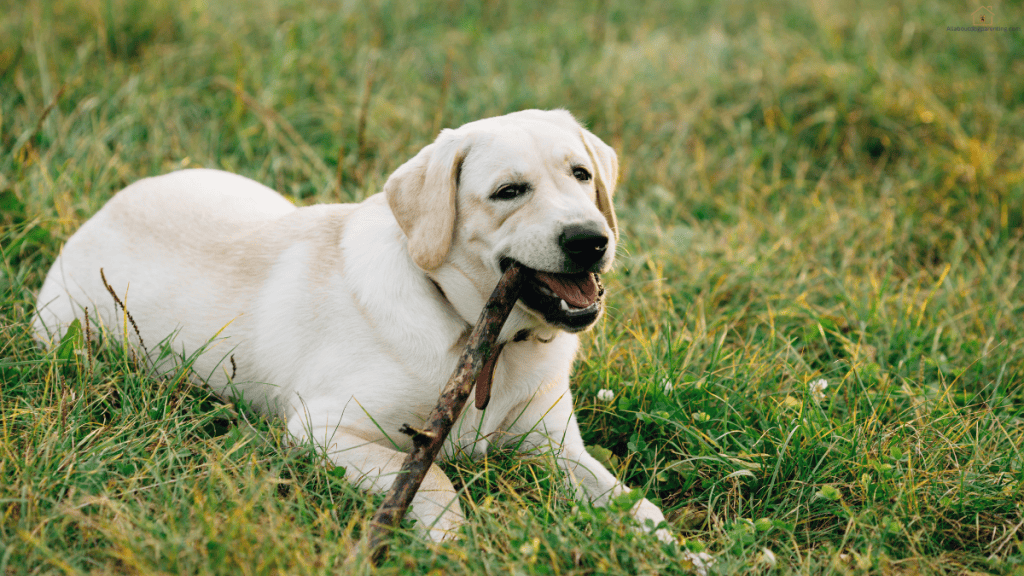
What this means practically for you as a Lab owner: your puppy may genuinely feel hungry between meals, even when adequately fed. One in four Labs has this mutation. That relentless food motivation isn’t a training failure. For a meaningful proportion of the breed, it’s hardwired biology. The response isn’t to feed more. It’s to manage portions with more discipline than owners of other breeds typically need.
The obesity-joint connection
Labs are predisposed to both obesity AND hip and elbow dysplasia. These two risks compound each other. Excess weight during the growth phase puts disproportionate stress on developing joints, amplifying the joint damage that genetics have already made more likely. The same controlled feeding logic that applies to GSDs for calcium management applies to Labs for weight management, though for different reasons.
Labs are also the breed most commonly seen in veterinary obesity clinics. Between one and two in three dogs in developed countries are overweight, a condition associated with reduced lifespan, mobility problems, diabetes, cancer, and heart disease. Labs are overrepresented in that statistic significantly.
Labrador Puppy Feeding Chart by Age
Overview:
A Lab puppy needs roughly 800 to 1,800 calories per day depending on age, split across 2 to 4 meals. Start with about 2 cups per day at 8 weeks and increase to 3.5 to 4.5 cups by 6 to 8 months, then taper as growth slows.
If you often find yourself wondering how much to feed Labrador puppy, this feeding chart will help you get a fair idea. The figures below are based on standard dry kibble at approximately 380 kcal per cup. Male Labs trend toward the higher end of each range; females toward the lower end.
| Age | Weight Range | Daily Calories | Cups Per Day | Meals Per Day | Per Meal |
| 8 to 10 weeks | 4 to 7 kg | 500 to 800 kcal | 1.5 to 2 cups | 4 | ~½ cup |
| 3 months | 9 to 12 kg | 750 to 1,000 kcal | 2 to 2.5 cups | 3 | ~¾ cup |
| 4 months | 12 to 17 kg | 900 to 1,200 kcal | 2.5 to 3 cups | 3 | ~1 cup |
| 5 months | 15 to 22 kg | 1,000 to 1,400 kcal | 3 to 3.5 cups | 3 moving to 2 | ~1 to 1.25 cups |
| 6 months | 18 to 27 kg | 1,100 to 1,500 kcal | 3 to 4 cups | 2 | ~1.5 to 2 cups |
| 8 months | 22 to 30 kg | 1,200 to 1,600 kcal | 3 to 4.5 cups | 2 | ~1.5 to 2.25 cups |
| 10 months | 25 to 33 kg | 1,100 to 1,500 kcal | 3 to 4 cups | 2 | ~1.5 to 2 cups |
| 12 to 15 months | 27 to 36 kg | Transition to adult | Adjust down | 2 | Per adult guidelines |
The Labrador puppy feeding chart above shows a peak around 6 to 8 months, followed by a gradual taper as height growth slows and calorie requirements decrease. This is the phase where Lab owners most commonly overfeed, because the puppy’s appetite doesn’t decrease when growth slows. The chart is your guide. Your Lab’s appetite is not.
A Lab will eat whatever you put in front of them, finish in under a minute, and look at you like it never happened. That’s normal Lab behaviour, not a signal they need more food. Check body condition weekly and adjust portions from the chart, not from the bowl reaction.
For the universal calorie calculation method that works across any kibble brand, see our how much to feed a puppy guide.
The “Always Hungry” Lab: How to Manage It
Overview:
Use slow feeder bowls to extend meal times, puzzle feeders to add mental engagement, the body condition check as your primary decision tool, and low-calorie vegetable fillers to manage volume hunger. Never use your Lab’s begging behaviour as a signal to feed more.
The practical side of this problem gets almost no coverage in standard feeding guides. Here are five tactics that actually help.
| Tactic | How It Helps | Method |
| Slow feeder bowl | Extends meal time from 30 seconds to 10 to 15 minutes, reduces gulping and bloat risk | Outward Hound Fun Feeder or similar maze bowl |
| Puzzle feeders | Turns meals into mental enrichment, slows eating, reduces post-meal begging | Kong Wobbler, snuffle mat, scatter feeding in the garden |
| Frozen Kongs | A portion of daily kibble stuffed and frozen takes 20 to 30 minutes to eat | Kong Classic stuffed with kibble and a small amount of broth, frozen overnight |
| Low-calorie vegetable fillers | Adds bulk to meals without meaningful calories | Green beans, carrot pieces, cucumber slices: up to 10% of daily food volume |
| Measured portions, no exceptions | Removes guesswork, prevents “just a little extra” creep | Use a digital food scale or a dedicated measuring cup. Never estimate by eye |
The slow feeder bowl is the most impactful single change a Lab owner can make. A puppy who finishes breakfast in 25 seconds and spends the next hour seeking food had a very different experience from one who worked through a slow feeder for 12 minutes. The satiety signals have a better chance of being processed when the meal is extended.
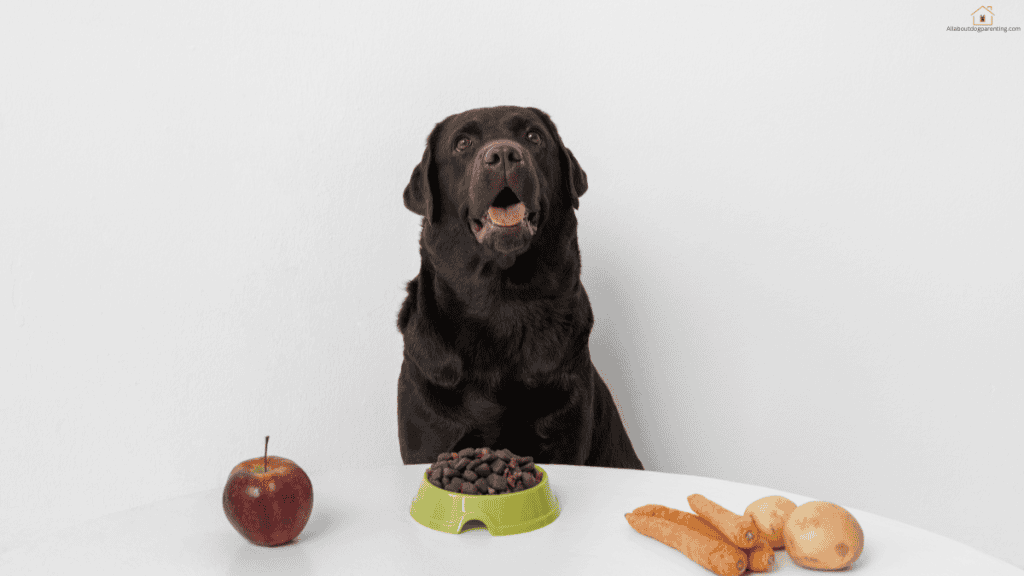
Vegetable fillers deserve more attention than they typically receive. Green beans are particularly effective: low calorie, satisfying volume, and most Labs eat them readily. Replacing 10% of the daily kibble volume with green beans reduces calorie intake slightly while maintaining the meal size your Lab experiences. This isn’t a substitute for correct portions, but it’s a useful tool during the phases where hunger is at its most persistent.
The body condition check, covered in detail later in this guide, is your final override. If your Lab looks and feels right, the portions are right regardless of what your puppy communicates to you at the bowl.
Best Food for Lab Puppies (2026)
Overview:
The best food for lab puppy feeding is a large-breed-specific formula with controlled calcium between 1.2 and 1.8%, moderate fat to prevent rapid weight gain, and DHA for brain development. Top picks: Purina Pro Plan Large Breed Puppy, Royal Canin Labrador Puppy, Hill’s Science Diet Large Breed Puppy, and Iams Large Breed Puppy.
Our Labrador puppy food guide identifies the foods that best align with your pet’s nutritional needs without packing on unnecessary calories:
Pick 1: Royal Canin Labrador Retriever Puppy — Best Breed-Specific
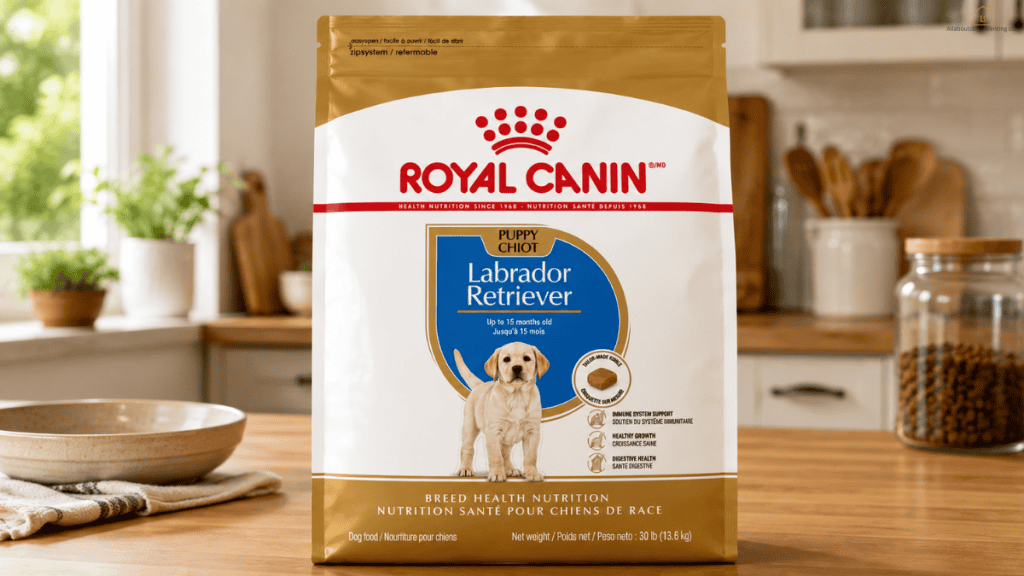
The only formula on the market designed specifically for Lab puppies. The kibble shape is designed for the Lab’s wider jaw, and the formula includes L-carnitine to support healthy metabolism, a genuine advantage for an obesity-prone breed. Controlled calcium at approximately 1.33% sits within AAFCO large-breed limits. The calorie density at 316 kcal per cup is the lowest on this list, which is actually an advantage for Labs: the same volume of food delivers fewer calories, which helps manage intake for enthusiastic eaters.
| Spec | Value |
| Protein | 29% min |
| Fat | 14% min |
| Calcium | ~1.33% |
| Kcal/cup | ~316 |
| Price estimate | ~$65–80 per 30 lb bag |
| AAFCO | Growth including large-size dogs |
Best for: Lab owners who want the most breed-tailored formulation. Particularly useful for Labs already showing weight management challenges. The lower calorie density makes accurate portion control slightly more forgiving.
Drawback: Highest price on this list. Contains corn and by-product meal. The breed-specific kibble shape is a convenience feature, not a nutritional necessity.
Pick 2: Purina Pro Plan Large Breed Puppy — Best Overall
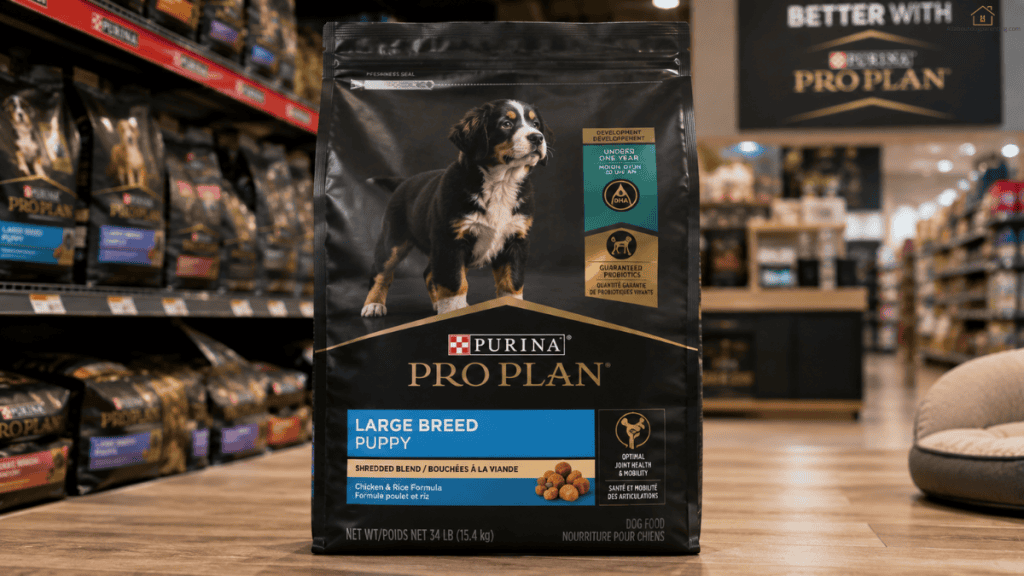
The most frequently recommended large-breed puppy food by veterinarians in the US. Live Lactobacillus probiotics in every serving, DHA from fish oil, glucosamine for joint support, and controlled calcium at approximately 1.3%. Available in a sensitive skin and stomach salmon variant for Labs with digestive sensitivities.
| Spec | Value |
| Protein | 28% min |
| Fat | 13% min |
| Calcium | ~1.3% |
| Kcal/cup | ~393 |
| Price estimate | ~$55–65 per 34 lb bag |
| AAFCO | Growth including large-size dogs |
Best for: Most Lab owners. The best food for lab puppy needs in the mid-price tier, with strong feeding trial validation and live probiotic support. One of the most consistently cited options in this labrador puppy food guide category across veterinary nutrition sources.
Drawback: Higher calorie density than Royal Canin means more careful portioning is needed for Labs prone to weight gain. Contains chicken by-product meal and corn.
Pick 3: Hill’s Science Diet Large Breed Puppy — Best for Weight Management
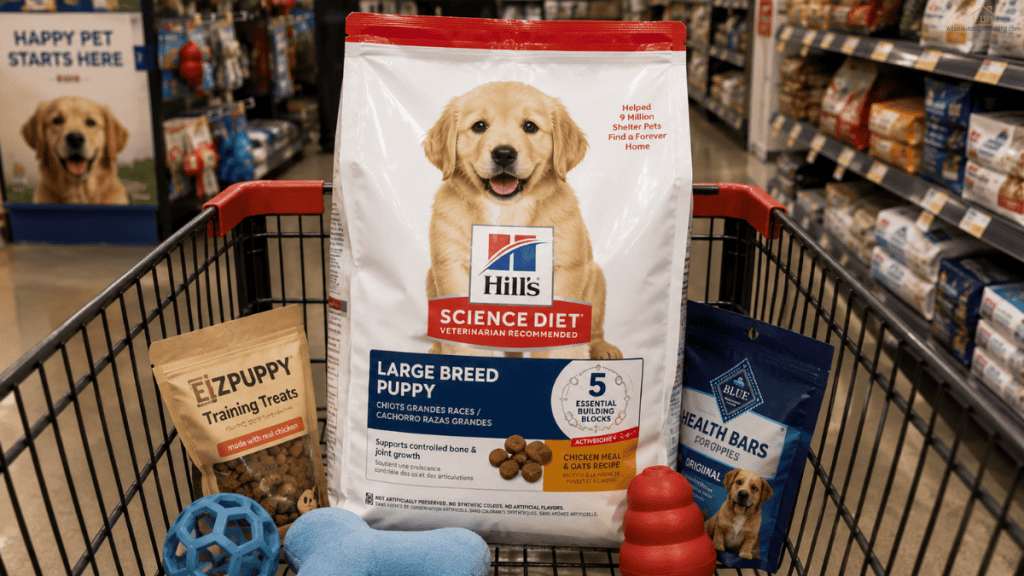
The tightest calcium control on this list at approximately 1.25%. Lower calorie density than Pro Plan, which is an advantage for weight-conscious Lab owners. Clinically proven antioxidants, glucosamine and chondroitin for joint support during the growth phase, and over 200 veterinary nutritionists behind the formulation.
| Spec | Value |
| Protein | 24.5% min |
| Fat | 12% min |
| Calcium | ~1.25% |
| Kcal/cup | ~363 |
| Price estimate | ~$60–75 per 30 lb bag |
| AAFCO | Growth including large-sized dogs |
Best for: Labs who are already on the heavier side for their age, or owners who want the most conservative approach to both calorie density and calcium control.
Drawback: Lower protein content than the other picks. Premium price per pound. Fat at 12% is the lowest on this list, which may be limiting for very active Labs.
Pick 4: Iams Large Breed Puppy — Best Budget Option
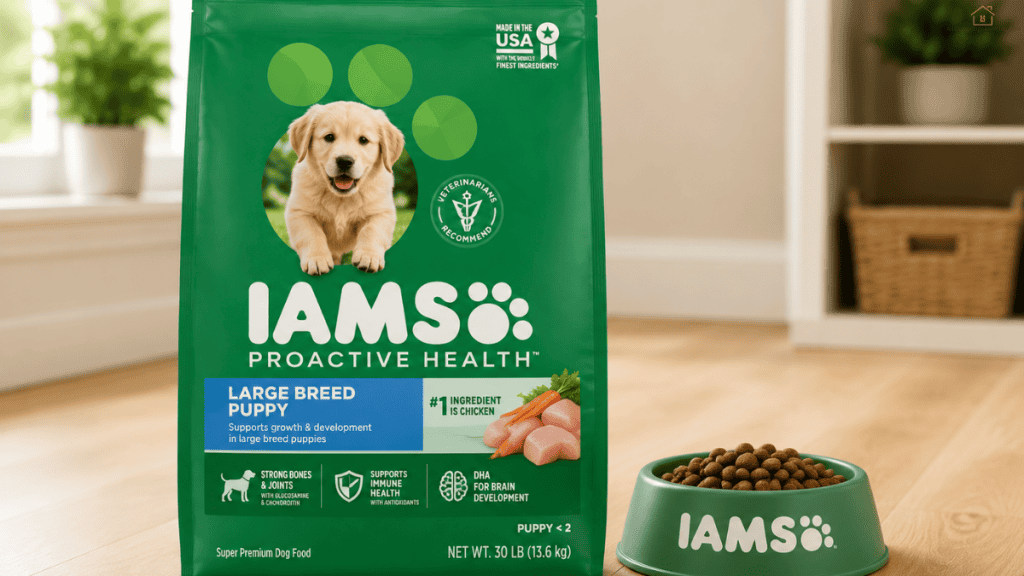
Farm-raised chicken as the first ingredient, AAFCO certified for growth of large-sized dogs, DHA from fish oil, and controlled calcium at approximately 1.3%. Mars Petcare employs veterinary nutritionists and validates Iams through feeding trials. The lab puppy diet doesn’t require premium pricing to be nutritionally complete.
| Spec | Value |
| Protein | 25.5% min |
| Fat | 13.5% min |
| Calcium | ~1.3% |
| Kcal/cup | ~354 |
| Price estimate | ~$35–45 per 30 lb bag |
| AAFCO | Growth including large-size dogs |
Best for: Budget-conscious Lab owners who want nutritionally complete large-breed-specific food at the lowest price on this list. See our best affordable puppy food guide for more options at this price tier.
Drawback: Lower protein than the top two picks. Contains corn and chicken by-product meal.
Side-by-Side Comparison Table
All four picks compared on protein, fat, calcium, calorie density, price, and best use case for the breed.
| Brand | Protein | Fat | Calcium | Kcal/Cup | Price Per Bag | L-carnitine | Best For |
| Royal Canin Lab Puppy | 29% | 14% | ~1.33% | 316 | ~$72 | Yes | Breed-tailored, weight management |
| Purina Pro Plan LB | 28% | 13% | ~1.3% | 393 | ~$60 | No | Best overall |
| Hill’s Science Diet LB | 24.5% | 12% | ~1.25% | 363 | ~$68 | No | Weight management, joint health |
| Iams LB Puppy | 25.5% | 13.5% | ~1.3% | 354 | ~$40 | No | Best budget |
Labrador Growth Chart: Weight by Age
Overview:
Male Labs typically reach 29 to 36 kg (64 to 80 lbs) at maturity; females reach 25 to 32 kg (55 to 70 lbs). Peak height growth occurs at 6 to 9 months, with muscle fill-out continuing until 15 to 18 months.
| Age | Male Weight (typical) | Female Weight (typical) | Growth Phase | Notes |
| 8 weeks | 4 to 7 kg | 3.5 to 6 kg | Rapid growth begins | Settling into new home |
| 3 months | 10 to 14 kg | 9 to 12 kg | Peak growth velocity | Appetite feels enormous |
| 5 months | 17 to 24 kg | 14 to 20 kg | Height growth continues | Looks slightly gangly |
| 7 months | 23 to 30 kg | 19 to 25 kg | Height approaching adult | May look nearly grown |
| 9 months | 26 to 33 kg | 21 to 28 kg | Growth slowing | Filling out in chest and muscle |
| 12 months | 28 to 35 kg | 23 to 31 kg | Approaching maturity | Growth plates may still be open |
| 15 to 18 months | 29 to 36 kg | 25 to 32 kg | Full maturity | Safe to switch to adult food |
Labs grow slightly faster and reach heavier adult weights than GSDs or Golden Retrievers of similar height. The chunky build that defines the breed also makes visual weight assessment less reliable than it is for leaner breeds. A healthy-weight Lab can look heavy to an observer used to slimmer breeds. This is why the body condition check matters more than visual impression.
Body Condition Check for Labs
Overview:
A healthy Lab puppy has ribs that are easily felt with light pressure but not visually prominent, a clear waist visible behind the ribs from above, and a slight abdominal tuck from the side. If you cannot feel ribs without pressing, reduce portions by 10 to 15%.
| Check | What to Look For | Too Thin | Just Right | Too Heavy |
| Ribs (touch) | Run fingers along ribcage | Ribs sharp and visible under coat | Ribs easily felt with light pressure, slight fat covering | Ribs difficult to feel, require firm pressure |
| Waist (view from above) | Look down at standing Lab | Very narrow waist, hip bones prominent | Clear hourglass shape behind the ribs | Little or no waist definition |
| Tummy (view from side) | Look at profile | Severe abdominal tuck | Slight upward slope from chest to belly | Belly level with or hanging below chest |
A Lab-specific note worth making: because the breed carries more body mass than leaner breeds, and because Labs have a double coat that hides body shape, a healthy-weight Lab can look thin to someone accustomed to the stocky, overweight Labs that are unfortunately common. Conversely, an overweight Lab can look “normal” to an owner who has always seen overweight Labs as the reference point.
The body condition check removes visual bias from the equation. Ribs you can feel easily with flat-handed, light pressure but cannot see from a metre away: that’s the target. Every Lab owner should do this check weekly throughout the growth period, particularly because the POMC gene mutation means a quarter of Labs will persistently appear hungry even at a perfectly healthy weight.
Common Lab Puppy Feeding Mistakes
Overview:
The biggest Lab-specific feeding mistakes are responding to appetite rather than body condition, skipping the slow feeder, using standard puppy food instead of large-breed-specific, and letting the “always hungry” behaviour gradually normalise overfeeding across weeks or months.
| Mistake | Why It’s a Problem | What to Do Instead |
| Feeding to appetite, not body condition | A Lab’s appetite is not a reliable hunger signal due to the POMC mutation | Use the body condition check weekly as your primary guide |
| Not using a slow feeder | Lab eats in 30 seconds, gulps air, begs immediately after | Slow feeder bowl extends the meal to 10 to 15 minutes |
| Standard puppy food instead of large-breed | Calcium too high for Lab skeletal development | Always choose food labelled “growth of large-size dogs” |
| Free-feeding (food available all day) | A Lab will overeat continuously: guaranteed weight gain | Measured meals at fixed times, bowl picked up after 15 minutes |
| Increasing portions because “they’re always hungry” | Gradual overfeeding that compounds weekly without obvious signs | Hold the chart, check body condition, adjust based on ribs, not requests |
| Treating table scraps as minor | Labs are highly food-motivated and scraps add up fast | No table food during growth phase |
| Switching food frequently | Labs don’t need variety; frequent switches cause digestive upset | Commit to one food for at least three weeks before evaluating |
When to Switch Your Lab to Adult Food
Overview:
Most Labradors should switch to adult food between 12 and 15 months, when growth has visibly slowed, and they’ve reached approximately 80% of expected adult weight. Labs mature slightly faster than giant breeds and slower than small breeds.
For Labs specifically, the adult food transition is also the moment to consider a weight-management or lower-calorie adult formula. The high-protein, calorie-dense puppy food that supported rapid growth is no longer appropriate once growth has ended, and keeping a Lab on a calorie-dense formula past maturity accelerates weight gain in a breed already prone to it.
Our when to switch to adult food guide covers breed-size timing and readiness signs in detail. When you make the change, follow the gradual process in our 10-day transition guide to avoid the digestive disruption that an abrupt food switch causes.
FAQs
1. How much should I feed my Labrador puppy?
A Lab puppy needs 1.5 to 4.5 cups of large-breed puppy kibble per day depending on age. Feed 4 meals daily until 12 weeks, 3 meals until 5 to 6 months, then 2 meals. Use the Labrador puppy feeding chart as a starting point and adjust based on body condition every week. Never adjust based on how hungry your Lab appears.
2. Why is my Lab puppy always hungry?
Around 25% of Labradors carry the POMC mutation, which causes increased interest in food and risk of obesity. The mutation triggers a starvation signal that tells the body to increase food intake and conserve energy, despite this being unnecessary. This is genetic, not behavioural. Use measured portions, a slow feeder, and the weekly body condition check as your decision tools, not your Lab’s appetite.
3. What is the best food for a Lab puppy?
A large-breed-specific puppy formula with controlled calcium between 1.2 and 1.8%, moderate fat, and DHA. The most consistently recommended options for this Labrador puppy food guide are Purina Pro Plan Large Breed Puppy, Royal Canin Labrador Retriever Puppy, and Hill’s Science Diet Large Breed Puppy. All three employ veterinary nutritionists, control calcium within AAFCO large-breed limits, and are validated through feeding trials. Avoid standard puppy food: the calcium levels are too high for large-breed skeletal development.
4. When should a Lab puppy switch to adult food?
Between 12 and 15 months, when growth has visibly slowed, and your Lab has reached approximately 80% of expected adult weight. Transition gradually over 10 days. Consider a weight-management adult formula if your Lab is already at the upper end of healthy weight when the switch happens.
5. Can I free-feed my Labrador puppy?
No, Labs are genetically predisposed to overeating and will consume everything available regardless of whether they need it. Free-feeding a Lab guarantees weight gain, makes it impossible to monitor intake accurately, and makes potty training significantly harder. Measured meals at set times are non-negotiable for this breed throughout the growth phase and beyond.
The Bottom Line
Feeding a Lab puppy well requires more discipline than feeding most other large breeds, and the reason is biological rather than behavioural. A quarter of Labs carry a gene mutation that makes them feel genuinely hungry even when adequately fed. That’s the most important thing in this Labrador puppy food guide, and it’s the thing most feeding advice glosses over.
Use the Labrador puppy feeding chart as your portion guide. Check body condition every week. Invest in a slow feeder. Never adjust portions in response to your Lab’s appetite alone. And choose a large-breed-specific formula with controlled calcium from the start, because the joint health risks in this breed make the calcium question just as important as the weight question.
The training treats section of your puppy’s nutrition matters here too. Labs are highly food-motivated, which makes training considerably easier, but it also means treat calories add up faster than with most breeds. Our best puppy treats for training guide covers low-calorie options and the calorie budget framework that prevents treats from becoming invisible overfeeding.