Puppy Supplements Guide: Which Are Worth It, Which Are a Waste, and Which Can Cause Harm
Overview:
Most puppies eating AAFCO-certified food need zero supplements. The exceptions: fish oil for brain development if not already in the food, probiotics during food transitions, and breed-specific joint supplements only if recommended by your vet. Never supplement calcium without veterinary direction. This puppy supplements guide explains why.
Every week, pet supplement companies spend money telling you your puppy might be missing something. Immunity boosters. Supercharged growth formulas. Joint support from eight weeks old. The pet supplement market reached $2.8 billion in 2025 and is projected to reach $4.6 billion by 2033. Almost none of that growth is driven by veterinary recommendation. Most of it is driven by owner anxiety.
This puppy supplements guide, part of our Complete Guide to Puppy Nutrition, exists to be the article nobody else will write: the one that starts with the honest answer before recommending anything to buy. For the vast majority of puppies on quality food, supplements are unnecessary. For some, they are actively harmful. A small number genuinely benefit from specific additions in specific circumstances. This article tells you which is which, and why.
The Baseline: If You Feed Quality Food, You Probably Don’t Need Supplements
Overview:
AAFCO-certified puppy food provides 100% of the nutrients a growing puppy needs by definition. Adding supplements on top of complete food does not fill gaps. It creates imbalances. The science supporting most puppy supplements is thin, and the marketing supporting them is very loud.
The AAFCO nutritional adequacy statement on a bag of puppy food means something specific: the food has been formulated to meet all known nutritional requirements for a growing puppy, either through laboratory analysis or through feeding trials. If your puppy’s food carries that statement and your puppy is healthy, their nutritional needs are covered.
So, if you have been wondering, “Should I give my puppy supplements?”, know that adding supplements on top of a complete diet is the nutritional equivalent of taking vitamin C tablets when you already eat enough citrus. At best, it does nothing. At worst, it disrupts a carefully calibrated balance. And for fat-soluble vitamins like A, D, E, and K, which the body stores rather than excretes, the “at worst” scenario is toxicity.

The supplement industry does not need to prove its products work before selling them. Pet supplements are regulated as food additives, not as drugs. That means a product can legally go to market with a compelling claim and limited evidence behind it. The marketing is sophisticated. Science, in most cases, is not.
Do puppies need supplements when they’re eating quality food? It is like asking whether a person eating three balanced meals a day needs a daily multivitamin. The answer for both is usually no.
The Evidence-Based Supplement Guide
Overview:
This puppy supplements guide rates the ten most commonly marketed puppy supplements on evidence level, actual usefulness, correct usage, and the risk of over-supplementing. Use it as your reference before spending money on anything.
| Supplement | Evidence Level | Worth It? | When to Use | Risk of Over-Supplementing |
| Fish Oil (DHA/EPA) | Strong | Yes, if not already in food | Brain development, coat health, anti-inflammatory. Check your food label first. | Low. Excess may cause loose stools |
| Probiotics | Moderate | Situationally | During food transitions, after antibiotics, for sensitive-stomach breeds (GSDs, Frenchies) | Very low. Generally safe |
| Glucosamine/Chondroitin | Moderate (adults) / Low (puppies) | Maybe, for large breeds | Joint support in breeds prone to dysplasia. Evidence stronger for adult dogs than puppies. | Low. Generally safe |
| Multivitamins | Low | Usually no | Only if feeding a nutritionally incomplete diet (which you shouldn’t be) | Moderate. Can create vitamin A/D toxicity |
| Calcium | Strong evidence AGAINST | No. It’s dangerous | Never, unless specifically prescribed for a diagnosed deficiency | High. Causes skeletal deformities in growing puppies |
| Vitamin C | Very low | No | Dogs synthesise their own vitamin C. Supplementation is unnecessary. | Low but pointless |
| Turmeric/Curcumin | Very low | No | Evidence mostly extrapolated from human studies. Minimal data for dogs. | Low but unproven benefit |
| CBD Oil | Very low | No | No approved veterinary use for puppies. Regulation is inconsistent. | Unknown. Insufficient safety data for growing puppies |
| Bone Meal | Low | No | Sometimes added as calcium source in homemade diets, but dosing must be precise | High. Uncontrolled calcium |
| Coconut Oil | Very low | No | Useful topically for skin. Minimal evidence for nutritional benefit when ingested. | Low but unnecessary calories |
The two entries in our puppy supplements guide worth discussing in more detail are fish oil and probiotics, because these have genuine uses. Everything below them on the table is either unnecessary or risky.
Fish oil: It is one of the best supplements for puppies because it provides DHA and EPA, the long-chain omega-3 fatty acids that support brain development, coat health, and have anti-inflammatory properties. Many puppy foods already include fish oil or fish meal as a DHA source. Check your label before buying anything. If fish oil, DHA, or omega-3 fatty acids appear in the ingredient list, you’re already covered. If they don’t, a fish oil supplement providing 50 to 100 mg of DHA daily for a medium-breed puppy has genuine support from veterinary nutritionists.
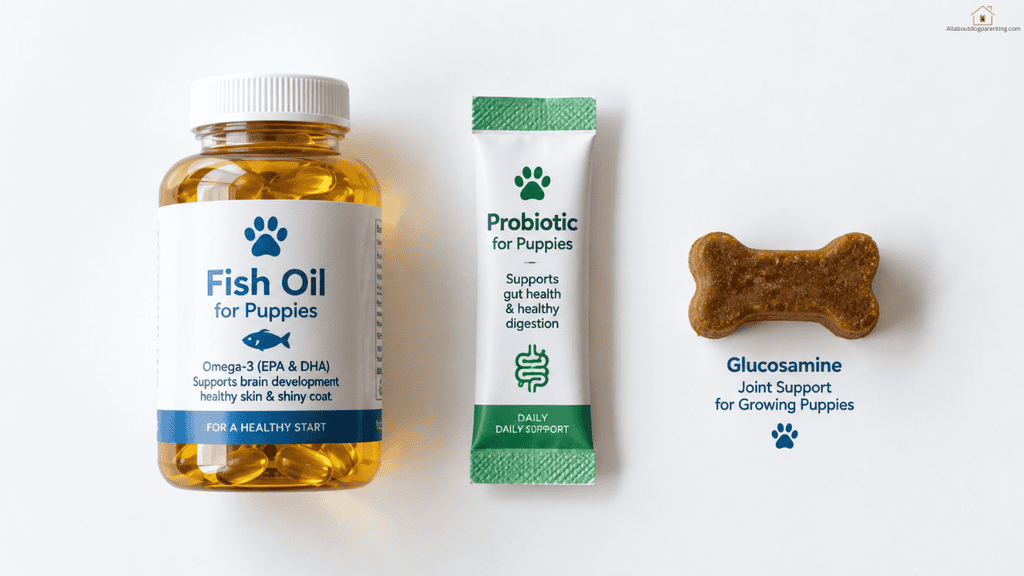
Probiotics: They have earned their moderate-evidence rating for specific situations. During a 10-day food transition, probiotics can ease the gut microbiome adjustment. After a course of antibiotics, which disrupt beneficial gut bacteria, a probiotic can help restore balance. Breeds with documented digestive sensitivity, including German Shepherds and French Bulldogs, often respond well to probiotic support. For everyday use when none of these situations apply, probiotics in a puppy on stable food are largely redundant.
For more detail on reading labels and checking for existing nutrients before you go out picking puppy vitamins, see our guide to reading puppy food labels.
The One Supplement That Can Cause Permanent Harm (Calcium)
Overview:
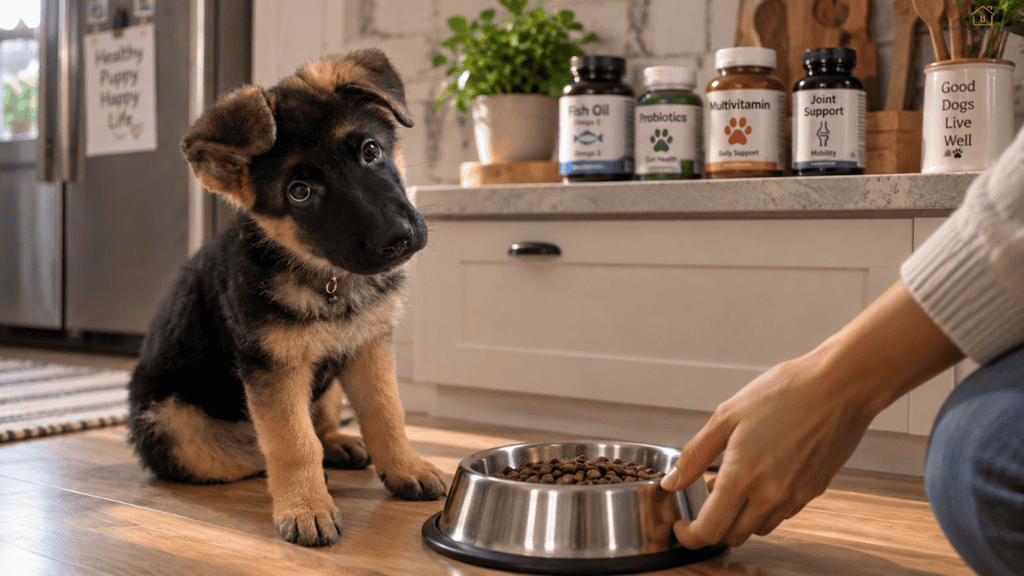
Never add calcium supplements to a puppy’s diet unless your vet specifically prescribes them for a diagnosed deficiency. Puppies under 6 months cannot regulate calcium absorption. They absorb essentially everything they ingest. Excess calcium causes osteochondrosis, hip dysplasia, and skeletal deformities that cannot be reversed once growth is complete.
This is the section I wish every puppy owner wondering, “Do puppies need supplements for calcium?”, read before they buy anything. A well-meaning friend told me to add a calcium supplement to my GSD’s food when he was around four months old. The reasoning sounded sensible: big dog, lots of growing, strong bones. My vet’s reaction was immediate and unambiguous. “Absolutely not. His food already has precisely controlled calcium. Adding more could damage his developing skeleton.” That conversation changed how I think about supplementation entirely.
Here’s the biology that makes this so important. Until around six months of age, a puppy’s small intestine passively absorbs the majority of dietary calcium. There is no regulatory mechanism to filter excess out. Whatever goes in gets absorbed. Large-breed puppy food is specifically formulated with calcium in the range of 1.2 to 1.8% dry matter, a window that supports skeletal development without causing harm. Adding a calcium supplement on top of that pushes calcium beyond the safe upper limit. The consequences include osteochondrosis dissecans, retained cartilage cores, growth plate abnormalities, and hip and elbow dysplasia.
These are not minor problems. They are painful, expensive to manage, and cannot be undone once they develop.
The reason well-meaning owners make this mistake is understandable. You want strong bones for your puppy. Calcium sounds like the right answer. It is the wrong answer when the food is already correctly formulated. A quality large-breed puppy food is already doing precisely what a calcium supplement promises to do, and doing it with far more precision than an over-the-counter supplement can provide.
If you have a large-breed puppy and want the full calcium and skeletal development science, our best puppy food for large breeds guide covers it in detail. For GSD-specific joint and feeding considerations, see our German Shepherd puppy food guide.
When Supplements Do Make Sense—The Decision Framework
Overview:
Supplements make sense in three situations: your food is missing a specific nutrient, your vet has diagnosed a specific deficiency or condition, or you’re feeding a homemade diet that requires supplementation by design. In all three cases, your vet should direct what and how much.
Should I give my puppy supplements is a question with a real answer. That answer depends almost entirely on what you’re feeding and whether your vet has identified a specific need. Here is the framework for working it out.
| Situation | Supplement Needed? | What to Do |
| Feeding AAFCO-certified puppy food | Almost certainly not | Check if DHA/fish oil is already in the ingredients. If yes, you’re covered. |
| Feeding a homemade diet | Yes. Multiple supplements required | Must be formulated by a veterinary nutritionist (DACVN). Find one at acvn.org. |
| Puppy has diagnosed skin or coat issues | Possibly. Fish oil | Discuss with your vet. May indicate food allergy rather than a deficiency. |
| Large-breed puppy, joint concern | Possibly, glucosamine | Discuss with the vet. Evidence is moderate. Never add calcium. |
| Puppy on antibiotics | Yes. Probiotic | Replenish gut bacteria disrupted by the antibiotic course. Purina FortiFlora is widely vet-recommended. |
| Puppy during food transition | Possibly. Probiotic | Can ease digestive adjustment during the 10-day transition process. |
| You’re worried “just in case” | No | AAFCO food covers everything a growing puppy needs. Supplementing “just in case” creates imbalances, not safety margins. |
The homemade diet row deserves emphasis. If you’re feeding home-cooked food, supplementation is not optional. Homemade diets are almost never nutritionally complete without specific, professionally calculated additions including calcium, fish oil, and a vitamin/mineral premix. This is why formulation by a board-certified veterinary nutritionist is non-negotiable for full homemade diets. Our homemade puppy food guide covers the supplement requirements for home cooking in full.
For probiotic use specifically during food transitions, our 10-day food transition guide covers timing and what to watch for.
How to Evaluate Supplement Claims—The Reality Check
Overview:
Be sceptical of supplements claiming to “boost immunity,” “supercharge growth,” or “prevent disease.” These claims are largely unregulated. Look for the NASC quality seal and third-party testing verification, and ask your vet before adding anything to your puppy’s diet.
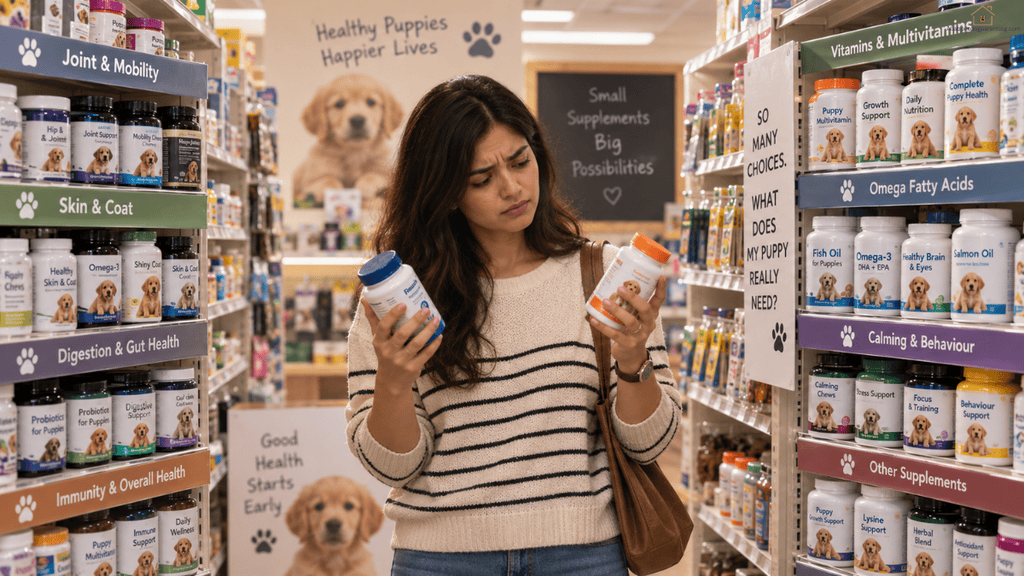
Pet supplements are not regulated as drugs. They do not have to prove efficacy before going to market. A supplement can legally claim to “support joint health” without clinical data demonstrating that it actually does. The regulatory language is deliberately vague because vague language avoids scrutiny. Hence, the need for a puppy supplements guide that lays out the facts as they are. A few things to look for when evaluating any product:
The NASC quality seal
The National Animal Supplement Council maintains a quality audit programme for member companies. Products bearing this seal have undergone manufacturing and quality control review. It doesn’t confirm the product works. It does confirm the product is made consistently and contains what the label says.
Third-party testing
Reputable brands submit their products to independent laboratories to verify ingredient content and rule out contamination. This information is typically available on the brand’s website or by calling their customer service line.
Red flag language
Claims like “prevents disease,” “cures joint pain,” or “clinically proven” on a supplement label are signals to be sceptical. If a supplement claims to treat or prevent a specific disease, it may be crossing into drug territory, which requires FDA approval the company almost certainly doesn’t have. The stronger the claim, the thinner the evidence typically is.
Ask your vet first
This is not a platitude. Veterinarians have access to clinical research that most owners don’t and can tell you whether the specific supplement you’re considering has evidence behind it for your puppy’s specific situation. A vet who knows your breed, your puppy’s health history, and your food choice is far better placed to answer the question of the best supplements for puppies for your dog than a product page.
FAQs
1. Do puppies need vitamins?
Not if they’re eating AAFCO-certified puppy food. The food is formulated to provide all required vitamins and minerals in balanced proportions. Adding a multivitamin on top can create imbalances, particularly with fat-soluble vitamins A, D, E, and K, which accumulate in the body and can reach toxic levels over time.
2. Should I give my puppy fish oil?
Check your food label first. If it already lists fish oil, DHA, or omega-3 fatty acids in the ingredients, supplementation is unnecessary. If it doesn’t, a fish oil supplement providing DHA at 50 to 100 mg per day for a medium-breed puppy supports brain development and coat health. This is the one supplement with broad veterinary support, and even then, only when it’s not already in the food.
3. Can I give my puppy a human multivitamin?
No, human vitamins contain different dosages calibrated for human body weight, and some contain ingredients that are toxic to dogs. Gummy vitamins frequently contain xylitol, which is acutely dangerous for dogs. If supplementation is genuinely needed, use a product specifically formulated for puppies and directed by your vet.
4. Are joint supplements worth it for large-breed puppies?
The evidence is moderate for adult dogs and limited for puppies specifically. Glucosamine and chondroitin may support joint health in breeds prone to dysplasia, including GSDs, Labs, and Goldens, but the strongest evidence base is for adult dogs. If you’re considering this for a puppy with a breed predisposition, discuss it with your vet. And never add calcium for joint health. That causes harm, not help. The distinction between the two is critical.
5. Are probiotics safe for puppies?
Yes, probiotics are generally safe and can be genuinely beneficial during food transitions, after antibiotic courses, and for breeds with sensitive digestive systems. Purina FortiFlora is the most commonly vet-recommended canine probiotic. For everyday use in a healthy puppy on a stable diet, probiotics already present in many puppy foods, listed as Lactobacillus or live active cultures on the label, cover most routine needs without additional supplementation. For puppies with documented digestive sensitivity, see our best puppy food for sensitive stomachs guide.
The Bottom Line
The honest answer to most questions about puppy vitamins and supplements is: check your food label before you buy anything. If the food is AAFCO-certified and already contains fish oil, you don’t need a fish oil supplement. If your puppy is healthy and eating quality food, you don’t need a multivitamin. If a supplement is being marketed to you with phrases like “supercharge immunity” or “prevent joint disease,” the science almost certainly does not match the claim.
Three supplements have genuine, specific uses: fish oil when it’s not already in the food, probiotics in specific circumstances, and glucosamine for certain large breeds when your vet recommends it. Everything else in this puppy supplements guide is either redundant at best or harmful at worst, and calcium supplementation without veterinary direction falls firmly in the harmful category.
Feed quality food. Read the label. Ask your vet before adding anything. That’s the complete framework.