How Long Can Puppies Hold Their Pee? (By Age, Size, and Day vs Night)
Overview:
Puppies can hold their pee for roughly 1 hour per month of age when resting, so a 3-month-old can manage about 3 hours. But awake, active puppies need to go far more often: every 30 to 90 minutes after eating, drinking, playing, or waking from a nap.
You’re in the thick of potty training, and you’re wondering if your puppy is broken. They peed 40 minutes ago, and they’re squatting again. You read somewhere that puppies can hold it for one hour per month of age, so your three-month-old should manage three hours. And suddenly, you’re wondering, “What’s going wrong? How long can puppies hold their pee really?”
Nothing is wrong. The one-hour-per-month rule is real but incomplete, and the gap between what the rule says and what’s actually happening in your living room is causing most of the confusion and all of the frustration. This article closes that gap. It covers how long can puppies hold their pee at every age, why awake puppies and sleeping puppies operate on entirely different timelines, when your puppy will finally sleep through the night, and how breed size changes everything the standard rules don’t account for.
The Puppy Pee Timeline: How Long at Every Age
Overview:
At 8 weeks, expect a potty break every 1 to 2 hours during the day. By 4 months, a resting puppy can hold it about 4 hours. By 6 months, most puppies approach adult-level control at 5 to 6 hours. The timeline depends on age, breed size, and whether the puppy is awake or resting.
The table on how long can dogs hold their pee shows three separate columns for a reason. Resting capacity, awake capacity, and overnight capacity vary for the same puppy at the same age. That’s why it’s important to cover them separately, instead of working with a broad rule of thumb on puppy bladder control by age:
| Age | Resting/Crated Hold Time | Awake/Active Hold Time | Overnight Hold Time | Typical Accidents Per Week | What’s Happening Developmentally |
| 8–10 weeks | 1–2 hours | 30–45 minutes | 2–3 hours | 5–10 or more (normal) | Bladder tiny, zero voluntary control. Pees reflexively when full. |
| 12 weeks (3 months) | 2–3 hours | 45–90 minutes | 3–4 hours | 3–7 (improving) | Bladder growing. Starting to recognise the “full” sensation. Beginning to signal. |
| 16 weeks (4 months) | 3–4 hours | 1–2 hours | 4–6 hours | 1–4 (getting rarer) | Voluntary control developing. Can start to choose to hold briefly. |
| 20 weeks (5 months) | 4–5 hours | 2–3 hours | 5–7 hours | 0–2 (occasional) | Most puppies can skip overnight breaks. Daytime accidents becoming rare. |
| 24 weeks (6 months) | 5–6 hours | 3–4 hours | 6–8 hours | 0–1 (rare) | Approaching adult control. Reliable if the schedule is consistent. |
| 8 months | 6–7 hours | 4–5 hours | 7–9 hours | 0 | Near-adult bladder capacity. Accidents at this age warrant investigation. |
| 10–12 months | 6–8 hours | 4–6 hours | 8–10 hours | 0 | Full adult control. You made it. |
The resting and awake columns are the piece most guides skip. Your four-month-old can hold it four hours in a crate. That same puppy, running around the house after drinking water, will need to go in 30 minutes. The “1 hour per month” rule is a resting guideline, not an activity guideline.
Why “1 Hour Per Month” Is Only Half the Story
Overview:
The popular rule works for resting or crated puppies, but active puppies need to go far more often. Triggers such as eating, drinking, waking up, playing, or getting excited override the age-based clock. A 5-month-old puppy can hold it 5 hours in a crate but will need to go 15 minutes after gulping water at the park.
The “1 hour per month” thumb rule tells you only half the story of how often do puppies pee because there are two separate systems running simultaneously when it comes to puppy bladder control by age. Understanding both is what separates potty training that goes smoothly from potty training that seems to produce endless accidents regardless of effort.
System 1: Age-based capacity
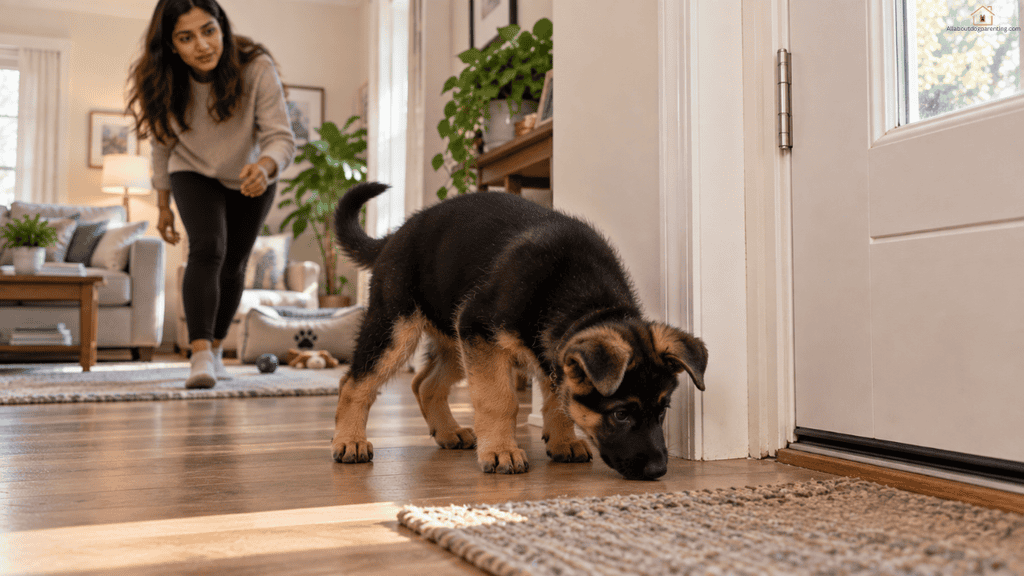
This is what the “1 hour per month” rule describes. It’s determined by bladder size and muscle development, and it grows roughly one hour per month of age. This is the upper limit. The longest a puppy can physically hold it is under ideal conditions, meaning resting, not recently fed or watered, calm, and unstimulated.
System 2: Trigger-based urgency
Regardless of where the puppy sits on the age-based capacity chart, these events trigger the need to pee within 15 to 30 minutes:
| Trigger | Time to Pee After Trigger | Why |
| Waking from any nap | Immediately, within 5 minutes | Bladder fills during sleep, muscles relax, waking triggers release reflex |
| Finishing a meal | 15–30 minutes | Food stimulates the gastrocolic reflex, which also triggers bladder activity |
| Drinking water | 15–30 minutes | Kidneys process water quickly in puppies. Smaller body means faster cycle |
| Active play or exercise | During or immediately after | Physical activity compresses the bladder, excitement weakens voluntary control |
| Excitement over guests arriving, meeting another dog | During the excitement | Adrenaline combined with weak bladder control produces “excitement pee”. Very common under 6 months |
| Anxiety or stress | During the stressful event | Stress hormones trigger bladder release, producing “submissive peeing” |
When I brought my GSD home at 8 weeks, I followed the one-hour-per-month rule and expected him to hold it for 2 hours. But he seemed to pee on no schedule at all. Sometimes within 30 minutes, sometimes in an hour. Meanwhile, I was trying to train him to follow the 2-hour window, and the whole thing turned into a frustrating mess where I’d wonder, “How long can puppies hold their pee, and what about this am I or he not getting?”
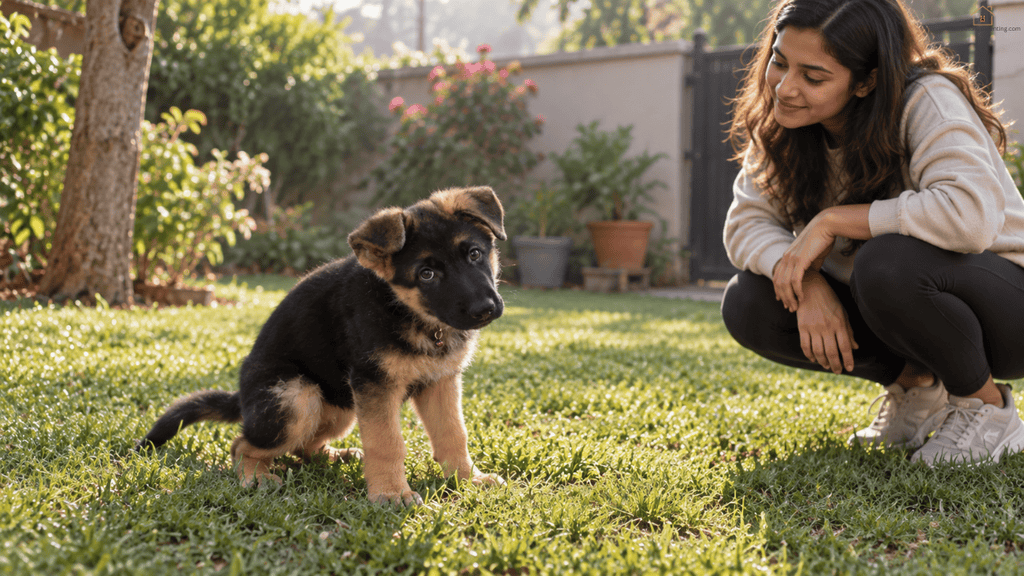
Turns out, there was something I wasn’t getting: he was awake, active, and drinking water. The 2-hour rule on how often do puppies pee only applied when he was napping in his crate. Once I understood the difference between resting capacity and awake triggers, the accidents dropped immediately, because I started taking him out after every trigger rather than just every 2 hours.
For how feeding times connect to potty timing in a full daily routine, our puppy feeding schedule guide maps the complete picture, including when to expect potty breaks relative to each meal.
Day vs Night: Why Puppies Hold It Longer While Sleeping
Overview:
Puppies can typically hold their pee 30 to 50% longer overnight than during the day. Metabolism slows during sleep, less urine is produced, and the body releases antidiuretic hormone (ADH) that concentrates urine. A puppy who needs to go every 3 hours during the day can often sleep 4 to 5 hours at night.
The biology behind overnight holding is worth understanding because it makes the day vs night difference in how long can dogs hold their pee feel logical rather than random. During sleep, the pituitary gland releases antidiuretic hormone, which tells the kidneys to produce less, more concentrated urine. The puppy also isn’t drinking water while asleep, so there’s less for the kidneys to process. Physical inactivity means no compression on the bladder from movement. All three of these factors combine to make nighttime holding meaningfully longer than daytime holding.
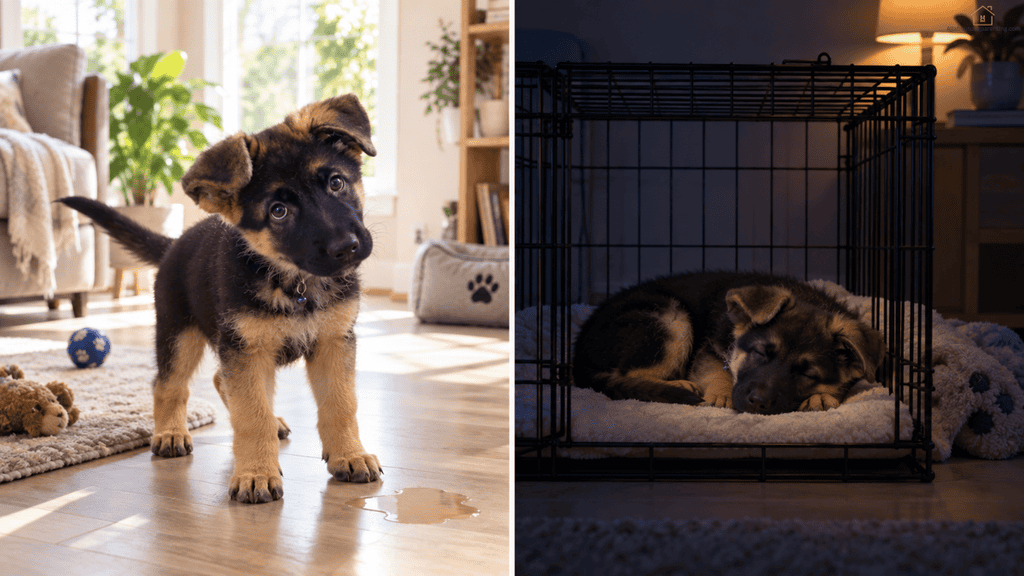
| Age | Daytime Hold (Active) | Nighttime Hold (Sleeping) | Difference | Notes |
| 8–10 weeks | 30 min–2 hours | 2–3 hours | +1 to 1.5 hours | Expect 1–2 overnight breaks |
| 3 months | 45 min–3 hours | 3–4 hours | +1 to 2 hours | May still need 1 overnight break |
| 4 months | 1–4 hours | 4–6 hours | +2 hours | Some puppies start skipping overnight breaks |
| 5 months | 2–5 hours | 5–7 hours | +2 to 3 hours | Most puppies sleep through the night |
| 6 months | 3–6 hours | 6–8 hours | +2 to 3 hours | Overnight accidents become rare |
| 8–12 months | 4–8 hours | 8–10 hours | +2 to 3 hours | Full overnight control |
This is why restricting evening water works for setting up an overnight puppy potty schedule that won’t leave you sleep-deprived. If you pick up the water bowl 2 to 3 hours before bed and offer one small final drink at the last potty break, you’re reducing the raw material the kidneys have to process overnight. Your puppy’s biology does the rest.
The Overnight Milestone: When Will My Puppy Sleep Through the Night?
Overview:
Most puppies can sleep 7 to 8 hours without a potty break by 5 to 6 months of age. Large breeds often reach this milestone by 4.5 to 5 months. Toy and small breeds may take until 6 to 7 months due to smaller bladders. Once your puppy wakes up dry three mornings in a row, stop the alarm.
This is the question every new puppy owner is asking at 3 am. When can puppies hold it through the night? Here’s the honest answer by breed size.
| Breed Size | Typical Age to Sleep Through the Night | Bladder Factor | What Helps |
| Toy (under 5 kg adult) | 6–7 months | Very small bladder | Restrict water 2 to 3 hours before bed; last potty right before crate |
| Small (5–10 kg) | 5–6 months | Small bladder | Same water management, consistent bedtime routine |
| Medium (10–25 kg) | 5–5.5 months | Standard development | Usually the smoothest transition |
| Large (25–40 kg) | 4.5–5 months | Larger bladder, faster development | Often the first to sleep through |
| Giant (40+ kg) | 4–5 months | Large bladder capacity | May surprise you with early overnight control |
How to know your puppy is ready to skip the overnight break
Your puppy wakes up with a dry crate three mornings in a row. They’re no longer frantic to pee when you take them out at your alarm. They’re calm, sometimes not even needing to go immediately. They’re 4.5 months or older for medium and large breeds, or 5.5 months for small and toy breeds.
When they’re ready
Stop setting the overnight alarm. If they wake you with whining, take them out quickly and quietly. No play, no lights, minimal interaction, straight back to crate. If you wake to a wet crate, they weren’t ready. Go back to the alarm for one to two more weeks.
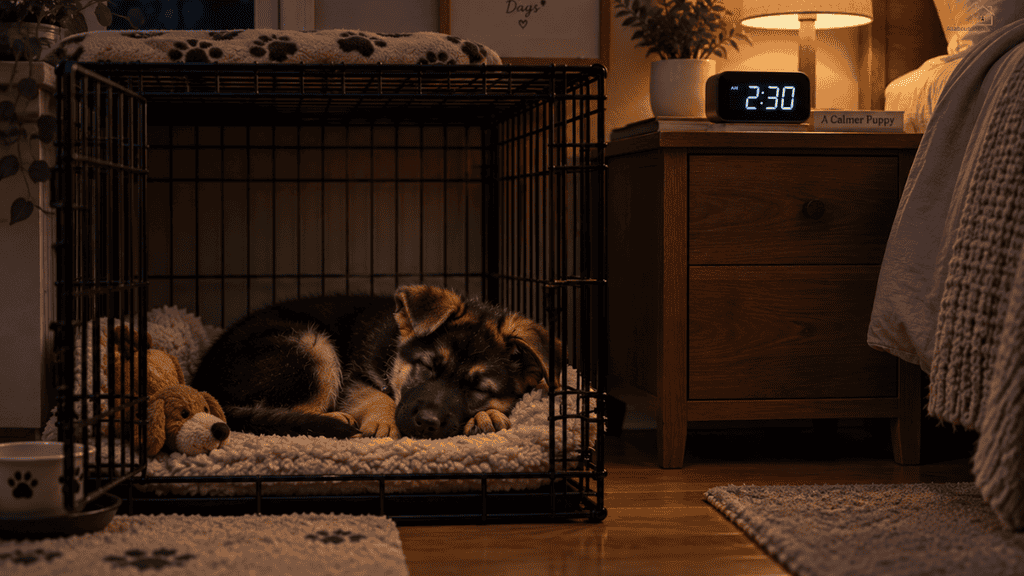
The night my GSD slept from 10 pm to 6 am without a peep was one of the best nights of my life. He was about 4.5 months old. I’d been setting a 3 am alarm for two months. That first uninterrupted night felt like winning a prize I’d forgotten I was competing for. If you’re in the 3 am alarm phase right now and wondering when can puppies hold it through the night: it ends. It always ends.
How Breed Size Affects Puppy Bladder Control
Overview:
Smaller puppies have physically smaller bladders and faster metabolisms, meaning they need to pee more frequently than larger puppies at the same age. A 4-month-old Chihuahua may need a break every 2 to 3 hours. A 4-month-old German Shepherd can comfortably manage 4 hours.
Generic potty training advice on how long can puppies hold their pee frustrates toy breed owners for a specific reason: the one-hour-per-month rule was calibrated on medium and large breeds. A Yorkie owner following it for their 3-month-old might expect 3-hour holds. Their puppy may actually need to go every 1.5 to 2 hours because the bladder is physically small.
| Breed Size | Bladder Capacity vs Medium Breed | Practical Impact | Example Breeds |
| Toy (under 5 kg) | ~40–50% smaller | Needs breaks 30–40% more often than the age chart suggests | Chihuahua, Yorkie, Maltese, Pomeranian |
| Small (5–10 kg) | ~15–25% smaller | Needs breaks 15–20% more often | Shih Tzu, Pug, Dachshund, Cavalier |
| Medium (10–25 kg) | Baseline | Use the age chart as-is | Beagle, Bulldog, Cocker Spaniel, Frenchie |
| Large (25–40 kg) | ~15–25% larger | Can often add 30–60 min to chart times | GSD, Labrador, Golden Retriever, Boxer |
| Giant (40+ kg) | ~30–40% larger | Can often add 1 to 1.5 hours to chart times | Great Dane, Mastiff, Newfoundland |
The rule works better for medium and large breeds. If you have a toy breed puppy, adjust down from the age chart and watch triggers closely rather than relying on the clock.
The Potty Triggers Cheat Sheet (Put This on the Fridge)
Overview:
Forget the clock and watch for triggers. Take your puppy outside immediately after every one of these events: waking up, eating, drinking, playing, arriving home, meeting someone new, or coming out of the crate.
A trigger-based potty training schedule prevents accidents a lot more effectively than timing breaks by the clock.
| When This Happens | Take Puppy Out | Success Rate |
| Puppy wakes from ANY nap | Immediately. Carry if needed | ~95% will pee within 2 minutes |
| Puppy finishes eating | Within 15–20 minutes | ~90% will pee or poop |
| Puppy drinks water | Within 15–20 minutes | ~85% will pee |
| Active play session ends | Immediately after | ~80% will pee |
| Puppy comes out of crate | Immediately. Take them straight outside | ~95% will pee |
| Guest arrives or excitement happens | During or immediately after greeting | ~70% will pee (excitement) |
| Puppy starts sniffing circles or squatting | Immediately. Interrupt and carry outside | Catching it in time is a huge training win |
| You notice it’s been a while | Check the clock. Has it been more than their age-based limit? | A proactive break prevents accidents |
This cheat sheet on how long can dogs hold their pee was more useful to me than any timer. I stopped watching the clock and started watching my puppy. Every time he woke up: outside. Every time he ate, 15 minutes later: outside. Every time we played: outside. The accidents stopped not because his bladder got bigger overnight, but because I got better at reading his triggers.
Water intake timing is the other side of this equation. How much your puppy drinks and when directly determines how often they need to pee. For a full guide on puppy water intake and how to use it to create a predictable potty schedule, refer to our how much water should a puppy drink guide.
When Too-Frequent Peeing Is a Warning Sign
Overview:
If your puppy is peeing significantly more often than the age chart predicts, for example, a 5-month-old going every hour, it could signal a urinary tract infection, bladder issue, or other medical concern. Frequent small pees, straining, blood in urine, or whimpering while peeing all warrant a same-day vet call.
A puppy peeing every 20 minutes at 5 months old is not a training failure. It is a medical signal. Knowing the difference between normal frequency and concerning frequency stops owners from doubling down on training when what they actually need is antibiotics.
| Age | Normal Frequency | Concerning Frequency | Possible Cause |
| 8–12 weeks | Every 1–2 hours awake | Every 15–20 minutes | UTI, excitement peeing, or drinking excessively |
| 3–4 months | Every 2–3 hours awake | Every 30–45 minutes | UTI, bladder issue, excessive water intake |
| 5–6 months | Every 3–5 hours awake | Every 1 to 1.5 hours | UTI, diabetes, kidney issue |
| 7–12 months | Every 4–6 hours awake | Every 1–2 hours | Medical issue — vet visit needed |
Call your vet today if you see any of these:
- Straining to pee with little or no output
- Blood or a pink tinge in the urine
- Whimpering, crying, or licking genitals after peeing
- Sudden increase in frequency after weeks or months of normal control
- Foul-smelling or cloudy urine
- Dribbling urine while walking or sleeping
How to Set Up a Potty Schedule That Actually Works
Overview:
Build your puppy potty schedule around triggers first, then fill in timed breaks based on your puppy’s age. The best schedules are trigger-based with age-based safety nets, not one or the other.
Here is how to set up an effective puppy potty schedule:
Sample schedule: 8- to 12-week-old puppy
| Time | Event | Potty Break? |
| 6:30 am | Puppy wakes up | Yes, immediately outside |
| 7:00 am | Breakfast | |
| 7:15 am | Post-breakfast | Yes, 15 minutes after eating |
| 7:30–9:00 am | Play, then nap | Yes, after play, before crate |
| 9:00 am | Wakes from nap | Yes, immediately |
| 9:30 am | Play | Yes after play |
| 10:00 am–12:00 pm | Nap | |
| 12:00 pm | Wakes up | Yes, immediately |
| 12:15 pm | Lunch | |
| 12:30 pm | Post-lunch | Yes |
| Continue pattern through afternoon… | ||
| 9:00 pm | Last potty break | Yes, final break |
| 9:30 pm | Crate for bed | |
| ~2:00 am | Alarm and overnight break | Yes, quick, quiet, no play |
Total potty breaks: 8 to 12 per day
Sample schedule: 5- to 6-month-old puppy
| Time | Event | Potty Break? |
| 6:30 am | Wake up | Yes |
| 7:00 am | Breakfast | |
| 7:20 am | Post-breakfast | Yes |
| 12:30 pm | Midday (if home) | Yes |
| 5:30 pm | After work or afternoon | Yes |
| 6:00 pm | Dinner | |
| 6:20 pm | Post-dinner | Yes |
| 9:30 pm | Final break before bed | Yes |
| 10:00 pm | Bed. Sleeps through |
Total potty breaks: 5 to 6 per day. No overnight break needed.
How often do puppies pee comes down to this: at 8 weeks, they go every 30 to 45 minutes while awake and need 8 to 12 breaks per day. By 5 to 6 months, they need 5 to 6 breaks per day, sleep through the night, and the worst of potty training is behind you. The schedules above get you from one to the other with a clear structure at each stage.
FAQs
1. How long can a 3-month-old puppy hold their pee?
About 2 to 3 hours when resting or crated, but as little as 45 to 90 minutes when awake and active. Always take your 3-month-old out after waking up, eating, drinking, and playing, regardless of how recently they last peed. One overnight break around 3 to 4 am is still normal at this age.
2. When can puppies hold it through the night?
Most medium and large breed puppies can sleep 7 to 8 hours without a break by 5 months of age. Small breeds may take until 6 months, and toy breeds until 6 to 7 months. Signs your puppy is ready: they wake up with a dry crate three mornings in a row and aren’t frantic to pee when you let them out.
3. Why does my puppy pee every 30 minutes?
If your puppy is under 4 months and awake and active, peeing every 30 to 45 minutes is completely normal. Triggers like play, drinking, and excitement override their limited bladder capacity. If your puppy is over 5 months and peeing this frequently, or if they’re straining, producing only small amounts, or showing blood in urine, contact your vet. It may be a urinary tract infection.
4. Should I wake my puppy up to pee at night?
Yes, until they can hold it through the night, which is typically around 5 to 6 months for medium and large breeds. Set an alarm for the middle of the night. Take the puppy out quickly and quietly. No play, no lights, minimal interaction. Once they consistently wake up dry, stop the alarm and let them sleep through.
5. Does crate training help puppies hold their pee longer?
Yes, most puppies instinctively avoid soiling their sleeping space, which motivates them to hold it longer in a crate than in an open room. But the crate only works within your puppy’s biological limits. Crating a 3-month-old puppy for 5 hours will result in an accident and teach the puppy that soiling their crate is acceptable. Match crate time to your puppy’s age-based holding capacity.
The Bottom Line
How long can puppies hold their pee depends on three things: their age, their breed size, and whether they’re resting or running around after a bowl of water. The timeline table gives you the resting and awake numbers for every age. The breed-size table adjusts those numbers for your specific dog. The trigger cheat sheet tells you when, within any given window, your puppy will actually need to go.
The potty training phase is genuinely exhausting. The 3 am alarm is genuinely hard. But the biology is working in your favour from the start, and every week it gets a little better. By 5 to 6 months, most puppies are sleeping through the night and having accidents only rarely. By 8 months, accidents should be essentially gone. You’re not failing. You’re on a timeline.