The Complete Puppy Training Guide: Everything You Need to Know
Overview:
Start training the day your puppy comes home, and use positive reinforcement only. Reward what you like and redirect what you don’t. Lay three foundations first: house-training, socialisation and bite inhibition. Everything else is built from it.
A useful puppy training guide should tell you what to do this week, with this puppy, in this house. Most of the ones I read when my first German Shepherd boy came home handed me a list of commands and a section on “choosing your method” that treated leash corrections and treats as equally valid options. Even with fifteen years of dog parenting behind me, I still found them exhausting.
So I’ll be upfront about how this complete puppy training guide works. It’s organised by time, the way you’ll live through it: the first week, the first month, months two to four, then the rest of year one. Each section gives you enough to act on today and points to a dedicated article for the full step-by-step. If you’re figuring out how to train a puppy for the first time, read top to bottom. Putting out a fire? The table below gets you to the right section.
My stance, since it shapes every word that follows: positive reinforcement only. No punishment, no leash pops, no alpha rolls. That’s where the evidence landed years ago. The American Veterinary Society of Animal Behavior’s position statement on humane dog training recommends reward-based methods for all training, including the treatment of behaviour problems. When Portuguese researchers followed 92 companion dogs through real training schools, dogs from the aversive-based schools showed more stress behaviours and bigger cortisol spikes after class than dogs trained with rewards. I don’t see a balanced debate there, so I won’t write one.
You’ll notice this guide borrows from our Complete Guide to Puppy Nutrition in places. Mealtimes decide potty times, and treats pay for every lesson, so the two topics overlap far more than is usually acknowledged.
| Stage | What you’re focusing on | Skills to start |
|---|---|---|
| Week 1 home | Safety and routine | Potty schedule, crate, first night |
| Weeks 2–6 home | Foundations | Name, sit, stay, come, leave it, loose leash |
| Up to 16 weeks old | Socialisation window | People, dogs, surfaces, sounds, places |
| Months 2–4 home | Behaviour management | Biting, jumping, barking, chewing, alone time |
| Months 4–12 | Reliability | Distractions, off-leash recall, adolescent dip |
Before You Start: How Puppies Actually Learn
Overview:
Puppies repeat behaviours that pay off and drop the ones that don’t. This is operant conditioning, the basis of all modern dog training. Your puppy has no concept of right and wrong, only of what worked.
Puppy training for beginners gets simpler once you see that your puppy is running constant little experiments. Sit near the treat jar and something good happens? They’ll sit there again. Positive reinforcement puppy training just means you decide which experiments pay off.
Punishment goes badly with puppies because they can’t reliably link your scolding to what they did seconds earlier, so they link it to you. Shout at a puppy for peeing on the carpet, and they learn that peeing in front of you is risky. A week later you’re finding puddles behind the sofa.
You have one to two seconds to reward a behaviour. After that, your puppy has moved on to sniffing the rug, which is now what you’ve paid for. Marker training solves this: a bright “Yes!” or a clicker marks the exact moment, and the treat can follow a second later.
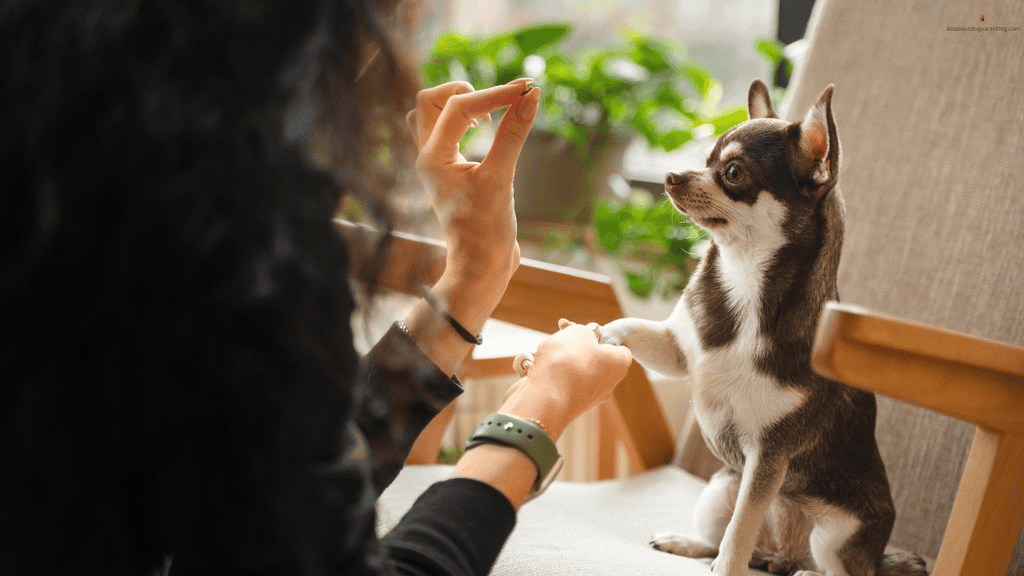
Keep sessions to 5–10 minutes, two or three times a day. Researchers comparing training schedules in dogs found that shorter sessions led to faster learning than longer, back-to-back ones, and my own puppy’s attention reliably started drifting around minute eight. For puppy treat training, build a simple hierarchy: use kibble from the day’s ration for easy things at home, and save better rewards for anything new or anything outdoors.
I trained my GSD entirely with positive reinforcement, and the bond it built is the single best outcome of his puppyhood. When something unsettles him, a strange dog across the road or a truck backfiring, his first move is to look up at my face. Every other technique in this puppy training guide depends on that kind of trust.
The First Week Home: Survival Training
Overview:
Your puppy’s first week home has three jobs: start a potty routine, introduce the crate and build trust. Hold off on formal commands for now. A puppy who feels safe will learn everything else faster.
What does a realistic puppy first week home look like? Repetitive, a bit damp, and shorter on sleep than anyone warned you. Stick to three jobs.
Potty routine, from the first hour
Take your puppy out every 30–60 minutes while they’re awake, straight after every nap, and 15–20 minutes after every meal. An 8-week-old can hold their bladder for one to two hours at rest, and far less mid-play. Reward every outdoor pee with a calm “Yes!” and a treat. Clean indoor accidents silently with an enzymatic cleaner, since leftover scent invites a repeat visit. My guide on how to potty train a puppy has the day-by-day plan, and how long puppies can hold their pee explains the bladder timeline by month.
A crate that feels like a den
Pick one your puppy can stand, turn, and lie down in, and no bigger. Most puppies won’t soil the place they sleep, so a snug crate quietly teaches bladder control during every nap. Feed meals inside it, leave the door open during the day, and keep it off-limits as a punishment spot forever. You find the full process lives in crate training a puppy.
Getting through the first night
Your puppy left their mother and littermates that morning, and the crying you’ll hear at midnight is grief. I kept the crate beside my bed, set a 2 a.m. potty alarm, and made that trip as boring as possible: out, pee, praise, back in, lights off. Most puppies settle within three to five nights. Read what to expect on your puppy’s first night home before pickup day.
House-Training: The Complete Overview
Overview:
House-training is mostly about schedule and a little supervision. Feed at fixed times, go out after every trigger, reward every outdoor success, and crate your puppy when you can’t watch them. Most puppies are reliable by six months.
There’s one sentence I end up repeating to every friend who brings home a puppy: an accident means someone missed a window. If your 3-month-old pees on the rug, their bladder was full, and nobody got them outside in time. Irritating to hear at 7 a.m. with a wet sock, but also good news, because the schedule is the one part of house training puppy life you fully control.
Puppies usually need to go 15–20 minutes after eating, so a fixed feeding routine hands you a predictable potty routine for free. My puppy feeding schedule by age sets out how many meals to give at each stage and when to drop one. After that, most owners find these intervals a sensible starting point:
- 8–12 weeks: every 1–2 hours while awake
- 3–4 months: every 2–4 hours
- 5–6 months: every 3–5 hours
- 6 months and older: every 4–6 hours
The puppy potty training schedule turns those into clock times for the fridge.
Potty training puppy setbacks are normal, but weeks of accidents despite a solid routine deserve a closer look. Urinary tract infections, excitement peeing, and a refusal to step onto wet grass are the usual suspects. Rule out the medical side with your vet first, then work through the rest with how to stop a puppy from peeing inside.
Living in a flat changes the logistics while the principle stays the same. Pee pads, a grass tray or a balcony station all work if you pick one spot and treat it like a patch of garden, with the same cue word and reward. Apartment puppy potty training compares the setups, including the ones I’d skip.
Essential Commands: The 6 Your Puppy Needs First
Overview:
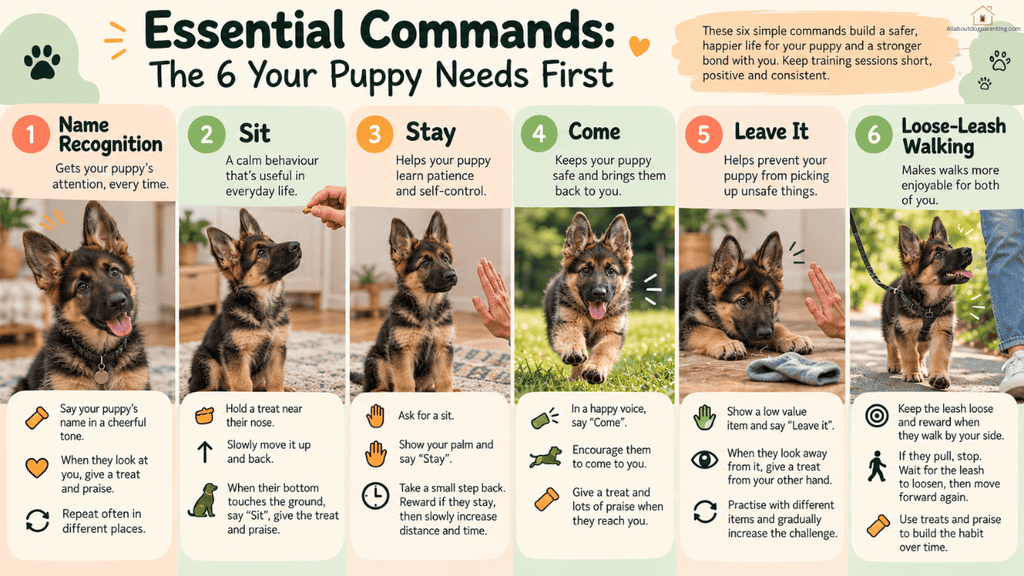
Teach six commands in this order: name recognition, sit, stay, come, leave it, and loose-leash walking. Each one builds on the last. A puppy who knows all six can handle most everyday situations safely.
A big part of how to train a puppy is sequencing. These six puppy commands build on each other, so the order matters.
How do you teach a puppy their name?
Say it once, and the instant your puppy glances at you, mark with “Yes!” and reward. Aim for twenty quick repetitions a day. Protect the name. If you use it while scolding and chatting, it stops meaning “look at me.” More in: how to teach a puppy their name.
How do you teach sit?
With a lure. Draw a treat from your puppy’s nose up and back over their head, and the bottom drops as the head tilts up. Once it’s reliable, say “Sit” just before the hand movement. The step owners rush is fading the treat out of your hand, which is how to teach a puppy to sit and walk through slowly.
What about stay?
Stay is impulse control, so it gets built in tiny increments. Ask for a sit, show an open palm, say “Stay,” wait a single second, then mark and reward. From there, you stretch it to three seconds, five, ten, thirty. Add distance or duration, never both in the same session. The full progression is in how to teach a puppy to stay.
Why does recall matter so much?
It’s the command most likely to save your puppy’s life one day. Puppy recall has one rule: “Come” must always mean something good, so never use it for a bath or a nail trim. Start indoors or on a long line, call in your happiest voice, and celebrate every arrival. Puppy recall training takes you from the living room to the park.
Leave it and drop it: what’s the difference?
“Leave it” means don’t touch that thing on the ground. “Drop it” means let go of whatever is already in your mouth. You’ll use both on chicken bones outside the dhaba, a painkiller rolling off the kitchen counter and, inevitably, poop. Here’s how to teach ‘leave it’ and ‘drop it’ using trades, so giving something up always pays better than keeping it.
How do you start loose-leash walking?
Forget a formal heel; that’s for the show ring. Reward every moment the leash hangs in a relaxed J-shape, stop dead when it goes tight, and move off once your puppy comes back. It’s tedious for two weeks, then it clicks. Leash training a puppy has the full progression.
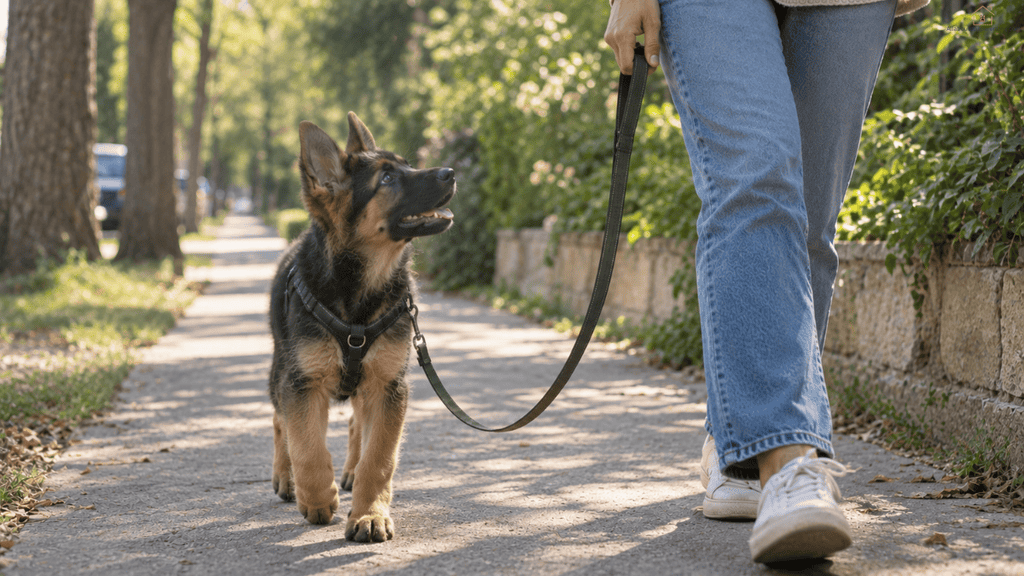
I taught my GSD these six in roughly this order during his first eight weeks home. Name came first, because none of the others work if you can’t get your puppy’s attention. Recall came before leash walking, because I needed an emergency brake long before I needed polished heel work.
Socialisation: The Window You Can’t Reopen
Overview:
The critical socialisation window closes at around 14–16 weeks. Positive experiences during this period shape your puppy’s adult temperament. Anything they miss can turn into a lifelong fear, so plan this stretch deliberately.
Between roughly 3 and 16 weeks, your puppy’s brain is busy filing everything it meets under “safe” or “scary,” and it does that filing through experience. The American Veterinary Society of Animal Behavior’s position statement on puppy socialisation calls the first three months the most important period for it, and points out that behaviour problems kill more dogs under three than infectious disease does.
That’s why AVSAB supports puppy classes from 7–8 weeks, provided your puppy had a first set of vaccines at least a week before. If you act on only one section of this puppy training guide, make it this one.
Ten calm meetings with strangers will do far more than a hundred overwhelming ones, so aim for variety and good feelings. Across those weeks, your puppy should meet:
- People: men, women, children, and people in hats, sunglasses, helmets and uniforms
- Dogs: calm, vaccinated adult dogs you know (dog parks can wait until vaccinations are done)
- Surfaces: grass, concrete, metal grates, tiles, carpet, a wobbly cushion
- Sounds: the pressure cooker whistle, the doorbell, traffic, and firecracker or thunder recordings played softly at first
- Places: car rides, pet stores, friends’ homes, outdoor cafés
Watch your puppy’s body more closely than the checklist. A tucked tail or a puppy backing away means you’ve gone too close too fast, so add distance and let them watch.
A good puppy class, force-free with small groups and clear vaccination rules, is the best money you’ll spend in these months. My puppy socialisation guide covers the when, where and how of puppy socialisation, and the puppy socialisation checklist of 100 experiences before 16 weeks gives you a printable list to tick off.
My GSD was wary of strangers from the start, which is typical of the breed, so weeks 8 to 14 were the most deliberate stretch of his whole puppyhood. I planned two or three pleasant encounters with new people every single day, like the neighbour’s son who sat on the steps and ignored him until curiosity won. Today he greets visitors politely and goes back to his mat, and I credit those six weeks more than any command I ever taught him.
Behaviour Problems: The Big 5 (And How to Fix Them)
Overview:
The five most common puppy behaviour problems are biting, jumping, barking, chewing and separation anxiety. All five are normal puppy behaviours. Punishment tends to make them worse, while redirecting them into acceptable outlets works.
Most puppies do at least three of these, usually in the same week. The puppy training tips below won’t fix them overnight, but they’ll stop you from making puppy behaviour worse by accident, which is half the job.
Why does my puppy bite so much?
Their mouth is the only pair of hands they have. Puppy biting is play, and the lesson here is bite inhibition, learning how gently to use those jaws on people. When teeth hit skin, say “ouch,” pause the game, then offer a chew toy and praise them for taking it. For six weeks, my GSD left my forearms looking like I’d lost an argument with a rose bush. The full method is in how to stop a puppy from biting and nipping.
How do I stop the jumping?
Jumping is your puppy trying to reach your face, and pushing them down reads as a game. Turn away, fold your arms, and reward the second all four paws land. Training your visitors to do the same is the hard half, which our guide on how to stop a puppy from jumping on people tackles directly.
What about barking?
Start with the reason. Attention barking fades once it stops working, so reward the first pause. Boredom barking means your puppy needs more to do. Alert barking gets a quick acknowledgement, a redirect, and a reward for quiet. Puppy barking: why they do it and how to manage it breaks each type down properly.
Chewing everything
Teething between 3 and 6 months hurts, and chewing soothes it. Keep a chew in each room, swap the chair leg for a toy the moment you catch them, and pick your shoes up, because a shoe left within reach is your mistake. My guide to puppy chewing everything covers redirection and puppy-proofing.
Separation anxiety
Some whining when you leave is normal. True puppy separation anxiety means panic, destruction or house-soiling every time you go out, and needs gradual desensitisation and sometimes a professional. Prevention is easier: from week one, step out of the room for 30 seconds, come back without ceremony, and lengthen the gaps slowly. Puppy separation anxiety: prevention and solutions goes deeper.
And the hyper puppy
A puppy tearing around the living room at 8 p.m. usually needs sleep. Overtired puppies get wired, like toddlers, and more fetch only winds them up. A crate nap or ten minutes of sniffing games settles them faster. How to calm a hyper puppy lays out energy management by age.
Crate Training and Sleep
Overview:
A well-introduced crate becomes your puppy’s den, a house-training aid and a safe spot when you can’t supervise. Done right, it’s where your puppy chooses to rest. Aim for a crate-comfortable puppy by week two.
Crate training almost always goes wrong at the same point: the owner closes the door too early. Spend the first few days making the crate the best spot in the house: meals inside, treats tossed in, door open. Then build closed-door time in small steps, from one minute to five, fifteen, thirty and eventually an hour.
For the first two to four weeks, keep the crate in your bedroom at night. Puppies can hold on for roughly one hour per month of age, so keep the night-time potty alarm until they last through. Puppy night crying past the first week usually has a fixable cause: a full bladder, a crate too far from you, or too much excitement before bed. Puppy crying at night works through each cause.
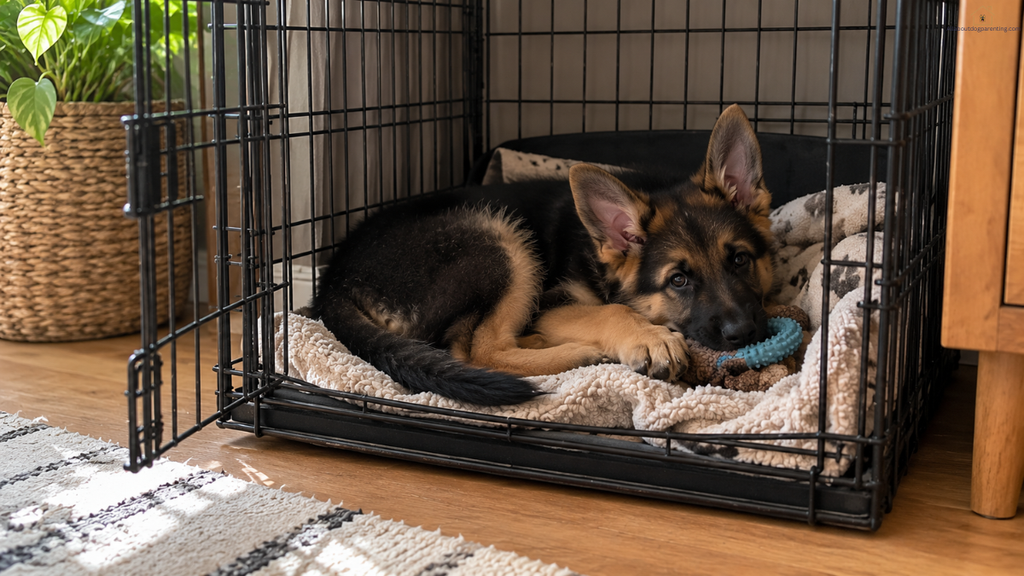
Puppy sleep catches most new owners off guard. An 8-week-old needs 18–20 hours a day, dropping gradually to 14–16 hours by six months. A lot of “bad behaviour” at this age is plain tiredness. My puppy sleep schedule maps out how much your puppy needs at each age, with sample nap routines.
My GSD’s crate became his favourite spot within ten days, and he still naps in it with the door wide open. Every crate experience came with a stuffed Kong, a meal or some quiet time with me sitting nearby.
The Week-by-Week Training Plan (Overview)
Overview:
Weeks 1–2 home cover survival skills, weeks 3–6 add basic commands, months 2–4 build behaviour management, and months 4–12 bring reliability. Build skills in layers instead of teaching everything at once.
This is the section I’d bookmark. A realistic puppy training schedule layers skills over months, and puppy training for beginners feels far lighter once you stop worrying about month four in week one.
Weeks 1–2 home: Survival
Get the potty routine running, introduce the crate, start bite inhibition work and name training, and take your puppy somewhere new every day, carried if vaccinations aren’t finished.
Weeks 3–6 home: Foundation
Introduce sit, stay and come. Start leash training in the garden or a quiet lane, add leave it and drop it, step socialisation up to two or three new experiences a day, and join a puppy class if you can find a good one.
Months 2–4: Building
Take every command somewhere new and add distractions slowly. Move leash manners onto real walks, stretch alone time bit by bit, and stay on top of jumping and barking.
Months 4–12: Refining
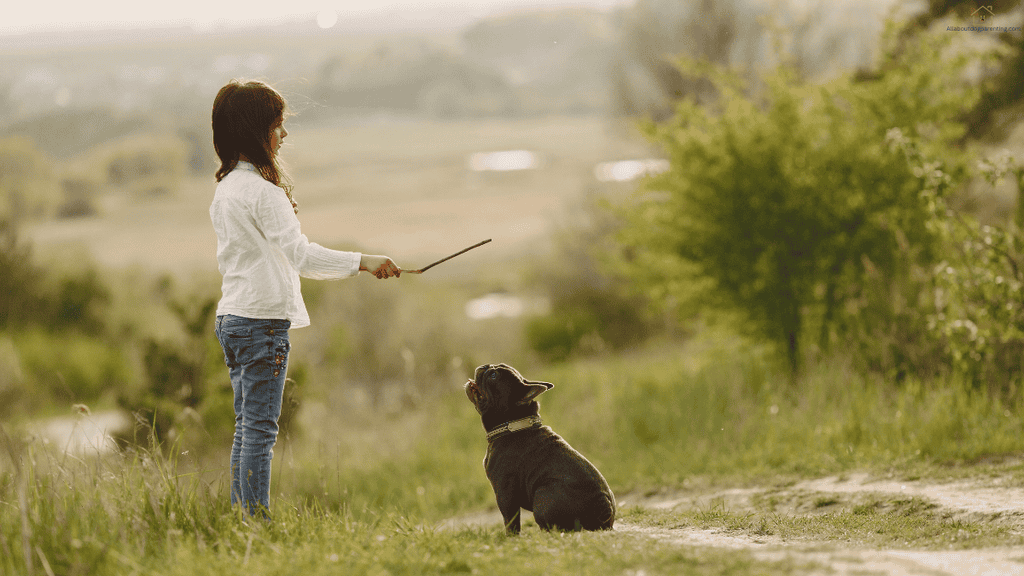
Aim for commands that hold up around moderate distractions, recall solid enough for off-leash time in safe, fenced spaces, and daily practice that keeps everything sharp.
A warning about that last stage: around 6–8 months, your well-trained puppy may act as though “sit” is a foreign word. It’s a documented phase. Researchers following young guide dogs found they responded less reliably to “sit” at eight months than at five, but only when the cue came from their own carer. Stay calm, stay consistent, and wait it out.
For the day-by-day version, see the puppy training schedule: week-by-week plan for the first 3 months, and download the printable puppy training checklist by age to track progress. Of all the puppy training tips I could give you, keeping a simple log is the one I wish I’d followed from day one.
Breed-Specific Training Considerations
Overview:
Every puppy needs the same foundations, but breed shapes how you teach them. Herding breeds need structure and mental work, retrievers need food-drive management, and flat-faced breeds need shorter, cooler sessions.
The foundations in this puppy training guide apply to every puppy, whatever their pedigree. What changes with breed is the delivery.
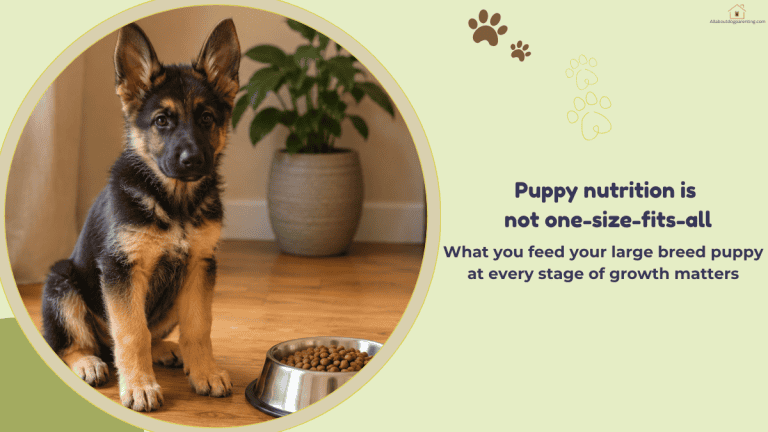
German Shepherds learn fast, bring a lot of drive, and need consistent structure. They’re mouthy, so bite inhibition work matters more than average, and without early socialisation their natural wariness can tip into reactivity. Give them tasks, and expect focus for 10–15 minute sessions. More in German Shepherd puppy training: breed-specific tips.
Labradors are often intensely food-motivated, and there’s genetics behind that. A University of Cambridge-led study found a deletion in the POMC gene linked to higher body weight and stronger food motivation in Labradors, and it turned up more often in Labs chosen as assistance dogs. Treat training comes easily to them, so calorie control is non-negotiable. See Labrador puppy training: managing energy and food drive.
French Bulldogs tend to have shorter attention spans, a stubborn streak, and flat faces that make them overheat quickly. Keep sessions to about five minutes, train somewhere cool, and bring your highest-value treats for the moments they decide they’d rather not. Read French Bulldog puppy training: stubbornness and short sessions.
I don’t believe any of these breeds is smarter than another. They’re motivated by different things. My GSD will work all day for praise and a job. A Lab will work for a single piece of kibble. A Frenchie works for whatever has caught their interest that afternoon. Find what drives your puppy and train through it.
Finding a Trainer (And What to Look For)
Overview:
Choose a trainer who uses reward-based methods only, holds a recognised certification such as CPDT-KA, KPA CTP or IAABC, keeps classes under six puppies and never uses choke, prong or shock collars.
Type “puppy training near me” into Google and you’ll quickly discover that anyone can call themselves a dog trainer. The profession is unregulated in most countries, India included, so certifications are the most reliable filter you have:
- CPDT-KA: Certified Professional Dog Trainer, Knowledge Assessed
- KPA CTP: Karen Pryor Academy Certified Training Partner
- IAABC: International Association of Animal Behavior Consultants
Walk away from anyone who talks about “dominance” or “alpha,” uses choke, prong or shock collars, guarantees results, or won’t let you watch a class before enrolling. AVSAB’s guidance on choosing a trainer runs through similar green and red flags.
Of the best puppy training methods open to you, a well-run group class ranks near the top, combining socialisation and training under someone qualified to spot problems early. No puppy training guide, this one included, can replace a professional watching your puppy in real time. How to choose a puppy trainer lists the questions to ask on your first call, and if classes aren’t practical where you live, my shortlist of the best puppy training books covers the ones I trust for training at home.
The Nutrition-Training Connection
Overview:
What your puppy eats shapes how they train. Fixed meal times create predictable potty times, treats should stay under 10% of daily calories, and regular kibble makes a free, perfectly portioned reward.
I built my nutrition and training articles as companion resources on purpose, and this complete puppy training guide is where the two meet.
A single training session can use anywhere from 30 to 100 rewards. At 3–5 calories each, that adds up quickly, especially for a small breed puppy. I use kibble from the day’s ration for easy work indoors and save high-value rewards, like tiny pieces of boiled chicken or freeze-dried liver, for new skills and distracting places. My guide to the best puppy treats for training covers my picks and a simple way to stay inside the 10% treat limit.
Water works the same way as food: when your puppy drinks decides when they need to pee. Keep fresh water available throughout the day, and ask your vet before changing anything around bedtime. How much water should a puppy drink per day depends on weight and age.
The week I moved my boy’s meals to fixed times was the week his accidents all but stopped. Treat feeding and training as one system and both get easier.
FAQs
1. When should I start training my puppy?
Immediately. If you’re wondering when to start training puppy manners, the answer is the day they come home, even at 8 weeks old. The first lessons are routines: a potty schedule, the crate and early socialisation. Formal commands like sit, stay and come can start in your second week, in five-minute sessions using positive reinforcement.
2. How long should puppy training sessions be?
Five to ten minutes, two or three times a day. Puppies have short attention spans, and short, frequent sessions get better results than long, tiring ones. End every session on a win: ask for something easy your puppy already knows, reward it, and stop while they still want more.
3. What is the first thing I should train my puppy?
House-training and name recognition. Neither is glamorous, but everything else depends on them. A puppy who looks at you when you say their name is ready to learn commands. A puppy who is reliably house-trained frees you to focus on obedience instead of watching the floor all day.
4. Is it too late to train my puppy if they’re already 6 months old?
Not at all. The socialisation window narrows after 16 weeks, but puppy obedience training and behaviour work are effective at any age. A 6-month-old may have a few habits to undo, and they’re also better at focusing and controlling their impulses than an 8-week-old. Start where you are, with the same reward-based methods.
5. Should I use treats or praise to train my puppy?
Both, in layers. Start with treats, since they motivate most puppies more than anything else, and pair every treat with praise like “Yes! Good dog!” Over time, reduce how often the treats appear while keeping the praise. Eventually, you reward unpredictably, known as variable reinforcement, which tends to keep behaviours stronger than rewarding every single time.
Bottom Line
If you’ve read this far with a puppy asleep on your feet, you already know more than I did the first time around. Pick the section that matches the week you’re in, open the linked guide, and ignore the rest for now. Training a puppy is a year of small, repetitive wins, and a dog who trusts you and settles when you ask is worth every 2 a.m. potty trip. When a new problem shows up, and it will, come back to the relevant section.