How to Transition Puppy Food: The Safe 10-Day Plan (With Troubleshooting)
🐾 Overview
Mix increasing amounts of new food with decreasing amounts of old food over 10 days: 20% new on days 1–2, 40% on days 3–4, 60% on days 5–6, 80% on days 7–8, and 100% from day 9. If digestive issues appear, hold at the current ratio for 2 extra days before moving forward.
How to transition puppy food correctly is one of the endless pet parenting decisions that you don’t really give much thought to before deciding you want to bring home a furry baby. But then, if you go ahead and swap out the food they’ve been on instantly, it becomes clear how crucial these seemingly infinitesimal choices are.
Whether you’re switching from the breeder’s food in week one of your puppy’s arrival home, moving between brands on your vet’s recommendation, or making the puppy-to-adult food change, the process is the same every time. Skip it and you’re almost guaranteed loose stools, a puppy who won’t touch the new bowl, and a stressful few days that were entirely avoidable.
This article, part of our Complete Guide to Puppy Nutrition, covers the mechanical how: the day-by-day plan, exactly what to watch for at each stage, and what to do when things go sideways.
Why You Can’t Just Switch Foods Overnight
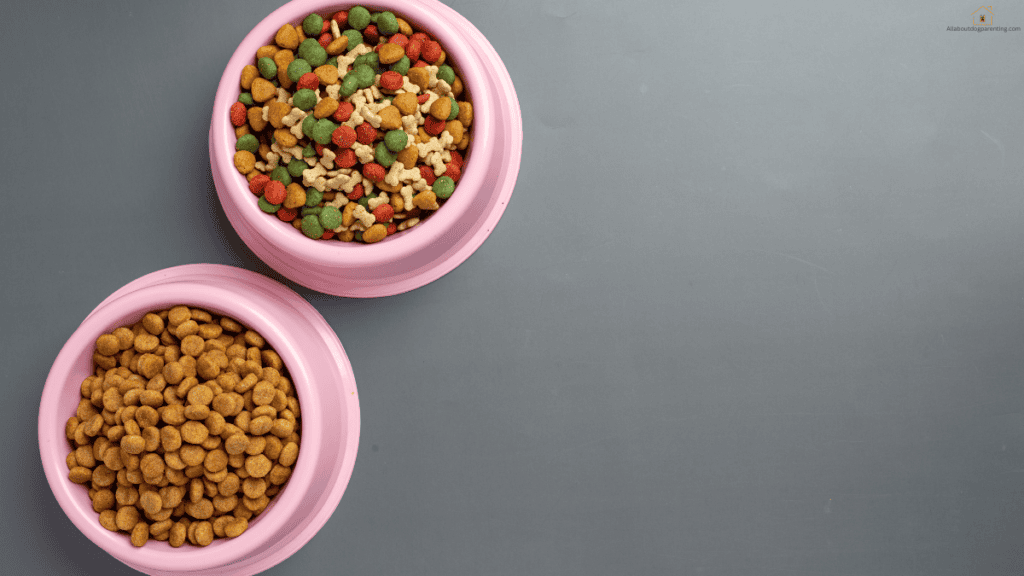
You cannot change puppy food overnight simply because their gut bacteria need time to adjust to new ingredients, protein sources, and fibre levels. Switching abruptly causes diarrhoea, vomiting, gas, and food refusal. The digestive system simply hasn’t had time to prepare for the change.
Your puppy’s gut contains billions of bacteria specifically adapted to whatever they’ve been eating. New food brings different protein sources, fat profiles, and fibre types that require different bacterial populations to digest. A gradual switch gives the gut time to build those populations before the old food disappears entirely. That’s why I felt the need to put together this guide on how to transition puppy food.
This applies to every food change. Brand switches, formula changes, even same-brand flavour changes can cause digestive upset if done cold. That’s why the puppy food transition plan needs steady phasing out of existing food and introduction of new. While most guides recommend making this transition over 7 days, I prefer a slower 10-day plan because it offers more margin for adjustment. Each ratio stage lasts 2 full days, giving you 48 hours to observe your puppy’s response before increasing the new food proportion. With a 7-day plan, you’re often advancing before you’re sure the previous stage has settled.
The 10-Day Transition Plan (Step-by-Step)
Over 10 days, gradually increase the proportion of new food while decreasing the old: 20/80 for days 1 and 2, 40/60 for days 3 and 4, 60/40 for days 5 and 6, 80/20 for days 7 and 8, and 100% new food from day 9 onward. Firm stools at each stage mean you can proceed. Here is how to transition puppy food over 10 days:
| Day | Old Food | New Food | What to Watch | If Problems Appear |
|---|---|---|---|---|
| Day 1 | 80% | 20% | Stool consistency, appetite, energy | Normal stools: proceed to Day 2 |
| Day 2 | 80% | 20% | Second day confirms tolerance | Soft stools: hold at 80/20 for 2 extra days |
| Day 3 | 60% | 40% | Slight softening is normal | Watery diarrhoea: return to 80/20 for 2 days |
| Day 4 | 60% | 40% | Is puppy eating the full bowl? | Refusing food: try warming slightly or adding broth |
| Day 5 | 40% | 60% | Stools should be stabilising | Persistent soft stools: hold at 60/40 for 2 extra days |
| Day 6 | 40% | 60% | Energy levels, coat condition | Vomiting: stop, return to old food, call vet |
| Day 7 | 20% | 80% | Stools should be near-normal | Mild softness still acceptable: continue |
| Day 8 | 20% | 80% | Final hold before full switch | Any concerns: hold here 2 extra days |
| Day 9 | 0% | 100% | First day on full new food | Monitor closely |
| Day 10 | 0% | 100% | Confirm firm stools, normal appetite | Transition complete: monitor 3 to 5 more days |
Worked example with real cup measurements
Say your puppy eats 1.5 cups per meal, twice daily. Here’s what each stage looks like in the bowl:
| Stage | Old Food | New Food | Total |
|---|---|---|---|
| Day 1 to 2 | 1¼ cups | ¼ cup | 1.5 cups |
| Day 3 to 4 | 1 cup | ½ cup | 1.5 cups |
| Day 5 to 6 | ⅔ cup | ⅚ cup | 1.5 cups |
| Day 7 to 8 | ¼ cup | 1¼ cups | 1.5 cups |
| Day 9 to 10 | 0 | 1.5 cups | 1.5 cups |
Mix the two foods together thoroughly rather than placing them on separate sides of the bowl. A puppy that can pick out the familiar food will do exactly that, which drags the transition out and defeats the gradual change entirely. Keeping the mix consistent also makes it easier to maintain a stable feeding schedule throughout.
The Extended 14-Day Plan for Sensitive Puppies
Puppies with sensitive stomachs, toy breeds, or puppies switching between very different food types may need a 14-day transition. The principle is identical to the 10-day plan. Each ratio stage just stretches to 3 days instead of 2. This is what a more comprehensive 14-day plan on how to transition puppy food looks like:
| Days | Old Food | New Food | Notes |
|---|---|---|---|
| Day 1 to 3 | 80% | 20% | Extra time at the lowest ratio |
| Day 4 to 6 | 65% | 35% | Increase gently, watch stools |
| Day 7 to 9 | 50% | 50% | Midpoint: most issues surface here |
| Day 10 to 12 | 30% | 70% | Nearly there |
| Day 13 to 14 | 0% | 100% | Full switch: monitor for one more week |
Use the 14-day plan when your puppy has a breed predisposition to digestive sensitivity. French Bulldogs, Boxers, and German Shepherds all fall into this category. It also applies to puppies under 12 weeks, puppies switching between very different food types such as chicken-based to fish-based or kibble to fresh food, and any puppy with a history of digestive issues or food sensitivities flagged by your vet.
German Shepherds are genuinely prone to sensitive stomachs, and this is a documented physiological trait rather than a breed stereotype. When I moved my GSD from puppy food to adult food at around 13 months, I went with the standard 10-day plan, with the 14-day version ready as a backup. I watched his stools closely at every stage, prepared to hold a ratio for a few extra days at the first sign of softness, but I didn’t need to. He finished the full switch on schedule without a single digestive issue. Not every GSD is that lucky, though, so if your puppy has a history of tummy trouble, start with the 14-day plan rather than waiting for problems to tell you to slow down.
The Emergency Fast Transition (When You Have No Choice)
Sometimes switching puppy food gradually simply isn’t an option. Food gets recalled. Your usual brand goes out of stock. Your vet says change today. In situations like these, where you must switch food immediately due to a recall, sudden allergy, or running out of old food, feed smaller portions of the new food for 2 to 3 days and gradually increase to normal amounts. Expect some digestive upset. A canine probiotic helps considerably. Here’s how to switch dog food when the standard 10-day plan isn’t available:
- Feed 50 to 60% of the normal portion size for the first 2 days. Smaller meals reduce the digestive load significantly.
- Increase to 75% of normal portions on days 3 and 4
- Then move to full portions from day 5 onward.
- Add a canine probiotic such as Purina FortiFlora for the first 7 to 10 days to support gut bacteria adjustment
- Expect soft stools for 2 to 4 days
- A tablespoon of plain canned pumpkin mixed into each meal helps firm things up in the meantime
The lesson: manage your expectations during a forced switch, protect the gut where you can, and treat the digestive response as a normal outcome rather than a sign something has gone seriously wrong.
Special Transition: Wet Food to Dry or Dry to Wet
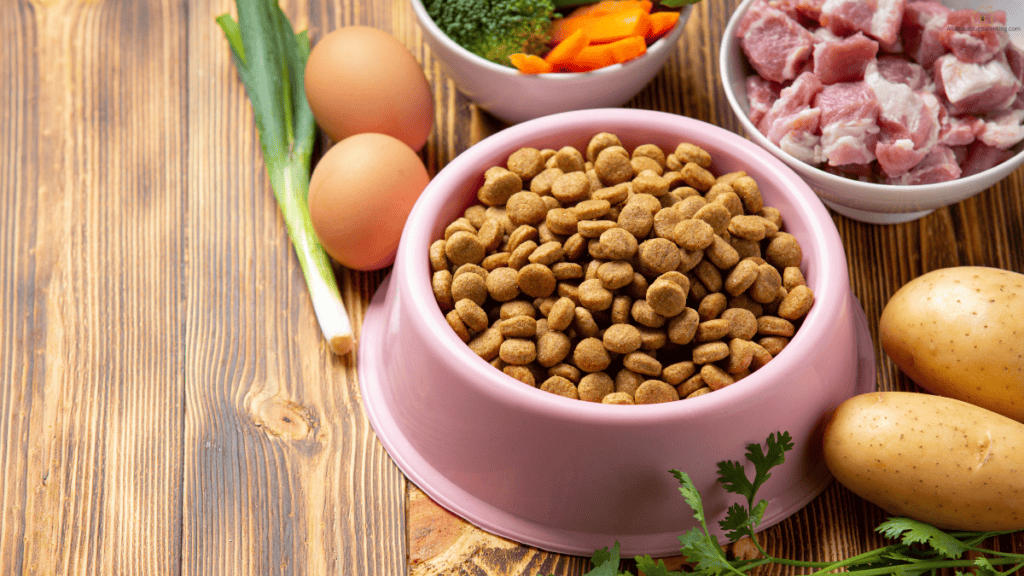
The switch isn’t always between two different varieties of kibble. You may want to move your puppy to a new food category altogether, going from dry to wet or vice versa. If you’re still deciding, our comparison of wet vs dry puppy food breaks down the pros and cons. This also includes moving from packaged to homemade foods.
Transitioning between wet and dry food follows the same gradual mixing principle, but texture differences mean some puppies resist the change. Reduce added moisture gradually when moving to dry kibble, or mix increasing amounts of kibble into wet food when going the other direction. Here is how to transition puppy food from wet to dry or vice versa:
Wet or softened kibble to dry
Many puppies start on kibble soaked in warm water, particularly between 6 and 10 weeks when very dry food is hard for small mouths and developing teeth. Moving to fully dry kibble should be gradual over 10 days
- Days 1 to 3: soak as usual
- Days 4 to 6: use half the usual water
- Days 7 to 8: just a small splash
- Days 9 to 10: fully dry
Some puppies resist the texture change at first. Don’t give in and re-soak permanently. Most accept dry kibble within 3 to 4 days. Monitor water intake once fully on dry food, as hydration needs increase slightly without the moisture from softened kibble.
Dry to wet
Mix increasing amounts of wet food into the kibble bowl following the standard 10-day ratio. The critical detail is calorie density. One cup of wet food does not represent the same caloric contribution as one cup of dry kibble. Check both labels, calculate what each component contributes to daily calories, and keep the total consistent. Our guide on how much to feed a puppy explains exactly how to calculate portions from calorie density.
Combination feeding permanently
Many owners settle on a long-term wet-plus-dry setup, and it works well. A common approach is 75% of daily calories from kibble and 25% from wet food, served mixed together in the same bowl rather than in separate meals. Whatever ratio you settle on, keep it consistent so the gut can fully adapt.
What’s Normal and What’s Not: The Stool Guide
Slightly softer stools during the first 3 to 5 days of a food transition are normal and expected when you change puppy food. Watery diarrhoea, blood in stool, or vomiting persisting beyond 24 hours is not normal. Pause the transition or contact your vet. Nobody warns you about the poop-monitoring phase of puppy ownership. During a food transition, checking stools is genuinely your best diagnostic tool. Here’s a plain-language guide of markers to pay attention to when you transition puppy to new food:
| What You See | What It Means | What to Do |
|---|---|---|
| Firm, well-formed stools | Transition going well | Proceed to next stage on schedule |
| Slightly softer than usual | Normal during transition | Continue current ratio, monitor for 48 hours |
| Consistently soft or mushy for 2 or more days | Transition moving too fast | Go back one stage, hold for 2 to 3 extra days |
| Watery diarrhoea | Digestive system overwhelmed | Return to 100% old food for 2 days, restart slower |
| Blood or mucus in stool | Possible sensitivity or irritation | Stop transition immediately, contact vet |
| Vomiting after meals | Possible intolerance to new food | Stop, return to old food, consult vet |
| Puppy refusing food entirely | Dislikes taste or texture, or feeling unwell | Try warming food, adding broth. If refusal exceeds 24 hours, call vet |
The most important distinction is between slightly softer stools, which is a normal transition symptom in the first few days, and watery diarrhoea, which signals the pace is too fast. When you’re unsure which category applies, slow down. Two extra days at a midpoint ratio costs nothing. Pushing through genuine digestive distress sets the whole transition back further.
Your Puppy’s First Food Transition: Breeder Food to Your Chosen Food
When you bring a new puppy home, keep feeding the breeder’s food for at least 2 weeks before starting any transition. Your puppy is already adjusting to a new home, new people, and new routines. Adding a food change on top of that stress compounds the risk of digestive upset considerably.
This is the first food transition every puppy owner faces, and it’s the one nobody prepares you for. Most people arrive home with a new puppy, a bag of food they’ve carefully researched, and the completely reasonable desire to start using it immediately. The breeder food switch should wait.
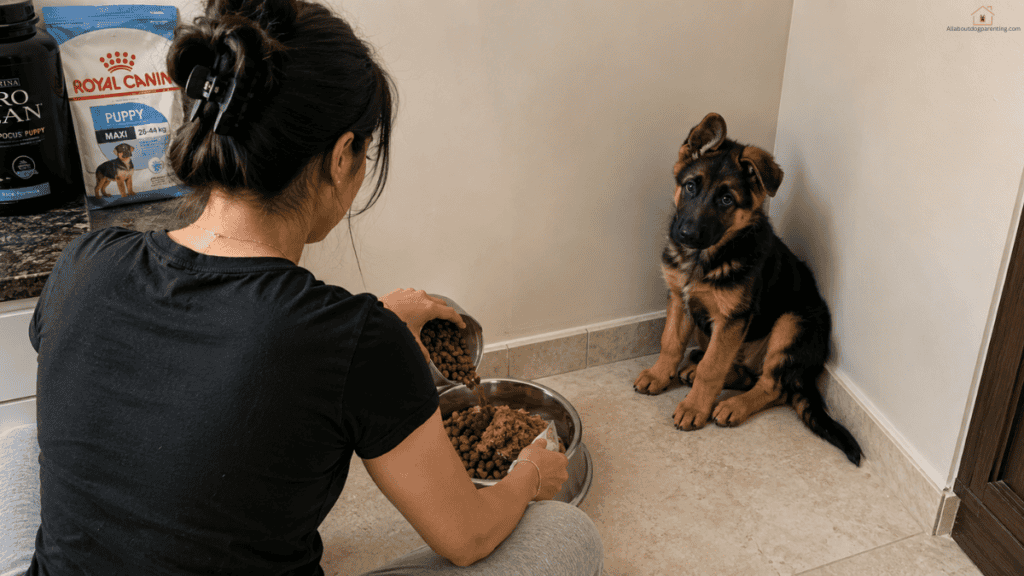
Ask your breeder for a 1 to 2 week supply of whatever the puppy has been eating, or at minimum, the exact brand name and formula so you can source it yourself. Feed it exclusively for the first 2 weeks while your puppy settles in. After that settling period, begin the standard 10-day puppy food transition plan to your chosen food. Your puppy won’t eat your preferred food until roughly weeks 3 to 4 in your home. That delay is worth it.
If the breeder’s food is one you’re happy to continue, the decision is even simpler. No need to figure out how to switch dog food at this stage at all.
My breeder gave me a generous zip-lock bag of their food when I collected my GSD. I’ve since learned to always ask for this up front when getting a puppy. Those first two weeks were stressful enough without adding stomach problems. The food transition came later, once he’d settled, and went smoothly as a result.
FAQs
1. How long does it take to transition puppy food?
A standard transition takes 10 days. Puppies with sensitive stomachs, very young puppies, or those switching between very different food types may need 14 days. Stool consistency is your guide throughout. Firm stools at each stage mean you can proceed. Softening at any point means hold where you are and give it 2 extra days.
2. Can I mix two different brands of puppy food?
Yes, during the transition period. Mixing is exactly how a gradual switch works. Once complete, feed one food consistently. Long-term mixing of different brands at every meal makes it harder to identify food sensitivities if they develop, because you can’t isolate which ingredient is causing the reaction.
3. My puppy won’t eat the new food. What should I do?
Warm the food for about 10 seconds in the microwave to release its aroma. Dogs respond to scent before anything else, and warming amplifies it. A small splash of low-sodium chicken broth added to the bowl often works well. If refusal continues beyond 2 days, the formula may contain a protein source or flavour your puppy genuinely dislikes. Try a different formula rather than forcing the issue.
4. Should I add pumpkin during a food transition?
A tablespoon of plain canned pumpkin, not pumpkin pie filling which contains sugar and spices, helps firm up soft stools during a transition. It’s safe, inexpensive, and vet-approved as a short-term aid. Use it as a temporary measure. If stools don’t normalise within a week of completing the full switch, the food itself is likely the issue rather than the transition process.
5. Do I need to transition if switching flavours within the same brand?
Yes, different flavours use different protein sources and ingredient profiles, meaning the gut bacteria still need time to adjust even within the same brand. A slightly shorter 7-day transition is usually sufficient for same-brand flavour switches, but skipping the gradual change entirely still risks digestive upset.
The Bottom Line
Switching puppy food safely comes down to giving the gut time to adjust. The 10-day plan does that reliably. The 14-day plan does it more slowly for puppies that need the extra margin. The stool guide tells you in real time whether the pace is right or whether you need to hold back. There’s no transition scenario where the gradual mixing approach doesn’t apply.
The ratios and timelines adjust depending on your puppy’s age, breed, and stomach sensitivity. The underlying logic holds every time. If you’re still working out the right time for your specific breed, our guide on when to switch your puppy to adult food covers breed-size readiness signs in full detail. For portion calculations during and after the transition, our puppy food calculator handles the maths.