Puppy Weight Chart by Age: How Much Should Your Puppy Weigh?
🐾 Overview
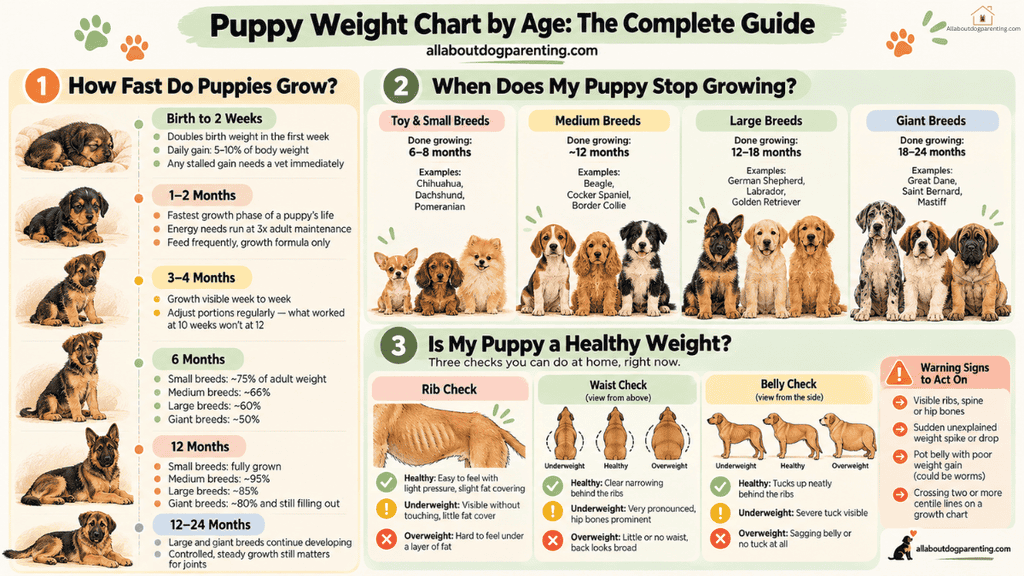
Puppies double their birth weight in about a week and grow fastest in the first two months. Small breeds reach adult weight by 6 to 8 months; large and giant breeds keep growing until 12 to 24 months.
One of the first things new puppy owners do after the initial excitement settles is start quietly worrying. Is my puppy too small? Too heavy? Growing too fast? Not fast enough? I’ve been through this cycle with the first couple of pups I’ve raised, and I can tell you, the anxiety is universal. While worrying is part of the pet parenting journey, the right context about what to expect at different stages of your puppy’s growth can help ease some of those worries. Something as basic as a puppy weight chart by age can go a long way in providing that context.
Puppy weight changes rapidly in the first year and varies enormously with breed size. A healthy eight-week-old Chihuahua and a healthy eight-week-old Saint Bernard have almost nothing in common on a scale. Understanding a puppy weight chart by age won’t just put your mind at ease. It will also help you catch genuine problems early, feed your puppy appropriately, and make better decisions about their care throughout that first critical year.
Puppy Weight Chart by Age at a Glance
🐾 Overview
Puppies double their birth weight in about a week, grow fastest in the first two months, and slow from there. Small breeds are close to adult weight by a year; large and giant breeds keep going.
| Age | What’s Happening | Why It Matters |
|---|---|---|
| 0 to 2 weeks | Puppies should double their birth weight in about a week and gain weight every day | Any weight loss or stalled gain in a newborn needs a vet straight away |
| 1 to 2 months | The fastest growth relative to body size; energy needs run at about three times adult maintenance | Frequent meals of a growth formula are essential |
| 3 to 4 months | Growth is visible week to week but beginning to slow | Portions need regular adjusting as weight climbs |
| 6 months | Small breeds are at about 75% of adult weight; large breeds about 60%, giant breeds about 50% | Small breeds are nearly done; large and giant breeds are still growing fast |
| 12 months | Small breeds are at full weight, medium breeds about 95%, large breeds about 85% | Time to plan the switch to adult food for smaller dogs |
| 12 to 24 months | Large and giant breeds keep filling out | Controlled, steady growth still matters for joints |
The percentages of adult size come from the AKC’s approximate figures, covered in more detail in the milestones section below.
Why Puppy Weight Changes So Quickly
🐾 Overview
Puppies build bone, muscle and organs from scratch, so their energy needs are far higher than an adult’s. Breed size and genetics then decide how fast that growth runs and when it stops.
Here’s why puppy weight by age changes so quickly in the first few months.
Early development
According to VCA Animal Hospitals, a healthy newborn should double their birth weight in about a week and gain around 5 to 10% of their body weight daily, and lagging gain warrants an immediate vet check. This stretch of the puppy growth timeline has no equivalent later in life, as the body builds bones, organs, muscle and the nervous system all at once.

Breed size differences
When you’re trying to work out “How much should my puppy weigh?”, breed size becomes the single most defining factor. Adult body weight varies around 100-fold across breeds, and a study comparing the growth curves of 12 breeds found that larger breeds take longer to finish growing. Comparing a Dachshund and a Great Dane on the same chart makes as much sense as using one growth curve for a newborn human and a baby elephant.
Metabolism and energy needs
The same study notes that a puppy’s energy needs fall from about three times adult maintenance at weaning to about 1.2 times near adulthood, which is why young puppies need frequent meals of calorie-dense puppy food.
Genetics
Your puppy’s genetic blueprint sets the ceiling. For purebreds, the AKC notes that a breeder can estimate adult size from the puppy’s relatives, while mixed breeds are much harder to predict.
Puppy Weight by Breed Size
🐾 Overview
Breed size decides how much your puppy should weigh and how long they’ll keep growing. Small breeds finish around 6 to 8 months; giant breeds can keep filling out until 24 months.
Breed size is the single biggest factor in how much your puppy should weigh and how long they’ll keep growing. According to the AKC and Purina, small breeds typically stop growing by 6 to 8 months, medium breeds by around 12 months, and large and giant breeds anywhere between 12 and 24 months. That’s why no single puppy weight chart by age can give exact numbers for every dog. My GSDs went through stretches of growth so fast I could practically watch them change week to week, and they were still filling out well past their first birthday.

For exact week-by-week weight ranges for your specific breed, see our full puppy weight chart by breed, which breaks down expected ranges for over 30 breeds across five size categories. And for a closer look at how quickly that growth happens, our guide on how fast puppies grow breaks it down month by month.
Average Puppy Weight Milestones
🐾 Overview
Use these puppy weight milestones as a rough sense of progress: arrival at 8 weeks, visible weekly growth at 3 months, a big size split at 6 months, and near-adult weight for most dogs by a year.
These are rough milestones on the puppy growth timeline, for a general sense of progress. For exact ranges by breed, use the breed-specific chart linked above.
At 8 weeks
Eight weeks is when most puppies arrive home, and “How much should my puppy weigh?” is usually the first question owners ask. Weight at this age varies so much by breed that one range means little, so record your puppy’s weight at the first vet visit as a baseline.
At 3 months
By three months, growth is visible week to week, and many puppies look gangly and out of proportion. Portions need frequent adjusting now: an amount that was right at ten weeks can leave a twelve-week-old hungry.
At 6 months
Six months is a meaningful marker. According to the AKC’s approximate figures, small breeds are at about 75% of their adult size, medium breeds about 66%, large breeds about 60%, and giant breeds about half. Exercise still needs care at this stage, since growth plates are still open. Our guide on safe puppy exercise by age covers what’s appropriate and what to avoid.
At 1 year
Small breeds are effectively done, and medium breeds are close at around 95% of adult size. Large breeds are at roughly 85%, and giant breeds about 80%, with several months of filling out still to come. One year is also when many owners start thinking about adult food. For large and giant breeds, timing that switch correctly matters, and our guide on when to switch puppy to adult food covers readiness by breed size.
Signs Your Puppy’s Weight Is Healthy
🐾 Overview
A healthy puppy has ribs you can feel but not see, a visible waist from above, steady energy and a steady upward growth curve. Visible bones, sudden spikes or any weight loss need a vet.
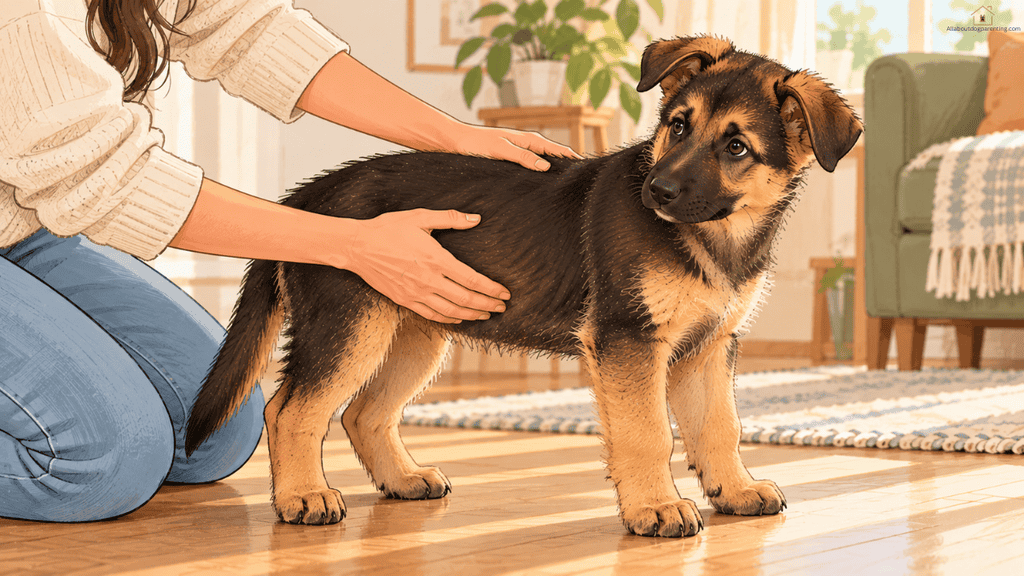
Your puppy weight chart by age only tells half the story; your hands tell the rest. The WSAVA body condition score that vets use comes down to three hands-on checks you can do at home.
| Check | Healthy | Underweight | Overweight |
|---|---|---|---|
| Ribs | Easy to feel with light pressure, with a slight fat covering | Easily visible, with little or no fat covering | Hard to feel under a layer of fat |
| Waist from above | Visible narrowing behind the ribs | Very pronounced, with hip bones prominent | Little or no waist; back looks broad |
| Belly from the side | Tucks up behind the ribs | Severe tuck | Little or no tuck, or a sagging belly |
Warning signs worth acting on
- Visible ribs, spine or hip bones: If you’re asking “is my puppy underweight?”, this is the clearest sign of it.
- A sharp spike in weight: Gradual climbing is healthy growth. A sudden jump warrants a feeding review.
- Any unexplained weight loss: At any age, call your vet straight away.
- Crossing growth-chart lines: On the WALTHAM growth charts, built from data on about 50,000 healthy dogs, a puppy who climbs or drops across two or more centile lines may be becoming overweight or not getting enough nutrition.
- A pot belly with poor weight gain: Roundworms are common in puppies and can cause failure to gain weight and a pot-bellied look, even in a puppy who seems to eat well. This is why routine deworming in the first year isn’t optional.
As for how often to weigh, WALTHAM’s guidance is monthly until six months, then at least every three months until adulthood, using your vet clinic’s calibrated scale. A growth curve built from regular weigh-ins tells you far more than any single number.
What Affects Puppy Weight
🐾 Overview
Breed and genetics set the range for puppy weight by age, and feeding, activity, health and parasites decide whether your puppy grows steadily within it.
| Factor | How It Affects Weight |
|---|---|
| Breed and genetics | The main determinant; parent size is the best practical predictor |
| Food quality and portions | A size-appropriate puppy food at consistent meal times is the baseline; portions need adjusting as your puppy grows |
| Activity level | Appropriate exercise builds muscle; overexertion during growth can strain developing joints |
| Health conditions | Chronic illness, malabsorption and growth plate injuries can all change the growth curve |
| Parasites | Intestinal worms are among the most common and overlooked causes of poor weight gain |
Common Mistakes Puppy Owners Make
🐾 Overview
The most common mistakes are comparing across breeds, overfeeding during growth, switching to adult food too early, ignoring sudden changes, and not adjusting portions as your puppy grows.
To keep your puppy’s growth on track, steer clear of these mistakes:
- Comparing across breed categories: Your neighbour’s Beagle reaching full weight at eleven months tells you nothing about your German Shepherd.
- Overfeeding during growth stages: More food doesn’t mean healthier growth. In large breeds, overnutrition is linked to musculoskeletal disorders, and a lifetime study of Labradors found that dogs kept lean developed arthritis later and lived a median 1.8 years longer. Follow your food’s feeding guide, adjust with your vet’s input, and ignore how much your puppy seems to want.
- Switching to adult food too early: Switching too soon deprives a growing puppy of the calories and nutrient ratios they still need.
- Ignoring sudden weight changes: Gradual, steady gains are normal. A sharp unexplained drop or spike deserves prompt attention.
- Not adjusting portions as your puppy grows: A three-month portion doesn’t suit a six-month puppy. Portions need to rise with growth and come back down as growth slows. Our puppy feeding chart shows how to calculate the right amount at each age.
FAQs
1. How much should a puppy weigh at 8 weeks?
It varies too much by breed for one useful number: a toy puppy and a giant breed puppy can differ more than tenfold at the same age. Check the expected range for your breed in our breed chart, and ask your vet whether your puppy is tracking normally.
2. Do large breed puppies gain weight faster than small breeds?
In pounds per week, yes. Proportionally, though, small breeds grow faster relative to their adult size and finish much sooner. Large and giant breeds grow more slowly in percentage terms but for far longer, often until 12 to 24 months.
3. How can I estimate my puppy’s adult weight?
It depends on breed size, and the rule of thumb changes by category: triple the 8-week weight for toy breeds, double the 12-week weight for small breeds, double the 14-week weight for medium breeds, double the 5-month weight for large breeds, and double the 6-month weight for giant breeds. Treat these as rough estimates. For purebreds, parent size and breed standards are more reliable, and our breed chart has worked examples for each size category.
4. Is my puppy underweight, and what should I do?
If you can easily see ribs, spine or hip bones, probably. Start with a vet visit before changing anything else. Underweight puppies are often dealing with parasites, an underlying illness or an unsuitable diet, problems that more food alone won’t solve. Your vet can assess body condition properly and give you a targeted plan.
5. Can overfeeding affect puppy growth?
Yes, and not in the way most people assume. Overfeeding doesn’t produce a bigger, stronger adult dog. It produces a heavier puppy whose developing bones and joints carry more stress than they should, especially in large breeds. Controlled, steady growth is the goal.
Bottom Line
A puppy weight chart by age is most useful as a frame of reference rather than a rigid standard: a way of seeing whether your puppy’s growth is moving in the right direction at a reasonable pace. Breed size decides almost everything about that curve: how fast, how long and where it ends. Feed for their size, keep regular vet appointments in the first year, watch for sudden changes, and resist benchmarking your puppy against a different breed.