Best Puppy Food for Large Breeds: 6 Vet-Reviewed Picks for 2026
Overview:
The best large-breed puppy foods are AAFCO-certified for “growth of large-sized dogs,” contain controlled calcium between 1.2 and 1.8% dry matter, and come from brands with veterinary nutritionists on staff. Top picks: Purina Pro Plan, Hill’s Science Diet, Royal Canin, Eukanuba, Iams, and The Farmer’s Dog.
Most best puppy food for large breed articles you’ll find online are written by people who earn a commission every time you click buy. PetMD is owned by Chewy. Dog Food Advisor earns affiliate commissions on every product link. The recommendations on almost every page-one result are shaped, at least in part, by which brands pay the best rates.
This article, part of our Complete Guide to Puppy Nutrition, earns nothing from any product on this list. No affiliate links, no brand partnerships. The six foods below were chosen because they meet specific nutritional criteria that every large-breed puppy owner should understand before they buy anything at all.
Why Large-Breed Puppies Need Different Food
Overview:
Large-breed puppies need food with controlled calcium, moderate fat, and a specific calcium-to-phosphorus ratio. Standard puppy food contains too much calcium for large breeds. Excess calcium causes skeletal deformities, hip dysplasia, and osteochondrosis that cannot be reversed once growth is complete.
Most puppy owners don’t know this when looking for the best puppy food large breeds. I didn’t, until I was researching food for my first German Shepherd. Once I understood the calcium problem, I stopped browsing by brand name and started checking percentages.
Here’s the biology in plain language:
Large-breed puppies grow for 15 to 24 months, compared to 7 to 12 months for small breeds. That extended growth window means more time for nutritional errors to compound. During the first six months specifically, puppies cannot regulate calcium absorption. Adults can excrete excess calcium, but puppies absorb essentially everything they eat.
AAFCO sets specific calcium limits for food labelled for large-breed puppy growth: a minimum of 1.2% and a maximum of 1.8% on a dry-matter basis. Standard puppy food can legally contain up to 2.5% calcium, far too high for a large-breed puppy who cannot excrete the excess. The consequences of getting this wrong are significant: osteochondrosis dissecans (OCD), hip and elbow dysplasia, retained cartilage cores, and hypertrophic osteodystrophy are all associated with excess calcium during development. These conditions can be painful, expensive to manage, and in some cases permanent.
Too little calcium creates a different set of problems: weakened skeletal structure, nutritional secondary hyperparathyroidism, and fractures during growth. The target range is narrow for a reason.
Fat content is also controlled in large-breed puppy food, running lower at 13 to 15% compared to 20 to 21% in standard puppy formulas. Moderating fat intake moderates the rate of growth, which is protective for developing joints. A puppy that grows too fast puts more stress on growth plates that aren’t ready for it.
For a detailed look at how growth timelines differ by breed size and what that means for care decisions across puppyhood, our puppy growth stages guide covers the full picture.
How We Selected These Foods (Our Criteria)
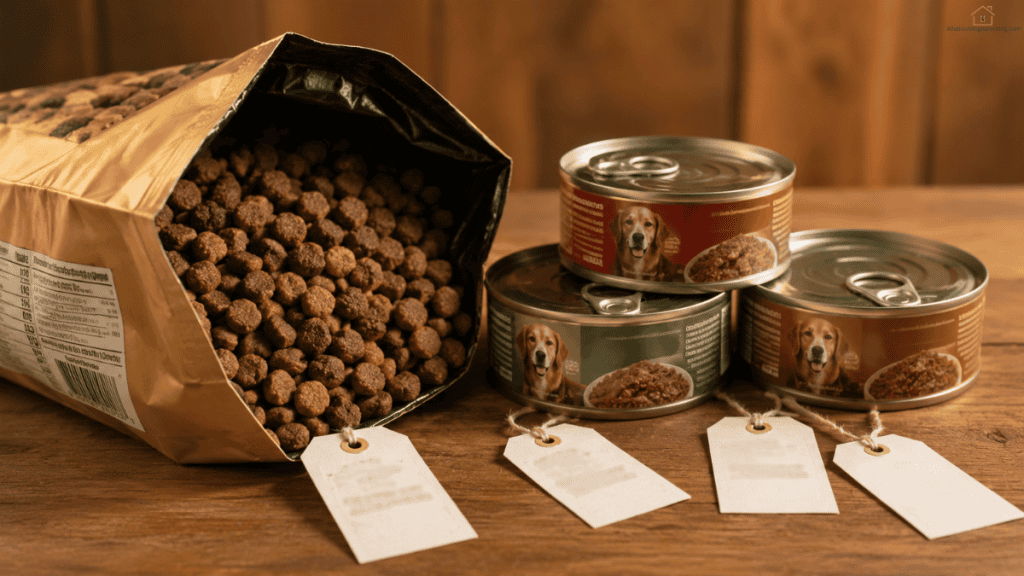
Every food on this best puppy food large breed list meets five non-negotiable criteria: AAFCO-certified specifically for large-breed puppy growth, calcium within 1.2 to 1.8% dry matter, manufactured by a brand with veterinary nutritionists on staff, validated through feeding trials, and available at a reasonable price point. We also factored in large breed puppy food reviews from real users. The right products followed.
1. AAFCO statement specifically for large-size dogs
The label must read “complete and balanced for growth of large-size dogs” or “all life stages including growth of large-size dogs.” The generic “for growth” statement is not sufficient. The large-breed-specific designation is what triggers the stricter calcium limits. If a food doesn’t carry this statement, it doesn’t belong in a large breed puppy food comparison regardless of how good the ingredients look.
2. Calcium 1.2 to 1.8% dry matter, phosphorus 1.0 to 1.6%, calcium-to-phosphorus ratio between 1:1 and 2:1
These figures come directly from AAFCO’s large-breed growth nutrient profiles. Not every brand publishes calcium percentages on the bag. Some require a call to the manufacturer or a check of their published nutritional data sheets. Every brand on this list provides this information.
3. Brand employs board-certified veterinary nutritionists
The single best proxy for formulation quality is whether the brand employs Diplomates of the American College of Veterinary Nutrition (DACVN). These are specialists, not general-practice vets, who formulate and verify diets. Every brand on this list meets this standard.
4. Feeding trial validation
AAFCO offers two paths to the “complete and balanced” claim: nutrient profile formulation (meeting standards on paper) and feeding trials (testing on actual dogs over time). Feeding trials are the higher bar. The majority of our picks have completed AAFCO feeding trials, not just formulation testing.
5. Widely available and reasonably priced
A food that’s difficult to source or costs more than most owners can sustain over 14 to 18 months of puppyhood isn’t a practical recommendation. Every pick on this list is available through major retailers.
The 6 Best Puppy Foods for Large Breeds (2026)
Our best puppy food large breed picks in this span budget to premium: Purina Pro Plan Large Breed Puppy (best overall), Hill’s Science Diet Large Breed Puppy (best for sensitive stomachs), Royal Canin Large Puppy (best breed-specific range), Eukanuba Large Breed Puppy (best for active puppies), Iams Large Breed Puppy (best budget), and The Farmer’s Dog (best fresh option).
Pick 1: Purina Pro Plan Large Breed Puppy — Best Overall
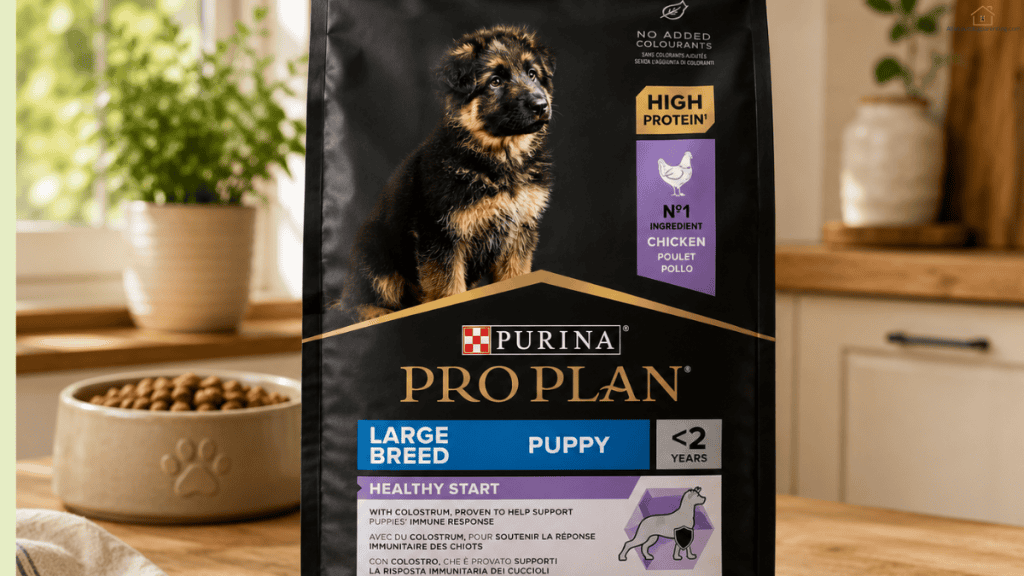
Purina employs more veterinary nutritionists than almost any other pet food company, and Pro Plan is the brand that most frequently appears in veterinary clinic recommendations. This formula has passed AAFCO feeding trials, contains live probiotics for digestive health, and includes DHA from fish oil for brain and eye development during the growth phase.
| Spec | Value |
| Protein | 28% min |
| Fat | 13% min |
| Calcium | ~1.3% (controlled for large breed) |
| Kcal/cup | ~393 |
| Price estimate | ~$55–65 per 34 lb bag (~$1.70/lb) |
Best for: Most large-breed puppies. It’s the proven, widely available default that consistently earns large breed puppy food vet-recommended status across multiple veterinary nutrition sources.
Drawback: Contains chicken by-product meal and corn. Both are nutritionally adequate and extensively studied, but some owners prefer to avoid them.
Pick 2: Hill’s Science Diet Large Breed Puppy — Best for Sensitive Stomachs
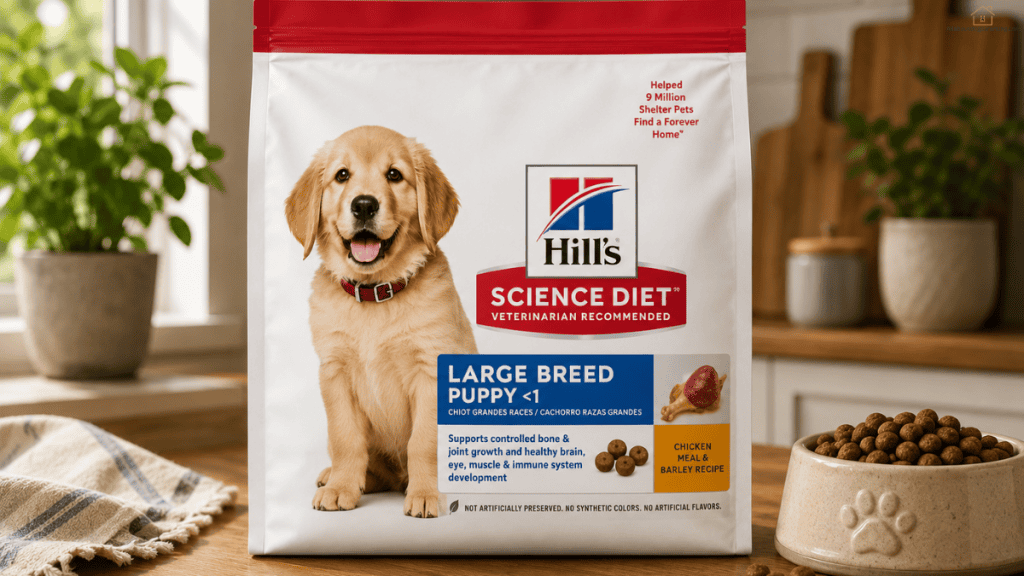
Hill’s employs over 200 veterinary nutritionists, food scientists, and technicians. Their large-breed puppy formula includes glucosamine and chondroitin for joint support during the growth phase, and is among the most tightly calcium-controlled options available. It’s widely used in veterinary clinics and frequently recommended by cardiologists and orthopaedic vets for at-risk breeds.
| Spec | Value |
| Protein | 24.5% min |
| Fat | 12% min |
| Calcium | ~1.25% (tightly controlled) |
| Kcal/cup | ~363 |
| Price estimate | ~$60–75 per 30 lb bag (~$2.20/lb) |
Best for: Large-breed puppies with sensitive digestion. German Shepherd owners specifically: GSDs are well-documented for stomach sensitivity, and Hill’s Science Diet handles that consistently well in my experience.
Drawback: Slightly lower protein than competitors. Higher price per pound than Purina Pro Plan.
Pick 3: Royal Canin Large Puppy — Best Breed-Specific Range
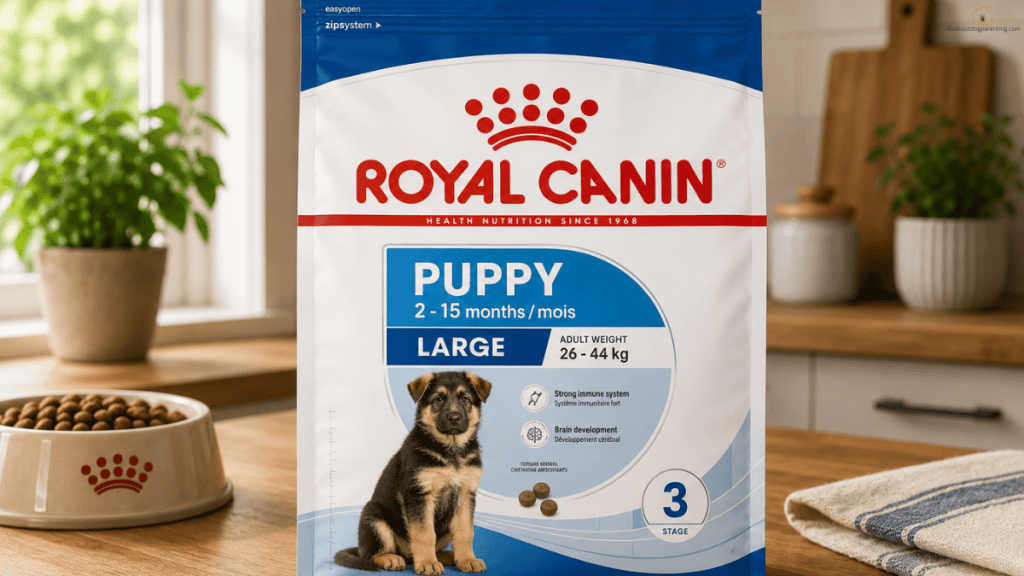
Royal Canin’s greatest strength is specificity. Beyond their general large-breed puppy formula, they offer breed-specific lines for German Shepherds, Labradors, Golden Retrievers, and others, each of which is calibrated to the particular developmental needs and known health risks of that breed. If you own a GSD, the German Shepherd Puppy formula accounts for the breed’s joint and digestive considerations directly.
| Spec | Value |
| Protein | 28% min |
| Fat | 14% min |
| Calcium | ~1.32% (controlled) |
| Kcal/cup | ~346 |
| Price estimate | ~$65–80 per 30 lb bag (~$2.40/lb) |
Best for: Owners who want breed-specific formulation. Particularly relevant for GSD, Lab, and Golden Retriever owners. Among the best large breed puppy food options for owners who want to go beyond generic large-breed standards.
Drawback: The most expensive kibble option on this list. Some owners dislike the inclusion of corn and by-product meals.
Pick 4: Eukanuba Large Breed Puppy — Best for Active Puppies
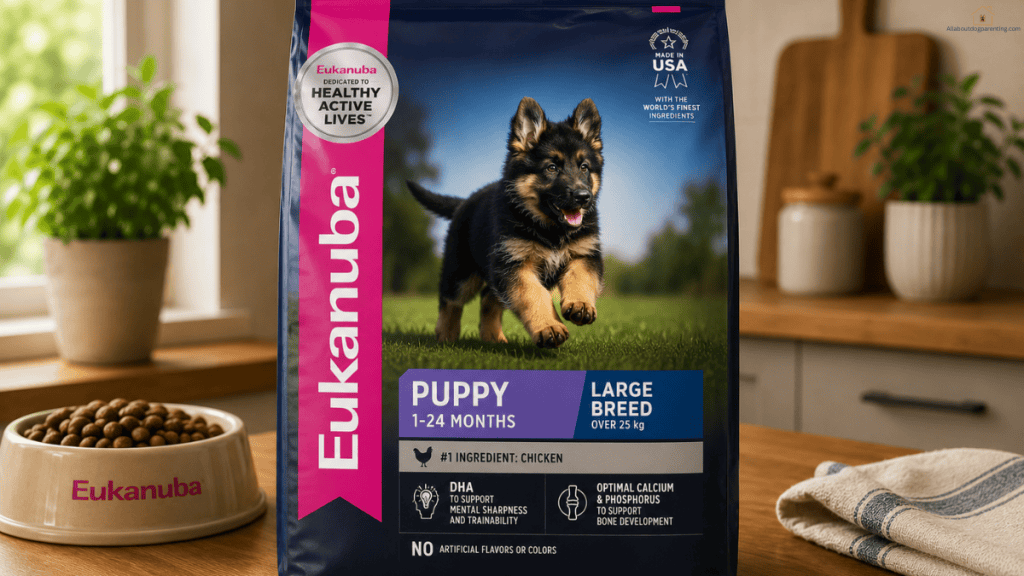
Mars Petcare employs veterinary nutritionists across its brands, and Eukanuba’s large-breed puppy formula runs slightly higher in protein and fat than some competitors, making it well-suited to high-energy working breed puppies. It still stays within the AAFCO large-breed calcium range and includes DHA for neurological development.
| Spec | Value |
| Protein | 27% min |
| Fat | 15% min |
| Calcium | ~1.4% (within large-breed range) |
| Kcal/cup | ~392 |
| Price estimate | ~$50–60 per 33 lb bag (~$1.60/lb) |
Best for: Active, high-energy large-breed puppies. It’s particularly ideal for working breeds and those with above-average daily activity. One of the more calorie-efficient large breed puppy food options in the mid-range category.
Drawback: Less widely available than Purina or Hill’s. Some formulas contain chicken by-products.
Pick 5: Iams Large Breed Puppy — Best Budget Pick
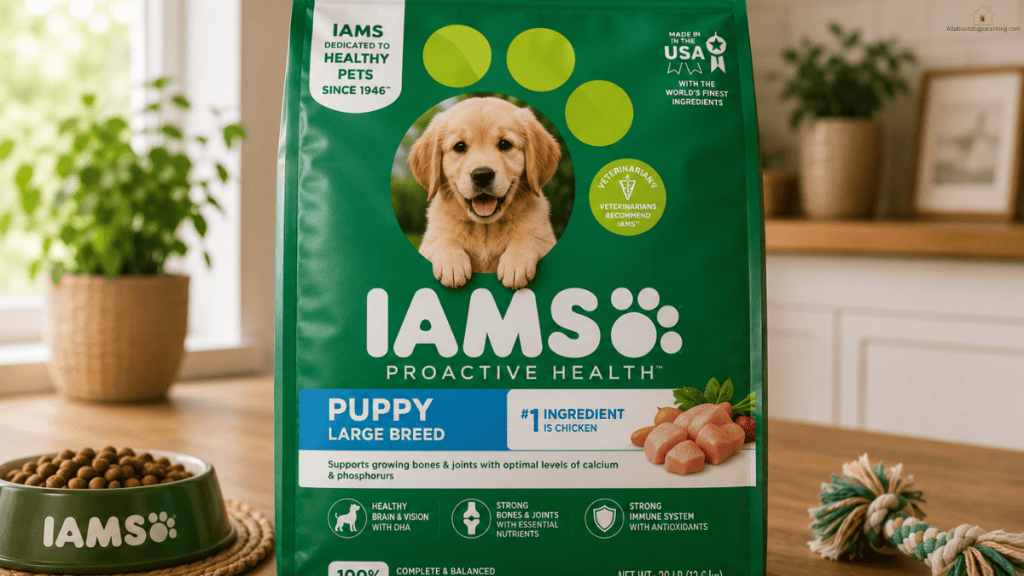
Iams delivers on the two things that matter most in puppy food for large breed dogs: AAFCO certification for large-breed growth and controlled calcium, at a price point significantly below the premium tier. Farm-raised chicken is the first ingredient. DHA from fish oil is included for brain development. This is the pick for owners who need a nutritionally complete, vet-sanctioned food at the lowest price on this list.
| Spec | Value |
| Protein | 25.5% min |
| Fat | 13.5% min |
| Calcium | ~1.3% (controlled) |
| Kcal/cup | ~354 |
| Price estimate | ~$35–45 per 30 lb bag (~$1.30/lb) |
Best for: Budget-conscious owners who still want a food specifically formulated for large-breed growth. At around $40 per month, it’s the most sustainable option over 14 to 18 months of puppyhood.
Drawback: Lower protein content than other picks. Contains corn and chicken by-product meals. Fewer premium ingredients overall, though it meets all AAFCO large-breed growth requirements.
Pick 6: The Farmer’s Dog — Best Fresh Option
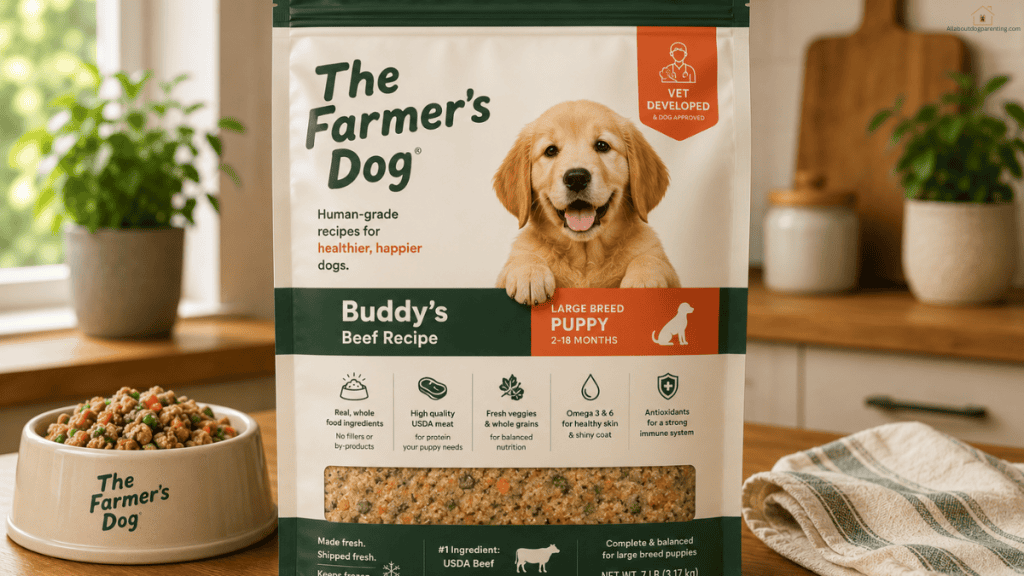
Among fresh food subscriptions, The Farmer’s Dog is one of the few that offers AAFCO-certified formulas specifically for growth, including large breeds. Human-grade whole ingredients, pre-portioned, delivered frozen. The nutritional profile is excellent. The cost is significant.
| Spec | Value |
| Protein | ~38–42% dry matter (varies by recipe) |
| Fat | ~20–25% dry matter |
| Calcium | Controlled for growth |
| Kcal/serving | Custom-portioned |
| Price estimate | ~$6–15/day for large breeds ($180–450/month) |
Best for: Owners with the budget for premium fresh food who want maximum ingredient transparency and minimal processing. Our fresh dog food for puppies guide covers the full cost analysis for large breeds over 14 months of puppyhood, which is worth reading before committing.
Drawback: Three to five times the cost of kibble. Requires freezer space. Not practical for puzzle feeders or training reward use. For most large-breed puppy owners, using a small amount as a kibble topper rather than a full subscription plan is the more sustainable approach.
Side-by-Side Comparison Table
All of the best puppy food large breed picks compared across protein, fat, calcium, calories, price, and whether the brand employs veterinary nutritionists and conducts feeding trials.
| Brand | Protein | Fat | Calcium | Kcal/Cup | Price/lb | Vet Nutritionists | Feeding Trials | Best For |
| Purina Pro Plan | 28% | 13% | ~1.3% | 393 | ~$1.70 | Yes | Yes | Most puppies |
| Hill’s Science Diet | 24.5% | 12% | ~1.25% | 363 | ~$2.20 | Yes | Yes | Sensitive stomachs |
| Royal Canin | 28% | 14% | ~1.32% | 346 | ~$2.40 | Yes | Yes | Breed-specific needs |
| Eukanuba | 27% | 15% | ~1.4% | 392 | ~$1.60 | Yes | Yes | Active puppies |
| Iams | 25.5% | 13.5% | ~1.3% | 354 | ~$1.30 | Yes | Yes | Budget-friendly |
| The Farmer’s Dog | ~40% DM | ~22% DM | Controlled | Custom | ~$6–15/day | Yes | Formulated | Premium fresh |
Every brand on this list employs veterinary nutritionists. That’s a deliberate selection criterion, not a coincidence. Formulation quality is where large-breed puppy health is won or lost, and board-certified nutritionists are the best insurance you can buy that the calcium-phosphorus ratios are actually right.
What to Look for on the Label (And What to Avoid)
Look for an AAFCO statement specifying “growth of large-size dogs,” a named protein as the first ingredient, calcium below 1.8%, and evidence the brand employs veterinary nutritionists. Avoid foods without the large-breed AAFCO specification, vague ingredient labelling, and grain-free formulas heavy in legumes. Reading a puppy food label for large breeds comes down to four things.
Must have
The AAFCO statement must specifically mention “large-size dogs” or “large breed.” The generic “for growth” or “all life stages” statement without that specification does not guarantee the calcium controls that large-breed puppies need. This is the single most important label check.
A named animal protein as the first ingredient: chicken, beef, salmon, lamb. Not “meat,” not “animal protein,” not “by-products” as the lead ingredient. Calcium between 1.2 and 1.8% on a dry-matter basis. If this isn’t on the bag, call the manufacturer or check their published nutritional data sheet. Reputable brands provide this information on request.
DHA from a named source, typically fish oil or fish meal. DHA supports brain and eye development during the growth phase.
Red flags
Any food without the large-breed-specific AAFCO statement. Marketing language about “natural ingredients” or “holistic nutrition” without that regulatory statement means nothing nutritionally.
Grain-free formulas where peas, lentils, or chickpeas appear in the first five ingredients. The FDA’s DCM investigation found a statistical association between high-legume grain-free diets and heart disease. Our grain-free vs grain-inclusive guide covers the full evidence. For large-breed puppies already navigating narrow nutritional requirements, adding unanswered questions about cardiac risk isn’t worth it.
Brands that don’t disclose their formulation team. A company that won’t tell you whether veterinary nutritionists developed their food is telling you something by not telling you. For the full guide on reading puppy food labels, portion calculations by breed size, and calorie targets by age, our how much to feed a puppy guide covers the practical detail.
FAQs
1. What makes large-breed puppy food different from regular puppy food?
Large-breed puppy food has controlled calcium between 1.2 and 1.8% dry matter, compared to up to 2.5% in standard puppy formulas. Fat is also moderated to control growth rate. These limits exist because large-breed puppies cannot regulate calcium absorption during development, and excess calcium causes skeletal problems including hip dysplasia and osteochondrosis. Always look for the AAFCO statement specifying “growth of large-size dogs.”
2. When should a large-breed puppy switch to adult food?
Most large breeds should switch between 14 and 18 months, and giant breeds between 18 and 24 months. The trigger is reaching approximately 80% of the expected adult weight, with your vet confirming growth is complete. Don’t switch based on age alone. Our full transition timing guide covers breed-size specifics, readiness signs, and the 10-day transition process.
3. Can I feed my large-breed puppy regular puppy food?
Not recommended. Standard puppy food contains calcium levels that can cause skeletal problems in large-breed puppies during the growth phase. If large-breed-specific food genuinely isn’t available, look for a standard puppy food with calcium below 1.5% on a dry-matter basis and discuss the specifics with your vet. This should be a temporary measure, not a long-term solution.
4. Is grain-free food safe for large-breed puppies?
Most veterinary nutritionists recommend grain-inclusive food as the default for puppy food for large breed dogs. The FDA investigated a statistical association between grain-free diets high in legumes and dilated cardiomyopathy. For large-breed puppies already working within narrow calcium requirements, adding DCM-related uncertainty isn’t worth it unless your puppy has a confirmed grain allergy. See our grain-free analysis for the complete evidence breakdown.
5. How much does large-breed puppy food cost per month?
Quality large-breed kibble runs $50 to $80 monthly for most large breeds. Royal Canin sits slightly higher at $65 to $80. The Farmer’s Dog costs $180 to $450 monthly for large breeds. Budget options like Iams run $35 to $45 monthly while still meeting all AAFCO large-breed growth standards. For a full cost breakdown across breed sizes and food formats, see our puppy feeding chart.
The Bottom Line
The best puppy food large breed decision comes down to one thing before any product comparison: confirming the food meets the AAFCO large-breed growth specification, with calcium controlled between 1.2 and 1.8%. Every pick on this list clears that bar. The differences after that are protein content, ingredient quality, price, and which specific situation each food serves best.
This is also a long-term commitment. A large-breed puppy stays on puppy food for 14 to 18 months. Factor the monthly cost into your decision as carefully as the ingredient list. A food that’s nutritionally excellent but financially unsustainable doesn’t serve your puppy over the full growth window. Any of the six picks above can take your puppy from 8 weeks to adult transition with healthy joints, consistent growth, and sound nutritional support throughout.