Puppy Weight Chart By Breed: Expected Growth from 8 Weeks to 18 Months
Overview:
Puppy weight depends on breed size: toy breeds reach 1 to 5 kg at maturity, small breeds 5 to 10 kg, medium 10 to 25 kg, large 25 to 40 kg, and giant breeds 40 to 70 kg plus. Use the breed-size charts below to track your puppy’s growth against expected ranges by age.
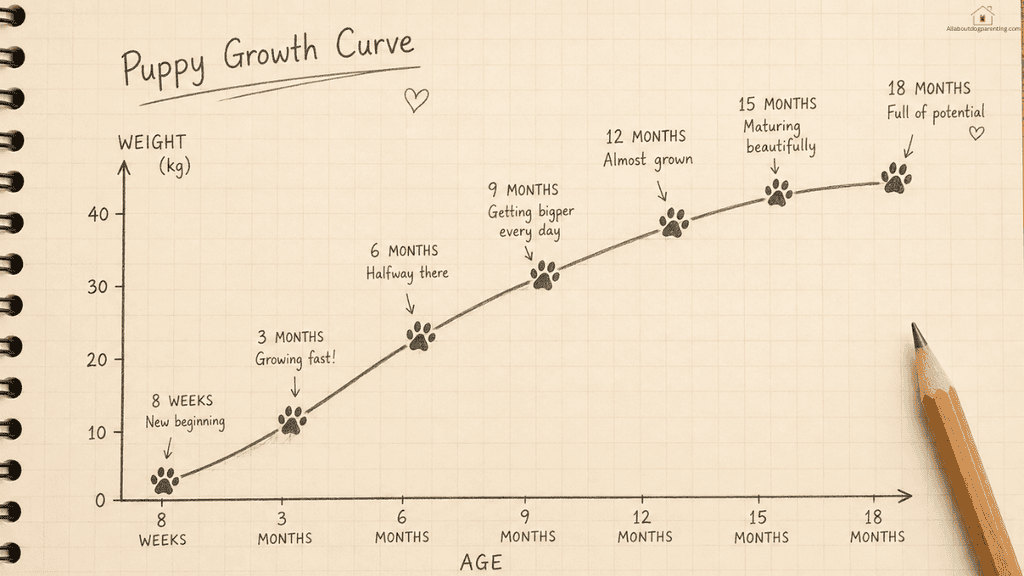
Puppies don’t grow on a smooth, predictable line. They spurt, plateau, look skinny for three weeks, suddenly fill out, and then plateau again. The puppy weight chart by breed is how you tell the difference between a puppy growing on their own perfectly normal trajectory and a puppy whose numbers warrant a call to the vet.
This article, part of our Complete Guide to Puppy Nutrition, goes beyond just the question of how much should my puppy weigh and gives you clear insight into the ideal growth trajectory you can expect. Five charts, every popular breed, ranges, not single figures, and a straight answer on when deviation is normal and when it isn’t. Bookmark it. You’ll want to come back to it every few weeks.
How to Use These Charts
Overview:
Find your breed in the size category table below, then look up your puppy’s age in the corresponding weight chart. A healthy puppy should track within the given range. Consistently 20% or more above or below warrants a vet conversation.
To get the right puppy weight by age, first, find which size category your breed falls into. Then go to that chart and look up your puppy’s current age. The ranges given are broad enough to account for normal variation across males and females, smaller and larger individuals within the same breed. Your puppy doesn’t need to hit a specific number. They need to be tracking in the right direction within a plausible range for their size.
Breed-to-Category Quick Lookup
| Breed | Size Category |
| Chihuahua | Toy |
| Yorkshire Terrier | Toy |
| Maltese | Toy |
| Pomeranian | Toy |
| Toy Poodle | Toy |
| Papillon | Toy |
| Shih Tzu | Small |
| Miniature Dachshund | Small |
| Cavalier King Charles Spaniel | Small |
| Pug | Small |
| Miniature Schnauzer | Small |
| Jack Russell Terrier | Small |
| Beagle | Medium |
| Cocker Spaniel | Medium |
| Bulldog | Medium |
| Border Collie | Medium |
| Australian Shepherd | Medium |
| Standard Poodle | Medium |
| French Bulldog | Medium |
| Labrador Retriever | Large |
| Golden Retriever | Large |
| German Shepherd | Large |
| Boxer | Large |
| Siberian Husky | Large |
| Standard Goldendoodle | Large |
| Great Dane | Giant |
| Mastiff | Giant |
| St. Bernard | Giant |
| Bernese Mountain Dog | Giant |
| Irish Wolfhound | Giant |
| Newfoundland | Giant |
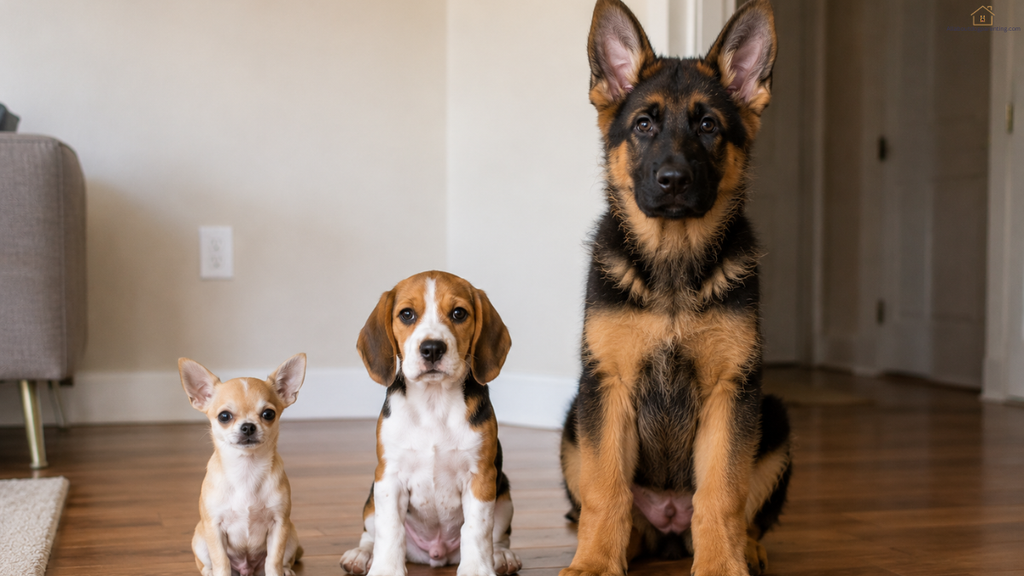
Not sure which category your mixed breed falls into? Estimate their likely adult weight. Under 5 kg adult: toy. 5 to 10 kg: small. 10 to 25 kg: medium. 25 to 40 kg: large. Above 40 kg: giant.
Toy Breed Puppy Weight Chart (1 to 5 kg Adult)
Overview:
Toy breeds grow fast and finish early. Most reach their adult weight by 7 to 9 months. Gains slow noticeably after 4 months, so don’t be alarmed when the weekly increases start shrinking.
Breeds: Chihuahua, Yorkshire Terrier, Maltese, Pomeranian, Toy Poodle, Papillon. This puppy growth chart, with expected weight ranges, gives you a clear idea of whether your pup’s growth is on track.
| Age | Weight Range (kg) | Weight Range (lbs) | Notes |
| 8 weeks | 0.4 to 1.4 kg | 0.9 to 3.1 lbs | Huge variation even within breed |
| 10 weeks | 0.5 to 1.6 kg | 1.1 to 3.5 lbs | |
| 3 months | 0.7 to 2.0 kg | 1.5 to 4.4 lbs | Rapid phase underway |
| 4 months | 0.9 to 2.5 kg | 2.0 to 5.5 lbs | Around 60% of adult weight |
| 5 months | 1.0 to 3.0 kg | 2.2 to 6.6 lbs | Growth beginning to slow |
| 6 months | 1.2 to 3.5 kg | 2.6 to 7.7 lbs | Around 80% of adult weight |
| 7 to 8 months | 1.4 to 4.5 kg | 3.1 to 9.9 lbs | Most toy breeds finishing growth |
| 9 to 10 months | 1.5 to 5.0 kg | 3.3 to 11.0 lbs | Mature weight reached for most |
Important for toy breed owners: Puppies under 2 kg face genuine hypoglycaemia risk if meals are skipped. Four to five meals daily until 12 weeks is not optional for very small toys. Weight loss of more than 10% of body weight in a week in a toy breed puppy is a vet call, not a wait-and-see situation.
Adult weight estimate for toy breeds: Triple the weight at 8 weeks for a rough adult estimate. It’s imprecise, but it gives you a working ballpark.
Small Breed Puppy Weight Chart (5 to 10 kg Adult)
Overview:
Small breeds grow steadily rather than explosively and typically reach adult weight between 9 and 12 months. They have more digestive flexibility than toy breeds but still benefit from 3 to 4 meals daily until 6 months.
Breeds: Shih Tzu, Miniature Dachshund, Cavalier King Charles Spaniel, Pug, Miniature Schnauzer, Jack Russell Terrier. A puppy weight chart by breed gives you a specific reference point rather than abstract numbers.
| Age | Weight Range (kg) | Weight Range (lbs) | Notes |
| 8 weeks | 0.8 to 2.2 kg | 1.8 to 4.9 lbs | |
| 10 weeks | 1.0 to 2.6 kg | 2.2 to 5.7 lbs | |
| 3 months | 1.4 to 3.5 kg | 3.1 to 7.7 lbs | Active growth phase |
| 4 months | 2.0 to 4.5 kg | 4.4 to 9.9 lbs | Around 50% of adult weight |
| 5 months | 2.5 to 5.5 kg | 5.5 to 12.1 lbs | |
| 6 months | 3.0 to 6.5 kg | 6.6 to 14.3 lbs | Around 70 to 80% of adult weight |
| 8 months | 4.0 to 8.0 kg | 8.8 to 17.6 lbs | Growth slowing considerably |
| 10 months | 4.5 to 9.0 kg | 9.9 to 19.8 lbs | Near adult weight for most |
| 12 months | 5.0 to 10.0 kg | 11.0 to 22.0 lbs | Mature weight reached |
Adult weight estimate for small breeds: Double the weight at 12 weeks and add a small amount for filling out. A Cavalier at 3 kg at 12 weeks is likely heading toward 6 to 7 kg as an adult. That’s what the entire mystery of puppy weight by age boils down to.
Medium Breed Puppy Weight Chart (10 to 25 kg Adult)
Overview:
Medium breeds have the most predictable growth curves. They grow fastest between 2 and 5 months, then slow steadily. Most reach adult weight between 12 and 14 months.
Breeds: Beagle, Cocker Spaniel, Bulldog, Border Collie, Australian Shepherd, Standard Poodle, French Bulldog. Check out the expected puppy weight for your pooch:
| Age | Weight Range (kg) | Weight Range (lbs) | Notes |
| 8 weeks | 2.0 to 5.5 kg | 4.4 to 12.1 lbs | |
| 10 weeks | 2.5 to 7.0 kg | 5.5 to 15.4 lbs | |
| 3 months | 4.0 to 10.0 kg | 8.8 to 22.0 lbs | Most active growth phase |
| 4 months | 6.0 to 13.0 kg | 13.2 to 28.7 lbs | Around 50% of adult weight |
| 5 months | 7.5 to 16.0 kg | 16.5 to 35.3 lbs | |
| 6 months | 9.0 to 18.0 kg | 19.8 to 39.7 lbs | Around 70% of adult weight |
| 8 months | 10.0 to 21.0 kg | 22.0 to 46.3 lbs | Growth slowing |
| 10 months | 10.5 to 23.0 kg | 23.1 to 50.7 lbs | Nearly there |
| 12 months | 11.0 to 24.0 kg | 24.3 to 52.9 lbs | Approaching adult weight |
| 14 months | 11.0 to 25.0 kg | 24.3 to 55.1 lbs | Mature weight reached |
Adult weight estimate for medium breeds: Double the weight at 14 weeks. A Border Collie at 7 kg at 14 weeks is heading toward 14 kg as an adult.
Large Breed Puppy Weight Chart (25 to 40 kg Adult)
Overview:
Large breeds grow for significantly longer than smaller breeds, typically reaching adult weight between 14 and 18 months. Tracking this puppy weight chart by breed is especially important for large breeds because rapid early growth directly increases joint injury risk.
Breeds: Labrador Retriever, Golden Retriever, German Shepherd, Boxer, Siberian Husky, Standard Goldendoodle
I decided to come up with this elaborate article on a puppy weight chart by breed because a similar chart helped me greatly as I was navigating raising my first German Shepherd. I used it almost obsessively. My GSD was 14 kg at 4 months and 34 kg at 12 months, tracking right in the middle of the expected range the whole way through. He had weeks where he barely gained anything, followed by a few weeks where he seemed to change shape overnight. The chart helped me stay calm about the plateau phases instead of worrying myself sick about whether there was something wrong with him and trying to compensate by pushing more calories into him.
| Age | Male Range (kg) | Female Range (kg) | Combined (lbs) | Notes |
| 8 weeks | 5 to 9 kg | 4 to 7 kg | 8.8 to 19.8 lbs | Wide range is normal |
| 10 weeks | 7 to 12 kg | 5 to 9 kg | 11.0 to 26.5 lbs | |
| 3 months | 11 to 16 kg | 9 to 13 kg | 19.8 to 35.3 lbs | Rapid growth underway |
| 4 months | 15 to 22 kg | 12 to 18 kg | 26.5 to 48.5 lbs | Around 50% of adult weight |
| 5 months | 19 to 27 kg | 15 to 22 kg | 33.1 to 59.5 lbs | |
| 6 months | 22 to 31 kg | 18 to 26 kg | 39.7 to 68.3 lbs | Growth plates still open |
| 8 months | 26 to 35 kg | 21 to 30 kg | 46.3 to 77.2 lbs | |
| 10 months | 29 to 38 kg | 24 to 32 kg | 52.9 to 83.8 lbs | Slowing noticeably |
| 12 months | 31 to 40 kg | 26 to 34 kg | 57.3 to 88.2 lbs | Not done yet |
| 15 to 18 months | 32 to 42 kg | 27 to 35 kg | 59.5 to 92.6 lbs | Mature weight reached |
Note on extended growth: Large breeds may look fully grown at 10 to 12 months while their growth plates are still open. This is why high-impact exercise restrictions continue past the point when the puppy appears mature. Switching to adult food too early is one of the most common large-breed mistakes. Our when to switch to adult food guide covers breed-size timing in detail.
Adult weight estimate for large breeds: Double the weight at 5 months. My GSD at 5 months was 22 kg and landed at 36 kg as an adult. The formula was remarkably close.
Giant Breed Puppy Weight Chart (40 kg Plus Adult)
Overview:
Giant breeds have the longest growth runway. Some don’t reach full adult weight until 24 months. Their puppy weight by age looks deceptively modest early on, then accelerates through months 4 to 9 in ways that seem extraordinary.
Breeds: Great Dane, Mastiff, St. Bernard, Bernese Mountain Dog, Irish Wolfhound, Newfoundland. Having a puppy weight chart by breed comes in especially handy when you’ve got a furry giant on your hands.
| Age | Male Range (kg) | Female Range (kg) | Combined (lbs) | Notes |
| 8 weeks | 6 to 14 kg | 5 to 11 kg | 11.0 to 30.9 lbs | Already larger than many adult small dogs |
| 10 weeks | 9 to 19 kg | 7 to 15 kg | 15.4 to 41.9 lbs | |
| 3 months | 14 to 28 kg | 11 to 22 kg | 24.3 to 61.7 lbs | Rapid phase begins |
| 4 months | 20 to 38 kg | 16 to 30 kg | 35.3 to 83.8 lbs | Around 40 to 50% of adult weight |
| 5 months | 27 to 48 kg | 21 to 38 kg | 46.3 to 105.8 lbs | |
| 6 months | 32 to 55 kg | 26 to 44 kg | 57.3 to 121.3 lbs | Growth plates very active |
| 8 months | 40 to 65 kg | 32 to 52 kg | 70.5 to 143.3 lbs | |
| 10 months | 46 to 72 kg | 37 to 58 kg | 81.6 to 158.7 lbs | |
| 12 months | 50 to 78 kg | 40 to 63 kg | 88.2 to 172.0 lbs | Still growing |
| 18 months | 55 to 85 kg | 44 to 68 kg | 96.8 to 187.4 lbs | Approaching adult weight |
| 24 months | 58 to 90 kg | 46 to 72 kg | 99.2 to 198.4 lbs | Mature weight for most |
Overfeeding risk: Giant breeds are the category where the temptation to feed generously does the most damage. Rapid weight gain in a giant breed puppy accelerates skeletal development in ways that compound joint risk across the dog’s entire lifespan. Lean growth is the target, not impressive weight numbers at 6 months. For portion guidance calibrated to your giant breed puppy’s age and weight, our how much to feed a puppy guide covers the calculations.
Adult weight estimate for giant breeds: Double the weight at 6 months. A Great Dane male at 50 kg at 6 months is heading toward roughly 85 to 90 kg as an adult. These estimates are rougher for giant breeds because individual variation is greater.
How to Predict Your Puppy’s Adult Weight
Overview:
For small breeds, double the weight at 12 weeks and add 50%. For medium breeds, double the weight at 14 weeks. For large breeds, double the weight at 5 months. For giant breeds, double the weight at 6 months. These are, of course, estimates, not guarantees.
| Breed Size | Formula | Example |
| Toy (1 to 5 kg) | Triple weight at 8 weeks | 0.8 kg at 8 weeks = ~2.4 kg adult |
| Small (5 to 10 kg) | Double weight at 12 weeks | 3.0 kg at 12 weeks = ~6 kg adult |
| Medium (10 to 25 kg) | Double weight at 14 weeks | 7.0 kg at 14 weeks = ~14 kg adult |
| Large (25 to 40 kg) | Double weight at 5 months | 19 kg at 5 months = ~38 kg adult |
| Giant (40 kg plus) | Double weight at 6 months | 45 kg at 6 months = ~80 to 90 kg adult |
These formulas work reasonably well for purebreds with consistent genetics. For mixed breeds, they become less reliable because the parental size mix is unknown. Sex matters too. Female dogs in most breeds run 15 to 25% lighter than males at the same age. If you’re using these formulas, factor that in.
When to Worry And When Normal Variation Looks Alarming
Overview:
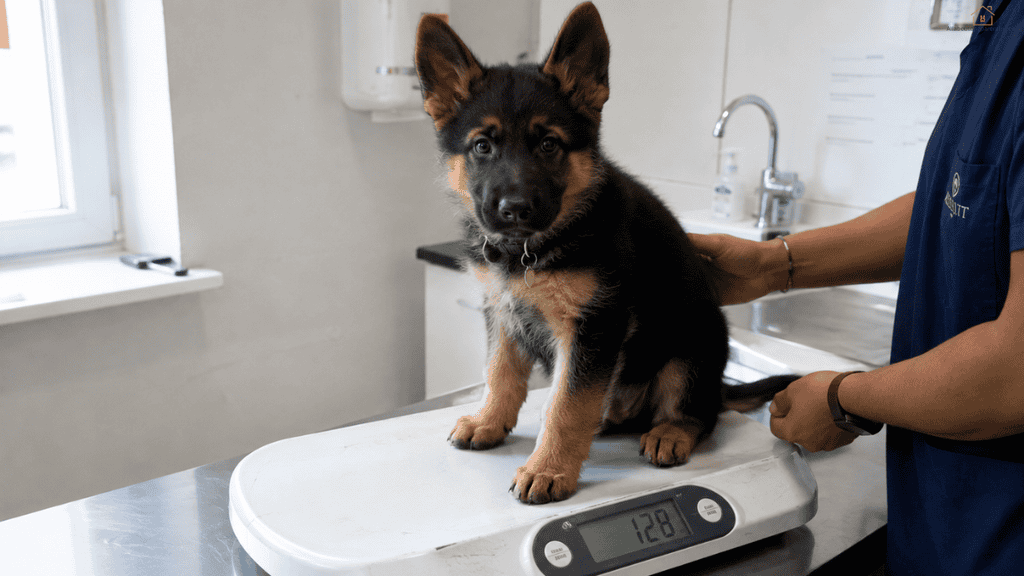
Puppies within 10% of the expected range are normal. Puppies 10 to 20% above or below should be monitored more closely. Puppies more than 20% off in either direction warrant a vet consultation.
Most of the weight anxiety new owners experience falls into the “normal variation” category. The ranges in these charts are wide for a reason. A Labrador who sits at the bottom of the expected range for their age is not necessarily underweight. They may just be female, or lean-framed, or going through a plateau.
| Deviation from Expected Range | What It Means | What to Do |
| Within 10% | Normal | Continue current approach, track monthly |
| 10 to 20% above expected | Possible overfeeding, larger genetics | Check body condition, reduce portions by 10% if ribs difficult to feel |
| 10 to 20% below expected | Possible underfeeding, leaner frame | Check body condition, review portions and feeding frequency |
| More than 20% above expected | Significant overfeeding or health issue | Vet consultation, body condition assessment |
| More than 20% below expected | Underfeeding, parasites, illness, or malabsorption | Vet visit. Stool sample to rule out parasites. |
| Growth stalled for 2 or more weeks | May be a plateau or may indicate a problem | Monitor for one more week, then vet visit if no change |
The body condition check: If you’re worried your pet’s numbers have consistently remained on the lower or higher spectrum of this puppy weight chart by breed, a body condition check can put you at ease. Run your hands along your puppy’s ribcage. You should feel individual ribs with light pressure but not see them prominently. There should be a visible waist behind the ribcage when viewed from above.
A puppy who is tracking below the expected weight but passes the rib check is lean, not underfed. A puppy tracking above the expected weight but where ribs are difficult to feel needs a portion reduction. Weight and body condition together give you the full picture. Neither alone tells you enough. If your puppy’s weight is off and you want to adjust feeding, our puppy feeding chart connects weight to daily calorie targets and shows you how to recalculate portions as your puppy grows.
FAQs
1. How much should my puppy weigh at 4 months?
It depends almost entirely on breed size. At 4 months, rough expected weights are: toy breeds 0.9 to 2.5 kg, small breeds 2.0 to 4.5 kg, medium breeds 6.0 to 13.0 kg, large breeds 14 to 22 kg, and giant breeds 20 to 38 kg. Check the specific chart for your breed category above, as these are wide ranges and individual variation is normal.
2. Why is my puppy growing faster than the chart?
Could be female versus male comparison (females typically weigh 15 to 25% less), the smaller end of normal genetics, a growth plateau (common and temporary), or underfeeding. If the puppy is lively, interested in food, and ribs are easily felt without being prominent, lean tracking is probably fine. If the puppy has low energy, prominent ribs and spine, or hasn’t gained anything in two or more weeks, see your vet and bring a stool sample to rule out parasites.
3. When do puppies stop growing?
By breed size: toy breeds finish at 7 to 9 months, small breeds at 9 to 12 months, medium breeds at 12 to 14 months, large breeds at 14 to 18 months, and giant breeds at 18 to 24 months. These are rough timelines. Individual dogs within each category can vary by a few months in either direction, and “stopped growing” in height often comes before “stopped filling out” in muscle and body mass.
4. Should I weigh my puppy weekly?
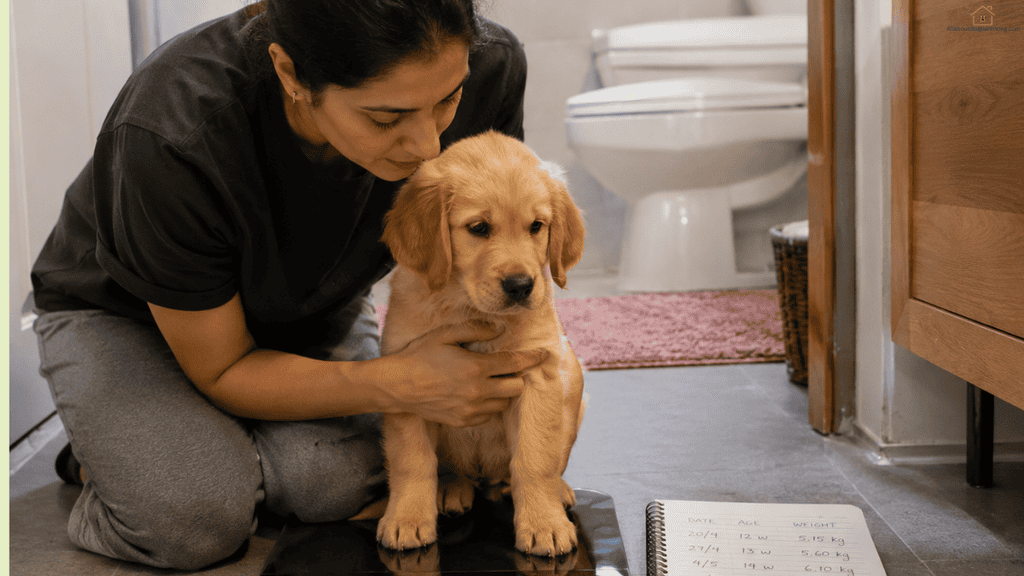
Yes, for the first 6 months. After that, every two weeks is enough. You don’t need a pet scale. Weigh yourself on a bathroom scale, then weigh yourself again holding your puppy, and subtract the first number from the second. Log the result each time so you have a growth trend rather than just a single data point. A trend tells you far more than any individual weigh-in.
The Bottom Line
The puppy weight chart by breed is a great reference point, but I’d warn you against reading it as a report card on your pet’s growth. Numbers within the expected range are reassuring. Numbers outside it are a starting point for investigation, not a cause for panic. Combine the chart with a weekly body condition check and you have a genuinely useful picture of how your puppy is developing.
The expected puppy weight ranges in these charts are wide because puppies are individuals. Use them as the framework they’re designed to be, check back as your puppy grows, and connect any weight concerns to a feeding adjustment or a vet visit, depending on what the body condition check tells you.