Can Puppies Eat Human Food? The Complete Safe and Unsafe List
Overview:
Can puppies eat human food? Yes, many human foods are safe and nutritious for puppies in moderation. Plain cooked chicken, carrots, blueberries, cucumber, sweet potato, and eggs are all excellent choices. Keep human food to 10% of daily calories and entirely avoid toxic foods.
The honest answer to can puppies eat human food is yes, and more freely than most owners realise. A piece of boiled chicken, a handful of blueberries, a few carrot sticks, a spoonful of plain pumpkin. Besides being safe additions to a puppy’s diet, they’re genuinely better training rewards than most commercial treats, cheaper, and completely ingredient-transparent.
I have raised my German Shepherds on home-cooked meals with ingredients that would be considered “human foods”—chicken, mutton, lamb, beef, vegetables, rice, that sort of thing—after a certain point in their growth journey. While I did keep them on foods formulated for puppy growth at least for the first 6 months to a year, human food was always part of their feeding routine.
Now, I’m talking table scraps for puppy here. That’s always a no-go. But using human foods as training rewards, toppers, or the kind of whole-food variety that makes sense when you’re already committed to feeding well is different. The key is knowing which foods earn a place in the bowl and which ones should never come anywhere near it. This article, part of our Complete Guide to Puppy Nutrition, covers both.
The Rules for Feeding Human Food to Puppies
Overview:
Three rules: keep it to 10% of daily calories or less if your puppy is on packaged food, never offer table scraps for puppy, and always check the safe list before sharing a new food. All preparation should be plain: no seasoning, no oil, no salt, no garlic, no onion in any form.
Introducing human food for puppies essentially boils down to these three crucial rules:
Rule 1: The 10% rule unless feeding home-cooked meals
Your puppy’s complete commercial food already provides 100% of their nutritional requirements. Human food sits on top of that. Unless you’re considering a shift to home-made meals, keep it under 10% of daily calorie intake and the nutritional balance stays intact. For a medium-breed puppy eating 900 calories per day, that’s 90 calories from human food, roughly 2 to 3 tablespoons of cooked chicken or a small handful of blueberries. For calorie targets by age and breed size, our how much to feed a puppy guide has the full calculations.
Rule 2: Never from the table
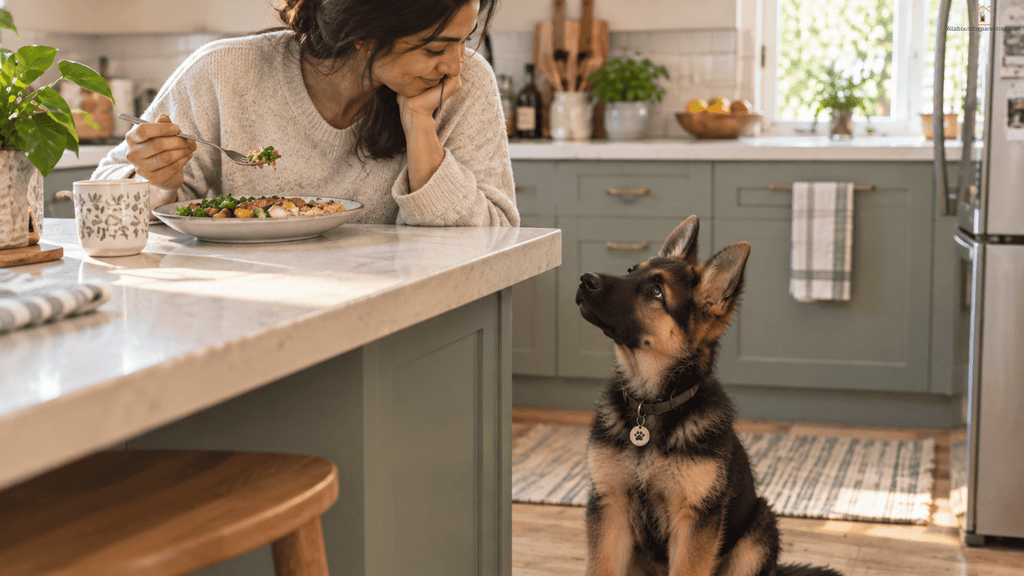
Can puppies eat human food? Sure they can, just not off the table. Food from your hand at the dining table creates a begging habit that is difficult to undo. If you want to share something with your puppy, put it in their bowl or use it deliberately as a training reward. The food itself isn’t the issue. The delivery method matters enormously for how the puppy learns to behave at mealtimes.
Rule 3: Plain preparation, always
Human food prepared for human consumption is usually seasoned, oiled, salted, or cooked with garlic and onion. All of these additions are problematic for dogs. Garlic and onion are toxic. Salt in excess causes sodium ion poisoning. Oil and seasoning can trigger pancreatitis. If you’re sharing food with your puppy, prepare their portion separately.
Safe Human Foods for Puppies: The Complete List
Overview:
The tables below cover 50-plus human foods organised by category. Each entry includes preparation method, serving size by breed size, and whether the food is suitable for regular use or moderation only. This is your reference list for what human food for puppies is genuinely safe.
What human food can puppies eat? Let’s see which foods in different categories are suitable for your pooch:
Fruits
| Food | Safe? | Preparation | Serving Size (Small / Medium / Large) | Notes |
| Blueberries | Yes | Wash, serve whole | 3 to 5 / 5 to 10 / 10 to 15 berries | Antioxidant-rich, perfect training treat size |
| Apple | Yes | Remove seeds and core, slice thin | 1 to 2 / 2 to 3 / 3 to 4 slices | Seeds contain cyanide. Always remove before serving. |
| Watermelon | Yes | Seedless only, remove rind, cube small | 2 to 3 / 3 to 5 / 5 to 8 small cubes | Hydrating, very low calorie, excellent summer treat |
| Banana | Yes (moderation) | Peel, slice thin | 1 to 2 / 2 to 3 / 3 to 4 thin slices | High in sugar. Occasional treat only, not daily. |
| Strawberries | Yes | Wash, remove stems, halve | 1 to 2 / 2 to 3 / 3 to 4 halves | Natural sugar. Use in moderation. |
| Mango | Yes (moderation) | Peel completely, remove pit, cube small | 1 to 2 / 2 to 3 / 3 to 4 small cubes | Remove pit. It is both a choking risk and contains cyanide compounds. |
| Pear | Yes | Remove seeds and core, slice thin | 1 to 2 / 2 to 3 / 3 to 4 slices | Seeds contain trace cyanide. Always remove the core. |
| Pineapple | Yes (moderation) | Fresh only, remove skin and core, cube small | 1 to 2 / 2 to 3 / 3 to 4 small cubes | High sugar. Avoid canned versions with syrup. |
| Cantaloupe | Yes | Remove seeds and rind, cube | 2 to 3 / 3 to 5 / 5 to 8 small cubes | High in sugar relative to other safe fruits. Moderation. |
| Grapes and raisins | TOXIC. NEVER. | Not applicable | Not applicable | Even one grape can cause kidney failure in some dogs |
| Avocado | No | Not applicable | Not applicable | Persin in flesh, skin, and pit is toxic to dogs |
| Cherries | No | Not applicable | Not applicable | Pits, stems, and leaves contain cyanide compounds |
Vegetables
| Food | Safe? | Preparation | Serving Size (Small / Medium / Large) | Notes |
| Carrots | Yes | Raw chopped small, or steamed | 1 to 2 / 2 to 3 / 3 to 4 small pieces | Excellent for teething puppies. Very low calorie. |
| Green beans | Yes | Steamed or raw, chopped | 2 to 3 / 3 to 5 / 5 to 8 pieces | Outstanding low-calorie filler for puppies managing weight |
| Cucumber | Yes | Sliced thin, seeds removed | 2 to 3 / 3 to 5 / 5 to 8 slices | Very low calorie, hydrating, most puppies love it |
| Sweet potato | Yes | Cooked only (baked or steamed), no seasoning | 1 tbsp / 1 to 2 tbsp mashed / 2 tbsp | Never raw. Raw sweet potato is difficult to digest and may cause blockage. |
| Pumpkin (plain) | Yes | Canned plain only, or cooked fresh | 1 tsp / 1 tbsp / 2 tbsp | Outstanding for digestion. Firms stools. Not pumpkin pie filling. |
| Broccoli | Yes (moderation) | Steamed, chopped into small florets | 1 to 2 / 2 to 3 / 3 to 4 small florets | Safe in small amounts. Large quantities cause gas. |
| Peas | Yes | Fresh or frozen, thawed. Not canned. | 4 to 5 / 5 to 8 / 10 to 12 | Avoid canned peas with added salt |
| Spinach | Yes (moderation) | Lightly cooked, small amounts | A few leaves maximum | High in oxalates. Only appropriate occasionally. |
| Zucchini | Yes | Raw sliced or steamed | 2 to 3 / 3 to 5 / 5 to 8 pieces | Low calorie, mild flavour, well-tolerated |
| Celery | Yes | Chopped small, strings removed | 1 to 2 / 2 to 3 / 3 to 4 small pieces | Remove stringy fibres. Good for breath. |
| Onion and garlic (all allium family) | TOXIC. NEVER. | Not applicable | Not applicable | All forms: raw, cooked, powdered, dehydrated |
| Corn on the cob | No (cob only) | Kernels off the cob are safe in small amounts | 1 tbsp / 1 to 2 tbsp / 2 tbsp kernels only | Cob is a severe choking and intestinal blockage risk |
Proteins
| Food | Safe? | Preparation | Serving Size (Small / Medium / Large) | Notes |
| Chicken | Yes | Boiled or baked, plain, no bones, no skin | 1 to 2 / 2 to 3 / 3 to 4 tbsp shredded | The gold standard puppy training treat and food topper |
| Turkey | Yes | Cooked, plain, no bones, no skin, no seasoning | Same as chicken | Novel protein, good for chicken-sensitive puppies |
| Salmon | Yes | Cooked thoroughly. Never raw. | 1 to 2 / 2 to 3 / 3 to 4 tbsp flaked | Raw salmon can carry parasites fatal to dogs. Always cook fully. |
| Tuna | Yes (moderation) | Canned in water only, no added salt | 1 tsp / 1 to 2 tsp / 1 tbsp | High mercury. Occasional only. Avoid canned in oil. |
| Eggs | Yes | Scrambled or boiled, no oil, no butter, no salt | 1/4 / 1/2 / 1 whole egg | Excellent complete protein. One of the most bioavailable protein sources available. |
| Lean beef | Yes | Cooked thoroughly, no seasoning, fat drained | 1 to 2 / 2 to 3 / 3 to 4 tbsp | Drain all visible fat. High-fat beef triggers pancreatitis risk. |
| Shrimp | Yes (moderation) | Cooked, shelled, deveined, no seasoning | 1 to 2 / 2 to 3 / 3 to 5 small shrimp | Remove shell completely. Moderation due to sodium content. |
| Plain yogurt | Yes (moderation) | Plain, unsweetened, no xylitol, no fruit | 1 tsp / 1 tbsp / 2 tbsp | Probiotic benefit. Avoid in lactose-sensitive puppies. Watch for loose stools. |
| Cottage cheese | Yes (moderation) | Plain, low-fat, no salt added | 1 tsp / 1 tbsp / 2 tbsp | Lower lactose than most dairy. Bland diet classic. |
| Raw meat | Use caution | See our raw food article | Not applicable | Pathogen risk for puppies with developing immune systems. See our raw food for puppies guide. |
Grains and Starches
| Food | Safe? | Preparation | Notes |
| Plain cooked rice | Yes | White or brown, no seasoning, no butter | Gentle on the stomach. Classic bland diet component for digestive upset. |
| Oatmeal | Yes | Cooked, plain, no sugar, no flavouring | Good fibre source, gentle on digestion. Not instant flavoured varieties. |
| Plain pasta | Yes (moderation) | Cooked, no sauce, no seasoning | Low nutritional value. Occasional use only. |
| Plain bread | Yes (moderation) | Small amounts, no toppings | Empty calories. Not recommended regularly. No xylitol-containing bread. |
| Raw bread dough | TOXIC. NEVER. | Not applicable | Expands in the stomach and ferments into alcohol. Emergency vet immediately. |
Dairy and Other
| Food | Safe? | Preparation | Serving Size | Notes |
| Cheese | Yes (moderation) | Plain, low-fat varieties. Small cubes. | 1 small cube / 2 small cubes / 3 small cubes | High-value training treat. Lactose can cause loose stools. Use sparingly. |
| Peanut butter | Yes (if no xylitol) | Check label for xylitol. Natural only. | 1/2 tsp / 1 tsp / 1 to 2 tsp | Check every jar before offering. Xylitol-containing peanut butter is acutely toxic. |
| Honey | Yes (moderation) | Raw or plain, tiny amounts | A small lick only | High in sugar. Not for puppies under 1 year with compromised immunity. |
| Popcorn | Yes (moderation) | Plain, air-popped, no butter, no salt | A few pieces | Salted or buttered popcorn is not appropriate. Plain is fine occasionally. |
| Coconut | Yes (small amounts) | Fresh coconut flesh, small pieces | 1 tsp / 1 to 2 tsp / 1 tbsp | Small amounts only. Large quantities cause loose stools. |
The 10 Best Human Foods to Keep on Hand for Your Puppy
Overview:
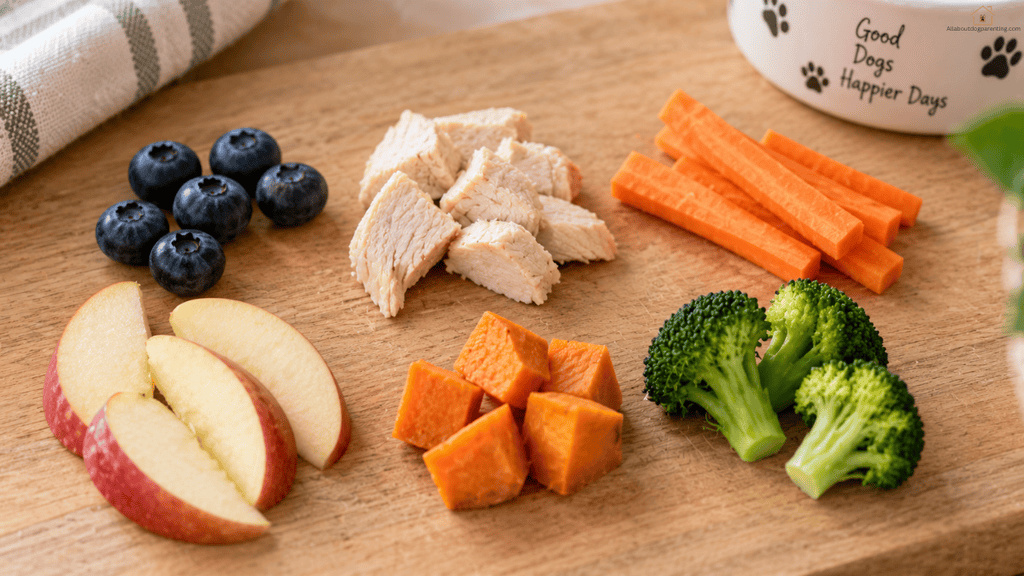
Stock these 10 foods for healthy, quick puppy treats and meal toppers: boiled chicken, blueberries, carrots, plain pumpkin, eggs, plain yogurt, cucumber, sweet potato, green beans, and watermelon. All are safe, nutritious, and considerably cheaper than most commercial treats.
This is the practical short-list of safe human food for dogs for owners who want a kitchen pantry approach to puppy feeding. Keep these stocked, and you’ll never reach for a processed commercial treat when you need something for training or a food topper.
1. Boiled chicken
The most versatile item on this list of safe human food for dogs. Shred a chicken breast, store in the fridge for up to four days or freeze in weekly batches. High protein, zero additives, and most puppies will do anything for it. Hundreds of training rewards from a $5 investment.
2. Blueberries
Perfect training treat size, genuinely nutritious, and most puppies eat them like candy. Keep a bag in the freezer. They’re just as good frozen as fresh and last for months.
3. Carrots
Raw carrots are excellent for teething puppies. Low calorie, hard enough to provide some gum stimulation, and available in any kitchen. Cut them small for training use.
4. Plain canned pumpkin
When you try to ascertain what human food can puppies eat, pumpkin is always a frontrunner because of its many benefits for your pet’s gut health. But here is a caveat: pumpkin pie filling or canned pumpkin is not a good option. Instead, use plain pumpkin, which settles upset stomachs, firms soft stools, and most puppies eat readily mixed into kibble.
5. Eggs
If you’re wondering what human foods puppies can eat, you can never go wrong with eggs. Scramble one in a dry pan or boil and crumble. One of the most bioavailable protein sources available and genuinely useful as a topper when your puppy is off their food or transitioning to a new diet.
6. Plain yogurt
A tablespoon mixed into kibble adds probiotic benefit, especially useful during and after food transitions or antibiotic courses. Buy plain, unsweetened, and always check for xylitol.
7. Cucumber
Essentially zero calories with a satisfying crunch. Excellent for puppies managing their weight and for hot-weather hydration. Most puppies enjoy it.
8. Sweet potato
Cook a batch on Sunday, cube it, and store it in the fridge. Gentle on the digestive system, nutrient-dense, and useful as a food topper or standalone treat throughout the week.
9. Green beans
Plain steamed green beans are one of the most useful tools for overweight puppies. They add volume to meals without meaningful calories. Most puppies eat them readily.
10. Watermelon
Seedless, rind removed, cubed small. Outstanding for summer and hot-weather hydration. Very low calorie and most puppies find it irresistible.
For the full guide to using these as training rewards within a daily calorie budget, our best puppy treats for training guide covers exactly how to work fresh food into training sessions without disrupting daily nutrition. And for incorporating these foods more regularly into your puppy’s diet as toppers and meal additions, our homemade puppy food guide covers the full approach.
Human Foods That Are Always Off-Limits
Overview:
Chocolate, grapes and raisins, onions and garlic, xylitol, macadamia nuts, alcohol, raw bread dough, avocado, and caffeine are always toxic to puppies. No amount is safe. See our complete toxic foods guide for severity levels and emergency steps.
While the answer to can puppies eat human food is yes, there are limitations. Certain foods are toxic to dogs. So, this is the non-negotiable list. The foods in the table above have nuance, preparation requirements, and serving limits. The foods below have none. They are off-limits in any amount, in any preparation, at any time.
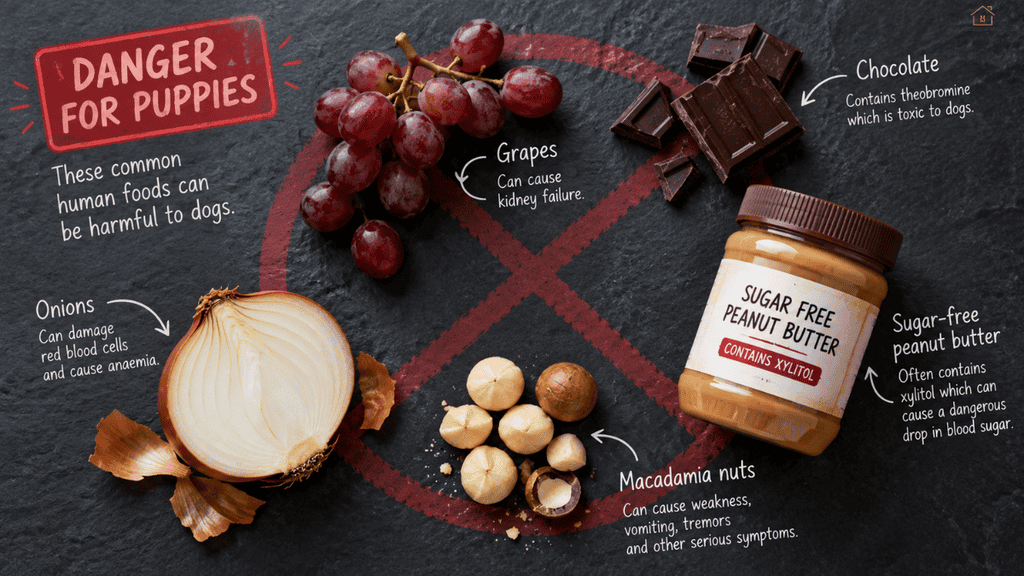
| Food | Why It’s Toxic | Emergency Action |
| Grapes, raisins, sultanas, currants | Can cause acute kidney failure. No safe dose established. | Emergency vet immediately |
| Onion, garlic, leeks, chives (all allium) | Damage red blood cells. Causes haemolytic anaemia. Cumulative. | Call vet even if no symptoms |
| Xylitol (artificial sweetener) | Causes rapid hypoglycaemia and liver failure | Emergency vet immediately |
| Chocolate | Theobromine toxicity. Cardiac and neurological effects. | Vet call with type and amount eaten |
| Macadamia nuts | Unknown toxin causes weakness, tremors, fever | Vet consultation |
| Alcohol (including raw bread dough) | CNS depression, respiratory failure, death | Emergency vet immediately |
| Caffeine | Methylxanthine toxicity. Same mechanism as chocolate. | Vet call immediately |
| Avocado | Persin causes vomiting, diarrhoea, myocardial damage | Vet consultation |
The ASPCA Animal Poison Control Center is available at 888-426-4435 for any suspected ingestion of these foods. Our foods toxic to puppies guide covers each of these in full detail, including dose thresholds, hidden sources, and what to do in the first 30 minutes.
FAQs
1. Can I feed my puppy table scraps?
Plain, unseasoned foods from the safe list above are fine in moderation, up to 10% of daily calories. What you shouldn’t do is feed from the dining table, which creates begging habits. Put the food in their bowl or use it as a training reward. Avoid anything seasoned, fried, buttered, or prepared with garlic or onion, which eliminates most food as it arrives on a human dinner plate.
2. What human food is best for puppy training treats?
Boiled chicken pieces, blueberries, and small carrot bits are the top three. All are low-calorie, high-motivation, and eaten instantly without interrupting the training rhythm. Plain yogurt works well for licking off a spoon as a reward for calm behaviour.
3. Can puppies eat cheese?
Yes, small amounts of plain low-fat cheese are safe for most puppies. Cheese is high-value as a training treat because of its strong smell and fat content. The issue is that many puppies are lactose-intolerant to some degree, and regular cheese feeding can cause loose stools or gas. Use it as a high-value reserve for difficult commands rather than an everyday treat, and watch for any digestive response the first few times.
4. Can puppies eat peanut butter?
Yes, with one non-negotiable check first. Flip the jar over and read the ingredient list. If xylitol, birch sugar, or birch extract appears anywhere on the list, do not use it. Natural peanut butter containing only peanuts and salt is safe in small amounts. The problem is that some brands marketed as natural or reduced-sugar use xylitol as a sweetener, and xylitol is acutely life-threatening for dogs.
5. How much human food can I give my puppy each day?
Keep it at 10% or less of daily calorie intake. For a medium puppy eating 900 calories per day, that is 90 calories from human food, roughly 2 to 3 tablespoons of cooked chicken, a small handful of blueberries, or a few tablespoons of plain pumpkin. Anything above 10% starts displacing the balanced nutrition in their complete puppy food.
The Bottom Line
Can puppies eat human food? Yes, and plenty of it. Plain cooked chicken, eggs, blueberries, carrots, cucumber, sweet potato, green beans, plain yogurt, plain pumpkin, and cooked salmon are all safe, nutritious additions to a puppy’s treat and topper repertoire. They are cheaper than most commercial treats, ingredient-transparent, and in many cases genuinely healthier.
The rules are simple: 10% of daily calories maximum, plain preparation always, never from the table, and check the toxic list before sharing anything new. The comprehensive tables in this article cover what human food for puppies is safe, how to prepare it, and how much to give based on your puppy’s size. Keep the short list of 10 foods stocked in your kitchen, use them freely within the 10% budget, and you’ll spend less on treats while feeding your puppy better.