Best Puppy Food for Large Breeds: 6 Evidence-Based Picks
🐾 Overview
The best large-breed puppy foods are AAFCO-certified for “growth of large-sized dogs,” contain controlled calcium between 1.2 and 1.8% dry matter, and come from brands with veterinary nutritionists on staff. Top picks: Purina Pro Plan, Hill’s Science Diet, Royal Canin, Eukanuba, Iams, and The Farmer’s Dog.
Most best puppy food for large breed articles you’ll find online are written by people who earn a commission every time you click buy. PetMD is affiliated with Chewy, the pet retailer. Dog Food Advisor earns affiliate commissions on its product links. The recommendations on almost every page-one result are shaped, at least in part, by which brands pay the best rates.
This article, part of our Complete Guide to Puppy Nutrition, earns nothing from any product on this list. No affiliate links, no brand partnerships. The six foods below were chosen because they meet specific nutritional criteria that every large-breed puppy owner should understand before they buy anything at all.
Why Large-Breed Puppies Need Different Food
🐾 Overview
Large-breed puppies need controlled calcium, moderate calories and a balanced calcium-to-phosphorus ratio. Standard puppy food can contain more calcium than they handle safely, and excess calcium is linked to skeletal malformations and osteochondrosis.
Most puppy owners don’t know this when looking for the best puppy food large breeds. I didn’t, until I was researching food for my first German Shepherd. Once I understood the calcium problem, I stopped browsing by brand name and started checking percentages.
Here’s the biology in plain language:
Large and giant breeds can take up to two years to reach adult weight, while small breeds typically finish growing by 6 to 8 months. That extended growth window means more time for nutritional errors to compound. And unlike adult dogs, puppies cannot adequately regulate how much dietary calcium they absorb, so excess calcium in the bowl ends up in a growing skeleton.
AAFCO sets specific calcium limits for food labelled for large-breed puppy growth: a minimum of 1.2% and a maximum of 1.8% on a dry-matter basis, calculated for food at 4,000 kcal per kg, so a lower-calorie food can sit slightly below 1.2% and still meet the standard. Standard puppy food can contain up to 2.5% calcium, far too high for a large-breed puppy. The consequences of getting this wrong are significant. When Great Dane puppies were fed three times the recommended calcium, researchers found disrupted bone formation and retained cartilage comparable to osteochondrosis, and large-breed puppies on high-calcium diets have shown retained cartilage cores and delayed skeletal maturity. These conditions can be painful, expensive to manage, and in some cases permanent.
Too little calcium creates a different set of problems: weakened skeletal structure, nutritional secondary hyperparathyroidism, and fractures during growth. The target range is narrow for a reason.
Large-breed puppy food also runs lower in fat and calories. Purina’s own range shows the difference: Pro Plan Large Breed Puppy has 13% fat and 419 kcal per cup, against 18% fat and 456 kcal for its standard puppy formula. Moderating calories moderates the rate of growth, which protects developing joints.
A puppy that grows too fast puts more stress on growth plates that aren’t ready for it, and a lifetime study of Labradors found that dogs kept lean developed arthritis later. Labs are especially prone to overeating, which is why our Labrador puppy food guide puts so much weight on portion control.
For a detailed look at how growth timelines differ by breed size and what that means for care decisions across puppyhood, our puppy growth stages guide covers the full picture.
Large Breed vs Giant Breed: Does the Distinction Matter?
🐾 Overview
Giant breeds grow for longer than large breeds, so their skeletons spend longer under calcium-related stress. The calcium limits are the same, but the margin for error matters more over a longer growth period.
Giant breeds such as Great Danes, Mastiffs, Saint Bernards and Newfoundlands are usually defined as dogs that will weigh over 90 to 100 lb as adults. Chewy uses 90 lb, and Royal Canin uses 100 lb. Not sure which side of that line your puppy will land on? Our puppy weight chart by breed estimates adult size.
According to the AKC, giant breed puppies grow until 12 to 18 months, and the very largest, like Mastiffs, may not reach full size until 24 months. VCA Animal Hospitals notes that large and giant breeds can take up to two years to reach adult weight. That’s months of extra growth during which a puppy on the wrong calcium level keeps accumulating risk.
Here’s the reassuring part: the regulations have no separate giant-breed category. AAFCO’s large-size growth standard covers any puppy expected to weigh 70 lb or more as an adult, so it applies to giant breeds as well. The label wording that matters is “including growth of large-sized dogs.” For more precision with a giant breed, Royal Canin offers Giant Puppy for 2 to 8 months, followed by Giant Junior from 8 to 18 or 24 months, both for dogs expected to exceed 100 lb. Both carry the large-size AAFCO statement and are less calorie-dense than the large-breed formula (338 and 311 kcal per cup, against 349).
For how long each size keeps growing and the signs growth is finishing, see our guide on when puppies stop growing.
How We Selected These Foods (Our Criteria)
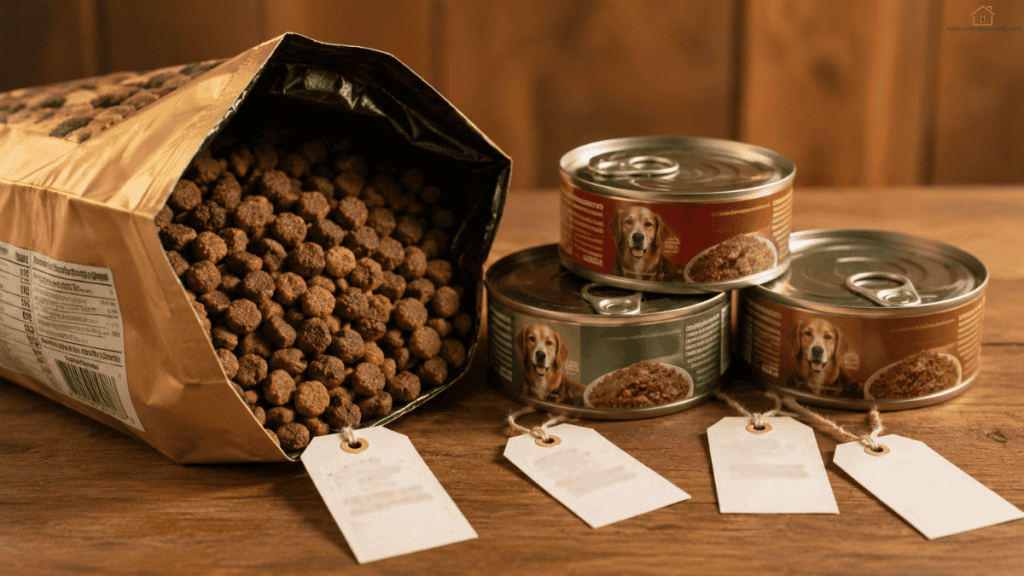
Every food on this best puppy food large breed list is formulated for large-breed puppy growth, has calcium controlled within AAFCO’s large-breed limits, comes from a brand with veterinary nutritionists on staff, and is available at a reasonable price point. Most are also validated through feeding trials. We also factored in large breed puppy food reviews from real users.
1. AAFCO statement specifically for large-size dogs
The label must read “complete and balanced for growth of large-size dogs” or “all life stages including growth of large-size dogs.” The generic “for growth” statement is not sufficient. The large-breed-specific designation is what triggers the stricter calcium limits. If a food doesn’t carry this statement, it doesn’t belong in a large breed puppy food comparison regardless of how good the ingredients look.
2. Calcium 1.2 to 1.8% dry matter, phosphorus 1.0 to 1.6%, calcium-to-phosphorus ratio between 1:1 and 2:1
These figures come directly from AAFCO’s large-breed growth nutrient profiles. Most bags list only a calcium minimum (usually 1.1% as fed), not the maximum, so you may need to check the manufacturer’s published nutritional data or call them for the full figure.
3. Brand employs board-certified veterinary nutritionists
The single best proxy for formulation quality is whether the brand employs Diplomates of the American College of Veterinary Nutrition (DACVN). These are specialists, not general-practice vets, who formulate and verify diets. Every brand on this list meets this standard.
4. Feeding trial validation
AAFCO offers two paths to the “complete and balanced” claim: nutrient profile formulation (meeting standards on paper) and feeding trials (testing on actual dogs over time). Feeding trials are the higher bar. The majority of our picks have completed AAFCO feeding trials, not just formulation testing.
5. Widely available and reasonably priced
A food that’s difficult to source or costs more than most owners can sustain over 14 to 18 months of puppyhood isn’t a practical recommendation. Every pick on this list is available through major retailers.
The 6 Best Puppy Foods for Large Breeds (2026)
🐾 Overview
Our best puppy food large breed picks in this span budget to premium: Purina Pro Plan Large Breed Puppy (best overall), Hill’s Science Diet Large Breed Puppy (best for sensitive stomachs), Royal Canin Large Puppy (best breed-specific range), Eukanuba Large Breed Puppy (best mid-range alternative), Iams Large Breed Puppy (best budget), and The Farmer’s Dog (best fresh option).
Here is a detailed look at what each of these offer:
Pick 1: Purina Pro Plan Large Breed Puppy — Best Overall
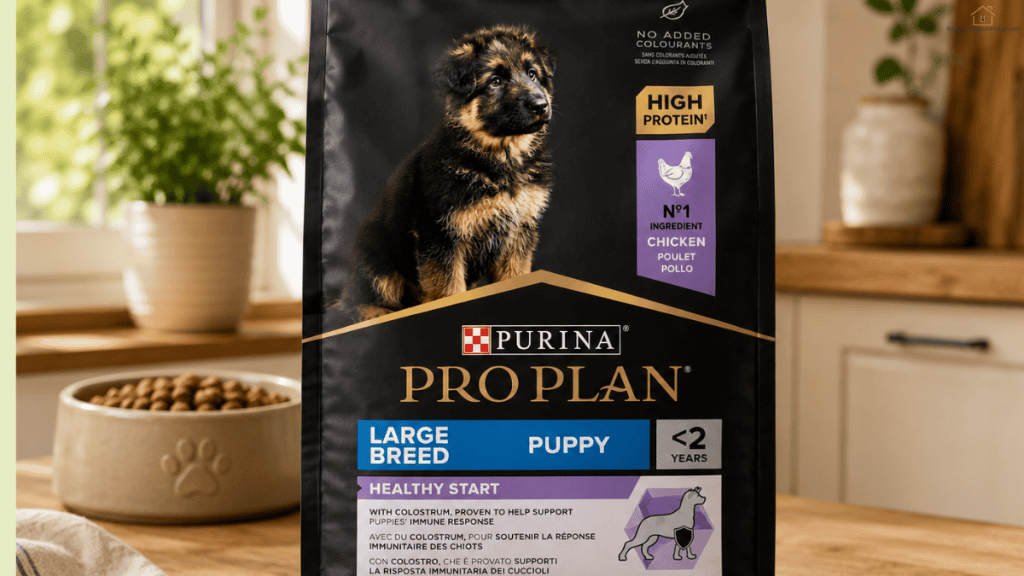
Purina employs board-certified veterinary nutritionists, and Pro Plan is one of the brands most often recommended in veterinary clinics. This formula’s AAFCO statement for all life stages, including growth of large dogs, is backed by feeding tests, and it includes DHA from fish oil for brain and eye development during the growth phase.
| Spec | Value |
|---|---|
| Protein | 28% min |
| Fat | 13% min |
| Calcium | 1.1% min (as fed) |
| Kcal/cup | 419 |
| Price estimate | ~$55–65 per 34 lb bag (~$1.70/lb) |
Best for: Most large-breed puppies. It’s the proven, widely available default that consistently earns large breed puppy food vet-recommended status across multiple veterinary nutrition sources.
Drawback: Contains poultry by-product meal, corn and wheat. All are nutritionally adequate and extensively studied, but some owners prefer to avoid them.
Pick 2: Hill’s Science Diet Large Breed Puppy — Best for Sensitive Stomachs
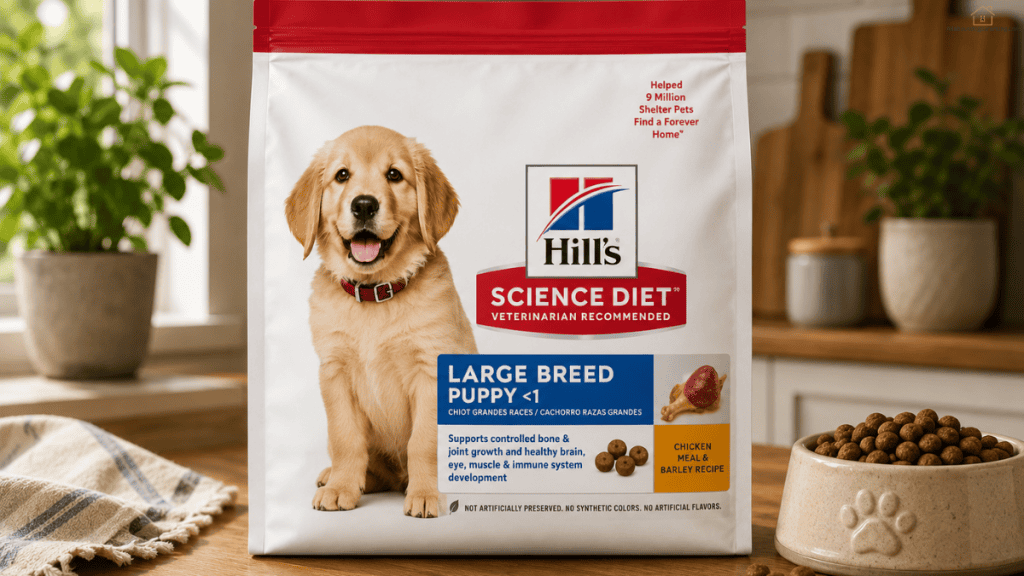
Hill’s employs a large team of veterinarians and nutritionists, and its large-breed puppy formula includes glucosamine and chondroitin for joint support during the growth phase. Chicken, brown rice and whole grain oats lead the ingredient list, and calcium is tightly controlled. Its AAFCO growth claim is backed by feeding tests, and it’s widely used in veterinary clinics.
| Spec | Value |
|---|---|
| Protein | 26.7% (dry matter) |
| Fat | 15.4% (dry matter) |
| Calcium | 1.16% (dry matter) |
| Kcal/cup | 387 |
| Price estimate | ~$60–75 per 30 lb bag (~$2.20/lb) |
Best for: Large-breed puppies with sensitive digestion. German Shepherd owners specifically. GSDs are well-documented for stomach sensitivity, and Hill’s Science Diet handles that consistently well in my experience. PS: Our German Shepherd puppy food guide covers the breed’s other needs in detail.
Drawback: Higher price per pound than Purina Pro Plan. Hill’s lists its nutrients on a dry-matter basis, which reads higher than the as-fed figures other brands use, so compare carefully.
Pick 3: Royal Canin Large Puppy — Best Breed-Specific Range
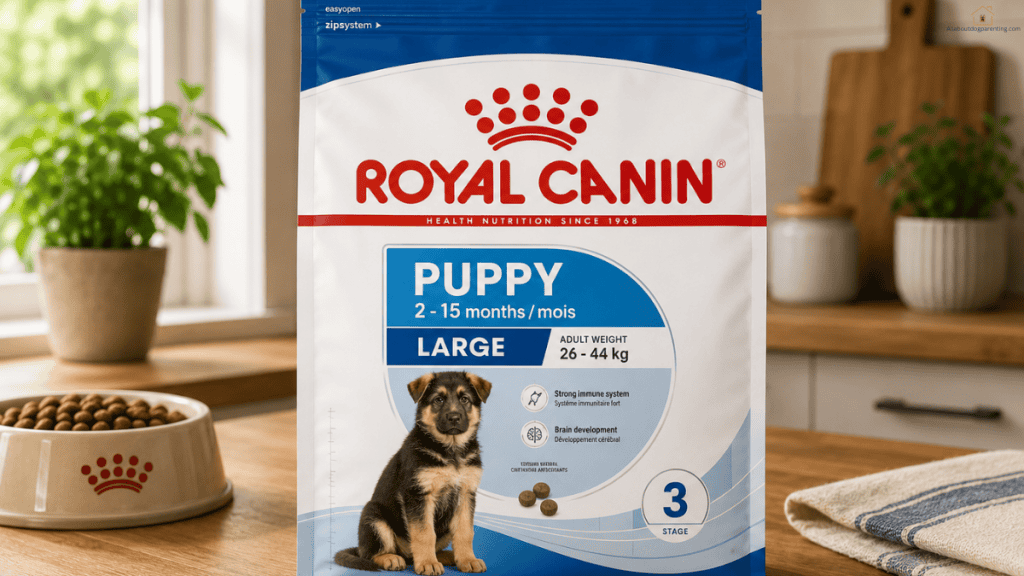
Royal Canin’s greatest strength is specificity. Its Large Puppy formula is designed for puppies who will weigh 56 to 100 lb as adults, fed up to 15 months. Beyond that, Royal Canin offers breed-specific lines for German Shepherds, Labradors, Golden Retrievers and others, each calibrated to the particular developmental needs and known health risks of that breed. If you own a GSD, the German Shepherd Puppy formula accounts for the breed’s joint and digestive considerations directly.
| Spec | Value |
|---|---|
| Protein | 28% min |
| Fat | 14% min |
| Calcium | Not published by Royal Canin |
| Kcal/cup | 349 |
| Price estimate | ~$65–80 per 30 lb bag (~$2.40/lb) |
Best for: Owners who want breed-specific formulation. Particularly relevant for GSD, Labrador and Golden Retriever owners. (If you have a Golden, see our full guide to Golden Retriever puppy food.) Among the best large breed puppy food options for owners who want to go beyond generic large-breed standards.
Drawback: The most expensive kibble option on this list. Chicken by-product meal is the first ingredient, followed by corn and wheat, which some owners prefer to avoid.
Pick 4: Eukanuba Large Breed Puppy — Best for Active Puppies
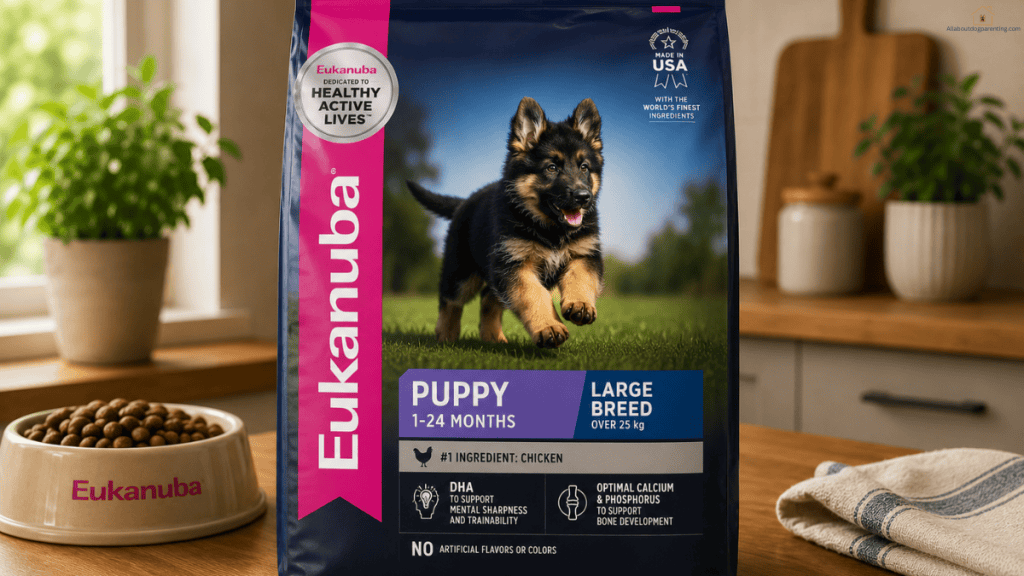
Mars Petcare employs veterinary nutritionists across its brands, and Eukanuba’s large-breed puppy formula is a solid, widely sold alternative to Purina and Hill’s. Chicken is the first ingredient, the formula is made to meet AAFCO’s growth profile including large dogs, and it includes DHA for brain development, an area Eukanuba puts particular emphasis on.
| Spec | Value |
|---|---|
| Protein | 25.5% min |
| Fat | 13% min |
| Calcium | 1.1% min (as fed) |
| Kcal/cup | 351 |
| Price estimate | ~$79 per 33 lb bag at PetSmart (~$2.40/lb) |
Best for: Owners who want a widely available alternative to Purina and Hill’s with the same large-breed safeguards.
Drawback: Lower protein than Purina or Royal Canin. Contains chicken by-product meal, wheat, corn and soybean meal.
Pick 5: Iams Large Breed Puppy — Best Budget Pick
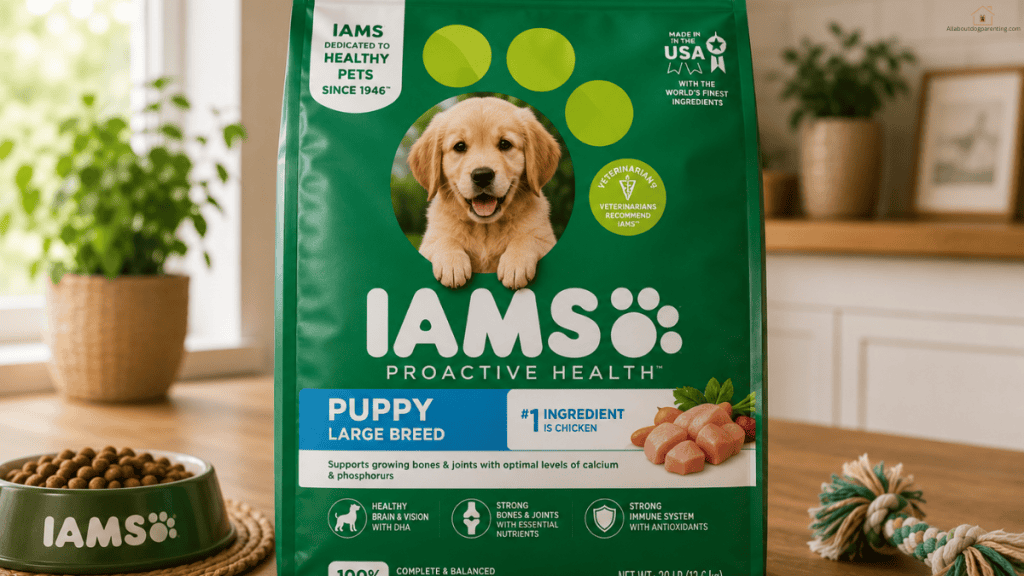
Iams delivers on the two things that matter most in puppy food for large breed dogs: a formula made for large-breed growth and controlled calcium, at a price point well below the premium tier. Iams describes it as complete and balanced for large-breed puppies who will weigh 51 to 90 lb as adults. Farm-raised chicken is the first ingredient, and DHA from fish oil is included for brain development. This is the pick for owners who need a nutritionally complete food at the lowest price on this list.
| Spec | Value |
|---|---|
| Protein | 24% min |
| Fat | 12% min |
| Calcium | 1.1% min (as fed) |
| Kcal/cup | 375 |
| Price estimate | ~$35–45 per 30 lb bag (~$1.30/lb) |
Best for: Budget-conscious owners who still want a food specifically formulated for large-breed growth. At around $40 per month, it’s the most sustainable option over 14 to 18 months of puppyhood.
Drawback: The lowest protein on this list. Contains corn and chicken by-product meal, with fewer premium ingredients overall.
Pick 6: The Farmer’s Dog — Best Fresh Option
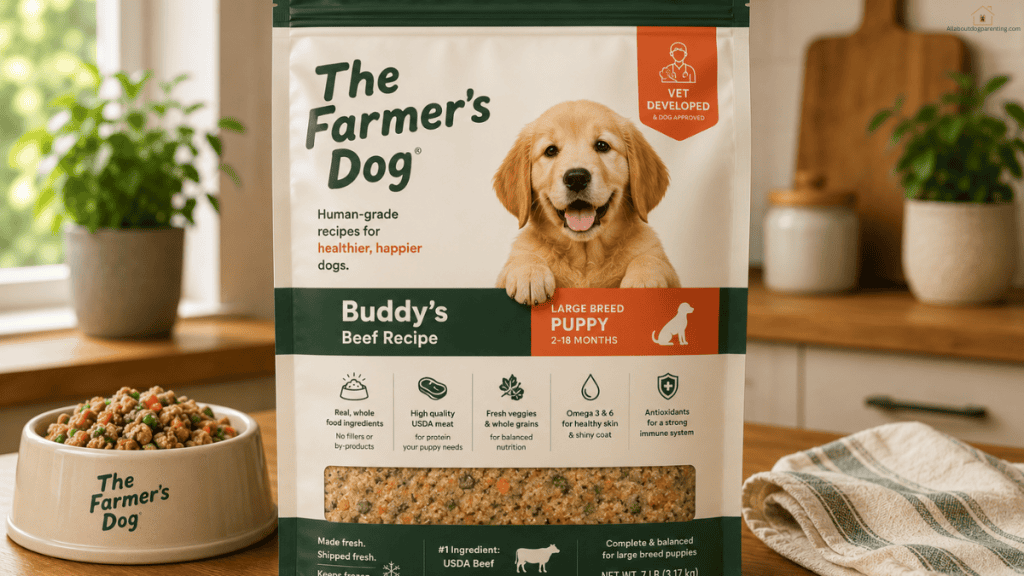
Among fresh food subscriptions, The Farmer’s Dog is one of the few with recipes formulated to meet AAFCO standards for all life stages, which includes growth. Human-grade whole ingredients, pre-portioned, delivered frozen. The nutritional profile is excellent. The cost is significant.
| Spec | Value |
|---|---|
| Protein | About 33% dry matter (Turkey recipe) |
| Fat | About 19% dry matter (Turkey recipe) |
| Calcium | Not published per recipe |
| Kcal/serving | Custom-portioned |
| Price estimate | ~$6–15/day for large breeds ($180–450/month) |
Best for: Owners with the budget for premium fresh food who want maximum ingredient transparency and minimal processing. Our fresh dog food for puppies guide covers the full cost analysis for large breeds over 14 months of puppyhood, which is worth reading before committing.
Drawback: Three to five times the cost of kibble. Requires freezer space. Not practical for puzzle feeders or training reward use. For most large-breed puppy owners, using a small amount as a kibble topper rather than a full subscription plan is the more sustainable approach. Before relying on it as a full diet, confirm with The Farmer’s Dog that your recipe meets AAFCO’s growth standard for large size dogs.
Side-by-Side Comparison Table
All of the best puppy food large breed picks compared across protein, fat, calcium, calories, price, and whether the brand employs veterinary nutritionists and conducts feeding trials.
| Brand | Protein | Fat | Calcium | Kcal/Cup | Price/lb | Vet Nutritionists | Feeding Trials | Best For |
|---|---|---|---|---|---|---|---|---|
| Purina Pro Plan | 28% | 13% | 1.1% min | 419 | ~$1.70 | Yes | Yes | Most puppies |
| Hill’s Science Diet | 26.7% DM | 15.4% DM | 1.16% DM | 387 | ~$2.20 | Yes | Yes | Sensitive stomachs |
| Royal Canin | 28% | 14% | Not published | 349 | ~$2.40 | Yes | Formulated | Breed-specific needs |
| Eukanuba | 25.5% | 13% | 1.1% min | 351 | ~$2.40 | Yes | Formulated | Mid-range alternative |
| Iams | 24% | 12% | 1.1% min | 375 | ~$1.30 | Yes | Check bag | Budget-friendly |
| The Farmer’s Dog | ~33% DM | ~19% DM | Not published | Custom | ~$6–15/day | Yes | Formulated | Premium fresh |
Every brand on this list employs veterinary nutritionists. That’s a deliberate selection criterion, not a coincidence. Formulation quality is where large-breed puppy health is won or lost, and board-certified nutritionists are the best insurance you can buy that the calcium-phosphorus ratios are actually right.
What to Look for on the Label (And What to Avoid)
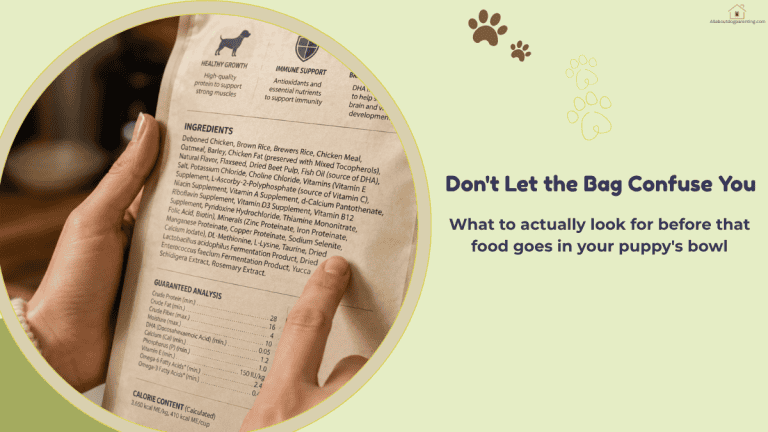
Look for an AAFCO statement specifying “growth of large-size dogs,” a named protein as the first ingredient, calcium below 1.8%, and evidence the brand employs veterinary nutritionists. Avoid foods without the large-breed AAFCO specification, vague ingredient labelling, and grain-free formulas heavy in legumes. Reading a puppy food label for large breeds comes down to four things.
Must have
The AAFCO statement must specifically mention “large-size dogs” or “large breed.” The generic “for growth” or “all life stages” statement without that specification does not guarantee the calcium controls that large-breed puppies need. This is the single most important label check.
A named animal source as the first ingredient: chicken, beef, salmon, lamb, or a named meal such as chicken meal or chicken by-product meal. Not “meat” or “animal protein,” vague terms that could include anything. Calcium between 1.2 and 1.8% on a dry-matter basis. Most bags list only a minimum, so if the full figure isn’t there, call the manufacturer or check their published nutritional data sheet. Reputable brands provide this information on request.
DHA from a named source, typically fish oil or fish meal. DHA supports brain and eye development during the growth phase.
Need a chicken-free option? All six picks above contain chicken or chicken by-products. If your puppy needs to avoid chicken, look for a salmon-, lamb- or beef-based formula that carries the same AAFCO “growth of large size dogs” statement and lists its calcium, and check the full ingredient list, since chicken fat and chicken meal often appear further down.
Red flags
Any food without the large-breed-specific AAFCO statement. Marketing language about “natural ingredients” or “holistic nutrition” without that regulatory statement means nothing nutritionally.
Grain-free formulas where peas, lentils, or chickpeas appear in the first five ingredients. The FDA’s DCM investigation found a statistical association between high-legume grain-free diets and heart disease. Our grain-free vs grain-inclusive guide covers the full evidence. For large-breed puppies already navigating narrow nutritional requirements, adding unanswered questions about cardiac risk isn’t worth it.
Brands that don’t disclose their formulation team. A company that won’t tell you whether veterinary nutritionists developed their food is telling you something by not telling you. Once you’ve chosen a food, our guide on how much to feed a puppy covers portion calculations by breed size and calorie targets by age.
FAQs
1. What makes large-breed puppy food different from regular puppy food?
Large-breed puppy food has controlled calcium between 1.2 and 1.8% dry matter, compared to up to 2.5% in standard puppy formulas. Fat and calories are also moderated to control growth rate. These limits exist because puppies cannot adequately regulate calcium absorption during development, and excess calcium is linked to skeletal problems including osteochondrosis. Always look for the AAFCO statement specifying “growth of large-size dogs.”
2. When should a large-breed puppy switch to adult food?
Most large breeds should switch between 14 and 18 months, and giant breeds between 18 and 24 months. The trigger is reaching approximately 80% of the expected adult weight, with your vet confirming growth is complete. Don’t switch based on age alone. Our guide on when to switch your puppy to adult food covers breed-size specifics, readiness signs, and the 10-day transition process.
3. Can I feed my large-breed puppy regular puppy food?
Not recommended. Standard puppy food contains calcium levels that can cause skeletal problems in large-breed puppies during the growth phase. If large-breed-specific food genuinely isn’t available, look for a standard puppy food with calcium below 1.5% on a dry-matter basis and discuss the specifics with your vet. This should be a temporary measure, not a long-term solution.
4. Is grain-free food safe for large-breed puppies?
Most veterinary nutritionists recommend grain-inclusive food as the default for puppy food for large breed dogs. The FDA investigated a statistical association between grain-free diets high in legumes and dilated cardiomyopathy. For large-breed puppies already working within narrow calcium requirements, adding DCM-related uncertainty isn’t worth it unless your puppy has a confirmed grain allergy.
5. How much does large-breed puppy food cost per month?
Quality large-breed kibble runs $50 to $80 monthly for most large breeds. Royal Canin sits slightly higher at $65 to $80. The Farmer’s Dog costs $180 to $450 monthly for large breeds. Budget options like Iams run $35 to $45 monthly while still meeting all AAFCO large-breed growth standards.
6. Is large-breed puppy food okay for giant breeds?
Yes, AAFCO’s large-size growth standard applies to any puppy expected to weigh 70 lb or more as an adult, which covers giant breeds as well as large ones. What changes for giant breeds is the timeline: they stay on puppy food longer, often until 18 to 24 months, because they keep growing for longer. Royal Canin’s Giant Puppy and Giant Junior formulas are calibrated further for dogs over 100 lb, but any food carrying the large-size AAFCO statement is nutritionally appropriate throughout.
The Bottom Line
The best puppy food large breed decision comes down to one thing before any product comparison: confirming the food meets the AAFCO large-breed growth specification, with calcium controlled between 1.2 and 1.8%. Every pick on this list clears that bar. The differences after that are protein content, ingredient quality, price, and which specific situation each food serves best.
This is also a long-term commitment. A large-breed puppy stays on puppy food for 14 to 18 months. Factor the monthly cost into your decision as carefully as the ingredient list. A food that’s nutritionally excellent but financially unsustainable doesn’t serve your puppy over the full growth window. Any of the six picks above can take your puppy from 8 weeks to adult transition with healthy joints, consistent growth, and sound nutritional support throughout. Pair whichever you choose with a consistent puppy feeding schedule by age. Steady meal timing makes it far easier to spot appetite and growth changes early.