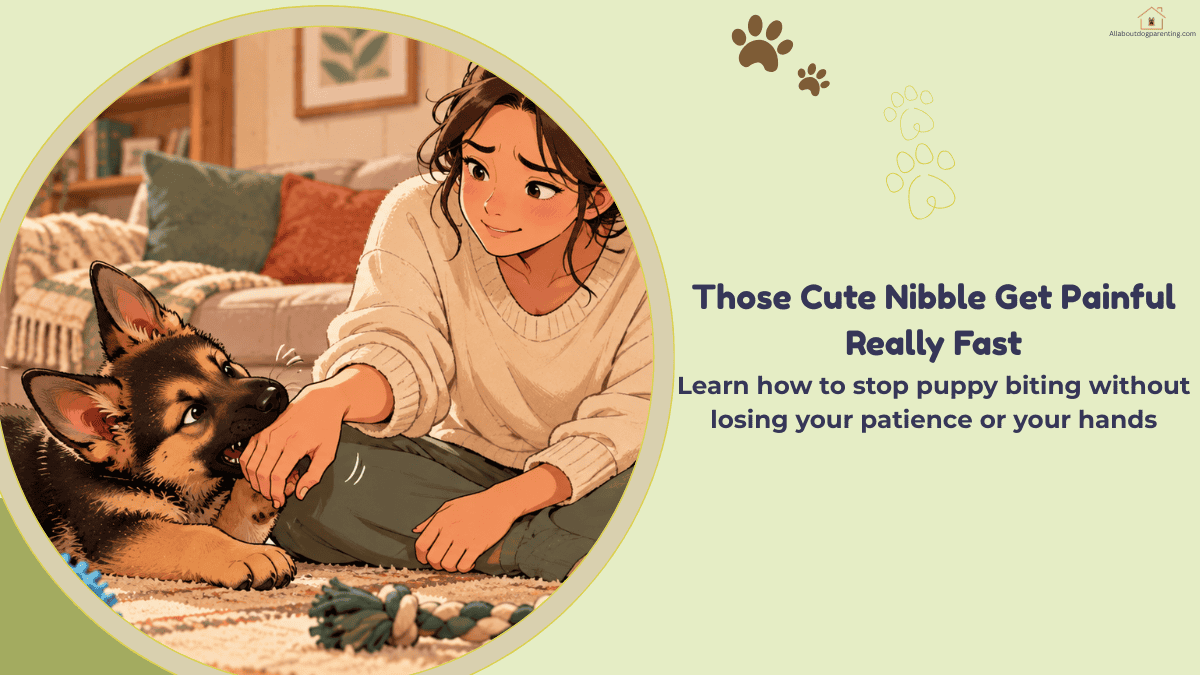
How to Stop a Puppy from Biting and Nipping
🐾 Overview
When your puppy bites, calmly leave for 30 seconds, then return with a toy. If biting turns frantic, your puppy is probably overtired and needs a crate nap. Most puppies stop biting hard by five to six months.
To stop puppy biting, you need two things working together: a calm, consistent response every time teeth land on skin, and enough sleep that your puppy has the self-control to learn from it. If your hands look like they lost a fight with a cheese grater and you’ve been searching how to stop puppy from biting all week, start with the reverse time-out below. It takes 30 seconds and you can use it today.
This article, part of our Complete Guide to Puppy Training, covers how to stop a puppy from biting at every stage: what’s normal at each age, how to build a soft mouth, why the evening meltdowns happen, and when biting needs a professional.
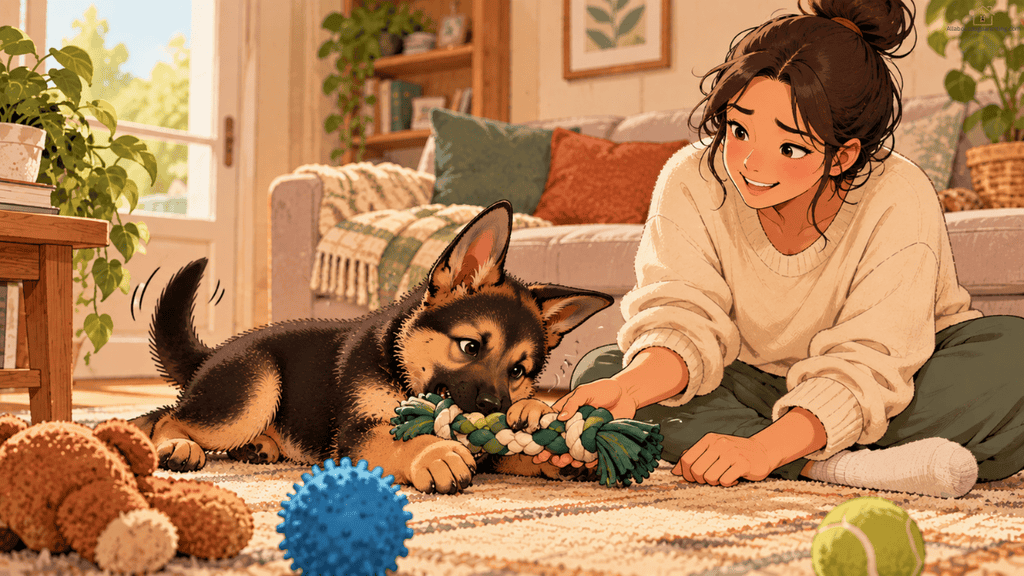
I’ll say this first, because you probably need to hear it: every puppy bites, and yours isn’t broken. My German Shepherd boy at nine weeks would usually mouth my hand so gently I barely felt his teeth. But if he was overtired and wound up, the bite was hard enough to cause pain and leave marks on the skin. I discovered that being overstimulated was the problem.
| Age | What biting usually looks like | Your main tool |
|---|---|---|
| 8–10 weeks | Constant, mostly soft exploration | Redirect to toys, start bite inhibition |
| 12–16 weeks | Harder, driven by teething | Frozen chew toys, stricter threshold |
| 4–6 months | Softer and shorter episodes | Naps, exercise, gentle mouthing only |
| 7 months and older | Hard biting should be gone | Vet check and a trainer if it isn’t |
Why Puppies Bite and Why It’s Usually Normal
🐾 Overview
Puppies bite to explore, play, relieve teething pain and tell you they’re tired. It’s normal development. The goal is teaching them how hard is too hard, and what to bite instead of you.
Puppy biting and nipping happen for four main reasons.
Exploration
The first is that puppies have no hands, so their mouth is how they work out what something is, whether it’s a shoelace or your thumb. This exploratory mouthing is soft and curious.
Play
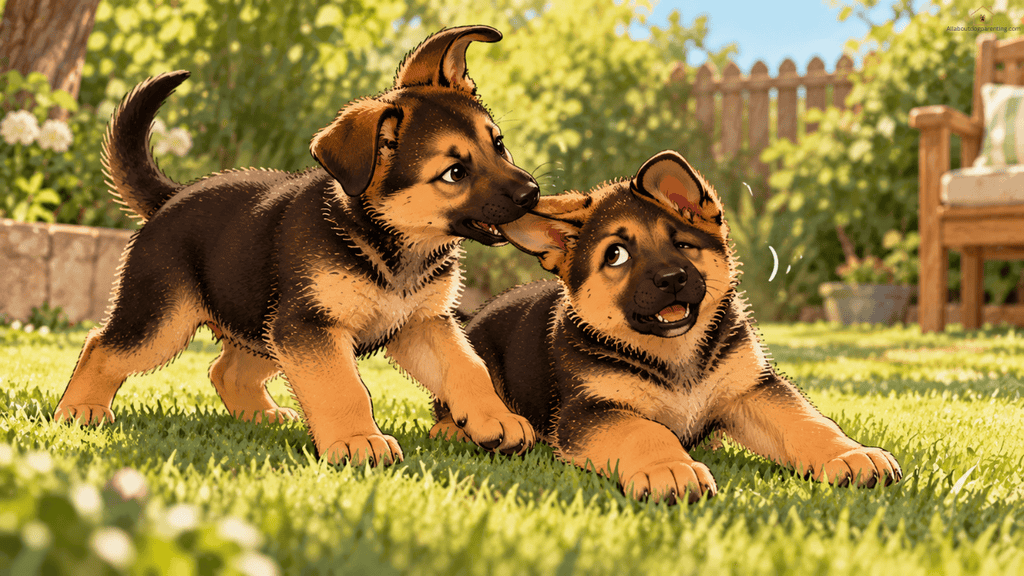
Play is the second reason, and the most important one for training. Littermates teach each other bite pressure through play: one puppy bites too hard, the other yelps and stops playing. The ASPCA describes this as how puppies first learn bite inhibition, which is a dog’s ability to control the force of its mouthing. Leaving the litter too early cuts that education short. One study found puppies separated at 30–40 days were more likely to develop problem behaviours than those who stayed until two months. Your job is to finish what the littermates started.
Teething
Teething is the third, and perhaps the most well-known, reason puppies bite. According to the AKC, baby teeth shed and adult teeth come through from about 12 to 16 weeks, with the adult set in by around six months.
Exhaustion
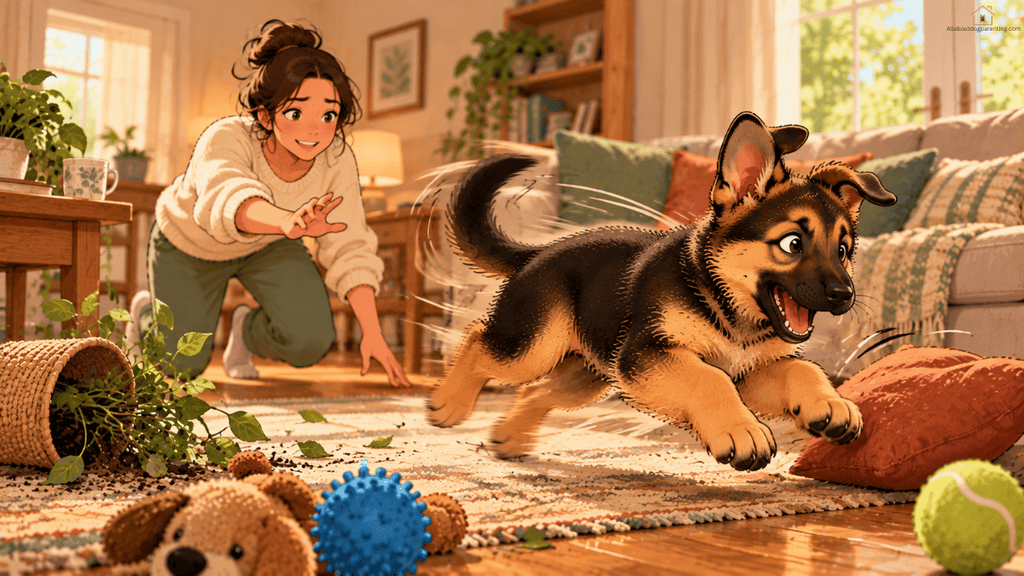
The fourth reason gets the least attention: exhaustion. A puppy who’s been awake too long stops listening, ignores the toy you’re offering and bites harder and faster. That’s a toddler meltdown with teeth.
What Is Bite Inhibition and Why It Matters More Than Stopping the Biting
🐾 Overview
Bite inhibition is a dog’s learned ability to control how hard they bite. A dog with good bite inhibition can mouth your hand without leaving a mark. It’s the most important safety skill you’ll teach your puppy.
If you remember one thing about how to stop puppy biting, make it this: the aim is a puppy who knows how to gently use their mouth, and only then a puppy who stops mouthing people. The ASPCA notes that dogs who learn gentle mouthing as puppies are less likely to bite hard and break skin if they ever bite out of fear or pain as adults. That’s the difference between a bruise and a hospital visit.
Most people want all mouthing gone on day one, but if you suppress every bite immediately, your puppy learns to avoid mouthing you without ever learning how hard is too hard. Veterinarian and behaviourist Ian Dunbar explains: you must teach a puppy to mouth gently before you stop the mouthing altogether, and he wants that soft mouth in place by about four and a half months, before the adult jaws develop.
🐾 How to Teach Bite Inhibition: The Phased Plan
- Weeks 1–2 at home: React only to hard bites, the ones that hurt. Ignore soft mouthing. Goal: no more painful bites.
- Weeks 3–4: Lower the bar. Medium-pressure bites now end play too. Soft mouthing is still allowed.
- Weeks 5–6: Only very gentle mouthing is tolerated. Anything firmer ends play.
- Weeks 7–8: Teeth on skin ends play. Your puppy learns to interact without mouthing you at all.
Puppy bite inhibition built this way, for a puppy who comes home at eight weeks, finishes around 16 weeks, comfortably inside Dunbar’s window. Each “ends play” moment is a reverse time-out, which is the next section. If your puppy struggles at a stage, stay there an extra week. Hand-feeding part of each meal also helps, since your puppy practises taking food gently from fingers. Our puppy feeding schedule by age shows how much to set aside at each meal.
The Reverse Time-Out Is Your Main Technique
🐾 Overview
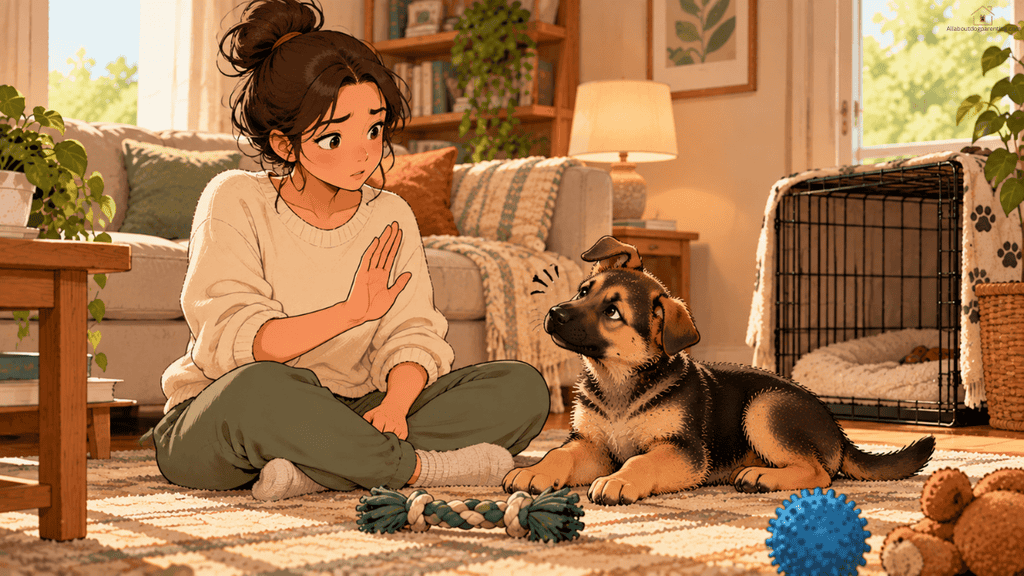
When your puppy bites, say “oops” calmly, stand up, turn away and leave for 30 seconds. Come back and play again. Teeth on skin means the fun person disappears. Most puppies start catching on within a few days.
Here’s the reverse time-out puppy owners can use to stop puppy biting during play, starting this afternoon:
- You’re playing and your puppy bites your hand.
- Say “oops” or “too bad” in a flat, neutral voice. It’s a marker, so keep anger out of it.
- Stand up straight away and say nothing else.
- Turn your back and walk away, stepping over a baby gate or out of the door if you can.
- Wait 30 seconds. It feels longer than it is, so count.
- Come back and play again, with a toy in your hand.
- If your puppy bites again soon after you return, repeat.
- If you’ve done three time-outs in five minutes, your puppy is probably overtired. Time for a crate nap. Think of it as a reset.
The ASPCA recommends a similar approach, with 30 to 60 seconds of ignoring or leaving the room for tooth contact. You leave and the puppy stays, because your attention is the reward.
About yelping: You’ll often be told to yelp like a littermate. Even the AKC says that a high-pitched “ow” makes some puppies more excited, and in my experience that includes a lot of confident, high-drive puppies. My GSD treated my yelp like a squeaky toy and came back harder. The reverse time-out has no such risk, which is why I’d make it your default.
🐾 Reverse Time-Out vs. Punishment
| Reverse time-out | Punishment |
|---|---|
| You leave the puppy | You put the puppy somewhere |
| Calm, neutral tone | Angry tone or physical correction |
| About 30 seconds | Long isolation |
| Puppy learns biting makes fun stop | Puppy learns hands are scary |
| Builds trust | Erodes trust |
Remember to never use the crate for punishing your pup for biting. It must remain a safe place for naps and calm.
How to Handle Puppy Biting by Age
🐾 Overview
At 8–10 weeks, biting is soft exploration. From 12–16 weeks, teething makes it harder. By 4–6 months, it should ease, and by seven months, hard biting should be gone. If not, see a professional.
Your approach to puppy biting must depend on what stage your pet is in.
8–10 weeks: Exploration
Puppy mouthing at this age is soft and constant, and puppy nipping hands and trouser legs is the norm. A puppy mouths everything at this age, so trying to stop puppy biting completely now is unrealistic. Redirect to a toy every time, start phase one of puppy bite inhibition, and use time-outs for the hard bites. The only real red flag is a puppy who stiffens and growls while biting, which is rare.
12–16 weeks: Teething
This is when puppy teething biting peaks and puppy biting hands starts to really hurt, because sore gums want pressure. The AKC suggests rubber teething toys you can freeze, and a frozen Kong does the same job. Count any food in it towards the day using our guide on how much to feed a puppy. Our round-up of toys for teething puppies has the ones that hold up. You should be in phase two now. Tiny lost teeth and a little blood on chew toys are normal. If your puppy also stops eating hard food or drools a lot, see your vet.
4–6 months: Biting should ease
Mouthing gets softer, episodes shorter, and your puppy can usually be redirected in one or two tries. Tighten the threshold to gentle mouthing only and add more exercise and brain work. Our list of mental stimulation activities helps on rainy days. If hard, frequent biting hasn’t shifted after four to six weeks of consistent time-outs, it’s time for a qualified trainer. Consider getting help if biting isn’t moderated by six months.
7 months and older: Hard biting should be gone
The adult teeth are in, so hard biting is no longer developmental. Some soft mouthing in play can hang on, especially in retrievers, and that’s fine as long as the pressure stays gentle. Persistent hard biting needs a vet check for pain, then a behaviour assessment. Our guide to puppy development stages explains what else changes now.
The Overtired Puppy: When Biting Means “I Need a Nap”
🐾 Overview
If your puppy turns into a biting tornado at predictable times, usually late afternoon or after visitors, they’re overtired. Young puppies need 18–20 hours of sleep. When they can’t self-regulate, they bite harder. The fix is a nap.
Puppy shark mode has a pattern. Check for these signs:
- Bites get harder, faster and more frantic
- Your puppy grabs the toy and your hand
- Body tense, movements jerky, eyes wide
- Zoomies and biting together
- It happens around the same time each day: early evening, after walks, after guests
Young puppies usually sleep 18 to 20 hours a day, and most won’t take that sleep without help. As a rule of thumb, puppies under four months should not stay awake for more than about an hour to an hour-and-a-half at a stretch. Once that limit has been hit, get your pup to nap for a similar duration or longer. Our puppy sleep schedule by age lays it out in detail.
If shark mode has already started, pick your puppy up from behind or with a towel to keep your hands away from their mouth, pop them in the crate with a frozen Kong, and walk away. Most fuss briefly and then crash. You aren’t crating them because they bit. Their brain is fried, and sleep is the reset. Puppy biting when excited after visitors or a long walk is the same story.
This changed everything with my first GSD. I thought he was getting more aggressive in the evenings, until I realised he’d been running on fumes since lunch. Once I enforced an afternoon nap, the evening piranha disappeared within days. The same goes for puppy biting at night. A puppy who mouths you at bedtime is usually overdue for sleep, so keep the last hour calm.
Puppy Biting and Children: Household Rules That Work
🐾 Overview
Teach children to “be a tree” when the puppy bites: stand still, fold arms, look away. No running or squealing near the puppy, supervise every interaction, and give puppy and children separate spaces.
Puppy biting children is the most common crisis I hear about, and kids make it harder to stop puppy biting. They move fast, squeal, wave their hands at mouth height, and usually respond to a nip by shrieking and running, which is the best game a puppy could ask for. It also matters for safety. The AVMA says about half of all dog bite victims are children.
To negate that risk, here are some house rules I’ve set in our home, and you should try them too:
1. Be a tree
When the puppy bites, children stop moving, fold their arms and look at the ceiling. A still, boring target loses its appeal fast. This comes from the Doggone Safe “Be a Tree” programme, and it’s worth practising with your kids before the puppy is in the room.
2. No running games near the puppy
If the kids want to run, the puppy goes into the crate or pen first.
3. Flat palms or the floor
Younger children shouldn’t hand-feed with fingers, which is where a lot of puppy nipping-at-hands incidents start. A flat palm, or treats tossed on the floor, keeps fingers out of the way.
4. Always supervised
The AVMA advises supervising young children around dogs at all times, however gentle either seems. Baby gates make that realistic.
5. The crate is off-limits
Children don’t reach into it, tap on it or follow the puppy into it. The puppy needs somewhere to escape to.
Puppy biting and nipping around kids eases faster when the puppy has calm early experiences with them, which is part of good socialisation. Our guide on how to socialise a puppy with other dogs and people covers it.
Breed-Specific Biting Patterns
🐾 Overview
Herding breeds nip ankles, retrievers mouth everything, terriers shake and tug, and bully breeds play with strong jaws. The same principles apply to all, but each breed type needs slightly different handling.
How you stop puppy biting depends partly on what your puppy was bred to do.
Herding breeds
Breeds like Border Collies, Aussies, Corgis, and German Shepherds often go for moving ankles and heels, because they were bred to move livestock. For puppy nipping at heels and puppy biting ankles, stop walking and stand still. Carrying a tug toy and offering it when your feet get ambushed also helps. Then give the instinct a legal outlet, like a flirt pole.
Retrievers
Retriever breeds like Labradors and Golden Retrievers were bred to carry game gently, and a retriever puppy mouths everything; a mouthy puppy is part of the package. Lean into bite inhibition work, since they take to soft mouths readily, and keep a toy handy. A retriever with something in their mouth isn’t mouthing you.
Terriers
They tend to grab, shake, and tug, which reflects their prey drive. Give them structured tug with rules: drop on cue, sit before the game restarts. They need more play, with a clear structure around it.
Bully breeds
Breeds such as French Bulldogs, English Bulldogs, and Staffies play persistently with strong jaws for their size. Rely heavily on the reverse time-out, and always end tug games on your terms.
When to Worry: Puppy Play Biting vs. Aggression
🐾 Overview
Play biting is loose and wiggly and stops when you disengage. Concerning biting is stiff, comes with growling or snapping, and escalates. If your puppy stiffens or bites over food, toys, or resting spots, get professional help.
When your dog is playful, you’ll notice a relaxed body and face, while aggression brings a stiff or frozen body, lips pulled back, and much more painful bites. Here’s how puppy play biting vs aggression usually looks side by side:
🐾 Play Biting or Concerning Biting?
| Play biting | Concerning biting |
|---|---|
| Loose, wiggly body | Stiff, tense or frozen body |
| Relaxed, open-mouthed play face | Lips pulled back, front teeth showing |
| Bites and lets go | Bites and holds, or shakes |
| Stops when you stop playing | Escalates when you move away |
| Responds to the reverse time-out | Doesn’t respond to redirection |
| Aimed at hands and feet during play | Aimed at the face, or triggered near food and toys |
| Playful growls at most | Low, sustained growling |
Get help promptly if your puppy bites when you approach their bowl, toy, or bed, bites when picked up or touched in one particular spot (see the vet first, since pain is a common cause), bites people or dogs outside play, or keeps biting harder despite four weeks of consistent work. A puppy biting hard and often at that point needs more than this guide. Any bite that breaks a child’s skin counts too. Our article on choosing the right dog trainer covers the credentials and red flags to look for.
Genuine aggression in young puppies is uncommon. Most of what looks aggressive is fear, pain, or overstimulation. When it is real, early help makes a big difference.
FAQs
1. When do puppies stop biting?
Most puppies stop biting hard by six to seven months, once teething ends and the adult teeth are in. Soft mouthing in play can carry on longer, especially in retrievers. If you still can’t stop puppy biting past seven months, it’s no longer a phase, so speak to a positive-reinforcement trainer.
2. Should I yelp when my puppy bites me?
It depends on the puppy. Yelping works for some sensitive puppies, but the AKC notes it excites others, which in my experience is common in high-drive breeds. The reverse time-out works regardless of temperament.
3. Is my puppy biting because they’re aggressive?
Almost certainly not. Most puppy biting is exploration, play, teething or overtiredness. A stiff body, sustained growling, or biting when you reach for their food or toys is different, and worth a call to a qualified behaviour professional.
4. Why does my puppy bite more in the evening?
Usually because they’re overtired. Young puppies need 18–20 hours of sleep, and many don’t nap on their own, so by late afternoon they can’t self-regulate. Schedule a crate nap about 30 minutes before the biting normally starts, and the evening chaos usually settles within days.
5. Why does my puppy only bite my kids?
Puppy biting when excited is most common around children, who move fast, squeal and wave hands at mouth height, and they often run when nipped, which makes the game more fun. Teach them to “be a tree,” keep running games away from the puppy, and supervise every interaction between your puppy and young children.
Bottom Line
If you take one plan away from this, make it three things: a calm 30-second exit when teeth touch skin, a phased push towards a soft mouth, and far more naps than you think your puppy needs. That’s how to stop a puppy from biting for the vast majority of puppies, usually faster than you expect. When do puppies stop biting for good? For most, somewhere between five and seven months. Your hands will heal, and the soft mouth you build now stays with your dog for life.