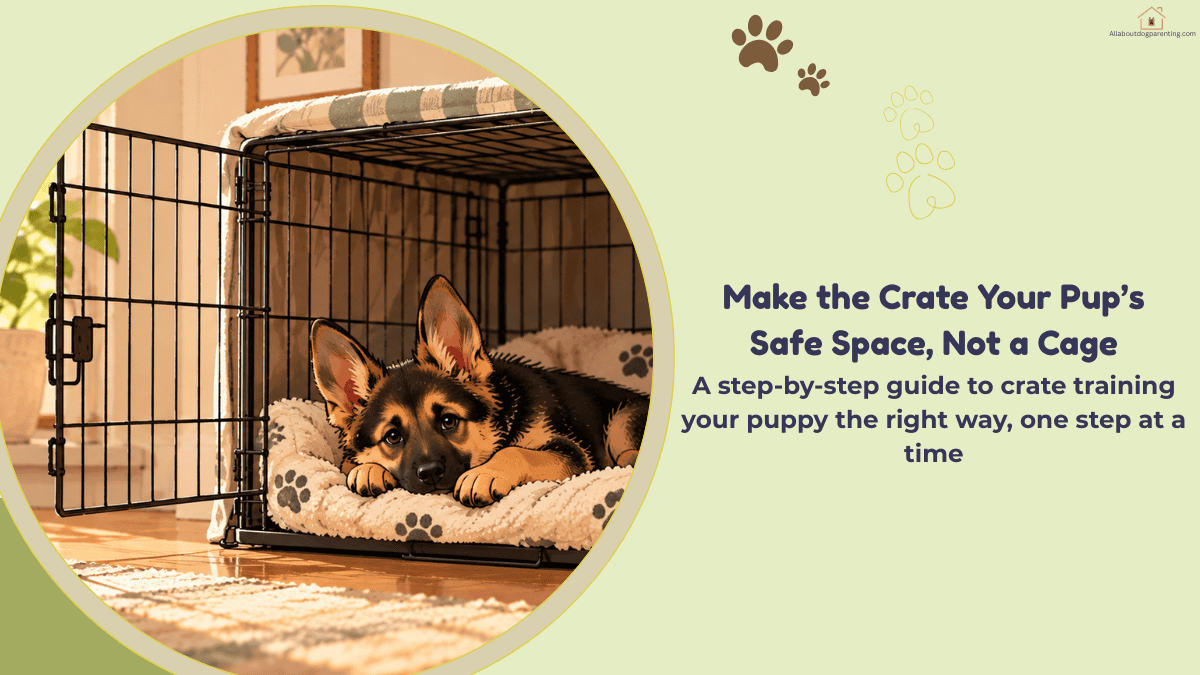
Crate Training a Puppy: A Step-by-Step Guide
🐾 Overview
Start with the door open and treats tossed inside. Build to closed-door meals over two or three days, and most puppies nap calmly in a closed crate within a week. Never force them, never punish with it.
Crate training a puppy routines work when the crate becomes the place where good things happen, so the whole process is about building that association one small, boring step at a time. Done that way, most puppies nap in a closed crate within a week. Rushed, it becomes the 2 a.m. screaming you may be reading this through.
This article, part of our Complete Guide to Puppy Training, covers how to crate train a puppy from the day the box arrives: a seven-day introduction, schedules by age, what to do about crying at night, and how the crate fits with potty training. If you have a puppy crying in crate right now, jump to the night-time section for the quick answer.
If you’re wondering whether crating is fair at all, I wondered too. After raising German Shepherds, here’s where I’ve landed: the crate training puppy approach in this guide gives you a safety tool. A crate used to store a puppy for hours, or to punish one, does harm.
| Puppy’s age | Daytime crate limit | Overnight |
|---|---|---|
| 8–10 weeks | 30–60 minutes awake, up to 2 hours napping | One break, roughly 3–4 hours in |
| 11–14 weeks | 1–3 hours | One break, pushed later each week |
| 15–16 weeks | 3–4 hours | Break often still needed |
| 4–6 months | 3–4 hours at most | Many sleep through by about 5 months |
| Adult | 4–5 hours during the day | Sleeps through |
The daytime limits follow the guidance Humane World for Animals, and they’re ceilings to stay under.
Why Crate Training Works (and When It Doesn’t)
🐾 Overview
Crate training works because puppies learn early to keep their sleeping space clean, which builds bladder control. It fails when the crate is too big, used as punishment, or used for too long.
You’ll often read that dogs are “den animals,” which is only partly true. Wolves use dens mainly for giving birth and raising pups, and adults rarely sleep in them. What carries over to your puppy is the habit they learned in the whelping box: keep the place you sleep clean. A well-sized crate taps into that habit.
Used well, a crate helps you:
- Build bladder control during naps, which speeds up house-training
- Keep a puppy safe from cables and socks when you can’t watch
- Handle travel and vet visits with a dog already comfortable confined
- Teach your puppy to settle on their own, a skill the RSPCA links to fewer separation problems later
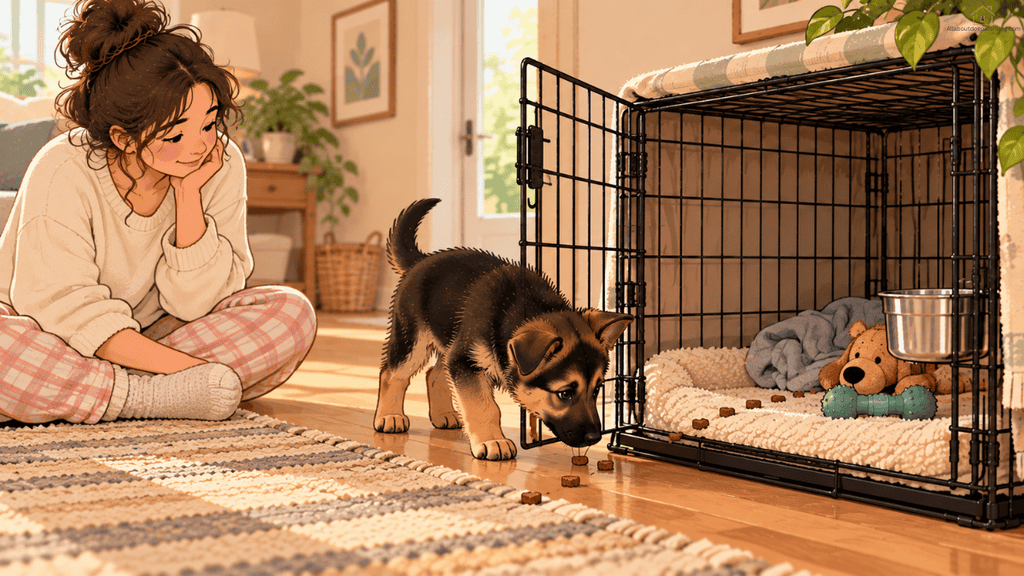
It goes wrong when the crate is used as punishment, the puppy is left in too long, the crate is big enough to pee at one end and sleep at the other, or the puppy is shut in before they’re comfortable.
My German Shepherd treated his crate like a fortress from his second week. He dragged toys in there, backed himself in after dinner, and eventually took himself off to it when the house got too loud. Getting there took five days of patient, treat-heavy, and frankly dull introduction.
What You Need Before You Start
🐾 Overview
You need a wire crate with a divider, high-value treats, a crate-safe chew like a frozen Kong, and a light blanket for three sides. Skip loose bedding at first; many puppies chew it or pee on it.
Here are the essentials you will need on hand to start crate training successfully:
The crate itself
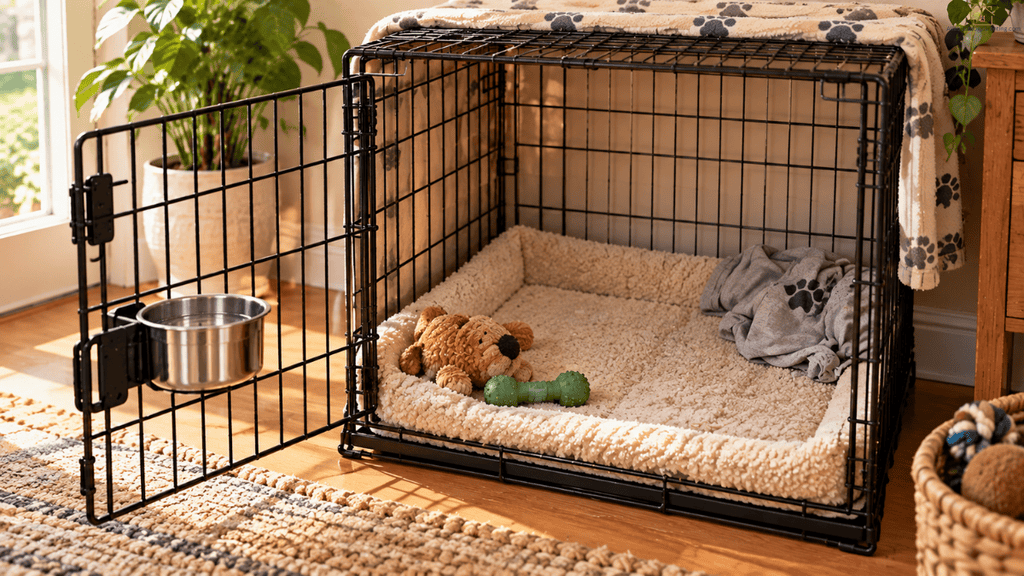
A wire crate with a removable divider suits most puppies, because you buy the adult size once and move the divider as they grow. Plastic crates double as travel carriers, and fabric crates are for calm adults; a teething puppy will go straight through one. Our round-up of crates for puppies compares the ones I’d buy.
🐾 Crate Size for a Puppy: The Rule
- Big enough to stand up, turn around and lie down comfortably, and no bigger.
- Too big, and your puppy can pee in one corner and sleep in the other, which undoes the potty training benefit.
- To measure, the AKC suggests taking your dog’s length from nose to tail and height from head to floor, then adding 3–4 inches to each. Buy for the expected adult size and use the divider until your puppy fills it.
What goes inside
A frozen Kong is the single most useful thing you’ll own for the next six months. Stuff it with soaked kibble and freeze it overnight. If you use peanut butter, check the label: the FDA warns that xylitol, found in some peanut butters, is toxic to dogs. Count Kong fillings as part of the day’s food, using our guide on how much to feed a puppy.
Leave out loose bedding for now. The AKC points out that some puppies prefer to pee on soft bedding, and a chewer can swallow pieces of it. Add a bed once your puppy is reliably dry and past the shredding stage. For longer stretches, clip a no-spill water bottle to the wire.
Where it goes
By day, put the crate where the family spends time. At night, put it beside your bed. Humane World for Animals recommends starting in your bedroom or a nearby hallway, especially with a puppy, and I’d keep it there for the first two to three weeks.
The Step-by-Step Crate Introduction (Days 1–7)
🐾 Overview
Day 1, door open with treats tossed in. Day 2, meals inside. Day 3, door closed during meals. Days 4–5, short closed-door sessions with you nearby. Days 6–7, real naps and brief absences.
This is how to crate train a puppy one small goal a day. If your puppy struggles at any stage, repeat the previous day.
Day 1: How do you introduce the crate?
Today’s only goal is for your puppy to walk in voluntarily at least once. Prop or tie the door fully open, toss three or four treats just inside, and let them investigate at their own pace. No pushing, no lifting them in. Every voluntary step inside earns a calm “yes” and a treat.
Run three to five sessions of two or three minutes each, and leave the crate open the rest of the day. Some puppies wander in for a nap by evening. Most don’t. Don’t close the door yet, and don’t react if they sniff it and walk off.
Day 2: Why do meals move into the crate?
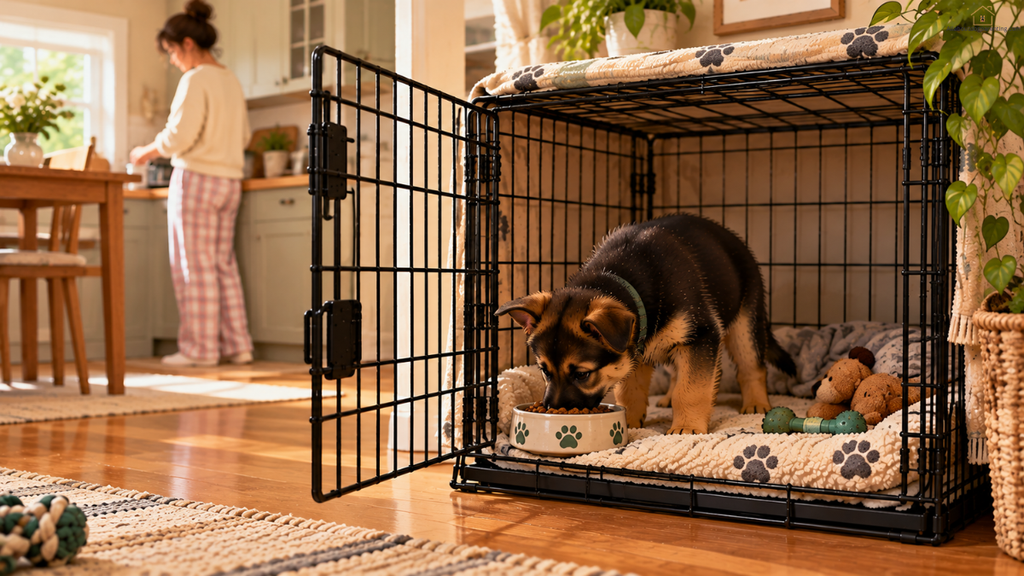
Because food is your puppy’s favourite thing, and you want that feeling attached to the crate. Feed every meal inside with the bowl at the back so they walk all the way in. The door stays open; they eat and leave. Between meals, keep tossing treats in and introduce the frozen Kong at the back.
Day 3: When does the door close?
Once your puppy is eating, gently close the door and stay right there. The moment they finish, open it. The lesson is that the door closes during good things and opens before anything bad happens. After meals, do the same with a Kong, sitting within arm’s reach, and open the door after five minutes or when the Kong is done, whichever comes first.
Watch what happens when the food runs out. Lying down quietly means comfortable. Pawing at the door straight away means tolerating it. Ignoring the food and whining from the start means you need to go back to Day 2.
Days 4–5: How do you build duration?
Start with a Kong, close the door, and sit across the room this time. When the Kong is finished, wait. If your puppy settles, let them rest. If they whine, wait for a three-second pause and then open the door calmly. Opening mid-whine teaches them that whining opens doors.
Gradually add distance: the doorway, then out of sight for 30 seconds, then a minute. If your puppy falls asleep, let them wake up in the crate and find nothing bad happened. By the end of day five, aim for 20–30 calm minutes with the door closed and you in the room.
Keep departures and returns flat, with no big goodbyes or celebrations when you open the door.
Days 6–7: What does success look like by the end of the week?
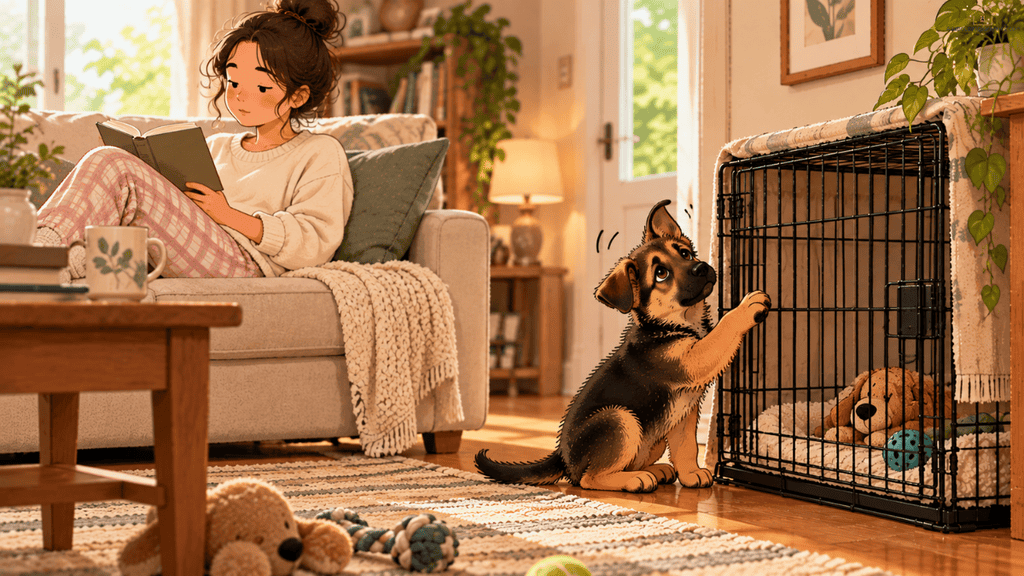
Now the crate becomes the nap spot. Puppies need 18 to 20 hours of sleep a day and often fight it, getting overtired and bitey instead. After 30–45 minutes of play and a potty trip, offer a frozen Kong in the crate, close the door and walk away. Our puppy sleep schedule by age shows how much rest your puppy needs at each stage.
Start short absences too: out of the house for five minutes, back in without fuss, building to ten by day seven. VCA suggests returning before a food toy is finished and greeting quietly, which is exactly the habit you want. If your puppy already shows signs of separation distress, our guide on crate training a dog with separation anxiety slows the process down further.
By the end of this puppy crate training step-by-step week, most puppies walk in when they see a Kong, nap for 45 minutes or more with the door closed, cope with you out of sight for five to ten minutes, and stay calm when the door shuts, with the odd mild whine.
Crate Training at Night and Puppy Crying in the Crate
🐾 Overview
Put the crate beside your bed, give a frozen Kong at bedtime, and set an alarm for the overnight potty break so you get there before the crying starts. Many puppies sleep through by about four to five months.
The 30-second answer: If the crying comes and goes and your puppy is otherwise calm, wait for a short pause and stay quiet. If it’s constant, escalating and paired with panting, drooling or frantic attempts to get out, open the door now. That puppy is distressed, and the training needs to go back a few steps.
For crate training at night, your puppy crate training first night and the few after it follow one routine. Last potty trip about ten minutes before bed, Kong in, puppy in, door closed, lights off, no talking. Set an alarm for three to four hours after bedtime so you wake before your puppy does. Carry them out with minimal light and no play, then straight back to bed.
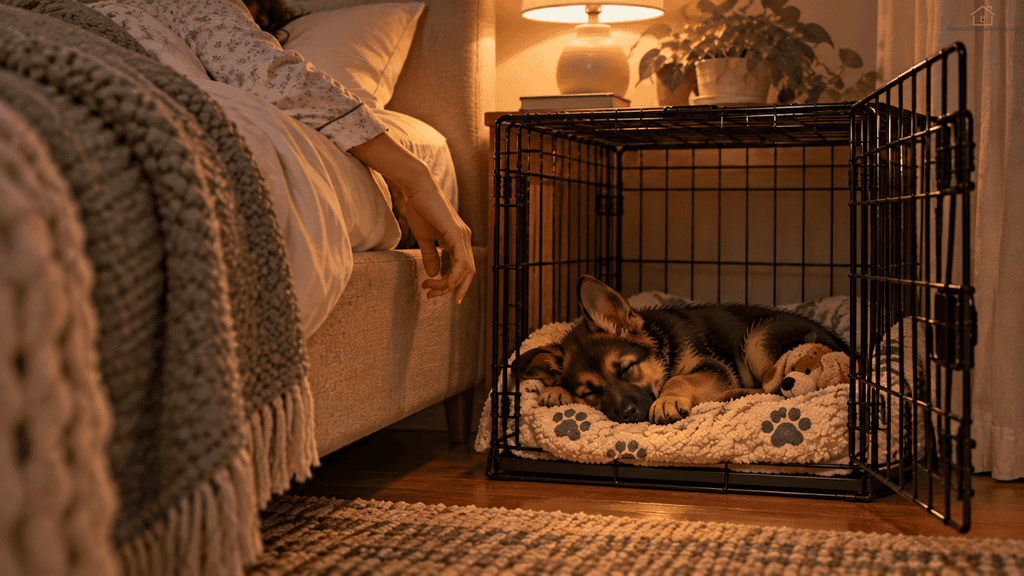
Puppies hold on longer asleep than awake. VCA’s veterinary behaviourists suggest trips every one to two hours during awake time but about every four hours during rest, and recommend overnight breaks until around five months.
Expect five to twenty minutes of whining on the first few nights. Puppy whining in crate at this stage is usually protest, and talking back only confirms you’re worth calling for. Humane World for Animals notes that a puppy testing you will usually stop on their own, and that you should never punish whining.
🐾 Puppy Crying in Crate: Protest or Distress?
| Situation | Protest whining | Distress crying |
|---|---|---|
| Sound | Comes and goes: whine, pause, whine | Continuous and getting louder |
| Food | Can be distracted by a Kong or treat | Ignores food entirely |
| Duration | Usually settles within 10–20 minutes | Gets more intense over time |
| Body | Normal posture, may paw at the door | Panting, drooling, shaking, clawing at the door |
| What to do | Wait for a three-second pause, then a quiet “good” | Open the door now and go back two steps in training |
The distress signs in that table match the ones VCA lists for separation-related distress, including salivating, damaging exit points and eliminating. A puppy showing them isn’t ready yet: move the crate against the bed, return to the Day 3–4 steps, or talk to a positive-reinforcement trainer. For the rest of the night-one setup, our guide on what to expect when bringing a puppy home covers it.
After three to five quiet nights in a row, move the crate towards its permanent spot a foot or two every few nights. If crying restarts, shift it back one step and hold.
Crate Training Schedules by Age
🐾 Overview
An 8-week-old can manage 30–60 minutes in the crate awake and up to two hours napping. Under six months, keep crate stretches to three or four hours, with months-plus-one as the ceiling.
🐾 How Long Can a Puppy Be in a Crate?
- Humane World for Animals says puppies under six months shouldn’t be crated for more than three or four hours at a time, and never longer than their age in months plus one hour.
- Adult dogs shouldn’t be crated for more than four to five hours during the day, by the same guidance.
- Night time is different because sleeping puppies hold on longer, but young puppies still need an overnight potty break.
This crate training schedule by age runs on fixed mealtimes, which is why you need to settle those first with our puppy feeding schedule by age.
8–10 weeks. Short active periods and long naps.
| Time | What’s happening | Crate? |
|---|---|---|
| 6:00 a.m. | Wake up, straight outside | No |
| 6:15 a.m. | Breakfast in the crate, door open or closed | Yes, for the meal |
| 6:30–6:35 a.m. | Potty trip after eating | No |
| 6:45–7:30 a.m. | Play and short training | No |
| 7:30–9:30 a.m. | Crate nap | Yes |
| 9:30 a.m. | Wake, straight outside | No |
| 9:45–10:30 a.m. | Supervised play | No |
| 10:30 a.m.–12:00 p.m. | Crate nap | Yes |
| 12:00 p.m. | Potty, then lunch in the crate | Briefly |
| Afternoon | Repeat: about 45 minutes active, 90–120 minutes napping, potty after each | Naps only |
| 9:00 p.m. | Last potty, crate for the night | Yes |
| 12:30–1:00 a.m. | Alarm, quiet potty trip | Briefly out |
| 5:00–6:00 a.m. | Second alarm or natural wake-up | Briefly out |
12–16 weeks. Three meals instead of four, naps of two to two and a half hours, active periods of 45–60 minutes, and the overnight alarm moving later, to around 3–4 a.m.
4–6 months. Daytime stretches of up to three or four hours, two to three meals, and many puppies sleeping through the night by around five months. For working owners, a realistic weekday looks like this:
| Time | What’s happening |
|---|---|
| 6:30–7:15 a.m. | Potty, breakfast, 30 minutes of exercise or training |
| 7:30–11:00 a.m. | Crate with a frozen Kong |
| 11:00 a.m.–12:00 p.m. | Midday break: you, a dog walker or a neighbour |
| 12:00–3:30 p.m. | Crate |
| 3:30–4:00 p.m. | Second break if your day runs long |
| Evening | Free time, training, dinner, family time |
6–12 months. This is when the crate moves from management to choice. Leave the door open when you’re home, then test freedom in one puppy-proofed room for 15 minutes and build from there. When to stop crate training depends on your dog; if chewing or accidents return, go back to the crate for two weeks. Some crate training regression around adolescence is normal, and our guide to puppy development stages explains why.
The Crate and Potty Training Connection
🐾 Overview
The crate speeds up potty training because puppies avoid soiling where they sleep, but only when it’s properly sized. Too big, and they can pee at one end and sleep at the other, which undoes the benefit.
This is where crate training puppy routines and potty training meet. Bladder control built during naps carries over into waking hours. It only works if three things hold: the crate is the right size, your puppy goes straight outside after every crate session, and they’re never left in longer than their bladder allows. our guide on how long puppies can hold their pee has the numbers by age.
If your puppy starts peeing in the crate, the AKC lists the usual suspects: a crate that’s too big, too long without a break, or a medical problem such as a urinary tract infection.
The schedule potty trained my GSD, and the crate made the schedule possible. Every nap ended with a trip outside and a treat, and within ten days he was walking to the door after every nap.
Common Crate Training Mistakes
🐾 Overview
The five biggest mistakes are using the crate as punishment, crating too long, choosing the wrong size, making a fuss over departures and arrivals, and giving up after one bad night. You can fix all five today.
These are the crate training tips I wish I’d had, as a list of things to stop doing. Crate training puppy mistakes are almost always one of these five.
1. The crate as punishment
“Go to your crate!” after a chewed shoe teaches your puppy the crate is where bad things happen. Humane World for Animals is clear that crates should never be used for punishment.
2. Too long in the crate
Every accident in the crate weakens the clean-den habit the whole method depends on. Stick to the limits above.
3. The wrong size
Too big and potty training stalls. Too small and your puppy is uncomfortable. Move the divider as they grow.
4. Big goodbyes and bigger hellos
Emotional departures tell your puppy that you leaving is an event.
5. Quitting after night one
The first night is almost always the worst. If you give up and bring your puppy into your bed after 45 minutes of crying, you’ve taught them that 45 minutes of crying works. Give it at least three nights before you judge.
FAQs
1. How long does it take to crate train a puppy?
How long to crate train a puppy depends on age, temperament and history. If you follow the puppy crate training step by step plan above, most accept a closed crate within five to seven days. Full crate training, with your puppy going in by choice and coping with short absences, usually takes a few weeks.
2. Should I cover the crate at night?
Covering three sides with a light blanket blocks the things that keep a puppy alert, and many settle faster. Leave the front open for airflow. If your puppy pulls the blanket through the bars to chew it, take it away.
3. Can I crate my puppy while I’m at work?
Only within their limits. An 8–12 week old shouldn’t be crated for more than two or three hours without a break, so you’ll need a midday plan: coming home at lunch, a dog walker or a neighbour. Under six months, keep stretches to three or four hours. No dog should spend a full working day in a crate.
4. Why does my puppy keep peeing in the crate?
Usually because the crate is too big, they were left in too long, or there’s a medical cause like a urinary tract infection, so see your vet if accidents continue. Background matters too: a large study found pet store puppies had more house-soiling problems than puppies from breeders, so they may need smaller steps and more patience.
5. Is crate training cruel?
Is crate training cruel? Not when crate training puppy rules are followed. A crate introduced gradually, kept within age limits and never used as punishment becomes a place your puppy chooses to rest. Misuse, meaning long hours, punishment or forcing a puppy in, is what makes it cruel.
Bottom Line
Crate training puppy habits pay off long after the puppy stage, and how long to crate train a puppy matters far less than how you do it. My boy’s crate still sits in the corner of the living room with the door wide open. He goes in when the house gets loud, and sometimes just because. That’s the goal: a space your dog chooses. Take the seven days slowly, keep the limits, and give crate training puppy nights at least three tries before you decide it isn’t working.