
French Bulldog Puppy Food: Complete Feeding Guide for Frenchie Owners
Overview:
French Bulldog puppies need small-breed-specific puppy food with high-quality protein, moderate fat, and highly digestible ingredients. Feed 3 to 4 small meals daily using a shallow bowl. The breed’s flat-faced anatomy, obesity risk, and high allergy rate make French Bulldog puppy food selection more consequential than it is for most breeds.
French Bulldogs are among the most popular dogs in the world, and among the most medically complex to feed. The flat-faced anatomy affects how they eat, how much they can exercise, and how they regulate temperature. The breed’s documented allergy rates mean that food choice directly impacts skin and digestive health in ways that aren’t always obvious in the first few weeks. And their tendency toward weight gain, combined with genuinely limited exercise capacity, makes overfeeding a risk that compounds quickly into breathing problems.
This guide, part of our Complete Guide to Puppy Nutrition, covers French Bulldog puppy food selection from week eight through the transition to adult food, with breed-specific detail on allergy management, the brachycephalic feeding setup, and what the nutrient numbers on labels actually need to look like for a Frenchie puppy.
Why Feeding a French Bulldog Puppy Is Different
Overview:
Three breed-specific factors shape every feeding decision for a Frenchie puppy: brachycephalic anatomy that affects how they eat and how much they can exercise, a high predisposition to food allergies and digestive sensitivity, and a strong tendency toward obesity that worsens their breathing.
Here are a few factors that need to be considered when choosing the right French Bulldog puppy diet:
The brachycephalic feeding challenge
The compressed skull and shortened airways that define the breed create practical feeding problems that standard puppy feeding guides don’t address. Frenchies cannot eat from standard-depth bowls comfortably. They push kibble around, inhale air while eating, and swallow food too fast. Petcro’s veterinary-sourced Frenchie feeding guide identifies shallow bowl shape and scheduled meals as non-negotiable for the breed, noting that feeding posture matters as much as portion size.
The airway issue also limits exercise capacity, which has a direct bearing on calorie needs. According to veterinary nutritionists cited by Tamaracamerablog’s brachycephalic nutrition resource, flat-faced dogs require approximately 15 to 20% fewer calories than mesocephalic breeds of equivalent weight. A 10 kg French Bulldog typically needs 450 to 550 calories daily, while a 10 kg Border Terrier of the same weight needs 550 to 650 calories. That gap matters enormously for portion sizing.

The allergy and digestive problem
French Bulldogs are heavily overrepresented in veterinary dermatology cases. A 2018 study published in Veterinary Dermatology found that French Bulldogs are overrepresented in cases of canine atopic dermatitis, especially in dogs under three years of age. Research by Vetified indicates that environmental allergies alone affect up to 50% of Frenchies, and when food allergies and fold-related dermatitis are included, prevalence climbs higher.
For puppy owners, the practical implication is this: the protein source in your Frenchie’s food is not a minor label detail. Dr. Linda Simon, MVB MRCVS, a licensed veterinary surgeon specialising in brachycephalic health, confirms that it is uncommon to find a Frenchie that does not have some form of allergic disease, and that the most common food triggers include chicken, beef, grains, peas, dairy, soy, and eggs. Choosing a protein your puppy hasn’t been extensively exposed to from the beginning of their diet reduces the likelihood of developing a sensitisation to it over time.
The obesity-breathing cycle
Excess weight doesn’t just affect a Frenchie’s joints and lifespan. It directly compromises an already-narrow airway. That’s why it’s important to be mindful of how much to feed French Bulldog puppy. Vets Love Pets’ vet-approved Frenchie feeding guide frames it correctly: treat weight as a breathing issue, not a cosmetic one. The relationship between excess weight and breathing difficulty in this breed is cyclical: extra weight worsens breathing, which limits activity, which promotes further weight gain. Portion control at every meal, from week eight onward, is a respiratory health intervention as much as a nutritional one.
What to Look for in French Bulldog Puppy Food
Overview:
Look for an AAFCO statement for “growth” or “all life stages,” a novel or easily digestible named protein as the first ingredient, moderate fat at 14 to 18%, no artificial additives, and a small kibble size appropriate for a compact Frenchie jaw.
| Feature | Why It Matters for Frenchies | What to Look For |
| AAFCO growth statement | Confirms complete nutrition for a growing puppy | “Complete and balanced for growth” on label |
| Named protein first ingredient | Allergy tracking requires knowing exactly what protein is being fed | Salmon, turkey, duck, lamb, not “meat” or “animal protein” |
| Moderate fat (14 to 18% for puppies) | Frenchies have limited exercise capacity; high fat accelerates weight gain | Check guaranteed analysis: crude fat 14 to 18% |
| Highly digestible protein | Reduces digestive upset in a breed prone to loose stools and gas | Hydrolysed proteins, single protein sources, limited-ingredient diets |
| Small or medium kibble | A Frenchie puppy’s jaw is compact; large kibble increases gulping | Kibble sized for small to medium breeds |
| No artificial colours, flavours, or preservatives | Sensitive Frenchie digestive systems react to unnecessary additives | Short ingredient list from recognisable sources |
| DHA from fish oil | Supports brain development in the growth phase | Fish oil or fish meal listed in ingredients |
One thing the label will not tell you directly: whether the kibble shape will work for your Frenchie puppy’s flat face. Flat, disc-shaped, or smaller square kibble pieces are easier for Frenchies to pick up than round pellets they end up chasing around a bowl. Some brands design kibble specifically for brachycephalic breeds—Royal Canin’s French Bulldog formula is the most well-known example—though the nutritional criteria above matter more than the shape.
French Bulldog Puppy Feeding Chart by Age
Overview:
The French Bulldog puppy feeding chart below is based on typical small-breed puppy kibble at approximately 380 to 400 kcal per cup. Female Frenchies trend toward the lower end of each range. Male Frenchies trend toward the upper end. Always adjust from the chart based on weekly body condition checks.
Wondering how much to feed French Bulldog puppy? Petcro’s veterinary-sourced Frenchie puppy chart, drawing from WSAVA, AAFCO, AVMA, and Tufts Petfoodology guidance, estimates that a Frenchie puppy needs roughly 520 to 580 kcal per day at four months and 610 to 680 kcal per day at eight months.
| Age | Weight Range | Daily Calories | Cups Per Day | Meals Per Day | Per Meal |
| 8 to 10 weeks | 1.5 to 3 kg | 350 to 500 kcal | 1 to 1.25 cups | 4 | ~¼ cup |
| 3 months | 3 to 5 kg | 450 to 580 kcal | 1.25 to 1.5 cups | 3 to 4 | ~⅓ to ½ cup |
| 4 months | 4.5 to 7 kg | 520 to 580 kcal | 1.25 to 1.5 cups | 3 | ~½ cup |
| 5 months | 5.5 to 8 kg | 550 to 620 kcal | 1.4 to 1.6 cups | 3 | ~½ cup |
| 6 months | 6.5 to 9.5 kg | 580 to 660 kcal | 1.5 to 1.7 cups | 2 to 3 | ~½ to ⅔ cup |
| 8 months | 7 to 11 kg | 600 to 680 kcal | 1.5 to 1.75 cups | 2 | ~¾ to 1 cup |
| 10 months | 8 to 12 kg | Begin transition to adult food | Adjust down | 2 | Per adult guidelines |
These figures are starting points, not prescriptions. The body condition check, described later in this guide, is your more reliable tool for knowing whether the amount is right.
Important: Never free-feed a Frenchie. At any age, at any stage. I Spy Frenchies’ nutrition guide puts it directly: Frenchies love to eat and can easily become overweight. Measured meals at set times, bowl picked up after 15 minutes, every meal.
For the universal calorie calculation method that works for any kibble brand, our how much to feed a puppy guide covers the calculation step by step.
French Bulldog Puppy Feeding Schedule
Overview:
Feed Frenchie puppies 3 to 4 times daily from 8 to 12 weeks, 3 times from 3 to 6 months, and twice daily from 6 months onward. Never feed within one hour of activity. Always offer fresh water immediately after meals.
| Age | Meals Per Day | Sample Schedule | Frenchie-Specific Notes |
| 8 to 12 weeks | 4 | 7 am, 11 am, 3 pm, 7 pm | Soak kibble slightly in warm water for very young puppies |
| 3 to 6 months | 3 | 7 am, 12:30 pm, 6 pm | Biggest appetite and growth phase |
| 6 to 10 months | 2 to 3 | 7:30 am, 1 pm, 6:30 pm | Can move to 2 meals if puppy consistently leaves food |
| 10 months onward | 2 | 7:30 am, 6:30 pm | Transition to adult food beginning |
Two Frenchie-specific feeding rules worth emphasising
First, the exercise-meal timing rule is more important for this breed than for most. Frenchies cannot pant effectively to cool down, and feeding a puppy that is still warm or panting from activity risks digestive distress and regurgitation. Petcro specifically flags never feeding a Frenchie that is still panting hard, and avoiding meals immediately before or after exercise as non-negotiable for the breed.
Second, always have fresh water available immediately after meals. The brachycephalic structure makes Frenchies prone to overheating, and proper hydration helps regulate body temperature. Frenchieholics’ French Bulldog nutrition guide recommends Frenchies consume approximately 50 to 60 ml of water per kg of body weight daily. A 10 kg Frenchie needs 500 to 600 ml daily.
For the full daily routine including potty timing and activity windows, our puppy feeding schedule guide covers how feeding and the rest of the day connect practically.
The Allergy Problem: How to Manage It From Puppy Food Onward
Overview:
French Bulldog food allergies most commonly involve chicken, beef, dairy, wheat, soy, and eggs. The only reliable diagnostic tool is an 8- to 12-week elimination diet supervised by a vet. Managing allergy risk from puppyhood means choosing a limited-ingredient food with a novel protein from the start.
This section is the one most Frenchie feeding guides handle superficially, which is a problem given that the AKC’s French Bulldog breed profile lists skin allergies and sensitivities among the breed’s most common health concerns.
Why protein choice matters from week eight
Allergies develop through repeated exposure. The immune system learns to recognise a protein as a threat after enough contact with it. A Frenchie puppy who eats chicken-based food from 8 weeks to 12 months has had twelve months of continuous exposure to chicken protein. If they develop a chicken sensitivity at month ten, identifying it and switching requires a full elimination diet. If the original diet had been salmon- or duck-based from the beginning, chicken would remain available as a novel protein to trial later.
This is not a reason to avoid common proteins entirely. It is a reason to make an intentional protein choice from the start rather than defaulting to chicken because it’s the most common option in commercial puppy food.

The allergy signs to watch for in a Frenchie puppy
American Natural Premium’s French Bulldog allergy guide identifies these as the primary symptoms of food allergies in the breed: itchy skin, recurring ear infections, paw licking, excessive gas, and loose or mucousy stools. Because skin and digestive symptoms can also result from environmental allergens and from the breed’s general digestive sensitivity, distinguishing food allergy from other causes requires veterinary involvement.
Do not switch protein sources without veterinary guidance if you suspect an allergy. Random protein switching simply changes the exposure. For the full diagnostic and dietary management framework, our best puppy food for allergies guide covers elimination diet protocols, limited-ingredient options, and when prescription hydrolysed diets are needed.
Best Food for French Bulldog Puppies (2026)
Overview:
The best food for French Bulldog puppy feeding is a small-breed AAFCO-certified formula with a novel or easily digestible protein, moderate fat, DHA from fish oil, and small kibble. Top picks: Royal Canin French Bulldog Puppy, Hill’s Science Diet Small Paws, and Natural Balance L.I.D.
Pick 1: Royal Canin French Bulldog Puppy — Best Breed-Specific
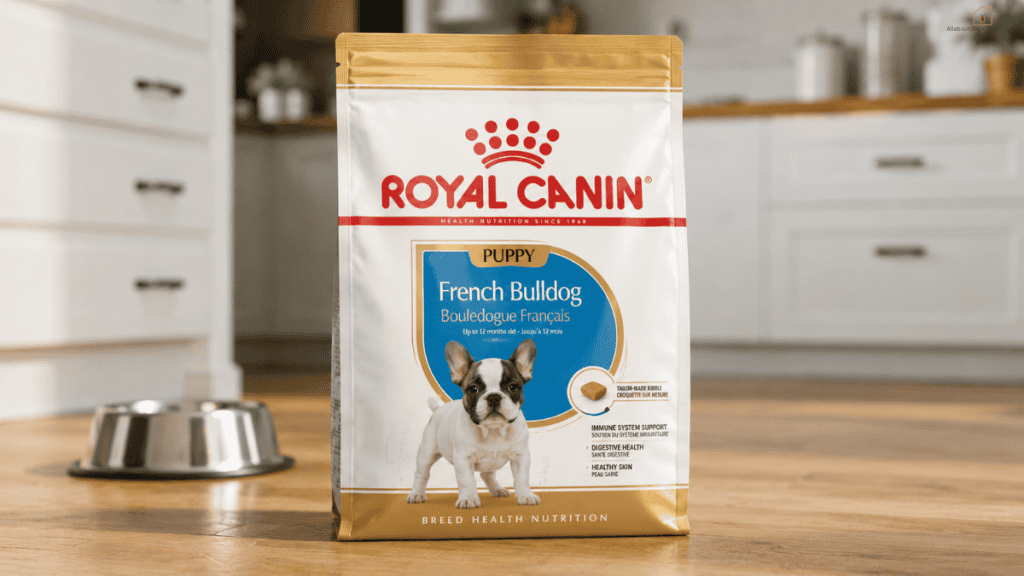
The only formula specifically designed for French Bulldog puppies. The kibble is shaped specifically for the breed’s jaw structure and encourages slower, more deliberate eating. The formula includes highly digestible L.I.P. proteins that directly address the breed’s digestive sensitivity, prebiotics for gut health, and EPA and DHA for skin and coat development. Controlled fat at 14% supports appropriate puppy growth without contributing to the weight gain this breed accumulates fast.
| Spec | Value |
| Protein | 28% min |
| Fat | 14% min |
| Kcal/cup | ~346 |
| Key Frenchie features | Breed-specific kibble shape, L.I.P. digestible proteins, prebiotics, EPA/DHA for skin |
| Price estimate | ~$55–70 per 17 lb bag |
| AAFCO | Growth (all breeds) |
Best for: French Bulldog owners who want the most breed-tailored formulation. Particularly relevant for Frenchies who have already shown signs of digestive sensitivity. Among the most targeted best food for French Bulldog puppy choices for owners starting with a clean slate.
Drawback: Uses chicken as the primary protein, which is one of the most commonly reported allergens in the breed. If your Frenchie has or develops a chicken sensitivity, this formula is not compatible. Expensive per pound.
Pick 2: Purina Pro Plan Small Breed Puppy (Salmon and Rice) — Best Overall Value
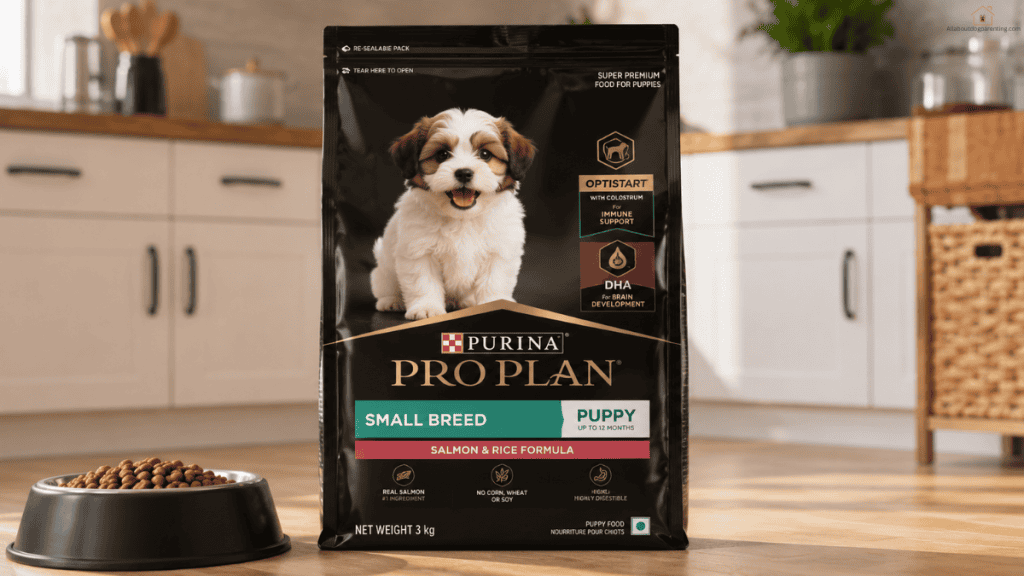
Salmon as the primary protein, which is one of the least commonly reported allergens in dogs, making this a smarter default choice for a breed prone to chicken sensitivity. Live Lactobacillus probiotics in every serving directly support the Frenchie’s sensitive digestive system. High calorie density at 418 kcal per cup means portion sizes stay small enough that overfeeding is harder to do accidentally.
| Spec | Value |
| Protein | 28% min |
| Fat | 17% min |
| Kcal/cup | ~418 |
| Key Frenchie features | Salmon primary protein, live probiotics, DHA from fish oil |
| Price estimate | ~$40–50 per 16 lb bag |
| AAFCO | Growth (all breeds) |
Best for: Most Frenchie owners as a practical, evidence-backed default. Salmon as the primary protein makes this a better starting point for allergy risk management than chicken-based alternatives. A consistently cited affordable French Bulldog puppy food vet-recommended option.
Drawback: Fat at 17% is on the higher end for a breed with limited exercise capacity. If your Frenchie gains weight on this formula, reduce portions by 10% and recheck body condition in two weeks.
Pick 3: Hill’s Science Diet Small Paws Puppy — Best for Sensitive Digestion
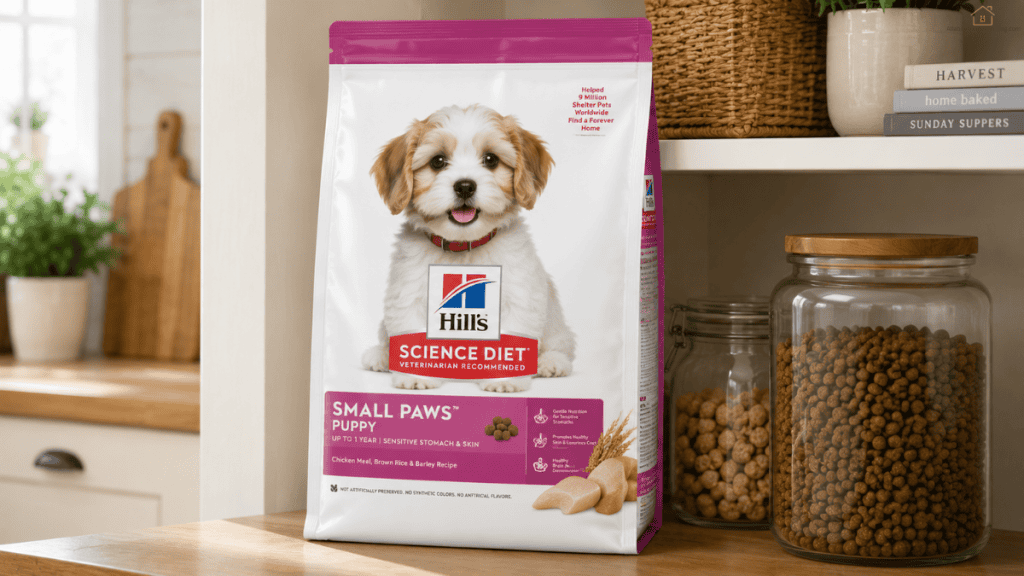
Chicken meal and barley as primary ingredients, with a prebiotic fibre blend clinically proven to support digestive health alongside immune-supporting antioxidants. Over 200 veterinary nutritionists behind the formulation, and widely used in veterinary clinics for small-breed puppies with digestive sensitivities. Fat at 17.5% is slightly higher than ideal for the most sedentary Frenchies.
| Spec | Value |
| Protein | 27% min |
| Fat | 17.5% min |
| Kcal/cup | ~395 |
| Key Frenchie features | Prebiotic fibre blend, antioxidants, clinically proven digestive support |
| Price estimate | ~$40–55 per 12.5 lb bag |
| AAFCO | Growth (all breeds) |
Best for: Frenchie puppies with loose stools or gas on other formulas. The prebiotic fibre blend makes this the most digestively supportive OTC option from a brand with genuine veterinary nutrition depth.
Drawback: Uses chicken as the primary protein. Not the right choice if your Frenchie has or is at high risk of developing a chicken sensitivity.
Pick 4: Natural Balance L.I.D. Puppy (Salmon and Brown Rice) — Best for Allergy-Prone Frenchies

Single animal protein (salmon) paired with one primary carbohydrate (brown rice) makes it a good fit for the French Bulldog puppy diet. Approximately 15 ingredients in total. This is the starting point for any Frenchie puppy whose owner wants to proactively reduce allergen exposure from day one, or for Frenchies who have already shown signs of food sensitivity.
| Spec | Value |
| Protein | 24% min |
| Fat | 10% min |
| Kcal/cup | ~360 |
| Key Frenchie features | Single protein, limited ingredients, salmon-based, suitable for elimination diet use |
| Price estimate | ~$45–55 per 22 lb bag |
| AAFCO | Growth (all breeds) |
Best for: Frenchie owners managing active food allergies, or owners making a proactive decision to start on a limited-ingredient food to reduce future sensitisation risk. The clearest diagnostic option if allergy testing becomes necessary.
Drawback: Lower protein and fat than standard puppy formulas. Not ideal long-term for very active Frenchie puppies, though most Frenchies are not high-activity dogs.
Side-by-Side Comparison Table
Overview:
All four picks compared on protein, fat, calories, primary protein, Frenchie-specific features, price, and best use case.
| Brand | Protein | Fat | Kcal/Cup | Primary Protein | Key Feature | Price Per Bag | Best For |
| Royal Canin French Bulldog Puppy | 28% | 14% | 346 | Chicken | Breed-specific kibble shape, L.I.P. proteins | ~$62 | Breed-tailored |
| Purina Pro Plan Small Breed (Salmon) | 28% | 17% | 418 | Salmon | Live probiotics, lower allergen protein | ~$45 | Best overall value |
| Hill’s Science Diet Small Paws | 27% | 17.5% | 395 | Chicken | Prebiotic fibre, digestive support | ~$48 | Sensitive digestion |
| Natural Balance L.I.D. Salmon | 24% | 10% | 360 | Salmon | Single protein, limited ingredients | ~$50 | Allergy management |
The Frenchie Body Condition Check
Overview:
Run your hands along your Frenchie puppy’s ribcage. You should feel ribs with light pressure but not see them. From above, a slight waist should be visible behind the ribs. A Frenchie who cannot be waist-checked from above needs immediate portion reduction.
The body condition check matters more for French Bulldogs than for most breeds because of the breathing-weight connection. An overweight Frenchie isn’t just carrying extra pounds. They’re carrying extra pressure on an already-compromised airway, and the deterioration in breathing quality that follows is genuinely difficult to reverse once established.
Vets Love Pets’ vet-approved Frenchie feeding guide recommends weighing food portions on a kitchen scale rather than measuring by cup, noting that the difference in accuracy between the two methods makes a real difference in a breed where even slight overfeeding accumulates into a clinical problem. If your Frenchie is losing waist definition and ribs are difficult to feel without pressing, a modest calorie cut of 10 to 15% is the right response before the weight becomes a respiratory concern.
One practical note for Frenchie owners: The breed’s compact build and chunky appearance make visual weight assessment genuinely harder than for leaner breeds. A Frenchie at a healthy weight often looks heavier than they are to someone unfamiliar with the breed’s build. Always use the rib check as your primary tool rather than appearance alone.
Setting Up the Frenchie Feeding Station
Overview:
Use a shallow bowl no deeper than 3 to 5 cm for a Frenchie puppy. Elevated feeders are not recommended for brachycephalic breeds. A slow feeder bowl or lick mat can extend meal time and reduce air swallowing. Feed in a cool location.
| Equipment | Recommendation | Why |
| Bowl depth | Shallow, 3 to 5 cm | Frenchies struggle to eat from deep bowls due to their flat faces |
| Bowl material | Stainless steel or ceramic | Plastic bowls can harbour bacteria in wrinkle-adjacent feeding |
| Elevated feeder | Avoid | Not recommended for brachycephalic breeds, as it increases air intake |
| Slow feeder bowl | Recommended | Reduces gulping, extends meal time, less air swallowed |
| Feeding location | Cool, shaded, quiet | Brachycephalic dogs cannot cool effectively; never feed in heat |
| Water bowl | Always available | Fresh water available before and after every meal |
The slow feeder recommendation deserves emphasis. A Frenchie who inhales their food in 30 seconds is swallowing significant air alongside it, which contributes to gas and the bloating that makes this breed uncomfortable. The Frenchie Shop’s feeding guide identifies shallow bowls, scheduled meals, and never feeding right before or after exercise as non-negotiable breed-specific requirements that apply from puppyhood onward.
When to Switch Your Frenchie to Adult Food
Overview:
Most French Bulldogs reach adult size between 9 and 12 months and should transition to adult food at this point. Transition gradually over 10 days. Adult Frenchie food should be lower in calorie density than puppy food to account for reduced growth-phase energy requirements.
The Frenchie Shop’s feeding guide confirms that Frenchies typically mature around 9 to 12 months and that a smooth 7 to 10 day transition works better than any abrupt food change. Given the breed’s digestive sensitivity, the 10-day gradual transition is more important here than for most breeds. Our 10-day food transition guide covers the daily ratios and what to watch for if digestive disruption appears during the switch.
FAQs
1. How much should I feed my French Bulldog puppy?
A Frenchie puppy needs approximately 350 to 680 kcal per day depending on age, which translates to 1 to 1.75 cups of standard small-breed kibble split across 3 to 4 meals. Use the French Bulldog puppy feeding chart above as a starting point and adjust based on weekly body condition checks. Always weigh portions on a digital scale rather than estimating by cup volume for this breed.
2. What is the best food for a French Bulldog puppy?
A small-breed AAFCO-certified puppy food with a novel or limited protein source, moderate fat between 14 and 18%, DHA from fish oil, and small or breed-specific kibble. Given the breed’s allergy predisposition, salmon or turkey as the primary protein is a smarter default than chicken for most Frenchie puppies who haven’t yet shown a specific sensitivity.
3. Why does my French Bulldog puppy have loose stools?
Loose stools in Frenchie puppies are common and can result from food sensitivity, transition-related digestive adjustment, intestinal parasites, or stress. Always rule out medical causes with a vet stool sample before switching food. If the issue starts after a food change, slow the transition down using the 10-day method. Persistent loose stools despite a stable diet warrant a vet visit.
4. Should I feed my French Bulldog puppy grain-free food?
Only if your Frenchie has a confirmed grain allergy, which requires a veterinary elimination diet to diagnose. Most food allergies in dogs are protein-driven rather than grain-driven. Grain-free formulas often replace grains with legumes like peas and lentils, which are associated with the FDA’s DCM investigation. Our grain-free vs grain-inclusive guide covers the full evidence. Grain-inclusive food is the safer default for Frenchie puppies unless a grain allergy has been specifically confirmed.
5. How do I know if my Frenchie puppy is overweight?
Run your hands along the ribcage. Ribs should be clearly felt with light pressure but not visually prominent. From above, a slight waist narrowing behind the ribs should be visible. If you cannot feel ribs without pressing hard, or if no waist is visible from above, reduce portions by 10 to 15% immediately and recheck after two weeks. Given the breed’s airway anatomy, even mild excess weight has direct breathing consequences.
The Bottom Line
French Bulldog puppy food decisions carry more weight than they do for most small breeds. The brachycephalic anatomy changes how they eat, how much they can exercise, and how many calories they actually need. The allergy rate means protein choice is a long-term health decision, not just a taste preference. And the obesity-breathing connection means every extra gram of unnecessary weight has a direct respiratory cost.
The right French Bulldog puppy food is AAFCO-certified, uses a high-quality novel protein, provides complete growth-phase nutrition in appropriate proportions for a breed that gains weight easily, and comes in a kibble size compatible with a flat face. Feed measured portions at consistent times using a shallow bowl, check body condition weekly, and never free-feed. These four habits do more for a Frenchie puppy’s health than any premium ingredient claim on the front of the bag.