Golden Retriever Puppy Food: Feeding Guide, Best Foods, and Breed-Specific Nutrition
Overview:
Golden Retriever puppies need large-breed-specific food with controlled calcium, DHA, and EPA for brain and coat development, and grain-inclusive ingredients. Goldens are a breed specifically flagged for diet-related DCM risk with grain-free diets. Feed 3 to 4 times daily and switch to adult food at 14 to 18 months.
Golden Retrievers are one of the most beloved breeds in the world, and among the most medically complex to own. So clarity on the right Golden Retriever puppy food before your furry baby even comes home is essential because this breed has two critical considerations that must be factored in when choosing the right food: a genetic predisposition to taurine-deficient DCM that makes grain-free diets specifically risky for Goldens, and one of the highest cancer rates of any breed, driving many owners to ask what nutrition can and can’t do about that risk.
This article, part of our Complete Guide to Puppy Nutrition, seeks to address those questions, based on experiences of Golden Retriever owners, my own experience with large-breed dogs, which applies to the issues of calcium, joint, and growth timeline questions, expert insights, and research.
What Makes Feeding a Golden Retriever Puppy Different
Overview:
Goldens face three breed-specific nutritional considerations: documented susceptibility to diet-related DCM making grain-free food particularly risky, a cancer rate above 60% driving interest in nutritional prevention, and a double coat requiring adequate omega fatty acids. None of these apply equally to other large breeds.
Here are the key factors that need to be considered in choosing the right golden retriever puppy food:
The DCM and taurine connection
Golden Retrievers were the most frequently reported breed in the FDA’s investigation into diet-related dilated cardiomyopathy. The FDA notes that past publications and research suggest that Golden Retrievers may be genetically predisposed to taurine deficiency, which is well-documented as potentially leading to DCM. Veterinary cardiologist Dr. Joshua Stern from the University of California at Davis has been studying the rise in cases of DCM in Golden Retrievers, including a potential dietary link. Many cases of DCM in Golden Retrievers are taurine-deficient.
A prospective observational study published in PLOS ONE found that Golden Retrievers eating non-traditional diets, which were typically grain-free and contained legumes, had significantly lower taurine concentrations and more frequent systolic dysfunction consistent with DCM. Non-traditional diets were significantly associated with increased relative risk for taurine deficiency and echocardiographic abnormalities, identifiable even in the absence of clinical signs.
Dr. Stern’s research involved 24 Golden Retrievers with dilated cardiomyopathy and documented taurine deficiency, the largest published collection of such cases. He found that dogs eating grain-free, legume-rich diets were not making or maintaining enough taurine, an amino acid critical for heart health.
The practical implication for this golden retriever puppy feeding guide is direct: grain-inclusive food is the strongly recommended default for this breed. Not as a general caution, but as a breed-specific recommendation backed by the FDA investigation and multiple peer-reviewed studies. Unless your Golden has a confirmed grain allergy, grain-free food carries meaningfully higher risk for this breed than for most others.

The cancer rate
Approximately 60% of Golden Retrievers will develop cancer during their lifetime, roughly twice the rate seen in the general dog population, where cancer affects around 25 to 30% of dogs overall. Among Golden Retrievers that die of natural causes, cancer is the cause of death in over 60% of cases, according to data from Morris Animal Foundation’s Golden Retriever Lifetime study, the largest study of canine health ever conducted.
A large longitudinal study now in its 12th year has found that three of every four documented retriever deaths have been linked to cancer, by far the highest rate for any breed. This is the statistic every Golden owner needs to know, and it deserves an honest response.
No specific diet has been proven to prevent cancer in Golden Retrievers. The research doesn’t support making that claim, and I won’t. What is supported: maintaining lean body condition throughout life, feeding complete nutrition, and avoiding excessive supplementation without veterinary guidance. These are the evidence-based contributions nutrition makes. They’re meaningful without being promises that science can’t back up.
The coat
The Golden’s iconic double coat requires adequate omega-3 and omega-6 fatty acids for health and texture. DHA and EPA from fish oil support both puppy brain development during the growth phase and coat quality throughout life. Zinc and biotin also contribute to coat health. For Goldens specifically, coat-focused nutrition isn’t vanity. It’s a reflection of general nutritional completeness.
Joint health
Same large-breed calcium concerns as GSDs and Labs apply here. Controlled calcium within AAFCO large-breed limits (1.2 to 1.8% dry matter), moderate fat to prevent overly rapid growth, and lean body condition throughout the growth phase to protect developing joints.
How Much to Feed Golden Retriever Puppy: Feeding Chart by Age
Overview:
A Golden Retriever puppy needs roughly 800 to 1,600 calories per day depending on age and growth stage. Start with about 1.5 to 2 cups per day at 8 weeks and increase to 3 to 4 cups by 6 months, then taper as growth slows.
These figures on how much to feed Golden Retriever puppy are based on standard dry kibble at approximately 380 kcal per cup. Male Goldens (expected adult weight 30 to 34 kg) trend toward the higher end; females (expected adult weight 25 to 29 kg) trend toward the lower end.
| Age | Weight Range | Daily Calories | Cups Per Day | Meals Per Day | Per Meal |
| 8 to 10 weeks | 4 to 7 kg | 500 to 800 kcal | 1.5 to 2 cups | 4 | ~½ cup |
| 3 months | 9 to 13 kg | 750 to 1,000 kcal | 2 to 2.5 cups | 3 | ~¾ cup |
| 4 months | 12 to 17 kg | 900 to 1,200 kcal | 2.5 to 3 cups | 3 | ~1 cup |
| 5 months | 15 to 21 kg | 1,000 to 1,400 kcal | 2.5 to 3.5 cups | 3 moving to 2 | ~1 to 1.25 cups |
| 6 months | 18 to 26 kg | 1,100 to 1,500 kcal | 3 to 4 cups | 2 | ~1.5 to 2 cups |
| 8 months | 22 to 29 kg | 1,100 to 1,500 kcal | 3 to 4 cups | 2 | ~1.5 to 2 cups |
| 10 months | 24 to 31 kg | 1,000 to 1,400 kcal | 2.5 to 3.5 cups | 2 | ~1.25 to 1.75 cups |
| 12 to 15 months | 27 to 34 kg | Transition to adult | Adjust down | 2 | Per adult guidelines |
Note the gradual tapering from 8 months onward. Goldens, like Labs, are food-motivated enough that portions need to be managed against a body condition check rather than the puppy’s enthusiasm. Check our how much to feed a puppy guide for the calorie calculation method that works for any kibble brand.
Why Grain-Free Is Especially Risky for Golden Retrievers
Overview:
Golden Retrievers were the most frequently reported breed in the FDA’s diet-related DCM investigation. The breed appears genetically predisposed to taurine deficiency when fed grain-free legume-rich diets. Unless your Golden has a confirmed grain allergy, grain-inclusive food is the strongly recommended default.
This aspect deserves attention because the evidence for Goldens specifically is stronger than for most other breeds. This isn’t the general DCM caution that applies across dogs. It’s a breed-specific risk supported by the FDA investigation, the UC Davis research led by Dr. Stern, and the PLOS ONE prospective study that found taurine deficiency and cardiac abnormalities in healthy Goldens eating non-traditional diets before clinical signs appeared.
From January 2018 through April 2019, the FDA received reports of 553 dogs with DCM. These included 95 Golden Retrievers, the highest number of any single breed. More than 90% of the associated diets were grain-free, and 93% contained peas or lentils.
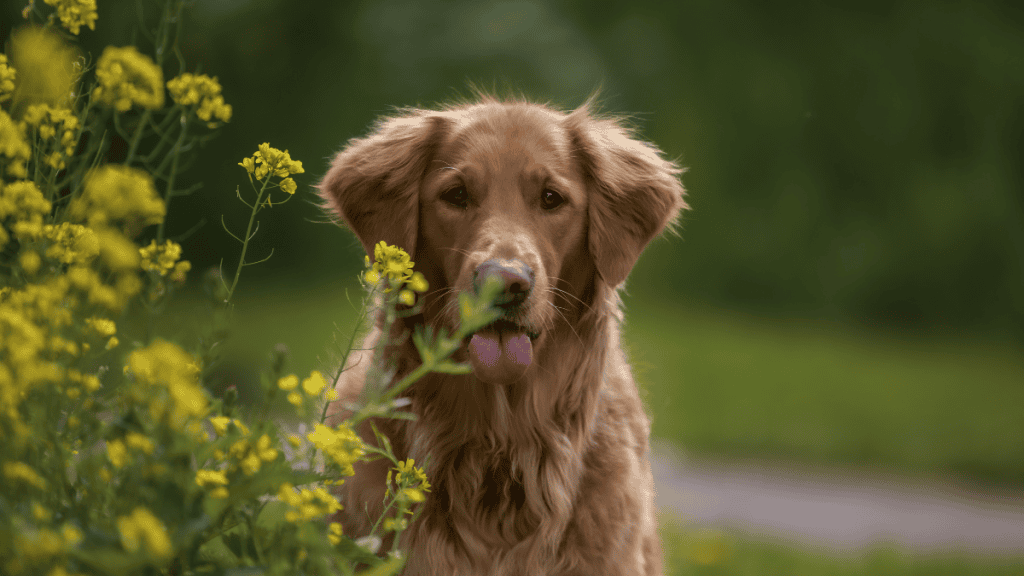
The Animal Medical Center notes that Golden Retrievers and American Cocker Spaniels can develop DCM secondary to taurine deficiency, distinguishing them from most other breeds where taurine deficiency is not considered a primary concern.
The grain-free vs grain-inclusive question for most breeds comes with genuine nuance. For Golden Retrievers specifically, the nuance leans heavily in one direction. Our grain-free vs grain-inclusive guide covers the full evidence for all breeds, but for a Golden owner the conclusion is clear: feed grain-inclusive unless your vet has diagnosed a specific grain allergy and recommended otherwise.
Best Golden Retriever Puppy Food Picks (2026)
Overview:
The best golden retriever puppy food options are grain-inclusive large-breed formulas with controlled calcium, fish oil for DHA and EPA supporting both brain development and coat health, and formulation by brands with veterinary nutritionists and feeding trial validation.
Here is our pick of the best Golden Retriever puppy food options:
Pick 1: Purina Pro Plan Large Breed Puppy — Best Overall
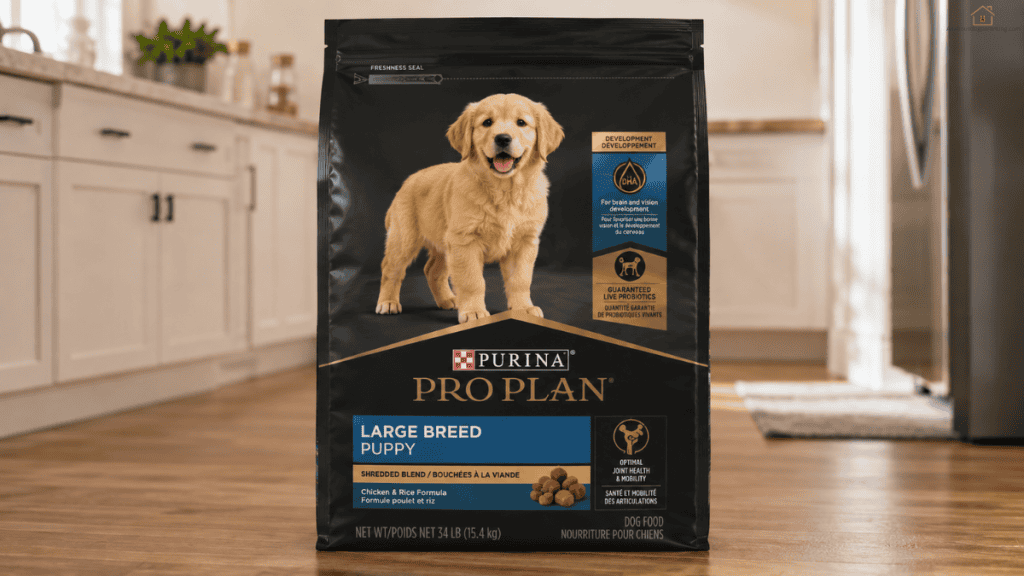
The most frequently recommended large-breed puppy food by veterinarians in the US definitely makes the cut as the best food for Golden Retriever puppy. Grain-inclusive, which makes it specifically appropriate for Goldens given the DCM research. Live Lactobacillus probiotics in every serving, DHA from fish oil for brain development and coat support, controlled calcium at approximately 1.3%, and glucosamine for joint health. Validated through AAFCO feeding trials.
| Spec | Value |
| Protein | 28% min |
| Fat | 13% min |
| Calcium | ~1.3% |
| Kcal/cup | ~393 |
| Fish oil DHA | Yes |
| Price estimate | ~$55–65 per 34 lb bag |
| AAFCO | Growth including large-size dogs |
Best for: Most Golden owners. The proven grain-inclusive default for the best food for golden retriever puppy feeding, with live probiotics, DHA, and the feeding trial data that most boutique brands lack.
Drawback: Contains chicken by-product meal and corn. Some owners prefer to avoid these despite both being nutritionally adequate and well-studied.
Pick 2: Royal Canin Golden Retriever Puppy — Best Breed-Specific
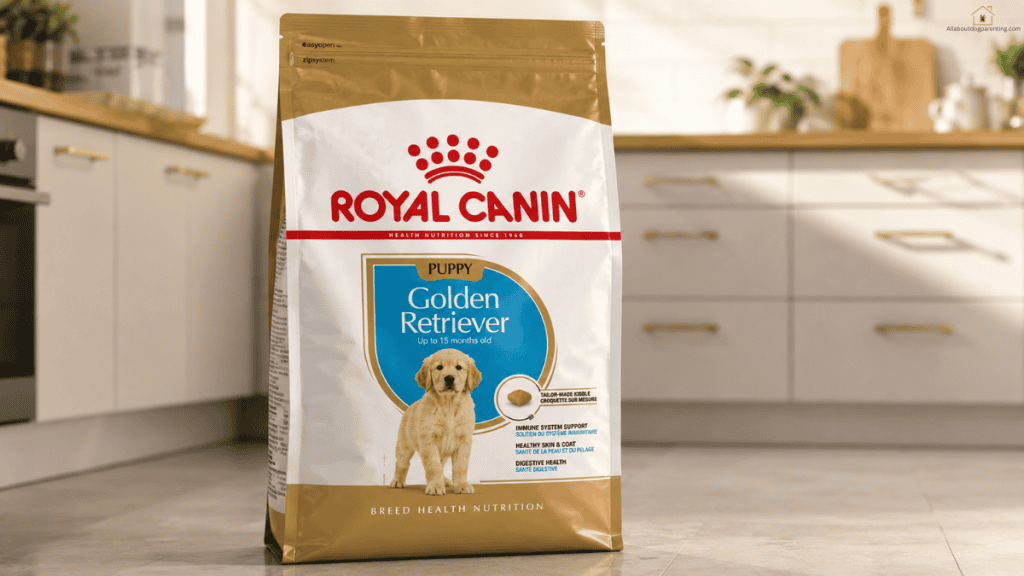
Royal Canin produces a formula designed specifically for Golden Retriever puppies. The kibble shape is designed for the Golden’s jaw width. The formula includes EPA and DHA specifically for coat development alongside brain support, prebiotics for digestive health, and controlled calcium. The coat-focused formulation is genuinely relevant for a breed whose double coat health reflects overall nutritional status.
| Spec | Value |
| Protein | 28% min |
| Fat | 15% min |
| Calcium | ~1.33% |
| Kcal/cup | ~346 |
| Fish oil DHA/EPA | Yes |
| Price estimate | ~$65–80 per 30 lb bag |
| AAFCO | Growth including large-size dogs |
Best for: Golden owners who want a breed-specific formulation with coat-focused EPA and DHA alongside standard large-breed nutritional controls. Among the more targeted golden retriever puppy food options for coat health specifically.
Drawback: The most expensive kibble on this list. Contains corn and by-product meal. The breed-specific kibble shape is a convenience feature rather than a nutritional necessity.
Pick 3: Hill’s Science Diet Large Breed Puppy — Best for Joint Protection
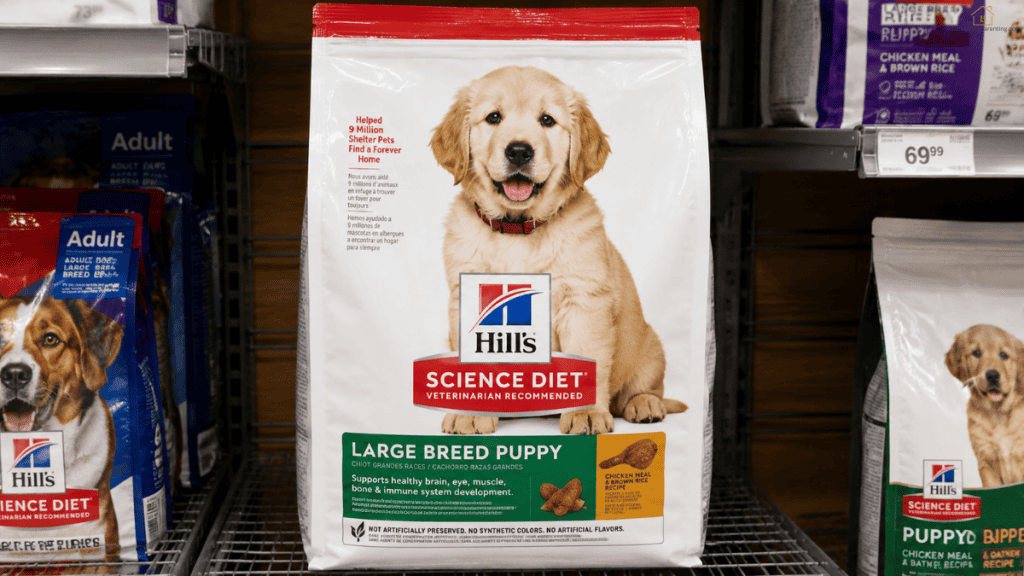
The tightest calcium control on this list at approximately 1.25% dry matter, making it the most conservative choice for Golden owners focused on minimising joint development risk. Glucosamine and chondroitin are included for joint support during the growth phase. Over 200 veterinary nutritionists are behind the formulation.
| Spec | Value |
| Protein | 24.5% min |
| Fat | 12% min |
| Calcium | ~1.25% |
| Kcal/cup | ~363 |
| Fish oil DHA | Yes |
| Price estimate | ~$60–75 per 30 lb bag |
| AAFCO | Growth including large-size dogs |
Best for: Golden owners who want the most conservative calcium level for maximum joint protection. Particularly relevant given Goldens’ joint disorder predisposition alongside their cancer vulnerability.
Drawback: Lower protein than competitors. Premium price per pound. Fat at 12% is the lowest on the list, potentially insufficient for very active field-line Goldens.
Pick 4: Eukanuba Large Breed Puppy — Best for Active Goldens
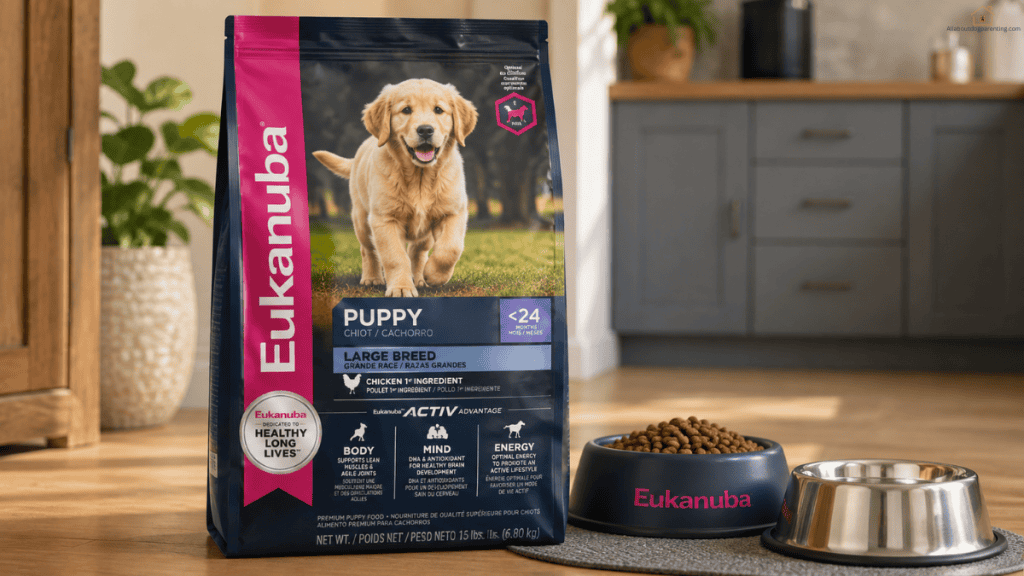
Higher protein and fat content suits field-line or very active Golden puppies who genuinely burn more calories daily. DHA for brain development, controlled calcium within AAFCO large-breed limits. Mars Petcare employs veterinary nutritionists and validates Eukanuba through feeding trials.
| Spec | Value |
| Protein | 27% min |
| Fat | 15% min |
| Calcium | ~1.4% |
| Kcal/cup | ~392 |
| Fish oil DHA | Yes |
| Price estimate | ~$50–60 per 33 lb bag |
| AAFCO | Growth including large-size dogs |
Best for: Working-line or highly active Golden Retriever puppies with above-average daily energy expenditure. Goldens in regular field work or sustained training programmes.
Drawback: Calcium at 1.4% is within range but at the higher end compared to Hill’s or Pro Plan. Less widely available than the top two picks.
Pick 5: Iams Large Breed Puppy — Best Budget Option
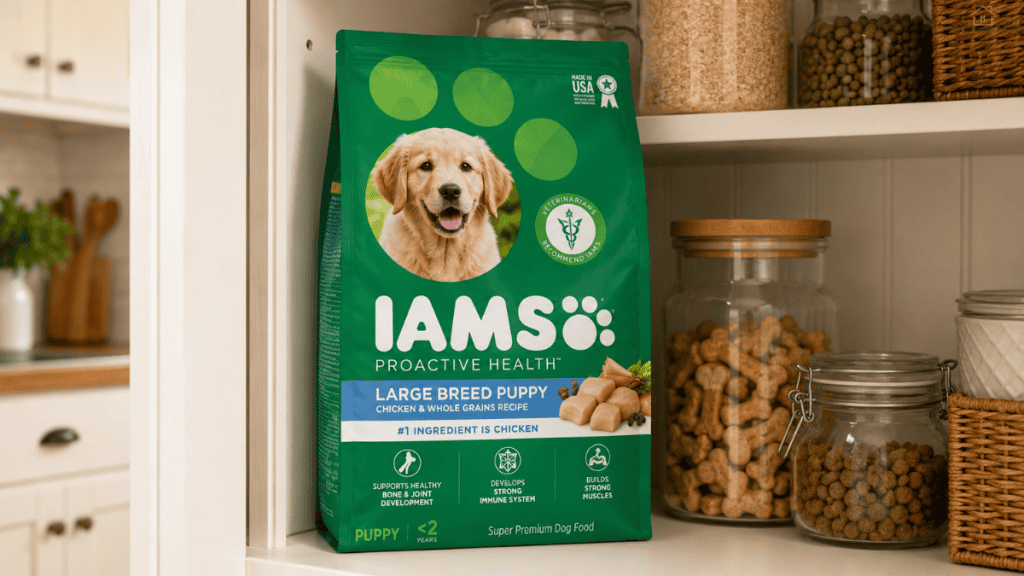
Farm-raised chicken as the first ingredient, AAFCO-certified specifically for the growth of large-sized dogs, DHA from fish oil, and controlled calcium. Mars Petcare employs veterinary nutritionists and conducts feeding trials. The most affordable pick on this list while meeting every nutritional criterion that matters for a Golden Retriever puppy. See our best affordable puppy food guide for more options at this tier.
| Spec | Value |
| Protein | 25.5% min |
| Fat | 13.5% min |
| Calcium | ~1.3% |
| Kcal/cup | ~354 |
| Fish oil DHA | Yes |
| Price estimate | ~$35–45 per 30 lb bag |
| AAFCO | Growth including large-size dogs |
Best for: Budget-conscious Golden owners who want nutritionally complete, grain-inclusive large-breed food without premium pricing.
Drawback: Lower protein than the top picks. Contains corn and chicken by-product meal.
Side-by-Side Comparison Table
Overview:
All five picks compared on protein, fat, calcium, DHA presence, calorie density, price, and best use case for Golden Retriever puppies specifically.
| Brand | Protein | Fat | Calcium | Kcal/Cup | DHA/EPA | Price Per Bag | Best For |
| Purina Pro Plan LB | 28% | 13% | ~1.3% | 393 | Yes | ~$60 | Best overall |
| Royal Canin Golden Puppy | 28% | 15% | ~1.33% | 346 | Yes (coat-focused) | ~$72 | Breed-specific, coat health |
| Hill’s Science Diet LB | 24.5% | 12% | ~1.25% | 363 | Yes | ~$68 | Tightest calcium, joint protection |
| Eukanuba LB Puppy | 27% | 15% | ~1.4% | 392 | Yes | ~$55 | Active/field-line Goldens |
| Iams LB Puppy | 25.5% | 13.5% | ~1.3% | 354 | Yes | ~$40 | Best budget |
All five picks are grain-inclusive, which for Golden Retrievers is not a minor detail. It’s the most breed-specific selection criterion on this list.
Golden Retriever Growth Chart: Weight by Age
Overview:
Male Goldens typically reach 30 to 34 kg (66 to 75 lbs) at maturity; females reach 25 to 29 kg (55 to 64 lbs). Peak height growth occurs at 6 to 9 months, with muscle fill-out continuing until 15 to 18 months.
| Age | Male Weight (typical) | Female Weight (typical) | Growth Phase | Notes |
| 8 weeks | 4 to 6 kg | 3.5 to 5.5 kg | Rapid growth begins | Settling into new home |
| 3 months | 10 to 14 kg | 8 to 12 kg | Peak growth velocity | Appetite is at its highest |
| 5 months | 18 to 23 kg | 14 to 19 kg | Height growth continues | Coat beginning to show |
| 7 months | 24 to 29 kg | 19 to 24 kg | Height approaching adult | May look nearly grown |
| 10 months | 27 to 32 kg | 22 to 27 kg | Growth slowing | Filling out in chest and shoulders |
| 12 months | 29 to 33 kg | 24 to 28 kg | Approaching maturity | Growth plates may still be open |
| 15 to 18 months | 30 to 34 kg | 25 to 29 kg | Full maturity | Safe to switch to adult food |
Goldens are slightly lighter than Labs of comparable height and have a softer, rounder build that can make body condition assessment somewhat harder visually. The body condition check below is your more reliable tool.
Coat Health Through Nutrition
Overview:
A healthy Golden coat starts from nutrition. DHA and EPA from fish oil, omega-6 fatty acids, zinc, and biotin all contribute to coat texture and shine. Look for fish oil listed in the ingredients and omega-3 content above 0.5%.
Every pick on this list includes fish oil as a DHA source, which means they all support coat health alongside brain development. For a breed whose double coat is one of its defining characteristics, this cannot be a tertiary consideration. Fish oil-derived DHA and EPA are the most bioavailable sources of long-chain omega-3 fatty acids for dogs, and they contribute to skin barrier function, coat density, and shine in ways that plant-based omega-3 sources like flaxseed do not replicate as effectively.
What to look for on labels: fish oil or fish meal listed in the ingredients, and an omega-3 fatty acid content stated as 0.5% or higher in the guaranteed analysis. Some premium foods state DHA content specifically, which is useful.
A dull or sparse coat on an otherwise healthy Golden puppy eating a quality food is worth a vet conversation. It can indicate inadequate fatty acid absorption, thyroid issues, or other underlying health concerns. A fish oil supplement (typically 1,000 mg per day for a puppy of this size) may be discussed with your vet, but supplementing on top of a well-formulated food without guidance isn’t always necessary.
FAQs
1. How much should I feed my Golden Retriever puppy?
A Golden puppy needs 1.5 to 4 cups of large-breed puppy kibble per day depending on age, split across 2 to 4 meals. Start with approximately 1.5 to 2 cups per day at 8 weeks across 4 meals. By 6 months, most Goldens eat 3 to 4 cups per day across 2 meals. Adjust portions based on the weekly body condition check: ribs easily felt with light pressure, visible waist from above, slight abdominal tuck from the side.
2. What is the best food for a Golden Retriever puppy?
A grain-inclusive, large-breed-specific formula with controlled calcium, fish oil for DHA and EPA, and formulation by a brand employing veterinary nutritionists. This golden retriever puppy feeding guide recommends Purina Pro Plan Large Breed Puppy as the best all-round option, Royal Canin Golden Retriever Puppy for coat-focused formulation, and Hill’s Science Diet Large Breed Puppy for the tightest calcium control. All three are validated through AAFCO feeding trials.
3. Is grain-free food safe for Golden Retrievers?
No, not as a default. Golden Retrievers were the most frequently reported breed in the FDA’s DCM investigation, and peer-reviewed research from UC Davis has found a specific association between grain-free legume-rich diets and taurine deficiency in Goldens. Unless your Golden has a confirmed grain allergy diagnosed by your vet, grain-inclusive food is the strongly recommended choice for this breed. Our grain-free vs grain-inclusive guide covers the full evidence.
4. When should a Golden Retriever puppy switch to adult food?
Between 14 and 18 months, when growth has visibly slowed and your Golden has reached approximately 80% of expected adult weight. Don’t switch at 12 months: Goldens may still have open growth plates even when they appear fully grown. Our when to switch to adult food guide covers the readiness signs and the 10-day transition process.
5. Do Golden Retriever puppies need supplements?
Generally no, if feeding a complete AAFCO-certified puppy food. The foods on this list already include DHA, EPA, and the nutrients needed for brain and coat development. Fish oil is the one supplement most commonly discussed for Goldens given the breed’s coat and cardiac health considerations, but supplementing on top of a fish oil-containing food without vet guidance isn’t necessary. Discuss with your vet at the first checkup before adding anything to the diet.
The Bottom Line
Golden Retriever puppy food decisions carry specific implications that don’t apply equally to other large breeds. The DCM research is the most actionable: feed grain-inclusive food from the start, without exception, unless your vet has specifically diagnosed a grain allergy. This isn’t precautionary advice. It’s based on the FDA investigation, the UC Davis research, and the PLOS ONE study that found cardiac abnormalities in healthy Goldens eating grain-free diets before symptoms appeared.
On cancer risk, be honest with yourself about what nutrition can do. It can provide a strong nutritional foundation. It can support lean body condition, which interacts with disease risk. It cannot make promises about preventing a condition driven primarily by genetics. Feed your Golden well, keep them lean, stay current with veterinary checkups, and let the Morris Animal Foundation’s ongoing Golden Retriever Lifetime Study continue to build the evidence base that may eventually give owners more specific guidance.
Every pick on this list is grain-inclusive, AAFCO-certified for large-breed growth, contains fish oil for DHA and EPA, and comes from a brand with veterinary nutritionists involved in formulation. Start there, check body condition weekly, and adjust as your Golden grows.