How to Teach a Puppy to Sit (Step-by-Step)
🐾 Overview
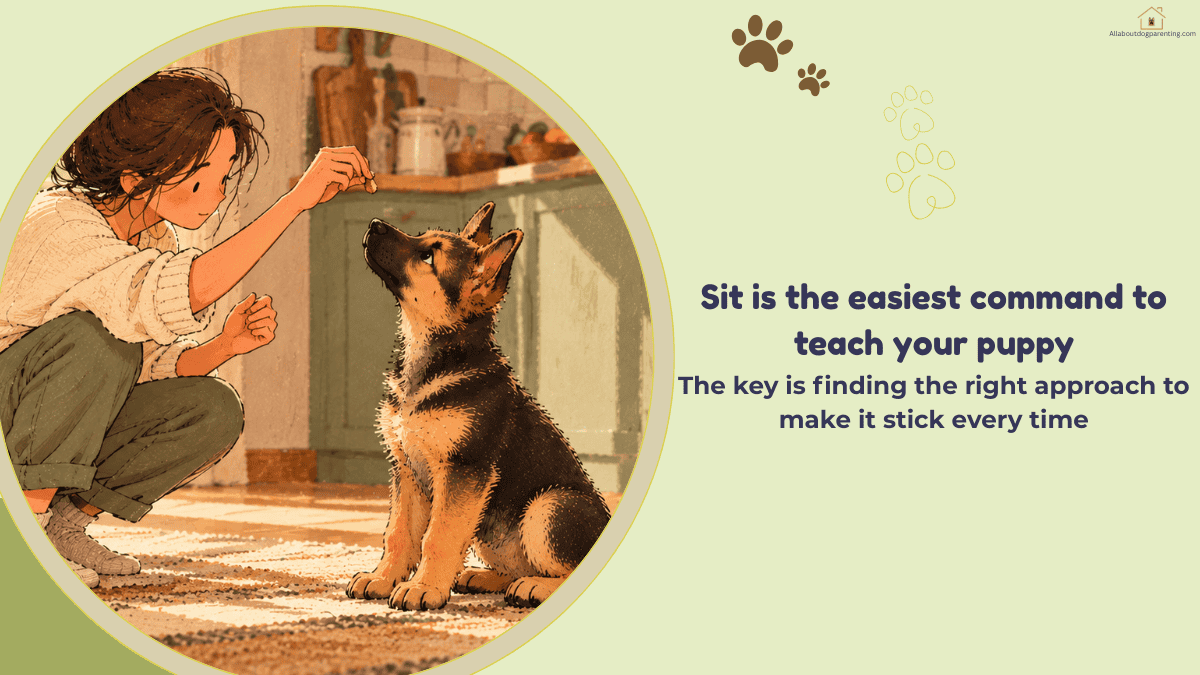
Hold a treat at your puppy’s nose and move it slowly up and back over their head. Their rear drops. Say “yes!” the instant it lands, then treat. Do five reps. Add the word “sit” later.
You can teach puppy to sit in a single five-minute session in your kitchen, today, with a handful of treats and no equipment at all. Getting from that first wobbly sit to one that works at the park takes a few weeks, and this guide walks you through every stage.
This article, part of our Complete Guide to Puppy Training, covers how to teach a puppy to sit using the lure method, how to fade the treat and add the word, a capture method for puppies who won’t follow a lure, and how to make sit work everywhere. It’s the first win most of us get with a new puppy, and it’s a good one.
| Stage | What you’re doing | Typical timing |
|---|---|---|
| Lure | Treat guides the puppy into a sit | Days 1–3 |
| Empty hand | Same hand motion, treat comes from elsewhere | Days 4–7 |
| Verbal cue | “Sit” said once, hand signal as backup | Days 7–14 |
| Proofing | Practising in harder places | Weeks 3–5 |
| Auto-sit | Puppy offers sit to ask for things | Ongoing |
Why Sit Is the First Command to Teach
🐾 Overview
Sit is the easiest behaviour to teach and one of the most useful. It gives your puppy something to do instead of jumping, bolting or mugging you for food, and it builds the impulse control every other skill needs.
It’s worth the effort to teach puppy to sit before anything else. A sitting puppy can’t jump on your guests, can’t bolt through an open door, and can’t climb you for the treat bag. That’s the real value of a puppy sit command. Instead of trying to teach “don’t do that” a hundred different ways, you teach one thing to do instead.
Sit also builds impulse control, the foundation for stay, leave it and loose-leash walking. And once your puppy realises sitting gets them things, they start offering it as a way of asking, which is my favourite part of puppy sit training.
What You Need
🐾 Overview
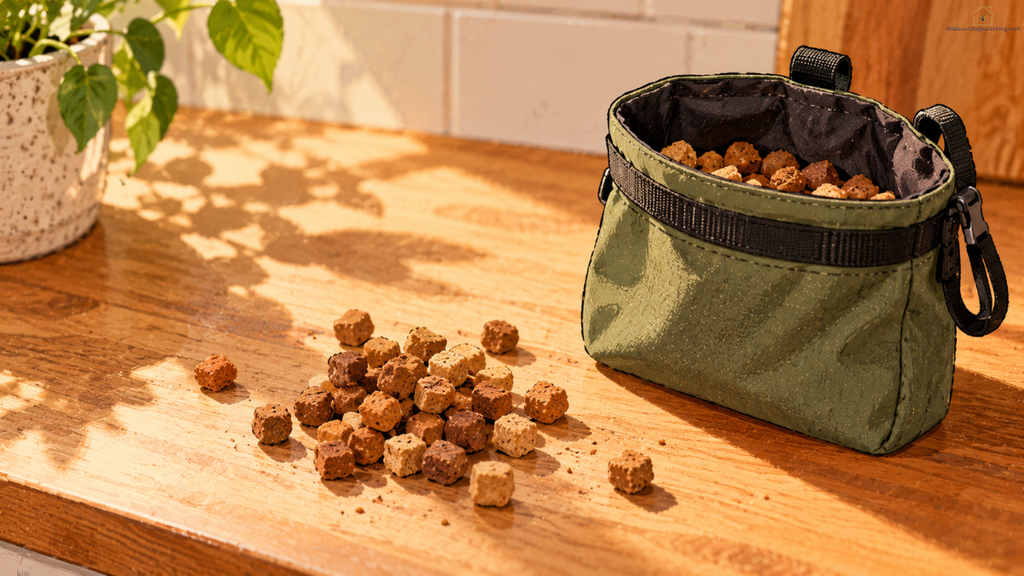
Soft, pea-sized treats your puppy loves, a quiet room and five minutes. No clicker needed. A bright “yes!” works as your marker. Train before a meal, when your puppy is keen for food.
You need very little to teach puppy to sit. If you’re asking when can a puppy learn to sit, the answer is the day they come home.
Treats
Small, soft and worth working for. Our guide to the best puppy treats for training has low-calorie picks, which matters when puppy sit treats add up over a day.
Timing
Train just before a meal. A full puppy is a distracted puppy.
A quiet room
No other pets, no TV. Distractions come later.
A marker
A bright, consistent “yes!” tells your puppy the exact moment they got it right. A clicker does the same job, but you don’t need one to start. In a study of 51 pet dogs, researchers found no difference in learning speed between a clicker, a spoken marker and food alone. If you’re curious about clicker training puppy sit sessions anyway, our article on whether dog training clickers work covers the pros and cons.
The Lure Method (Step by Step)
🐾 Overview
Arc a treat slowly from your puppy’s nose up and back over their head. As the head rises, the rear drops. Say “yes!” the instant it lands, then treat. Five reps, three sessions a day.
This is puppy lure training at its simplest, and it’s the classic way to teach dog to sit step by step.
Step 1: Get their attention
Hold a treat between your thumb and fingers right at your puppy’s nose, close enough to smell but not to grab. Say nothing. No “sit” yet.
Step 2: Arc the treat up and back
Move the treat slowly upwards and slightly back over the top of your puppy’s head, towards their tail. As their nose follows it up, their rear naturally drops; a puppy can’t comfortably look straight up while standing. Aim for a smooth movement of about two seconds.
Step 3: Mark and reward the instant their rear touches the floor
Say “yes!” at that exact moment, then get the treat to their mouth within a second. Deliver the treat while your puppy is still sitting, or you teach them to pop straight back up.
🐾 Why Timing Matters
- The “yes!” tells your puppy exactly which moment earned the treat.
- Say it as they stand back up and you’ve rewarded standing.
- Say it two seconds late and the sit and the treat don’t connect.
- Precise timing is the difference between a puppy who learns in three reps and one who’s confused after thirty.
Step 4: Release and reset
Toss a treat on the floor so your puppy stands up, then start again.
Step 5: Stop after five reps
Five reps make a session. Run three sessions a day, at least an hour apart. Short, spaced sessions are backed by research. In one study, dogs trained once a day learned faster than dogs given three sessions in a row. Stop while your puppy still wants more.
Fading the Lure and Adding the Verbal Cue
🐾 Overview
After a few days, keep the same hand motion with no treat in that hand and reward from the other. Once your puppy sits on the signal, say “sit” just before it.
This is where many owners rush. Take it in three stages, and move on only when your puppy hits each checkpoint.
Stage 1: Treat in the luring hand (days 1–3)
The standard lure, with the reward from the same hand. Move on after five out of five sits in two sessions in a row.
Stage 2: Empty hand, same motion (days 4–7)
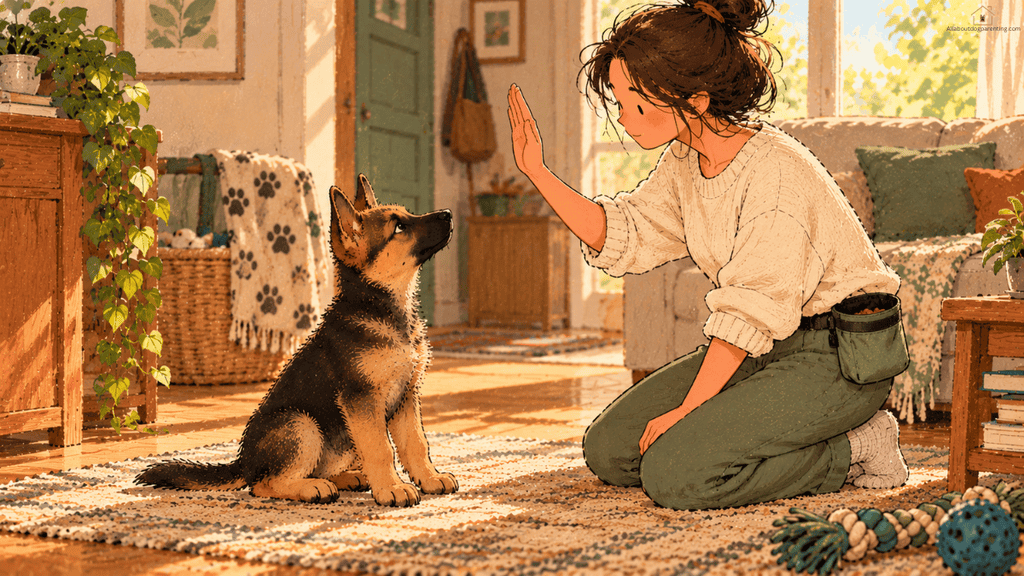
Make exactly the same arc with no treat in that hand; the treat comes from your other hand or a pouch. If yours hesitates, wait three seconds. If they sit, give a jackpot of three or four treats in a row. If they don’t, do one more lure rep and try again. Move on after five out of five empty-hand sits in two sessions in a row.
Stage 3: Add the word (days 7–14)
Say “sit” once, in a normal voice, pause for a second, then give the hand signal. Over time, your puppy learns the word predicts the signal and starts sitting on the word alone. The San Francisco SPCA puts the key rule plainly: say “sit” only once. If nothing happens within three seconds, use the hand signal and try the word alone next time. Move to proofing when your puppy sits on the word alone in four out of five reps across two sessions.
That’s how long to teach puppy sit on cue for most puppies: about two weeks.
The Capture Method (For Puppies Who Won’t Follow a Lure)
🐾 Overview
If your puppy jumps at the treat or won’t follow your hand, capture the sit. Say “yes!” the instant they sit on their own and toss a treat. Add the word later.
Capture method dog training is another way to train puppy to sit, and it suits puppies who leap for the treat, aren’t very food-motivated, or don’t track a moving hand. Keep treats in your pocket. Every time your puppy sits on their own, say “yes!” and toss a treat a little way off so they have to get up. Then wait for the next sit. No formal sessions needed.
After 15–20 captures, most puppies start sitting more often, because sitting has started to pay. From there, say “sit” just as you see them beginning to lower, exactly like Stage 3 above. Capturing usually takes a little longer than luring, but your puppy works the behaviour out for themselves.
Proofing: Making Sit Work Everywhere
🐾 Overview
A puppy who sits in the kitchen but ignores you at the park has learned “sit in the kitchen.” Proofing means practising in gradually harder places, changing one thing at a time, until the cue works anywhere.
If you teach puppy to sit only in the kitchen, you get a kitchen sit. If your puppy sits at home but not outside, nothing is wrong with them. Dogs don’t automatically carry a behaviour from one place to another, which is why the SF SPCA advises practising sit in different places around the house before you take it further afield. To proof puppy commands, work up a ladder:
- The quiet room where you taught it
- A different room in the house
- The garden, balcony or building corridor
- The front of the house or driveway, with people passing
- A quiet street on a walk, sitting at every kerb
- A park or pet store, with dogs in the distance
- Busy places: the vet’s waiting room, a market street, near the dog park
Change one thing at a time, go back to rewarding every sit in each new place, and use better treats outdoors. If your puppy misses two in a row at a new level, drop back a rung for a session. Each rung usually takes two or three sessions, so the whole ladder takes about two to three weeks. If your puppy struggles to focus on you at all outside, our guide on how to train a dog to listen helps build attention first.

Building the Auto-Sit (Sit as a Default Behaviour)
🐾 Overview
The real goal is a puppy who sits automatically when they want something: before meals, before the door opens, before the leash goes on, and when greeting people. That’s when sit stops being a command and becomes a habit.
An auto sit puppy is the payoff, and it’s where a puppy sit command turns into a habit. The AKC suggests rewarding sits your dog offers in everyday moments, like when you fill the food bowl, and that’s exactly how it starts.
🐾 Four Everyday Auto-Sits
- Sit before meals: Hold the bowl and wait silently. The bowl goes down the instant your puppy sits.
- Sit before the leash goes on: Hold the leash up. A sit clips it on and the walk begins. A jump puts the leash behind your back.
- Sit before the door opens: A sit opens the door, a jump takes your hand off the handle. It also stops bolting.
- Sit for greeting: Guests give attention to a sitting puppy and turn away from a jumping one.
My German Shepherd cracked sit before meals in three dinners. By the second day, he was sitting in front of the fridge, the treat jar and the back door, staring at me. He’d worked out the rule: sitting makes humans hand things over. Sit before meals fits neatly into a routine, and our puppy feeding schedule by age gives you the mealtimes to practise at. Sit for greeting is also part of good manners with visitors, which our guide on how to socialise a puppy with other dogs and people covers.
Common Mistakes In Teaching a Puppy to Sit
🐾 Overview
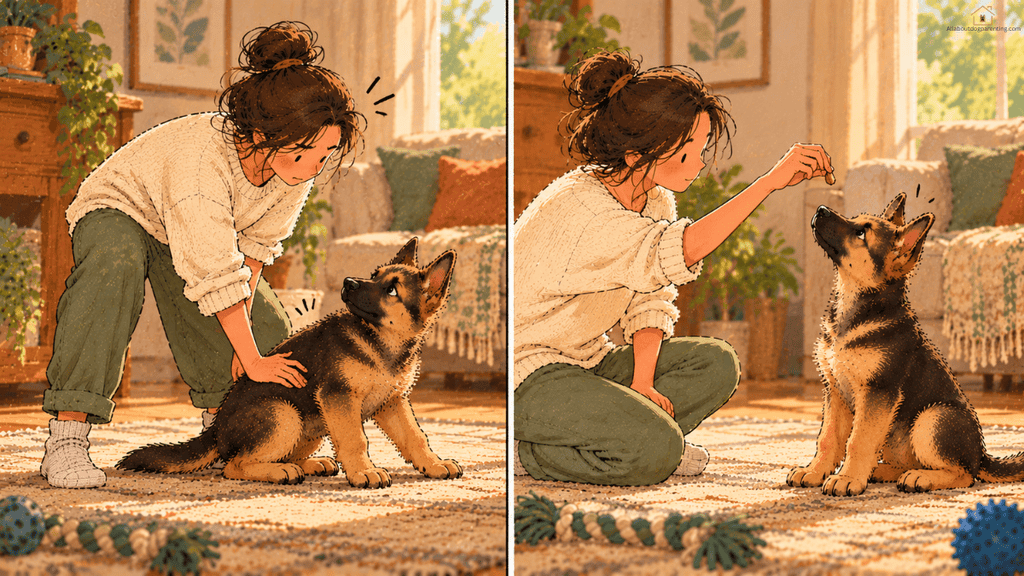
The five biggest mistakes are pushing your puppy’s rear down, saying the cue too early, repeating “sit, sit, sit,” rewarding late, and training after a full meal. You can fix all five in one session.
Most of the problems people hit when they teach puppy to sit come down to these five.
- Pushing the rear down: The AKC warns that pushing your dog’s hind end down can be intimidating and confusing. Your puppy learns far more when they choose the position.
- Saying “sit” too early: Teach the action first and name it second.
- Repeating the cue: “Sit. Sit! SIT!” teaches your puppy to wait for the third, loudest version. Say it once, wait three seconds, then use the hand signal.
- Rewarding late: Fumble in a pouch for five seconds and you’ll end up rewarding the ear scratch that followed the sit.
- Training after a meal: A full puppy doesn’t care about treats. Train before meals, and count the treats as part of the day’s food; our guide on how much to feed a puppy explains how.
Troubleshooting
🐾 Overview
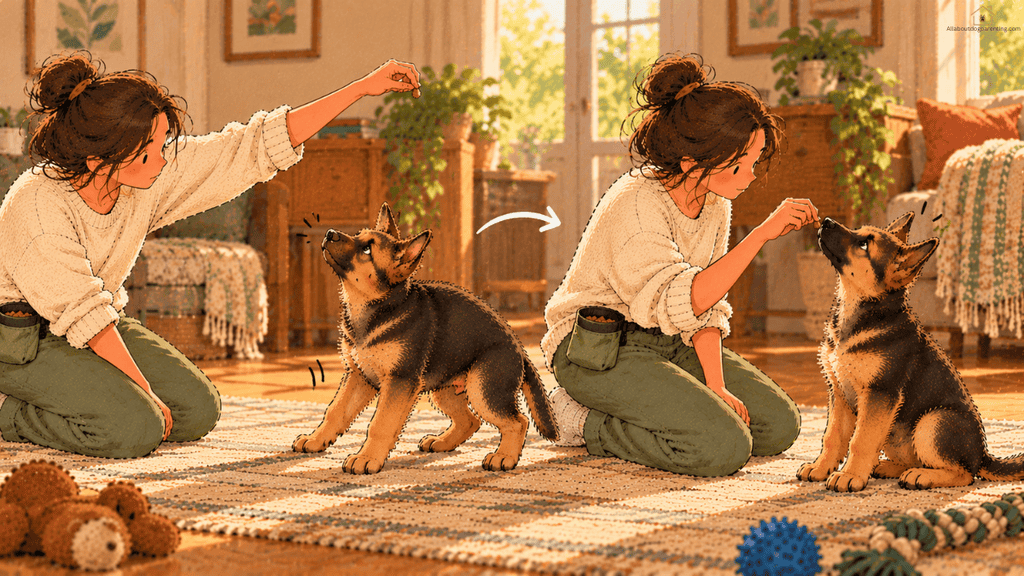
Jumping for the treat means it’s too high. Backing up means you’re moving it too far back. Lying down usually means too slow or too low. And a puppy who won’t follow at all needs the capture method.
While “sit” is one of the easiest commands to teach a puppy, there’s no guarantee that the process will be without it’s challenges. Here are some common issues you may encounter along the way and how to deal with them:
- Puppy jumps for the treat: Lower your hand so the arc just clears their head. With small breeds, kneel or sit on the floor.
- Puppy backs up instead of sitting: You’re moving the treat too far back. Think up more than back, or practise with your puppy’s rear near a wall.
- Puppy lies down: Speed the arc up slightly and keep the treat just above nose level.
- Puppy loses interest quickly: Use better treats and train before meals.
- Puppy won’t sit for other family members: Each person needs to practise. If you’ve tried to teach puppy to sit for three weeks without progress, a qualified trainer can spot what’s going wrong; our article on choosing the right dog trainer covers what to look for.
FAQs
1. When can a puppy learn to sit?
From the day they come home, usually around eight weeks. If you’re wondering when to teach puppy to sit, the answer is as soon as they can eat a treat and look at you. Keep sessions to five reps and use good treats. There’s no need to wait for vaccinations or classes.
2. How long does it take to teach a puppy to sit?
Most people can train puppy to sit on cue in one to two weeks by following the teach dog to sit step by step plan above, with three short sessions a day. Proofing takes another two to three weeks, so plan on four to six weeks in all.
3. Should I use a clicker to teach sit?
You can, but you don’t need one. A study comparing a clicker, a spoken marker and food alone found no difference in how fast dogs learned, so a bright “yes!” works well.
4. Why does my puppy sit at home but not outside?
Because they haven’t generalised it yet. Work up the proofing ladder one level at a time, with better treats in new places, and within a few weeks it will hold up most places you go.
5. Should I push my puppy’s bottom down to teach sit?
No. Placing your puppy teaches very little because they didn’t choose the position, and it can make them wary of hands near their rear. Lure or capture the sit instead.
Your First Win
That’s how to teach a puppy to sit: three short sessions a day, a slow fade, the word said once, and somewhere new every few days. Before long, puppy sit training stops being a lesson and becomes the way your puppy asks for things. When you’re ready for what comes next, our list of 30 essential dog training commands shows where to go from here.