Leash Training Puppy: How to Teach This Essential Skill
🐾 Overview
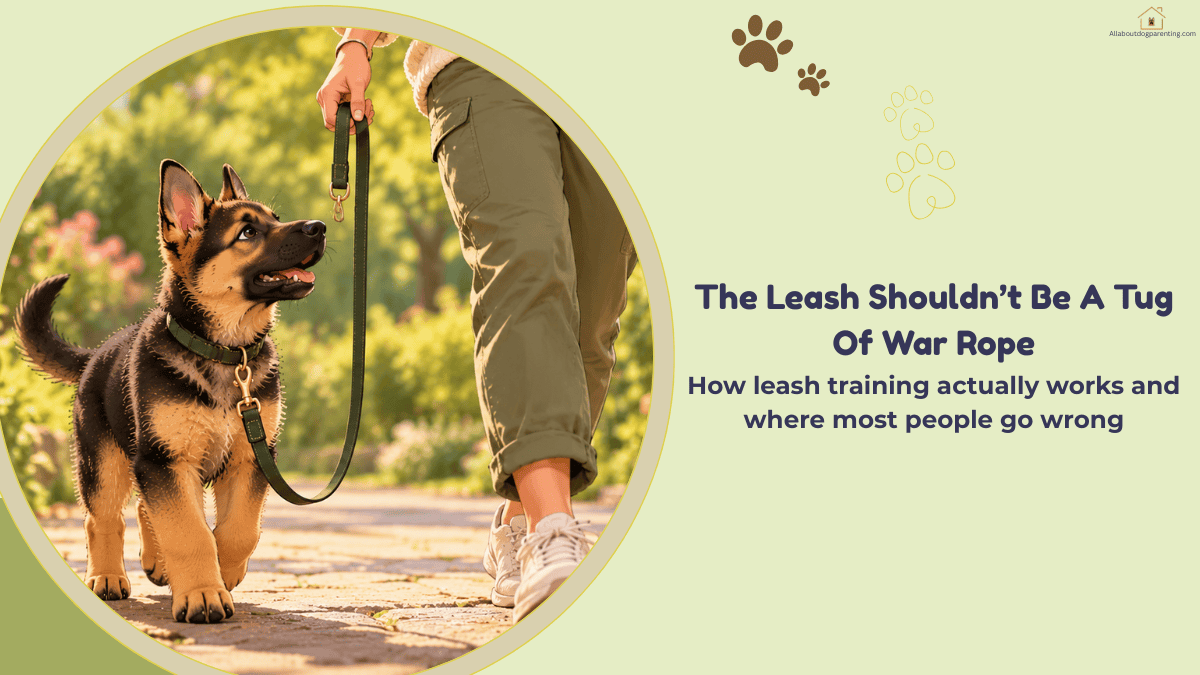
Start indoors. Let your puppy wear a harness for a day, let them drag a leash, then reward them for walking beside you. Move outdoors only once indoor walking is relaxed and loose.
Leash training puppy skills start in your living room, long before the first walk down the street. Most of the pulling, freezing and leash-chewing owners struggle with comes from skipping those early indoor steps, so this guide works through them in order, with a clear sign for when your puppy is ready to move on.
This article, part of our Complete Guide to Puppy Training, covers how to leash train a puppy from the first collar to proper walks: the gear, a five-phase plan with checkpoints, two techniques for pulling, what to do when your puppy plants their feet, and the adolescent wobble that catches almost everyone out.
One thing to settle first: the goal here is loose leash walking puppy style, with slack in the leash and room to sniff. A formal heel is a nice extra for later. Most of us just want a dog who doesn’t drag us into traffic, and that’s what this puppy leash training step-by-step plan delivers.
| Age | Walk length | Sessions a day | Reward rate |
|---|---|---|---|
| 8–10 weeks | 5–10 minutes, mostly indoors | 3 short sessions | Every 2–3 steps |
| 12–16 weeks | 10–15 minutes | 2 sessions | Every 5–8 steps |
| 4–6 months | 15–25 minutes | 1–2 sessions | Every 10–15 steps |
| 6–12 months | 20–40 minutes | 1–2 walks | Occasional, with surprise rewards |
What You Need Before You Start (Gear Guide)
🐾 Overview
Use a front-clip harness for walking, a flat collar for ID tags, a fixed leash of about 1.5–2 metres, and soft, pea-sized treats. Skip retractable leashes, choke chains and prong collars entirely.
Here is a round up of essentials that can aid you in leash training:
A harness for walking
For most puppies, a front clip harness puppy owners attach at the chest is the best default, and it’s where leash training puppy gear should start. When your puppy pulls, the front ring turns them back towards you. The RSPCA describes front-attach harnesses as a gentle training aid that helps stop dogs pulling, and a 2024 study found dogs pulled significantly less on a front-connection harness than on a martingale collar.
Back-clip harnesses take all pressure off the neck, which matters for toy and flat-faced breeds, but they don’t discourage pulling. In one study of 52 dogs, they pulled harder in a back-clip harness than on a collar when food was on offer. Measure the chest just behind the front legs, check you can slide two fingers under every strap, and re-check the fit every few weeks while your puppy grows.
A collar for ID
On the puppy harness vs collar question, I use the collar for tags and the harness for walking. A puppy pulling on a flat collar puts pressure directly on the throat. VCA notes that tracheal collapse is most common in breeds like Chihuahuas, Pomeranians, Yorkies and toy poodles, and recommends using a harness instead of a collar. Take the collar off in the crate, where it can catch.
A fixed leash
Nylon or leather, light clip, roughly 1.5–2 metres long. The RSPCA warns that a leash that’s too short sets a dog up to pull, and it doesn’t recommend retractable leashes at all. A retractable lead teaches your puppy that pulling buys more line, which is the opposite of what you’re teaching.
Treats and a pouch
You’ll hand out a lot of rewards, so keep them tiny and soft. Our guide to the best puppy treats for training has low-calorie picks.
Head halters
These come in later, if at all. The RSPCA says many dogs find them uncomfortable and suggests using them only as a last resort, after trying loose-leash work and a front-clip harness.
🐾 Gear to Avoid
- Choke chains and slip collars: The RSPCA says these, along with prong collars, cause pain and distress
- Prong or pinch collars: Same reason, and they risk teaching your puppy that the world hurts
- Retractable or bungee leads: They reward pulling and give you little control in an emergency
- What to use instead: A front-clip harness, a fixed leash and a pocket full of treats
The 5-Phase Leash Training Plan
🐾 Overview
Phase 1, wear the harness. Phase 2, drag the leash indoors. Phase 3, walk beside you indoors. Phase 4, the garden or driveway. Phase 5, quiet streets. Most puppies get there in two to three weeks.
This plan is how to leash train a puppy without skipping the foundations. Each phase has a goal and a checkpoint, and if your puppy struggles, stay where you are a little longer.
Phase 1: How do you get a puppy used to a collar and harness? (Days 1–2)
Goal: Your puppy ignores the collar and harness completely. If you’re wondering when to start leash training puppy skills, this phase starts the day they come home.
Put the flat collar on with a two-finger gap and hand over a treat straight away. Then play or feed a meal to distract from the new feeling. Most puppies scratch at it for a few minutes and then forget it’s there. If yours panics, take it off, wait an hour and try again with treats scattered on the floor as you clip it on.
Once the collar is a non-event, usually within a few hours, introduce the harness the same way. It’s bulkier, so expect a bit more fuss.
Move on when your puppy wears both for 30 minutes or more without scratching or trying to wriggle out.
Phase 2: What’s the point of the leash drag? (Days 3–4)
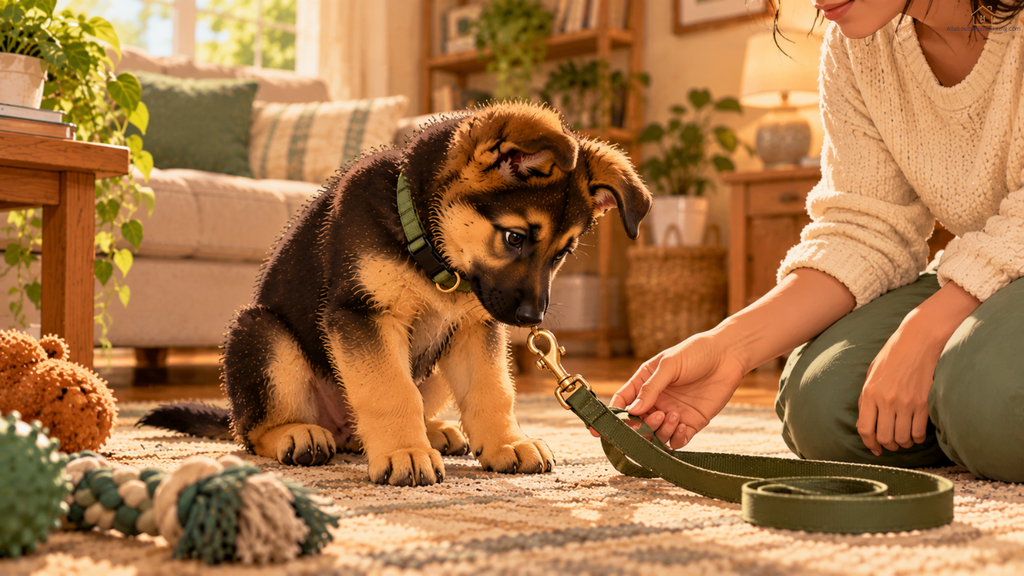
Goal: Your puppy is relaxed with a leash attached and trailing behind them.
Clip the leash to the harness and let your puppy drag it around the house, always supervised, since a trailing leash can snag on furniture. Don’t pick it up yet. You want the leash to become boring. If your puppy chews it, offer a toy instead. If they freeze, scatter treats just ahead of them so they move on their own.
Run 10–15 minutes of leash-dragging three or four times a day.
Move on when your puppy moves freely with the leash trailing and only chews it now and then.
Phase 3: How do you teach walking beside you indoors? (Days 5–10)
Goal: Your puppy walks 15–20 steps beside you indoors with the leash loose.
Pick up the leash and stand still. Your puppy will head off somewhere. Don’t follow and don’t pull back; just wait. The moment they look at you or step towards you, say “yes!” and deliver a treat right beside your leg. Pick one side and stick to it.
Take a single step. If your puppy follows with the leash loose, “yes!” and a treat at your leg. If they pull, stop, wait, and reward when they come back. Build from one step to three, five, then ten. Always deliver the treat at your leg, never at arm’s length. That’s how your puppy learns where the good stuff happens.
Keep sessions to five minutes, three times a day, and practise in different rooms. End on a win, even if that’s three good steps. Asking for a sit before the leash goes on makes a calm start to every session.
Move on when your puppy manages 15–20 loose-leash steps indoors in three sessions in a row.
Phase 4: What changes in the garden or driveway? (Days 10–15)
Goal: Loose-leash walking in a quiet outdoor space.
Your garden, driveway, apartment courtyard or building corridor all work. Leash training puppy progress often vanishes on the first outdoor session; the smells and sounds are competing with you, and that’s normal. Start again from standing still and rewarding attention.
This is where the sniff reward earns its place. After five to ten good steps, say “go sniff” and let your puppy investigate for 10–15 seconds, then carry on. Your puppy learns that walking nicely leads to sniffing, and pulling leads nowhere.
Before your puppy’s vaccinations are complete, stick to your own garden and quiet, clean areas. Our puppy vaccination schedule by age shows where your puppy should be.
Sessions are 8–10 minutes, twice a day. Keep them separate from potty trips, so your puppy knows which is which.
Move on when your puppy walks 30 or more loose-leash steps outside and follows your stops and turns, three sessions in a row.
Phase 5: How do you move to real walks? (Day 15 onwards)
Goal: Loose-leash walking on streets and in parks, with rising distractions.
Your puppy first walk outside the gate should be on a quiet residential street. Hold off on busy roads and dog parks until your puppy can manage a full block on a loose leash. Puppy walking on leash in the real world gets harder one variable at a time: walk for longer, add more distractions, or go further from home, but never all three at once.
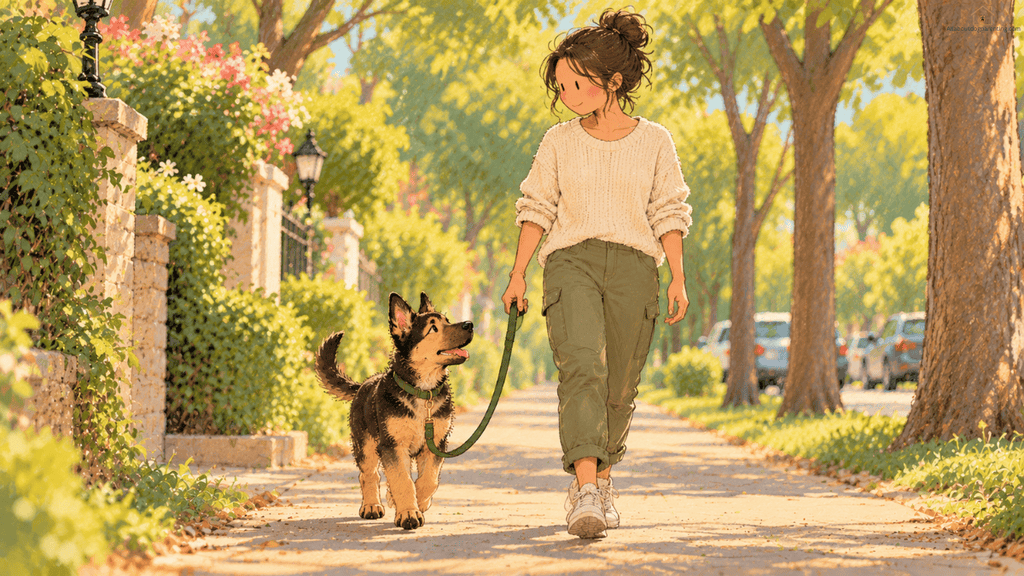
Start with a reward every five to ten steps and fade gradually. Within a couple of months, most puppies can manage a block with only a few treats and the occasional surprise reward. For puppy walking distance by age, our guide to puppy exercise by age explains how much activity is safe while joints are still growing. Walk outings are also prime socialisation time, which our guide on how to socialise a puppy with other dogs and people covers.
How to Stop Puppy Pulling on the Leash
🐾 Overview
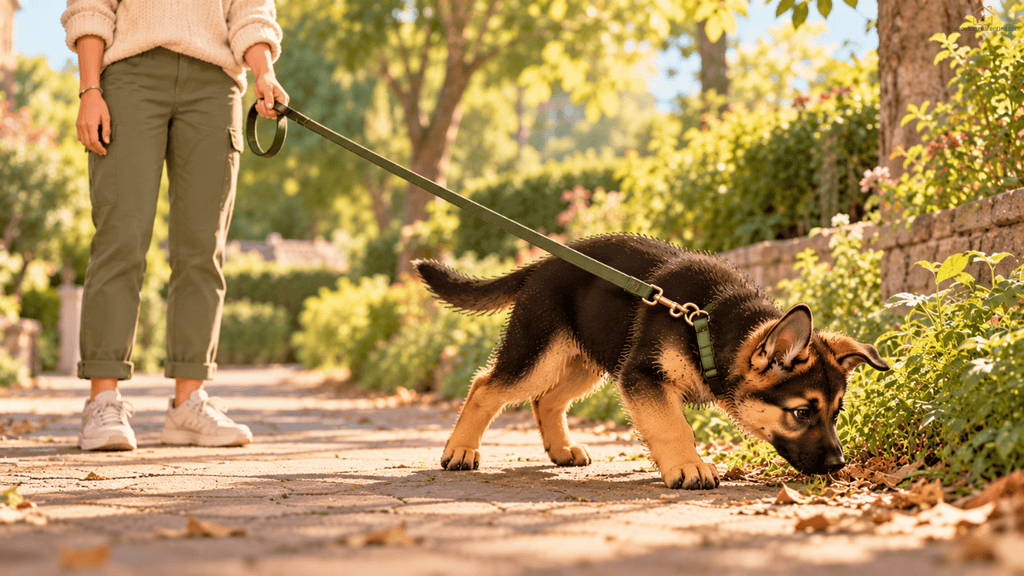
Use two techniques. “Be a tree” means stopping the moment the leash goes tight and moving on once it’s slack. The “U-turn” means calmly changing direction whenever your puppy pulls ahead. Both teach that pulling gets them nowhere.
Puppy pulling on leash happens for one reason: it works. It’s also the most common reason people give up on leash training altogether. Every step you take on a tight leash teaches your puppy that pulling gets results. Here’s how to stop puppy pulling without ever jerking the leash.
Stop and Stand Still (The Tree Method)
The instant the leash goes tight, stop and plant your feet. Say nothing. Your puppy will pull, look around, and eventually glance back. The moment they look at you or step towards you, “yes!” and a treat at your leg, then walk on. This works best for gentle pullers and younger puppies.
The U-turn
When the leash goes tight, say “this way” cheerfully, turn around and walk the other way. Your puppy has to follow, and when they catch up at your side, “yes!” and a treat. Pull again, turn again. Your first U-turn walk will look ridiculous. That’s fine; by the third or fourth walk, you’ll turn far less. It’s the better choice for strong pullers and bigger puppies who can outmuscle a stationary human.
🐾 What Not to Do
- Don’t jerk the leash. Corrections teach your puppy that the leash means discomfort, and do nothing for loose-leash walking.
- Don’t keep walking on a tight leash. Every step forward pays off the pull.
- Don’t wrap the leash around your hand. Hold the loop and gather the slack, so you can let go in an emergency.
When Your Puppy Freezes or Refuses to Walk
🐾 Overview
A puppy who freezes or sits down mid-walk is usually overwhelmed. Move somewhere quieter, crouch down, scatter treats at ground level and let them come to you. Never drag a frozen puppy.
If your puppy refuses to walk, you’re far from alone. It’s especially common in small breeds, rescue puppies, puppies under 12 weeks and puppies living somewhere noisy. A puppy freezes on walk for a few reasons: too much new input at once, one specific trigger like a truck or a drain grate, plain tiredness, or a surface that feels wrong underfoot.
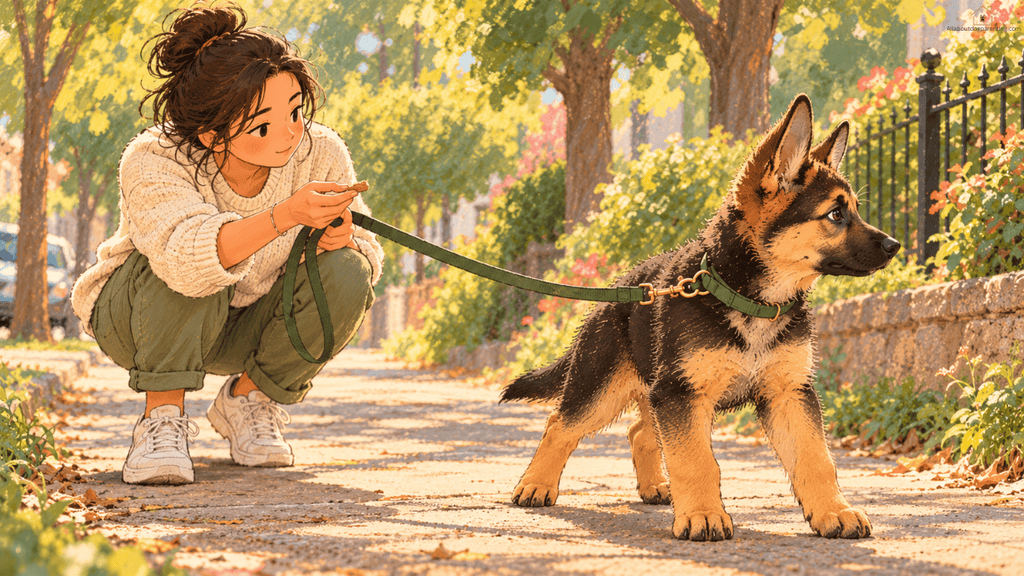
Stop. Don’t pull and don’t drag. Crouch down to make yourself small, scatter a few treats by your feet and wait. Often 30 seconds of stillness is enough. If nothing changes after a minute or two, carry them a short distance somewhere quieter and try again.
If your puppy freezes on every walk, you’ve moved to the street too soon. Go back to Phase 4 for another week. For surface refusals, bring the problem home: put a piece of the surface your puppy dislikes indoors, scatter treats on it and let them approach in their own time.
Breed-Specific Leash Training Notes
🐾 Overview
Herding breeds learn position quickly but want to manage everything they see. Retrievers pull towards anything friendly. Toy breeds freeze more than they pull. Bully breeds are strong early, so start harness work young.
How you approach leash training also depends a great deal on the breed you’re dealing with.
Herding breeds
Breeds like German Shepherds, Border Collies, Aussies, and Corgis usually pick up position fast. Their challenge is wanting to “manage” joggers, cyclists and other dogs, so the U-turn gets plenty of use. If your puppy nips at your ankles while you walk, stop moving until they stop.
Retrievers
Labradors, Golden Retrievers want to greet every person, dog and smell, and they’ll mouth the leash given half a chance. Give them a toy to carry on walks; a retriever with something in their mouth isn’t chewing the leash.
Toy breeds
Chihuahuas, Yorkies, Maltese, Pomeranians and the like freeze more often than they pull. Go slowly and keep walks short.
Bully breeds
Staffies, French Bulldogs, and English Bulldogs are strong for their size from a young age, so start harness work early. Flat-faced breeds should always walk on a harness, and walks should be short and cool in warm weather, because they struggle with heat and breathing.
The Adolescent Regression (6–10 Months)
🐾 Overview
Somewhere around 6–10 months, many puppies seem to forget their leash training. They pull harder and notice everything. Go back one phase, use better treats, shorten walks, and stay consistent. It passes.
Your puppy walked beautifully at five months. Now they pull, lunge at dogs and act as though their name belongs to someone else. This is adolescence, and there’s evidence behind it: a study of young guide dogs found they responded less reliably to “sit” at eight months than at five, but only with their own carer. They were testing their people, and the phase turned out to be temporary.
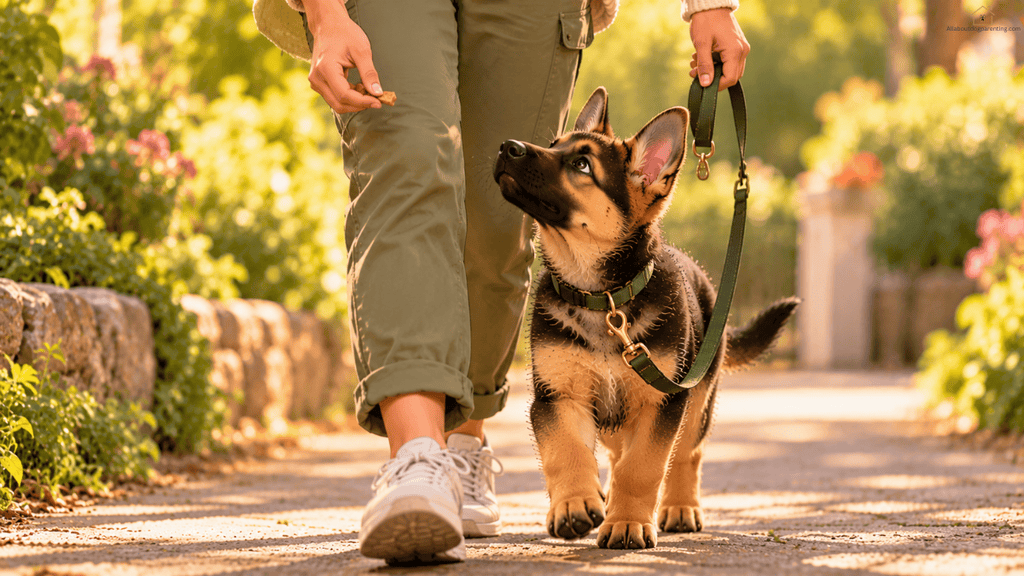
My German Shepherd walked beautifully from his third week of training. Then adolescence arrived at about seven months and he forgot everything overnight. Suddenly every jogger was a threat that needed managing. We went back to Phase 3 indoors for a week, and within a fortnight he was back on track.
When it happens to you:
- Go back one phase: If busy streets fall apart, return to quiet ones. If quiet streets fall apart, return to the garden.
- Upgrade the treats: What worked at four months won’t compete with adolescent distractions. Small pieces of cheese or cooked chicken usually do, and our guide on how much to feed a puppy helps you account for the extra calories.
- Shorten walks: Fifteen good minutes beat forty minutes of pulling.
- Stay consistent: How long to leash train through adolescence varies, but steady practice brings most dogs back. Our guide to puppy development stages explains what’s changing in your puppy’s brain at this age.
Many owners give up here and accept pulling as just how their dog walks. Please don’t; these months decide what the next decade of walks looks like.
Leash Training Troubleshooting
🐾 Overview
Leash biting usually means your puppy needs something to carry. Circling means you’re luring too much. Pulling towards dogs is excitement, so add distance and reward calm attention. Each problem has a specific fix.
These leash training tips cover the problems I’m asked about most.
Puppy biting leash
Usually teething or excitement. Give your puppy a toy to carry, keep sessions short since leash-biting rises with tiredness, and use a bitter spray on the leash if it persists.
Walking in circles around you
Your puppy is following your treat hand. Deliver rewards at your leg after a few steps instead of luring step by step.
Pulling towards other dogs
In most young puppies this is excitement. Increase the distance, ask for a sit, reward attention on you, and close the gap gradually over days. Catching it early helps prevent a leash-reactive puppy growing into a reactive adult, and our guide to reactive dog training covers the next steps if it’s already happening.
Pulling towards home
Your puppy knows dinner and the sofa are waiting. Vary your route, and save the best rewards for the last five minutes. Walking before meals also helps, and our puppy feeding schedule by age makes it easy to plan around.
Behaving differently with different people
If one person lets your puppy pull, your puppy pulls with everyone.
FAQs
1. When to start leash training puppy skills?
Leash training puppy work starts the day your puppy comes home, usually around eight weeks, with indoor harness and leash work. Indoor walking can start within the first week. Outdoor walks in public areas depend on vaccinations, so ask your vet; many advise waiting until about two weeks after the final core vaccine before public grass and dog parks.
2. How long should a puppy leash training session be?
In a puppy leash training step-by-step plan, sessions run about five minutes, three times a day, at 8–10 weeks; around ten minutes twice a day at 12–16 weeks; and 15–25 minutes once or twice a day at four to six months. That’s your leash training schedule in a nutshell. If your puppy starts pulling constantly or chewing the leash, the session has run too long.
3. Should I use a harness or a collar for leash training?
A harness for walking and a collar for ID tags. A front-clip harness keeps pressure off the throat and helps reduce pulling. A collar puts pressure on the neck when your puppy pulls, which is a particular concern for toy and flat-faced breeds. Once your dog walks reliably on a loose leash, walking on a well-fitted collar is fine for many dogs.
4. Why does my puppy pull on the leash?
Because pulling has worked before, and puppy pulling on leash keeps working as long as you follow. Whenever the leash goes tight and you keep walking, your puppy learns that pulling gets them where they want to go. The fix is simple in principle: never step forward on a tight leash. Use “be a tree” or the U-turn, and make sure everyone in the house does the same.
5. My puppy was walking well and suddenly started pulling again. Why?
Between about six and ten months, the likeliest reason is adolescence, and loose leash walking puppy skills usually return with patience. Go back one phase, use better treats and keep walks short. In a younger puppy, check for pain, an outgrown harness that rubs, or a new fear on your route, and see your vet if anything seems physical.
Bottom Line
Leash training puppy habits take a few weeks to build and a lifetime to enjoy. Start inside, move out only when the leash stays loose, and treat every stop and turn as information for your puppy. Whether this is your puppy walking on leash for the first time or rescuing a walk that’s gone wrong, the same rule holds: tension comes from your puppy, never from you. Once loose-leash walking is solid, our guide on training a dog off leash is the natural next step.