Goldendoodle Puppy Food: Complete Feeding Guide for Mini, Medium & Standard Sizes
Overview:
Goldendoodle puppy food depends on expected adult size: minis need small breed formula, standards need large breed formula, and mediums can go either way. Every size benefits from DHA and controlled calcium.
Feeding a Goldendoodle puppy well is genuinely different from feeding most other breeds, and not for the reason most owners expect. The hybrid genetics mean two puppies from the same breed name can need completely different feeding plans. The lack of AKC recognition means there’s no dedicated body of breed research to lean on. When I started putting together this Goldendoodle puppy feeding guide, what struck me most was how much of the advice online treats “Goldendoodle” as a single dog with one set of needs, when it’s really three dogs wearing the same name.
This guide, part of our Complete Guide to Puppy Nutrition, covers everything that actually matters: why size prediction is the single most important decision you’ll make before buying a bag of kibble.
What Makes Feeding a Goldendoodle Puppy Different
Overview:
Goldendoodles face two challenges most breed guides miss: unpredictable adult size from hybrid genetics, and zero breed-specific feeding research since the AKC doesn’t recognize them. Generic large-breed advice addresses neither.
Understanding these two challenges is key to making informed choices:
Challenge 1: Size unpredictability from hybrid genetics
Here’s the thing nobody tells you when you bring home an eight-week-old Goldendoodle puppy: you’re not really feeding a “Goldendoodle.” You’re feeding whatever combination of Golden Retriever and Poodle genetics happened to land in that particular litter. A first-generation (F1) Goldendoodle from a Standard Poodle can grow into a 35 kg dog. A mini from a Miniature Poodle line might plateau at 8 kg. Same breed name, completely different nutritional playbook.
That’s the core problem with generic goldendoodle puppy food advice. It treats a 10 kg dog and a 35 kg dog as if they have the same skeletal growth rate, the same calcium tolerance, and the same calorie needs. They don’t. A standard Goldendoodle puppy, like any large breed, is vulnerable to rapid, uncontrolled growth that stresses developing joints. A mini Goldendoodle puppy has the opposite problem: proportionally higher calorie needs and a much smaller stomach to fit them into.
Size Category
| Size | Expected Adult Weight | Food Type Needed | Maturity Age | Key Nutritional Concern |
|---|---|---|---|---|
| Mini Goldendoodle | 7–15 kg (15–33 lbs) | Small or medium breed puppy | 9–12 months | Calorie density, small kibble size |
| Medium Goldendoodle | 15–25 kg (33–55 lbs) | Standard or large breed puppy | 12–14 months | Standard large-breed guidelines |
| Standard Goldendoodle | 25–40 kg (55–88 lbs) | Large breed puppy (mandatory) | 14–18 months | Controlled calcium, hip dysplasia risk |
A few practical clues get you closer to a real prediction than guesswork ever will:
- Ask about the Poodle parent: A Miniature Poodle parent usually produces a smaller adult than a Standard Poodle parent. Ask the breeder directly, and ask for the weight of both parents, not just the breed size label.
- Look at the paws: At eight to ten weeks, oversized paws relative to the leg length are a fairly reliable sign of a bigger adult dog. It’s not foolproof, but breeders and vets both use it as a rough gauge.
- Trust the breeder’s weight prediction over an online calculator: A breeder who’s raised several litters from the same lines has seen the pattern play out. A generic online chart hasn’t.
- Use the weight-doubling rule as a rough sanity check: Many puppies land somewhere around double their 14-week weight by six months, though this stretches less accurately the bigger the eventual dog gets. Treat it as a loose estimate, not gospel. Our puppy weight chart by age breaks this rule down further if you want the fuller picture across breed sizes, not just Goldendoodles.
If you genuinely don’t know yet, the safer default is a large breed puppy formula with controlled calcium. It won’t harm a smaller Doodle, but feeding a small-breed formula to a puppy that turns out to be standard-sized can mean too much calcium too fast during a critical growth window.
Challenge 2: No AKC recognition means no breed-specific research

The American Kennel Club does not recognize Goldendoodles as a breed. They’re a hybrid, or “designer dog,” cross between a Golden Retriever and a Poodle, and because their parentage spans two distinct breeds, the AKC classifies them as a crossbreed rather than granting them their own standard. Organizations like the Goldendoodle Association of North America have stepped in with their own health testing and registry guidelines, but there’s still no equivalent of the large-scale, breed-specific nutritional research that exists for recognized breeds like German Shepherds or Labradors.
What that means practically: every recommendation in this guide is derived from research on the parent breeds, Golden Retrievers and Poodles, rather than from studies conducted on Goldendoodles themselves. That’s not necessarily a weakness but an honest, evidence-based starting point until breed-specific research catches up, and I’d rather tell you that upfront than pretend otherwise.
Feeding Chart: How Much to Feed Goldendoodle Puppy
Overview:
Portion sizes shift dramatically across mini, medium, and standard Goldendoodles. Use the chart matching your puppy’s predicted adult size, and recheck it every couple of weeks as your puppy grows.
This is where most Goldendoodle feeding content stops short. You’ll find a single chart, maybe two, and an assumption that one size fits most. It doesn’t. Here are three separate charts, because a 10 kg mini and a 30 kg standard should never be reading the same portion column. The maturity ages in each chart line up with how long different breed sizes take to finish growing, which is worth a look if you want the full picture beyond Goldendoodles specifically.
If you’re searching for how much to feed Goldendoodle puppy at a given age, the honest answer is “it depends on the chart below,” not a single universal number. Find your puppy’s size category first, then use the corresponding chart, adjusting every couple of weeks as they grow. For the universal calorie calculation method that works regardless of which food you choose, see our how much to feed a puppy guide. AAFCO’s Growth and Reproduction nutrient profile sets a narrow calcium range specifically because too much during this window is a real orthopedic risk, not just a formality on the bag.
Mini Goldendoodle Feeding Chart
A mini Goldendoodle needs food that works harder per gram, since a smaller stomach still has to fit in enough calories for steady growth.
| Age | Weight Range | Daily Calories | Cups per Day* | Meals per Day |
|---|---|---|---|---|
| 8–12 weeks | 2–5 kg | 400–600 | 1–1.5 | 4 |
| 3–6 months | 5–10 kg | 600–900 | 1.5–2.25 | 3 |
| 6–9 months | 10–13 kg | 700–950 | 1.75–2.4 | 2 |
| 9–12 months | 13–15 kg | 650–850 | 1.6–2.1 | 2 |
Medium Goldendoodle Feeding Chart
Mediums straddle two categories, so portions climb steadily through the first year before tapering as growth slows around 12 to 14 months.
| Age | Weight Range | Daily Calories | Cups per Day* | Meals per Day |
|---|---|---|---|---|
| 8–12 weeks | 3–7 kg | 500–750 | 1.25–1.9 | 4 |
| 3–6 months | 7–15 kg | 800–1,200 | 2–3 | 3 |
| 6–12 months | 15–22 kg | 1,000–1,400 | 2.5–3.5 | 2 |
| 12–14 months | 22–25 kg | 900–1,200 | 2.25–3 | 2 |
Standard Goldendoodle Feeding Chart
Standards have the longest growth window of the three, so portions stay elevated well into the second year before settling at adult levels.
| Age | Weight Range | Daily Calories | Cups per Day* | Meals per Day |
|---|---|---|---|---|
| 8–12 weeks | 4–9 kg | 650–950 | 1.6–2.4 | 4 |
| 3–6 months | 9–20 kg | 1,100–1,700 | 2.75–4.25 | 3 |
| 6–12 months | 20–32 kg | 1,500–2,000 | 3.75–5 | 2 |
| 12–18 months | 32–40 kg | 1,300–1,700 | 3.25–4.25 | 2 |
*Cup measurements assume a standard 350–380 kcal/cup puppy kibble. Always check your specific bag, since calorie density varies a lot between brands, and adjust from there based on body condition rather than sticking rigidly to a number on paper.
If you’re wondering how much to feed a Goldendoodle puppy in the weeks right after a growth spurt, expect the numbers to shift fast, sometimes within a couple of weeks. Weigh your puppy every two weeks during the first six months and recalculate rather than eyeballing it. A puppy that’s constantly finishing the bowl and looking for more isn’t necessarily underfed. Ribs you can feel easily under a thin layer of fat, and a visible waist from above, are far more reliable signs than appetite.
Goldendoodle Puppy Feeding Schedule
Overview:
Feed 4 times daily from 8 to 12 weeks, 3 times from 3 to 6 months, and twice daily from 6 months onward, regardless of size category. Predictable timing matters more than exact clock hours.
| Age | Meals Per Day | Sample Schedule | Notes |
|---|---|---|---|
| 8–12 weeks | 4 | 7 am, 11 am, 3 pm, 7 pm | Soak kibble in warm water for the first week or two |
| 3–6 months | 3 | 7 am, 12:30 pm, 6 pm | Biggest appetite phase, especially for standards |
| 6 months onward | 2 | 7:30 am, 6:30 pm | Adult pattern, maintain long-term |
Two things matter beyond the clock. First, don’t feed within an hour of vigorous exercise. Standard and medium Goldendoodles carry the same deep-chested build risk factor as other large breeds for bloat (gastric dilatation-volvulus), a life-threatening condition where the stomach fills with gas and rotates. Walk first, wait 30 minutes, then feed, or feed first and wait an hour before any activity.
Second, if your Doodle eats fast, use a slow-feeder bowl. Gulping air while eating is a contributing factor to bloat risk, and Goldendoodles, food-motivated by both parent breeds, are prone to eating quickly during peak growth months.
Best Goldendoodle Puppy Food Picks (2026)
Overview:
The best food for Goldendoodle puppy needs to be size-appropriate formulas with controlled calcium and DHA. Top picks: Purina Pro Plan Puppy, Royal Canin Medium/Large Puppy, Hill’s Science Diet Puppy, Wellness Small Breed Puppy, and Iams Puppy.
Finding the best food for Goldendoodle puppy needs means matching the formula to the size category above, not picking whatever’s trending on a retailer’s bestseller list. Here are five that consistently hold up across all three sizes, broken down individually below.
Pick 1: Purina Pro Plan Puppy (Size-Appropriate): Best Overall
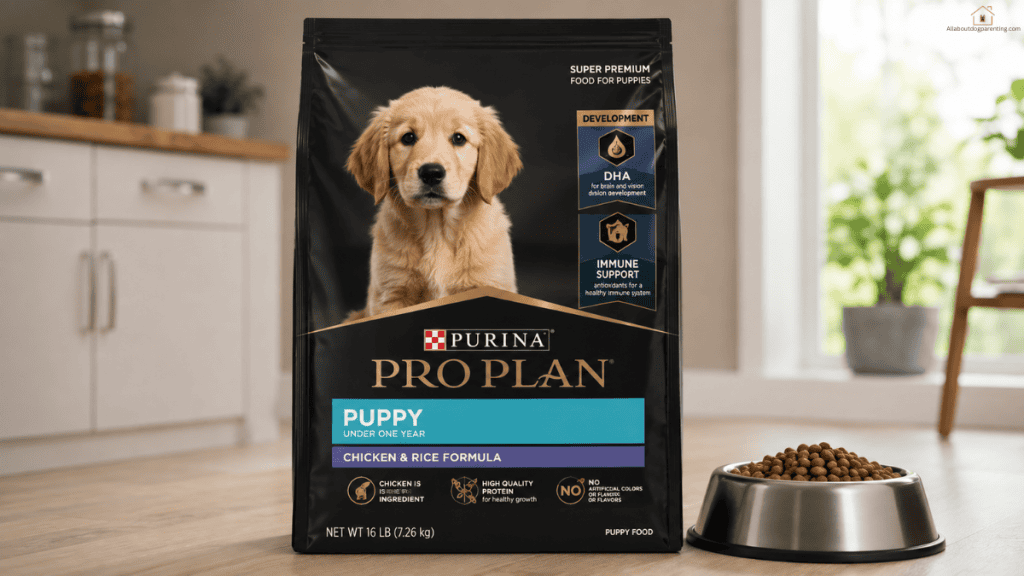
The easiest recommendation on this list, because it removes the guesswork entirely for owners who don’t yet know their Doodle’s adult size.
Purina Pro Plan tends to be the food I point people toward first, simply because it’s sold in small breed, standard, and large breed variants under one trusted line, each formulated to the calcium level that size of dog actually needs. It’s the same brand I recommend as the best overall pick in our German Shepherd puppy food guide, for what it’s worth. The live probiotics and size-appropriate composition hold up across breeds, not just Doodles.
The small breed formula runs a higher protein and calorie density to match a mini’s faster metabolism, while the large breed formula controls calcium more tightly for standards. All variants lead with real chicken, include DHA from fish oil for brain development, and add live probiotics for digestion.
| Spec | Value (varies by size variant) |
|---|---|
| Protein | 28% min (large breed) to 33% min (small breed) |
| Fat | 13% min (large breed) to 20% min (small breed) |
| Calcium | ~1.1% (small breed) to ~1.3% (large breed, controlled) |
| Kcal/cup | ~393–397 |
| Key Goldendoodle features | Sold in three size variants, live probiotics, DHA |
| Price estimate | ~$50–65 per 30–34 lb bag |
| AAFCO | Growth, including large-size dogs where labeled |
Best for: Owners who don’t yet know whether their puppy is heading toward mini, medium, or standard, and want a trusted line that scales correctly once the size becomes clearer.
Drawback: Contains chicken by-product meal and corn in most variants. Some owners prefer to avoid these despite both being nutritionally adequate.
Pick 2: Royal Canin Medium/Large Puppy: Best for Standards
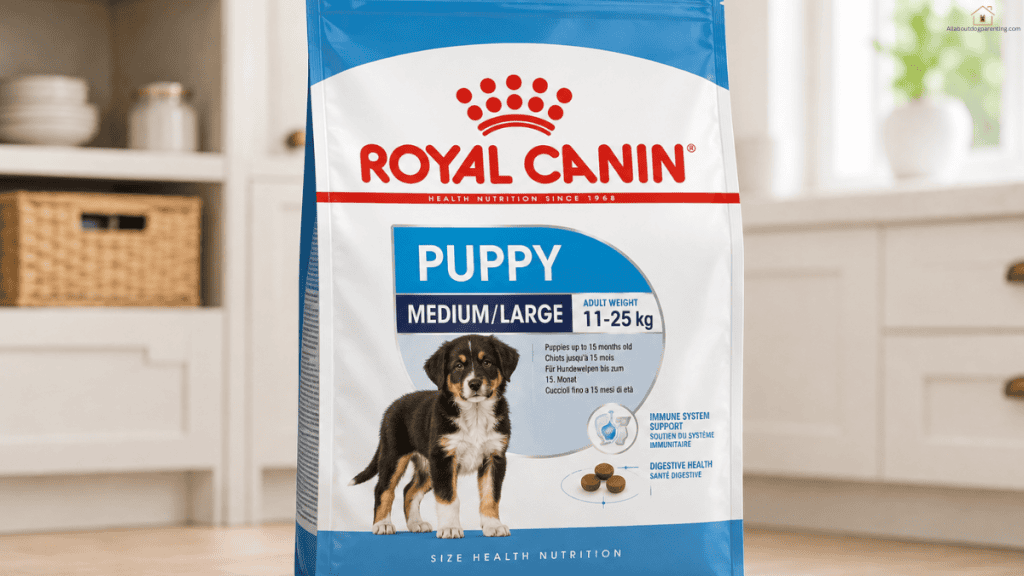
The strongest pick for standard Goldendoodles specifically, thanks to calcium and phosphorus ratios built for large-breed skeletal growth.
Royal Canin’s medium and large breed puppy lines are worth the extra cost for any Goldendoodle tracking toward 25 kg or more. Controlled calcium genuinely matters here, since standard Doodles carry real hip dysplasia risk if calcium and calorie intake run too high during peak growth months. The kibble is also sized for bigger jaws, which cuts down on the gulping and choking risk you sometimes see when a large puppy eats a small-breed kibble too fast.
| Spec | Value |
|---|---|
| Protein | 30% min |
| Fat | 18% min |
| Calcium | ~1.3% (controlled, estimated from Royal Canin’s large-breed formulations) |
| Kcal/cup | ~410 |
| Key Goldendoodle features | Controlled calcium and phosphorus, large-jaw kibble shape, DHA |
| Price estimate | ~$60–75 per 30 lb bag |
| AAFCO | Growth, including large-size dogs |
Best for: Medium and standard Goldendoodles tracking toward 25 kg or more, where calcium control matters most.
Drawback: Pricier than most competitors on this list. Not the right pick for a confirmed mini, since it’s formulated for larger growth curves.
Pick 3: Hill’s Science Diet Puppy: Best for Sensitive Doodles
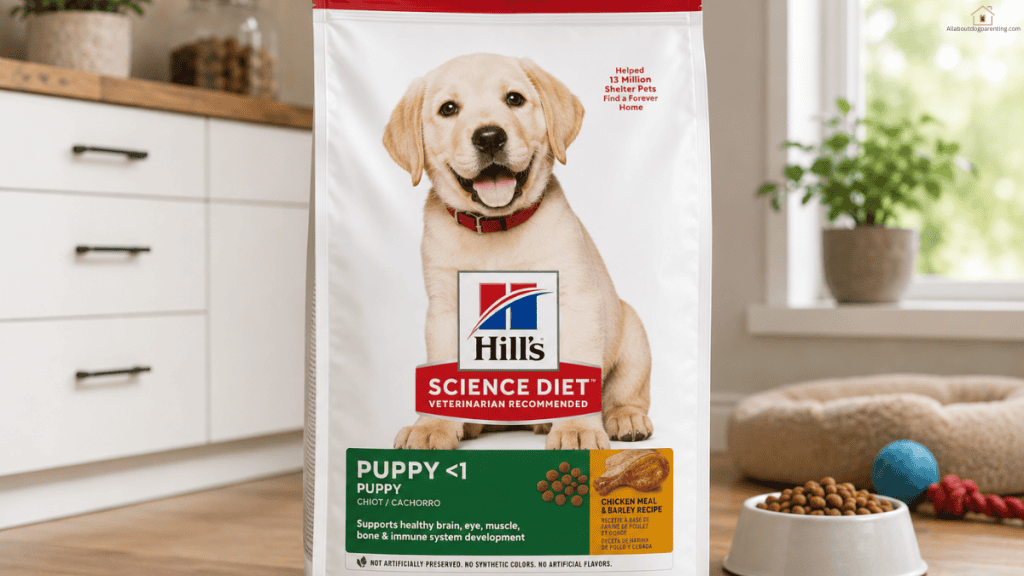
A gentle, well-researched option for Doodles with sensitive stomachs, available in every size category.
Hill’s has one of the longer clinical research histories in the puppy food space, and it shows in how consistently well it sits with dogs that don’t tolerate rich formulas. If your Goldendoodle puppy has had loose stools or picky eating on other brands, this is usually the first swap I’d suggest trying. It’s available across small breed, medium, and large breed formulas, so sizing it correctly to your Doodle isn’t a problem.
| Spec | Value |
|---|---|
| Protein | 23% min |
| Fat | 15% min |
| Calcium | ~1.1% (varies by size formula) |
| Kcal/cup | ~393 |
| Key Goldendoodle features | Available in all size formulas, gentle on digestion, DHA |
| Price estimate | ~$55–70 per 25–30 lb bag |
| AAFCO | Growth, size-appropriate labeling |
Best for: Goldendoodles of any size with a history of soft stools, food sensitivities, or picky eating.
Drawback: Lower protein than most competitors on this list. Not the top pick for a highly active, working-line standard Doodle that needs more calorie density.
If digestion is the main issue rather than size, our best puppy food for sensitive stomachs guide covers more options beyond just Hill’s.
Pick 4: Wellness Complete Health Small Breed Puppy: Best for Minis
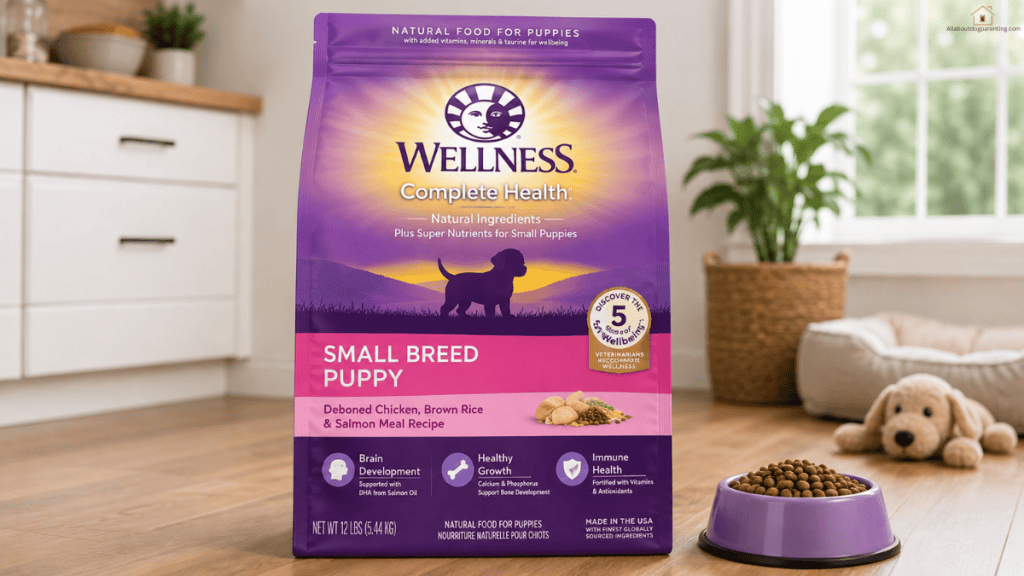
Built specifically for smaller mouths and faster metabolisms, making it the strongest pick for a mini Goldendoodle puppy. A mini Goldendoodle puppy burns through calories faster per kilogram than a standard, and needs a kibble small enough to chew comfortably without gulping.
This mini Goldendoodle puppy food checks both boxes, with a calorie-dense small breed formula and a genuinely small kibble size. It lists deboned turkey or chicken first, skips corn and wheat, and includes DHA for the same brain and eye development benefits larger Doodles get from bigger-format foods.
| Spec | Value |
|---|---|
| Protein | ~29% min |
| Fat | ~18% min |
| Calcium | ~1.2% min |
| Kcal/cup | ~489 (small breed formula, calorie-dense) |
| Key Goldendoodle features | Small, calorie-dense kibble, named protein first, DHA |
| Price estimate | ~$50–65 per 24 lb bag |
| AAFCO | Growth, small breed labeling |
Best for: An 8 to 10 kg mini Goldendoodle puppy that needs concentrated calories in a small, easy-to-chew kibble.
Drawback: Not appropriate for medium or standard Doodles, since the calcium and calorie density aren’t calibrated for larger-breed growth.
Pick 5: Iams Puppy (Size-Appropriate): Best Budget Pick
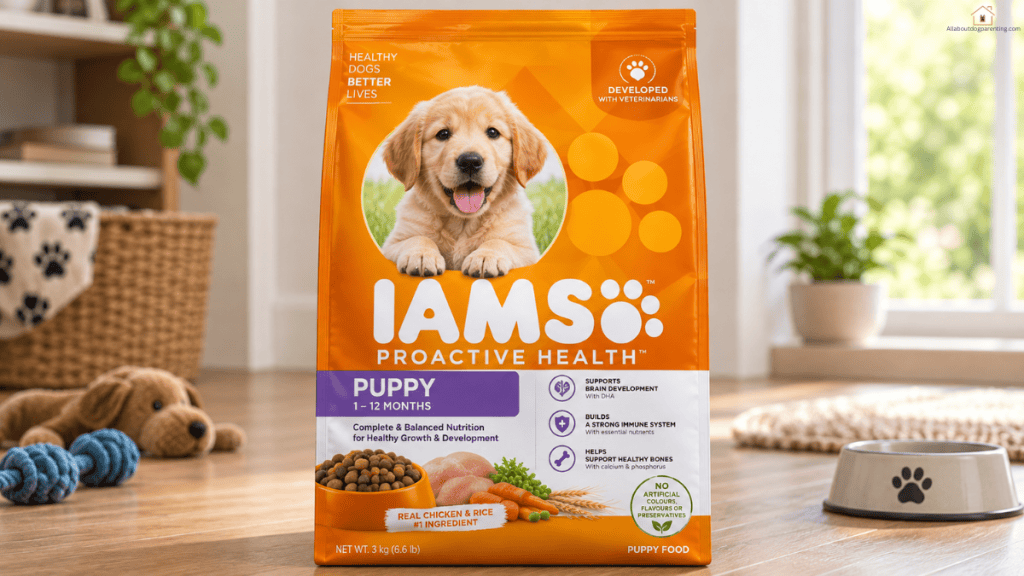
The best budget option that doesn’t sacrifice size-specific formulation to hit a lower price point. Iams isn’t going to win on ingredient prestige, but it earns its place here because it’s genuinely sized correctly across small, medium, and large breed variants, at a price that undercuts most of this list.
For owners managing a tight budget without wanting to gamble on an unproven bargain brand, this is the safer choice. It covers the nutritional basics AAFCO requires for growth, and the size-appropriate formulas mean you’re not stuck choosing between “affordable” and “correctly sized.”
| Spec | Value |
|---|---|
| Protein | 28–30% min (varies by size variant) |
| Fat | 14–18% min (varies by size variant) |
| Calcium | ~1.2% min |
| Kcal/cup | ~354 (large breed variant) |
| Key Goldendoodle features | Affordable, size-specific formulas, DHA |
| Price estimate | ~$30–45 per 30 lb bag |
| AAFCO | Growth, size-appropriate labeling |
Best for: Budget-conscious Goldendoodle owners who still want nutritionally complete, correctly sized food.
Drawback: Lower protein than the premium picks on this list. Contains corn and chicken by-products.
None of these formulas were developed with Goldendoodles specifically in mind, because that research doesn’t exist. What they do reflect is solid science on the parent breeds, and that’s the honest, evidence-based starting point until breed-specific studies catch up. Any of the five picks above will serve a Goldendoodle puppy well. The choice between them comes down to your puppy’s size category, budget, and digestive history.
Side-by-Side Comparison Table
All five picks compared on protein, fat, calcium, calories, price, and best use case for Goldendoodles.
| Brand | Protein | Fat | Calcium | Kcal/Cup | Price Per Bag | Best For |
|---|---|---|---|---|---|---|
| Purina Pro Plan Puppy | 28–33% | 13–20% | ~1.1–1.3% | ~393–397 | ~$50–65 | Best overall, unknown adult size |
| Royal Canin Medium/Large Puppy | 30% | 18% | ~1.3% | ~410 | ~$60–75 | Best for standards |
| Hill’s Science Diet Puppy | 23% | 15% | ~1.1% | ~393 | ~$55–70 | Sensitive stomachs |
| Wellness Complete Health Small Breed | ~29% | ~18% | ~1.2% | ~489 | ~$50–65 | Best for minis |
| Iams Puppy (size-appropriate) | 28–30% | 14–18% | ~1.2% | ~354 | ~$30–45 | Budget-friendly |
Coat Nutrition for Goldendoodles
Overview:
Lorem ipsum dolor sit amet, consectetur adipiscing elit. Aenean diam dolor, accumsan sed rutrum vel, dapibus et leo.
Overview: A curly or wavy Doodle coat needs more than grooming. Omega-3 and omega-6 fatty acids from the diet support skin barrier health, and a dull coat is often the first sign something’s off nutritionally.
A Goldendoodle’s curly or wavy coat isn’t just a grooming project. It’s also a nutrition one. Omega-3 fatty acids, specifically DHA and EPA from fish oil, support skin barrier function and reduce the kind of low-grade inflammation that leaves a coat looking dull or brittle. Omega-6 fatty acids matter too, working alongside omega-3s to maintain the skin’s structural integrity rather than against them. Research on dogs with poor-quality coats has found that daily fish oil supplementation measurably improved coat and skin condition within a few months, which lines up with what groomers who work with Doodle coats will tell you anecdotally too.
Look for a puppy food with fish oil listed in the first ten ingredients and an omega-3 content above roughly 0.5%. A dull, dry, or flaky coat on a Doodle puppy is often the first visible sign that the diet isn’t giving the skin what it needs, well before you’d notice anything else off. If you do decide to switch foods to test this, follow a gradual transition rather than swapping bowls overnight. Our dog food transition guide walks through the day-by-day ratios. If the coat still isn’t improving after eight to ten weeks on the new food, that’s worth a vet visit rather than another swap. Coat problems in young dogs can also point to allergies, thyroid issues, or parasites, and diet alone won’t fix those.
The Golden Retriever Parent and DCM Risk
Overview:
Goldendoodles inherit Golden Retriever genetics, and Goldens rank among the breeds most flagged in diet-linked heart disease reports. Grain-inclusive food is the more cautious default until Doodle-specific research exists.
This aspect of Goldendoodle nutrition doesn’t get the attention it deserves. Golden Retrievers are one of the breeds most frequently flagged in reports of diet-associated dilated cardiomyopathy (DCM), a serious and sometimes fatal heart condition. When the FDA opened its investigation into a potential link between certain diets and canine DCM, Golden Retrievers made up one of the largest single-breed groups in the case reports, alongside mixed-breed dogs. The diets involved were overwhelmingly grain-free and heavy in peas or lentils.
I’ll be straight with you here: the science is still genuinely unsettled. The FDA stopped issuing regular updates in 2022 after concluding the picture was too complex to pin on any one ingredient, and there’s real disagreement within the veterinary nutrition community about how strong the link actually is. But since Goldendoodles carry Golden Retriever genetics, and nobody has done breed-specific research to rule the risk in or out for Doodles, the precautionary approach makes sense here. Stick with a grain-inclusive Goldendoodle puppy food, and be cautious of formulas that lean heavily on peas or lentils as primary protein or carb sources. It’s not an emergency. It’s a small, easy adjustment that costs you nothing and errs on the side of a dog’s heart health.
Our grain-free vs. grain-inclusive breakdown covers the practical side of that decision in more depth, including when grain-free genuinely helps and when it doesn’t.
The Body Condition Check for Goldendoodle Puppies
Overview:
Run your hands along your Doodle’s ribcage weekly. You should feel ribs easily with light pressure but not see them prominently. A curly coat hides body shape more than most, so touch matters more than sight.
| Check | What to Look For | Too Thin | Just Right | Too Heavy |
|---|---|---|---|---|
| Ribs (touch) | Run fingers along ribcage | Ribs sharp and prominent with no pressure | Ribs felt easily with light pressure, thin fat covering | Ribs difficult to feel under fat layer |
| Waist (view from above) | Look down at standing Doodle | Waist dramatically narrowed, hip bones visible | Clear hourglass shape visible behind ribs | No waist definition, rectangular silhouette |
| Tummy (view from side) | Look at Doodle profile | Severe abdominal tuck | Slight upward tuck from chest to belly | Belly level with or hanging below chest |
The curly or wavy coat that makes Goldendoodles so recognizable also makes body condition harder to judge by eye alone. A Doodle who looks like they’re carrying extra weight under all that fur may actually be lean underneath, and the reverse is just as common. Touch, not appearance, is the reliable check here, especially in the months leading up to a grooming appointment when the coat is at its fullest.
When to Switch Your Goldendoodle to Adult Food
Overview:
Minis are usually ready between 9 and 12 months, mediums between 12 and 14 months, and standards should stay on puppy food until 14 to 18 months, since skeletal growth takes longer to finish in bigger dogs.
The timing question causes more anxiety than it should, mostly because generic large-breed guides give a single number that doesn’t account for how much a standard Goldendoodle’s growth window actually stretches. A mini who’s plateaued in weight and started leaving food in the bowl at 10 or 11 months is genuinely ready. A standard who looks fully grown at 12 months usually isn’t, since growth plates in larger dogs close later even when the outward size makes a puppy look done growing.
The safest confirmation is a vet check rather than a guess based on appearance. If your Doodle’s weight has held steady for three to four consecutive weigh-ins and they’re consistently leaving a little food behind, that’s a reasonable signal to start the conversation with your vet about transitioning. Switch gradually over 7 to 10 days regardless of size, since abrupt food changes are hard on any puppy’s digestion.
Common Goldendoodle Puppy Feeding Mistakes
Overview:
The most common Goldendoodle feeding mistakes are guessing at adult size instead of asking the breeder, using one chart for all sizes, switching to adult food too early, and ignoring the DCM precaution.
| Mistake | Why It’s a Problem | What to Do Instead |
|---|---|---|
| Guessing at adult size | Feeding the wrong calcium level for the eventual weight | Ask the breeder about the Poodle parent and use paw size as a rough guide |
| Using one chart for mini, medium, and standard | Portions and calcium needs differ dramatically by size | Match the chart to your puppy’s predicted size category |
| Switching to adult food before 12 months | Larger Doodles may still have open growth plates | Wait until 9 to 18 months depending on size, confirmed by a vet |
| Choosing grain-free without a reason | Golden Retriever genetics carry documented DCM risk factors | Default to grain-inclusive unless a vet has diagnosed a grain allergy |
| Ignoring a dull or dry coat | Often an early sign of insufficient omega-3 intake | Check for fish oil in the first ten ingredients before assuming it’s a grooming issue |
| Free-feeding (food available all day) | Makes it impossible to monitor intake or catch overfeeding early | Measured meals at set times, with the bowl picked up after 15 to 20 minutes |
FAQs
1. How much should I feed my Goldendoodle puppy?
It depends entirely on which size category your puppy falls into. A mini typically eats 1 to 2.4 cups per day, a medium 1.25 to 3.5 cups, and a standard 1.6 to 5 cups, depending on age. Use the mini, medium, or standard chart earlier in this guide and adjust based on body condition every couple of weeks rather than relying on the printed number alone.
2. What is the best food for a Goldendoodle puppy?
The most consistently reliable options for the best food for Goldendoodle puppy needs are Purina Pro Plan Puppy, Royal Canin Medium/Large Puppy, and Hill’s Science Diet Puppy, provided you buy the size-appropriate variant for your dog. All three employ veterinary nutritionists, control calcium within AAFCO limits for the relevant size, and are backed by feeding trial data. Purina Pro Plan is the easiest starting point if you don’t yet know your puppy’s adult size, since it’s sold in small, medium, and large breed formulas under one line.
3. When should a Goldendoodle switch to adult food?
Minis are usually ready between 9 and 12 months, mediums between 12 and 14 months, and standards should stay on puppy food until 14 to 18 months, since their skeletal growth simply takes longer to finish. A vet check is the most reliable way to confirm readiness rather than going by appearance alone.
4. Do Goldendoodles need grain-free food?
No, and given the Golden Retriever parent’s documented DCM susceptibility, grain-inclusive is the more sensible default unless a vet has diagnosed a specific grain allergy. Most food allergies in dogs are triggered by a protein source rather than grains, so grain-free formulas rarely solve the problem owners are trying to fix.
5. How do I know if my Goldendoodle will be a mini, medium, or standard?
Ask the breeder about the Poodle parent’s size, since a Miniature Poodle parent typically produces a smaller adult than a Standard Poodle parent. Check paw size relative to the legs at around eight weeks, and use the weight-doubling estimate from the 14-week mark as a loose guide. None of these methods are exact, so when in doubt, feed toward the large breed formula rather than the small one.
The Bottom Line
Goldendoodle puppy food decisions carry more nuance than they do for most single-breed dogs, mainly because “Goldendoodle” isn’t really one dog. It’s three, spread across a size range wide enough that a formula right for one is wrong for another. There’s no AKC-backed research to fall back on, so every recommendation here leans on solid parent-breed science instead, and I think that honesty matters more than pretending otherwise.
Solve for size first, and the rest of the feeding decisions fall into place. Ask the breeder about the Poodle parent, watch the paws, weigh regularly, default to grain-inclusive food given the Golden Retriever DCM connection, and check body condition by touch rather than by how the coat looks. Feed the right food for your Doodle’s actual size, not their breed name, and when in doubt, lean toward the large-breed formula rather than the small one. It’s the safer mistake to make.