Puppy Socialisation: When, Where & How (The Critical Window)
🐾 Overview
Puppies accept new people, places and sounds most easily between about 3 and 14 weeks. Here’s what to expose yours to, how to do it safely before vaccinations finish, and how to recover from a bad outing.
The short answer this puppy socialisation guide gives to “when should I start?” is today, before the vaccinations are finished, because the stretch of development in which puppies accept new things most easily starts closing somewhere between 12 and 16 weeks. This article, part of our Complete Guide to Puppy Training, covers the science behind that window, a week-by-week plan from 8 to 16 weeks, a checklist you can work through, and a recovery plan for the days that go sideways.
With my first German Shepherd, I approached this process with a lot of caution and a generous dose of anxiousness. With the puppies after him, I grew more confident and learned to watch ears, tails, and faces to see how far my pup was willing to go, and strike that tricky balance between nudging them a little beyond their comfort zone but not so much that it overwhelmed into fear. The difference in the adult dogs was obvious. This puppy socialisation guide is built on this very approach.
| Question | Short answer |
|---|---|
| When does the window open? | Around 3 weeks, while your puppy is still with the breeder |
| When does it start to close? | Sensitivity drops from about 12 to 14 weeks; most vets treat 16 weeks as the outer edge |
| Can I start before vaccinations? | Yes, with sensible precautions. AVSAB calls it the standard of care |
| How long should sessions be? | A few minutes each, ending while your puppy is still relaxed |
| What matters most? | How your puppy feels during each experience |
What Socialisation Actually Means (And What It Doesn’t)
Before getting into how to socialise a puppy, it helps to be clear on the goal. Socialisation is the process of introducing your puppy to the people, animals, places, sounds and handling they’ll meet as an adult dog, in small enough doses that each experience feels safe or pleasant. Habituation sits alongside it: learning that the vacuum cleaner, the bin lorry and the hairdryer are boring background noise.
The stakes are real. A 2024 literature review by the American Veterinary Medical Association found that puppies deprived of varied experiences early on are at higher risk of fear, aggression and over-arousal later in life. And the American Veterinary Society of Animal Behavior points out that behaviour problems are the leading cause of death in dogs under three, through relinquishment and euthanasia.
You’ve probably seen the “100 people by 12 weeks” rule. I followed it with my first puppy, and I’d retire it. A number encourages you to rush through encounters, and a puppy who meets 100 people while trembling has learned that people are scary 100 times over. Most socialisation puppy training advice treats every outing as equal. They aren’t. Five calm, rewarding meetings with men in hats will do more than fifty chaotic ones.
So, what socialisation doesn’t include:
- Passing your puppy around a crowd of strangers
- Letting unknown dogs charge up and “say hello”
- Holding your puppy in place while something scary happens
- Dog parks, at any age in this window
The Socialisation Window: Why 3–16 Weeks Matters
Puppies go through a sensitive stage of brain development when new experiences are absorbed with curiosity, and caution is slow to switch on. That stage is the critical period puppy socialisation research keeps returning to. The AVMA review notes that exposure should begin by 3 weeks, that puppies are most responsive to unfamiliar dogs between 3 and 14 weeks, and that puppies kept from new environments until after 14 weeks can stay fearful of them for life. It also notes that development carries on to at least 20 weeks, which is why the work doesn’t stop at 16.
Here’s how the puppy socialisation timeline breaks down in practice. The ages are approximate, and individual puppies vary. For the wider picture of what’s happening physically and mentally, see our guide to puppy development stages.
| Age | Where your puppy is | What’s happening | Your role |
|---|---|---|---|
| 3–5 weeks | With mum and littermates | Eyes and ears working; first curiosity about the world | Ask your breeder what handling and sounds they introduce |
| 5–8 weeks | Still with the breeder | Peak openness; bite inhibition develops through littermate play | Choose a breeder who raises puppies indoors around household life |
| 8–12 weeks | Home with you | The window is wide open; first fear period may appear | Gentle, daily exposure to everyday life |
| 12–16 weeks | Home with you | Caution increases; new things take longer to accept | Broaden settings, keep sessions positive |
| 16 weeks onward | Home with you | Window narrowing; adolescence approaching | Keep up regular exposure through the first year |
🐾 My puppy came home at 10 weeks. Have I missed it?
- No. Ask your breeder what they did between 3 and 8 weeks, so you know where the gaps are.
- Prioritise the categories your puppy hasn’t met at all, starting with people and household sounds.
- Keep the pace gentle. Two weeks of catching up is better spent on quality than volume.
The puppy socialisation window is the reason I tell friends to pick a breeder carefully. A puppy raised in a kennel block until 8 weeks starts with a deficit that a puppy raised in a busy kitchen doesn’t.
The Vaccination Question
The question of when to socialise a puppy usually comes down to vaccines, and every puppy socialisation guide has to deal with the tension. This is where most new owners get stuck. Your vet says to keep your puppy safe from parvovirus until vaccinations are complete. Behaviour experts say socialise early. Both are right, and they can be reconciled.
Socialising puppy before vaccinations is the standard of care, according to the AVSAB socialisation position statement. AVSAB recommends puppies can start classes as early as 7 to 8 weeks, provided they’ve had at least one set of vaccines and a first deworming at least seven days before the first class. In a 2013 study of puppies attending socialisation classes, none of the 231 vaccinated puppies in classes was suspected of contracting parvovirus, and puppies aged 16 weeks or younger in classes were at no greater risk than those kept at home.
The caution has a real basis, though. Cornell University’s College of Veterinary Medicine explains that parvovirus spreads when dogs ingest virus shed in faeces, and that it can survive in the environment for months, up to a year in the right conditions. That’s why the ground in busy dog areas is the risk, and why the final puppy vaccine matters. That last core dose is usually given at 16 weeks or later, and PetMD advises waiting about two weeks after it before your puppy walks in public dog areas. Our puppy vaccination schedule by age covers the full timeline.
| SAFE NOW (before final vaccines) | WAIT (until about two weeks after final vaccines) |
|---|---|
| Carrying your puppy around shops, cafés and train stations | Dog parks and off-lead areas |
| Car rides and sitting in a parked car near a busy road | Grass verges and footpaths heavily used by dogs |
| Visitors at home, including children and people in hats or uniforms | Meeting dogs whose vaccination history you don’t know |
| Playdates with healthy, fully vaccinated adult dogs you know | Boarding kennels and doggy daycare |
| Puppy classes that check vaccine records and clean floors | Pet shop floors and vet waiting room floors |
| Your own garden, if no unvaccinated dogs have used it | Popular dog beaches and walking trails |
🐾 Three rules for pre-vaccination outings
- Keep paws off ground where many unknown dogs toilet. A sling, a carrier or a blanket on your lap works well.
- Let your puppy watch the world from a distance before anyone touches them.
- Bring treats every time, so new sights get paired with something good.
The 4-Phase Socialisation Plan (Weeks 8–16)
This puppy socialisation plan is centered on the typical trend that people bring puppies home at 8 weeks. If yours arrived later, start at the phase that matches their age and borrow from earlier phases where needed. Aim for a few new experiences a day, each lasting a few minutes, and keep small, high-value training treats in every pocket you own.
Phase 1: Settling In (Weeks 8–10)
Your puppy has just lost their mum, littermates, and everything familiar. The first few days are for sleep, routine, and trust. Our article on bringing a puppy home covers that first week in detail. After that, the world comes to your puppy:
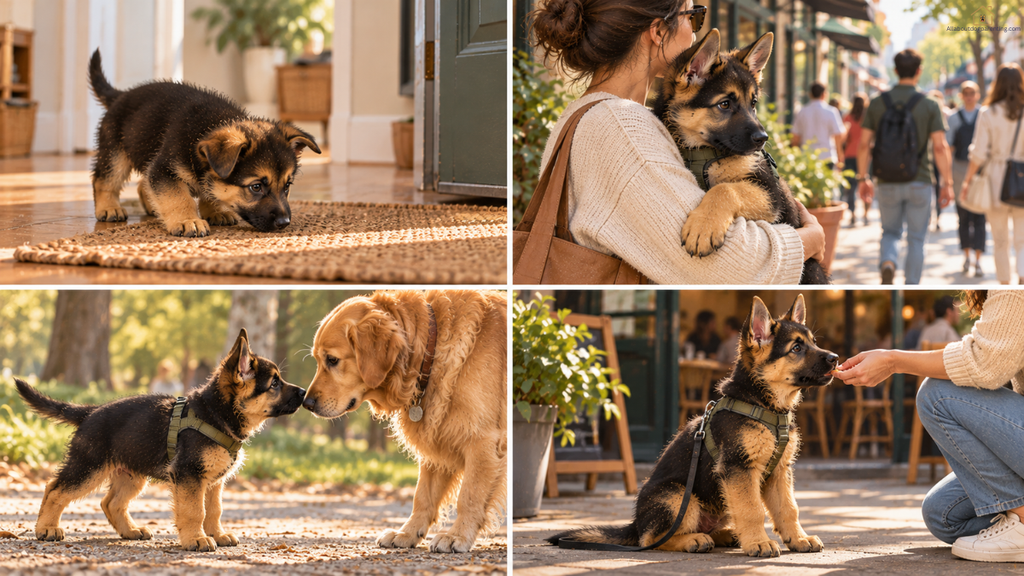
- Household sounds at low volume, such as a washing machine, kettle, hairdryer, and doorbell
- Two or three calm visitors a week, each one sitting on the floor and letting your puppy approach
- Puppy handling practice. Touch their ears, paws, and mouth for a second, then offer a treat
- New surfaces indoors, such as a doormat, a towel, a baking tray, a cushion
My younger GSD was especially sensitive to his ears being touched, so much so that he nearly threw his back out once trying to get away from it. But a few seconds of touch every day, followed by his favorite treat, went a long way. Within a month, he would voluntarily lie down to have his ears cleaned.
Phase 2: Expanding the World (Weeks 10–12)
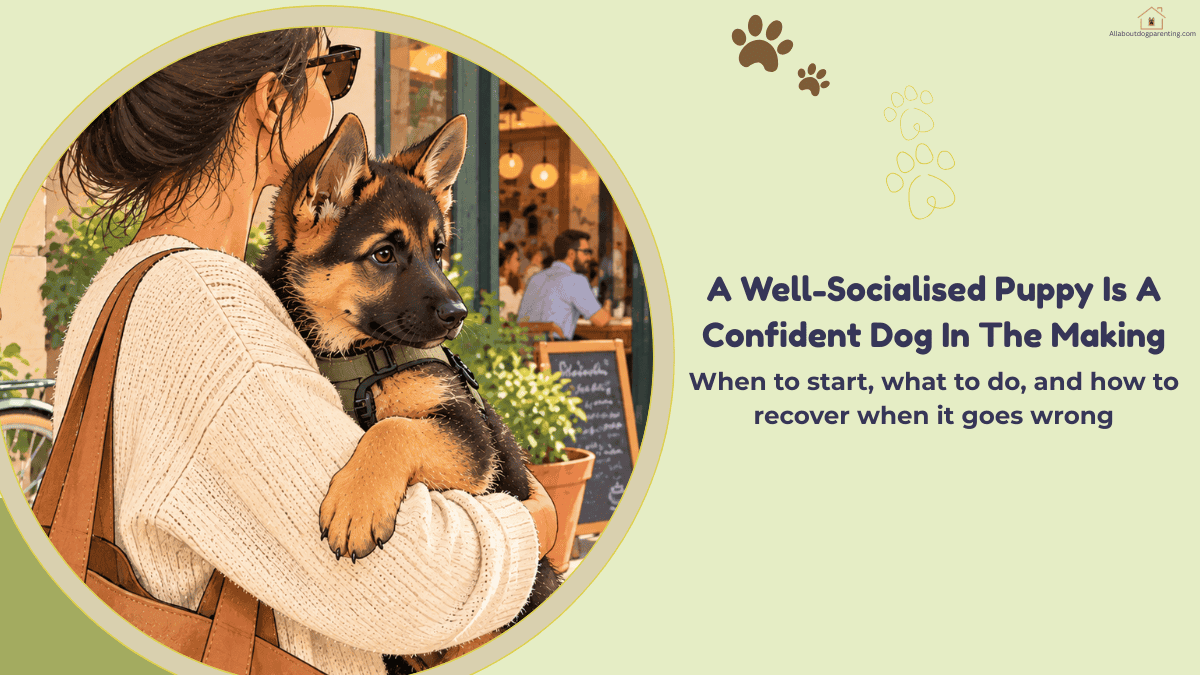
Now you start carrying your puppy out into the world. This is when to socialise a puppy to traffic, crowds and strangers, from your arms.
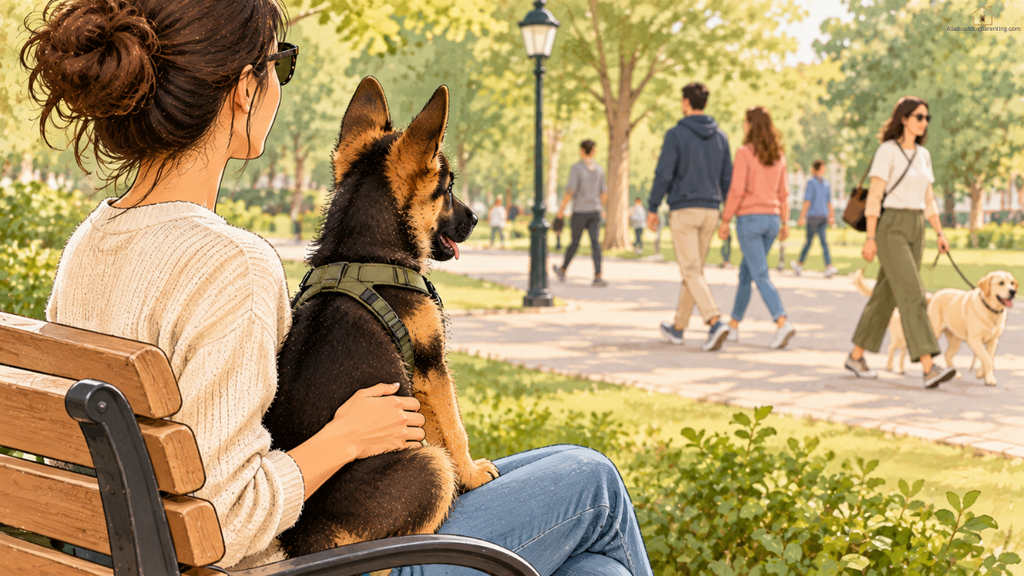
Sit on a bench outside a supermarket for ten minutes. Watch buses from a quiet corner. Ask one friendly stranger to toss a treat without reaching for your puppy. Book a puppy class if you haven’t already, because this is the age most classes accept puppies.
These puppy socialisation exercises are short on purpose. A successful outing is one your puppy would happily repeat.
Phase 3: Building Confidence (Weeks 12–14)
Your puppy is noticing more and hesitating more. That’s normal brain development, and it’s your cue to move from exposure toward puppy confidence building.
Set up small challenges your puppy can solve: stepping over a broom handle, walking across a wobbly cushion, finding a treat inside a cardboard box. Let them investigate the scary umbrella at their own pace. Introduce short spells alone, too, since coping with solitude is part of socialisation. If your puppy panics when left, our guide on how to crate train a dog with separation anxiety walks you through it.
| Exercise | What it teaches |
|---|---|
| Box of crinkly paper with treats hidden inside | Strange textures and sounds lead to rewards |
| Watching a skateboard from across the street | Moving objects can be ignored |
| Five-minute spells in a crate with a chew | Being alone is safe |
| Meeting a calm, vaccinated adult dog | Polite dog manners |
Phase 4: Generalisation (Weeks 14–16)
Dogs are poor at generalising. A puppy comfortable with your neighbour in a cap may still bark at a stranger in a cap at the train station. This phase is about repeating familiar experiences in new places, at new times, with new people.
Once your vet clears your puppy for public walks, take the lessons on the road. Practise sitting calmly outside a café. Walk the same street at night and in the rain. Revisit anything that worried your puppy earlier and check it still feels easy, then use the puppy socialisation checklist below to spot gaps.
Fear Periods
A puppy fear period is a short stretch when your puppy suddenly reacts to things they ignored the week before. The American Kennel Club places the first one at around 8 to 11 weeks and a second, during adolescence, at roughly 6 to 14 months. They’re normal, and they pass.
Signs your puppy is uncomfortable:
- Lip licking or yawning out of context
- Whale eye, where the whites of the eyes show
- Ears pinned back and tail tucked
- Freezing, or turning away
During a fear period, scale back. Revisit easy experiences, increase distance from anything new, and let your puppy choose whether to approach.
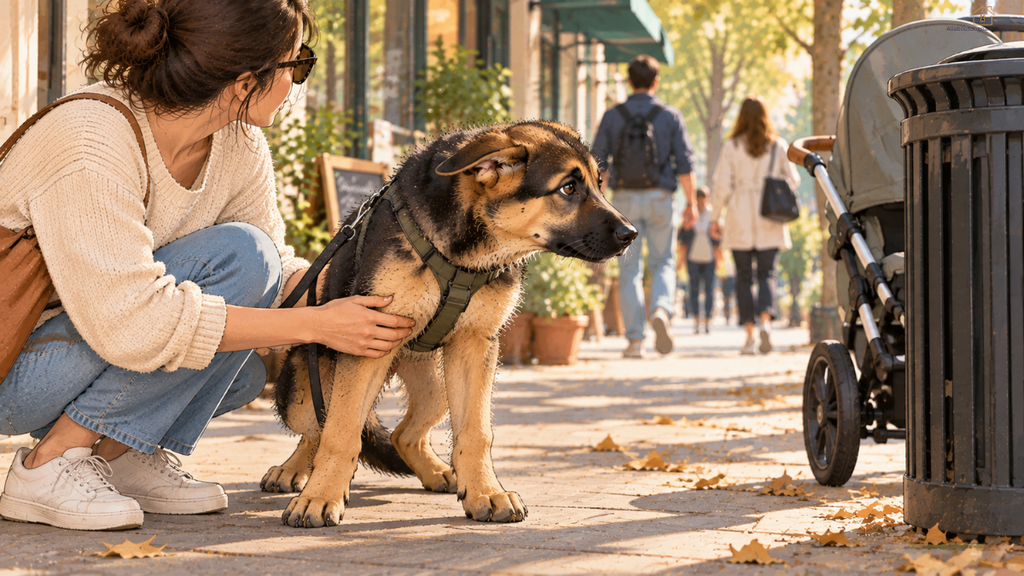
And yes, you can comfort a frightened puppy. The old advice that reassurance “rewards” fear doesn’t hold up. A 2018 study by Mariti and colleagues found that dogs whose owners comforted them in a stressful situation showed no rise in fear. Fear is an emotion, and a calm hand on the chest doesn’t teach your puppy to feel it more. When my older boy hit his adolescent wobble at seven months and started barking at bins, I sat beside him on the pavement and talked to him quietly. It helped him settle faster.
When Socialisation Goes Wrong: Recovery Protocol
Even with care, things go wrong. A dog rushes up off lead, a toddler grabs an ear, a car backfires. One bad experience rarely undoes weeks of good work, provided you respond well. Counter-conditioning puppy fears means changing how your puppy feels about the trigger by pairing it with something they love, starting at a distance where they barely notice it.
🐾 Five-step recovery protocol
- Get your puppy out of the situation calmly, and let them decompress at home for a day or two.
- Find the distance at which your puppy can see the trigger and still take a treat. That’s your starting point.
- Each time the trigger appears, deliver high-value food. When it disappears, the food stops.
- Close the distance in small steps, and only on days your puppy stays relaxed. Let them move away whenever they want.
- If fear isn’t easing after two to three weeks, or you see growling or snapping, speak to your vet or a qualified behaviourist.
Of everything in this puppy socialisation guide, these steps are the ones I return to most. Keep a simple log of distances and reactions. Progress tends to look flat for days, then jump. Our guide to reactive dog training goes deeper into the same method for older dogs.
The Socialisation Checklist
This is the section of the puppy socialisation guide I’d print and stick on the fridge. Use this puppy socialisation checklist as a menu. Work across every category each week, and tick an item only once your puppy has met it calmly a few times.
| Category | What to include | Signs it’s going well |
|---|---|---|
| People | Men, women, children, older people, people with beards, hats, hoods, sunglasses, uniforms, walking sticks, wheelchairs | Loose body, approaches on their own |
| Animals | Calm vaccinated adult dogs, puppies in class, cats, birds, livestock from a distance | Curious, then able to look away |
| Places | Cafés, shop entrances, train stations, car parks, the vet clinic for a treat-only visit | Takes treats, explores the space |
| Surfaces | Grass, gravel, tiles, metal grates, wet ground, stairs, a wobbly board | Walks over without hesitation |
| Sounds | Traffic, thunder recordings, vacuum, fireworks recordings, crying babies, sirens | Ears flick, then carries on |
| Handling | Ears, paws, nails, mouth, collar grab, brushing, being lifted, a vet-style exam | Relaxed muscles, no pulling away |
| Objects | Umbrellas, prams, bikes, scooters, bins, balloons, flapping flags | Sniffs, investigates, ignores |
Handling deserves extra time. Your puppy will be examined by vets, groomers and the occasional curious child for years to come.
Breed and Temperament Adjustments
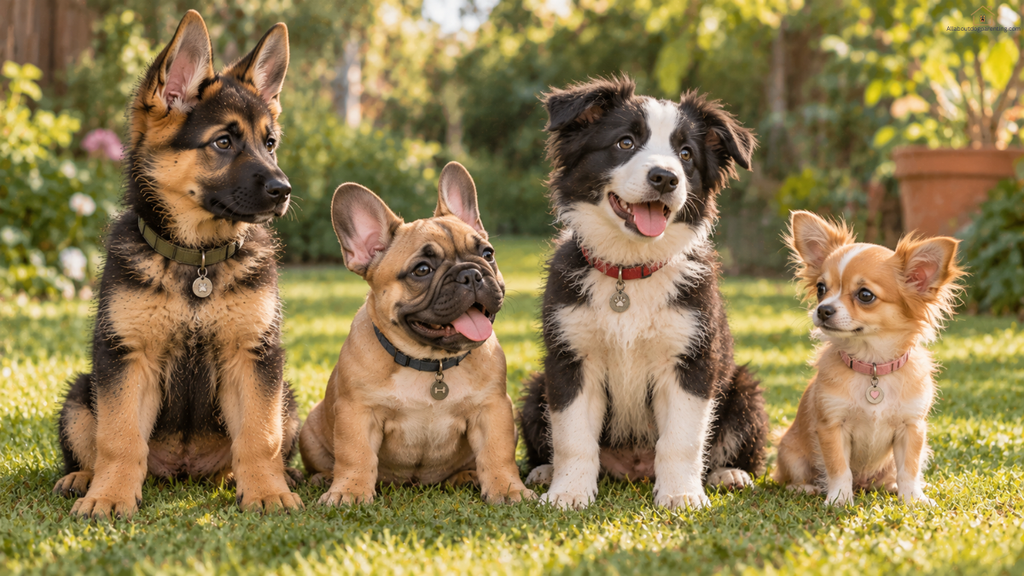
No puppy socialisation guide fits every breed. How to socialise a puppy depends partly on what the breed was built to do. These adjustments come from raising my own dogs and from what I’ve watched friends go through with very different breeds.
Guardian breeds
German Shepherds, Rottweilers, Dobermans, and similar breeds were selected to be watchful of strangers. My German Shepherd needed about three times the stranger exposure of my friends’ Labradors. I made a habit of asking calm adults to stand still and toss treats, never to lean over him. By 14 weeks, he would approach new people calmly, and that steadiness has lasted into adulthood.
Toy breeds
Small puppies get scooped up whenever something happens, which means they rarely learn to cope on their own four feet. Give them supervised ground time in safe spaces, and keep play with large dogs gentle and short.
Brachycephalic breeds
Pugs, French Bulldogs and Bulldogs struggle to cool down. A Royal Veterinary College and Nottingham Trent University study found flat-faced dogs had twice the risk of heatstroke compared with Labradors, and Bulldogs 14 times the risk. Schedule outings for the cooler parts of the day and keep sessions brief.
High-energy and working breeds
Border Collies, Kelpies and Malinois puppies tend to treat every encounter as a party. For them, socialisation includes learning to settle while the world carries on. Reward calm watching as much as friendly greeting.
FAQs
1. Can I socialise my puppy before vaccinations are finished?
Yes. Socialising puppy before vaccinations is safe with a few precautions. Carry them in public, invite visitors home, arrange meetings with healthy vaccinated dogs you know, and join a class that checks records. Avoid dog parks and heavily used dog areas until about two weeks after the final vaccine.
2. Is it too late to socialise after 16 weeks?
No, although it takes more patience. Missing the puppy socialisation window means slower progress, and plenty of late starters still turn into steady adults. Development continues to at least 20 weeks, past the critical period puppy socialisation studies focus on, and dogs keep learning about the world throughout adolescence. Anything your puppy has never met will take longer to accept, so lean on the recovery protocol above.
3. How many socialisation sessions should my puppy have a day?
There’s no proven number. I aim for three or four short experiences a day, often slotted into ordinary routines like a car trip or a visitor at the door, with plenty of rest in between.
4. What’s the difference between socialisation and flooding?
Socialisation lets your puppy observe, retreat and approach at their own pace. Flooding forces your puppy to stay in contact with something frightening until they stop reacting, which usually means they’ve shut down. The AVMA review recommends allowing fearful puppies to withdraw.
5. Are puppy socialisation classes worth it?
Yes, when they’re well run. A study by Duxbury and colleagues found that dogs who attended puppy classes were more likely to stay in their homes. Look for small groups sorted by size, reward-based methods, and a trainer who separates puppies when play gets rough. Our guide on choosing the right dog trainer lists the red flags to watch for.
Final Thoughts
If you take one thing from this puppy socialisation guide, let it be this: watch your puppy’s body language more than the clock or the checklist. A few minutes of pleasant exposure each day, kept up through the first year, is enough to raise a steady adult dog. Start with one new sound tonight and build from there.