How to Stop a Puppy from Peeing Inside: Find the Cause, Then Fix It
🐾 Overview
A puppy peeing inside is undertrained, regressing, unwell, or reacting to excitement, fear, stress or a rushed outdoor trip. Identify the cause first, because each one has a different fix, and rule out medical problems before changing your training.
It’s 6 a.m., there’s a puddle in the hallway, and you took your puppy out 45 minutes ago. If that’s your morning, I’ve been there. A puppy peeing inside house is almost always telling you something specific, and once you know which message it is, the fix gets much simpler.
This article, part of our Complete Guide to Puppy Training, works the other way round from most advice. Instead of handing you ten generic tips, it helps you work out why your puppy keeps peeing in house first, then gives you the fix for that cause. We start by addressing the medical red flags because no amount of tips in the world can fix an infection.
Medical Red Flags: See the Vet First
🐾 Overview
If your puppy suddenly starts having accidents after being reliable, or you see blood, straining, frequent small amounts, extra thirst, strong-smelling urine or lethargy, see your vet before you change anything about your training.
🐾 See the Vet If You Notice Any of These
- Blood or a pink tinge in the urine
- Straining, whining or crying while peeing
- Frequent attempts to pee that produce very little
- Drinking noticeably more than usual
- Strong-smelling or cloudy urine
- Repeated licking of the genital area
- A sudden break in house-training with no other change at home
- Lethargy, appetite loss or other behaviour changes alongside the accidents
These line up with the signs of a urinary tract infection listed by VCA, which also notes that young puppies are overrepresented among dogs with UTIs and calls a sudden break in house-training a red flag. Puppy UTI signs are easy to mistake for a training lapse, which is exactly why they come first here.
Your vet will usually start with a urinalysis, a quick urine test that checks for infection, blood, crystals and sugar. If it’s clear and accidents continue, they may look at kidney, hormonal or metabolic causes depending on what else they see. It’s worth knowing what normal looks like before you seek medical help. Our guide to how long puppies can hold their pee gives bladder capacity by age.
Once a medical cause has been ruled out, you can explore the various possible triggers and their solutions.
Which Problem Do You Actually Have? A Diagnostic Guide
🐾 Overview
Indoor peeing has seven distinct causes, and the fix depends on which applies. Match your puppy to the scenario below, then go straight to that section.
If you’re asking why is my puppy peeing inside, start here. Read every accident as information. A puppy peeing inside house isn’t being defiant, and there’s nothing to punish. Where, when and what happened in the half hour before usually point to the cause.
🐾 Diagnostic Guide
| If your puppy… | The likely cause is… | Go to… |
|---|---|---|
| Has never been reliably clean (under six months, regular accidents) | Incomplete training | Back to basics |
| Was clean for weeks, then started again at about 5–8 months | Adolescent regression | Adolescent regression |
| Pees within 10–20 minutes of a successful trip outside | Incomplete emptying | The “pees right after coming in” fix |
| Pees during greetings, play or excitement | Excitement urination | Excitement urination |
| Pees when scolded, approached or handled, crouching or looking away | Submissive urination | Submissive urination |
| Lifts a leg on furniture, doorframes or walls | Territorial marking | Marking |
| Started after a move, new baby, new pet or schedule change | Stress | Stress and environmental changes |
More than one can apply. A 6-month-old who has just moved house may need both the regression fix and the stress fix, so work through every scenario that fits.
Incomplete Training: Back to Basics
🐾 Overview
If your puppy has never been reliably clean, go back to the structured schedule for their age. Most puppies under six months haven’t finished learning, and punishment or “trying harder” won’t speed that up.
This is the most common cause of puppy peeing inside house, and the easiest to fix. Puppy accidents in house during the first months usually come down to inadequate training. Here is how you can address it:
Go back to an age-appropriate schedule
Use clock times built around meals, since most puppies need to go 15–20 minutes after eating. Our puppy feeding schedule by age sets the mealtimes, and our puppy potty training schedule builds the trips around them.
Restrict freedom between trips
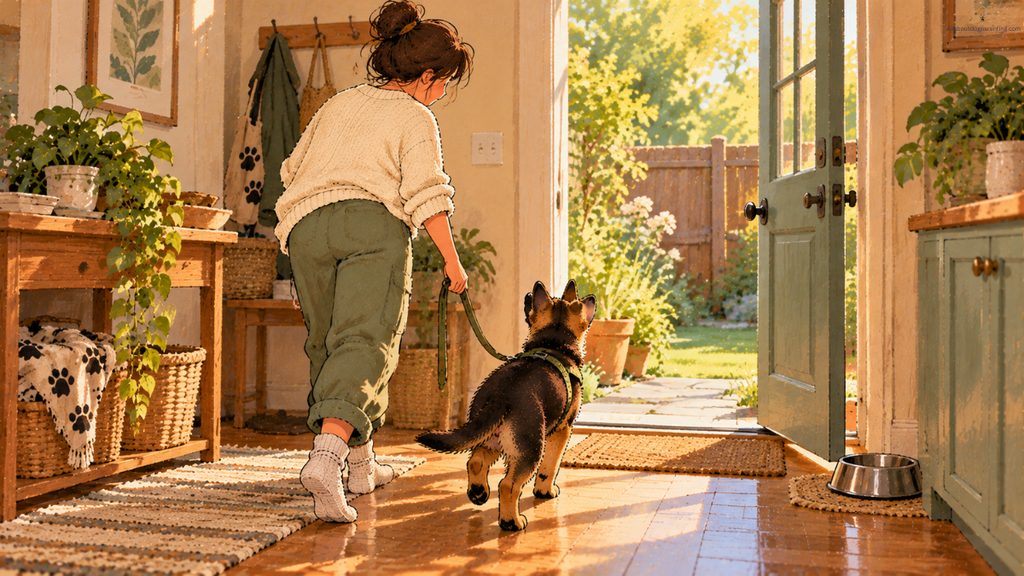
If your puppy isn’t in your line of sight, they should be in a crate, a pen, or on a leash tethered to you. Freedom gets earned by dry days. A puppy who has been clean for three days hasn’t earned the house; one who’s been clean for three weeks can start earning it room by room. Our round-up of crates for puppies covers sizing, which matters, since a crate that’s too big leaves room to pee at one end.
Reward outdoor success immediately
Say “yes!” the moment the stream stops and treat within a couple of seconds, outside, before you head back in. Our list of the best puppy treats for training has small, low-calorie options. For the broader method, our dog potty training guide walks through it.
With consistent scheduling, most puppies show a real improvement within a week, and full reliability usually takes several more weeks of the same routine.
Adolescent Regression (5–8 Months)
🐾 Overview
A clean puppy who starts having accidents at around 5–8 months is usually going through a normal adolescent phase. Tighten the schedule by one age bracket for a few weeks, and it passes.
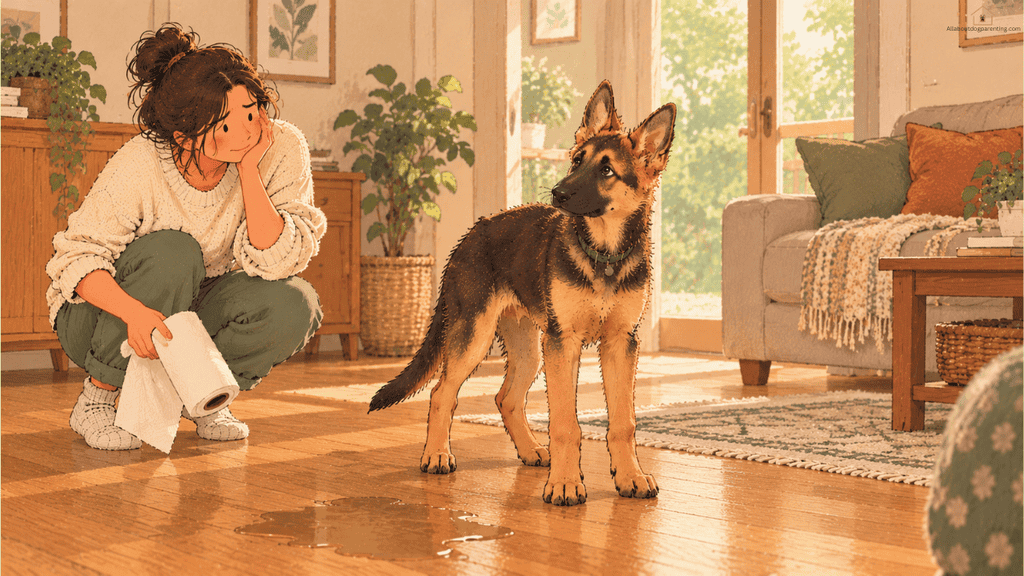
The version of puppy peeing inside house known as adolescent puppy regression is often the most worrisome because just when you had heaved a sigh of relief that the messy days of house training are behind you, it starts all over again. Puppy regression peeing inside often arrives alongside other adolescent changes such as developing a sudden case of selective hearing, a recall that suddenly falls apart, and being more interested in the world than in you.
Research on young guide dogs found they responded less reliably to their carers around eight months than at five, and many owners see house-training wobble in the same window. Our guide to puppy development stages explains what’s changing.
My German Shepherd hit this phase at six months, and there were a couple of accidents involving him peeing in the hallway or just by the front door. The good news is that you just need to go back to basics and not start from scratch. Here’s how:
- Drop back one age bracket. On the 4–6 month schedule? Return to the 12–16 week one for two to three weeks.
- Re-restrict freedom. Line-of-sight supervision again, with the crate or pen when you can’t watch.
- Bring the treats back. If you’d faded outdoor rewards, reinstate them for now.
- Don’t scold. Punishment adds anxiety, and anxiety makes accidents more likely.
If house training regression or puppy peeing inside after being outside carries on for more than a month despite a tight routine, see your vet to rule out an infection.
The “Pees Right After Coming In” Fix
🐾 Overview
If your puppy pees inside minutes after a successful trip, they almost certainly didn’t empty fully outside. The fix is mechanical: more time outside, the leash, a later reward and a second trip.
Puppy peeing inside after being outside is the most maddening version of this problem. Knowing how to stop puppy peeing inside here is a mechanical question, and the cause is usually one of three things.
They got distracted
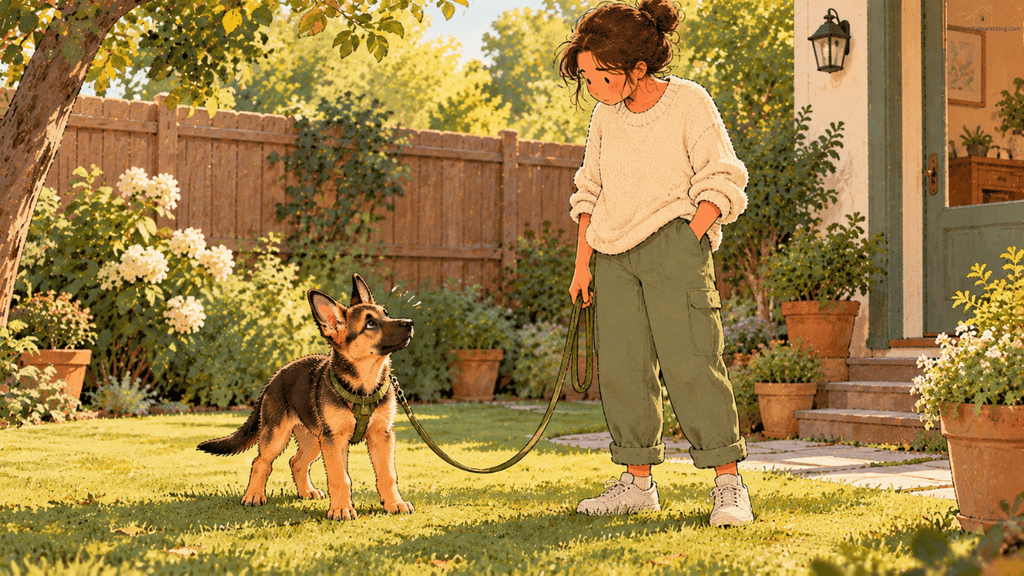
Sniffing, birds, the neighbour’s dog. Your puppy did a little pee and moved on. Keep them on leash at the potty spot, with no play or exploring until they’ve peed and pooped. The fun comes afterwards, as the reward.
You rewarded too early
You praised the first squat, your puppy stopped mid-stream for the treat, and the rest came out in the kitchen. Wait until they’ve finished, usually when they shift position or walk off, then mark and reward.
Coming inside set off a second round
Excitement indoors can trigger another wee. Use a double trip: come in, crate your puppy calmly for ten minutes, then take them back out. If they go, that’s the big reward. If nothing happens in five minutes, they’re empty, and supervised freedom can start.
Excitement Urination
🐾 Overview
Excitement urination happens during happy greetings, play or big moments, and it’s largely involuntary. It’s most common in young puppies and usually fades with age. Manage it calmly and never punish it.
Excitement urination puppy owners see is a maturity issue more than a training one. VCA notes that many dogs grow out of it, either because they become less excitable or because they gain better urine control as they mature. It tends to happen at homecomings, when guests arrive and when play escalates.
To manage it, keep greetings low-key: no high voice, no bending over your puppy, and a few calm minutes before you say hello properly. Take your puppy out before the exciting thing happens, whether that’s a visitor or a walk. If they pee during a greeting, say nothing and clean up. Any reaction, even a negative one, adds excitement.
Submissive Urination
🐾 Overview
Submissive urination comes with a crouch, flattened ears, a tucked tail or looking away, and happens when your puppy is approached, scolded or handled. It’s a fear response, and the fix is building confidence.
Submissive urination puppy behaviour looks different from excitement urination, and it needs a different response. Unlike excitement urination, it can happen at any age, so you can’t just wait for your puppy to grow out of it.
🐾 Excitement or Submissive?
| Excitement urination | Submissive urination |
|---|---|
| Bouncy, wiggly, tail wagging | Crouched, ears flat, tail tucked |
| Happens during happy greetings and play | Happens when approached, scolded or handled |
| Puppy seems unaware it happened | Puppy looks away, licks lips, may roll over |
| Usually fades with age | Needs confidence-building |
UC Davis veterinary behaviour guidance recommends approaching from the side, crouching to your puppy’s level and avoiding direct eye contact, petting under the chin instead of on top of the head, and never scolding, which makes it worse. Let your puppy come to you. Reward brave moments, like approaching a new person or exploring somewhere new.
If one particular person is a trigger, having them hand over meals or treats for a while can help your puppy see them differently. Our guide on how to socialise a puppy with other dogs and people covers confidence-building more broadly.
Territorial Marking
🐾 Overview
Marking is small amounts of urine on vertical surfaces like furniture legs and doorframes. It’s driven by scent and hormones more than a full bladder, and it’s most common in intact males, especially after changes at home.
Marking looks different from an accident. Clinician’s Brief describes it as small amounts, sometimes only a few drops, usually on vertical surfaces in prominent spots, while a large puddle points to house-training, access or medical issues. You’ll often find several spots in one go, and new objects, bags and the corners a visiting dog walked past are common targets.
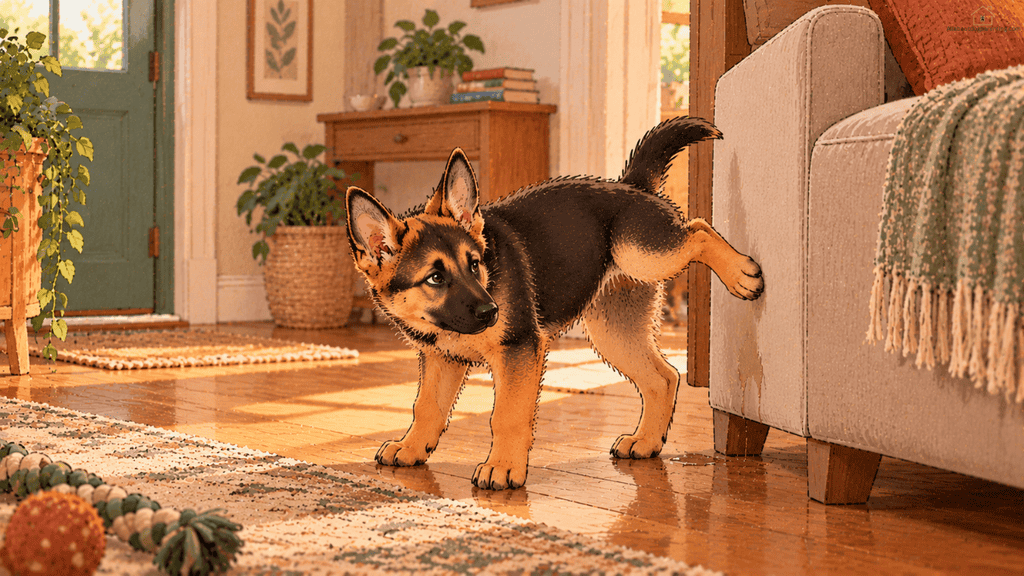
On neutering, the same review cites one study where marking fell by about half in 60–80% of dogs, and by around 90% in 25–40%; another reported resolution or clear improvement in roughly half. It helps many dogs without being guaranteed. Beyond that, clean every marked spot with an enzymatic cleaner, block access to favourite targets with gates or closed doors for a while, and supervise closely.
If you see a leg starting to lift, interrupt calmly and head outside. If you need to stop puppy marking inside after a new pet arrives, deal with that relationship too, since marking is one reason a puppy keeps peeing in the house.
Stress and Environmental Changes
🐾 Overview
A house-trained puppy who starts peeing inside after a move, a new baby, a new pet or a schedule change is usually stressed. Rebuild a predictable routine and tighten the schedule for a week or two.
Stress-related puppy peeing inside house usually follows a clear trigger: moving house, a new baby or family member, another pet, a change in your working hours, boarding, and building work at home.
Tighten the potty schedule by one age bracket for a week or two, exactly as you would for regression. Find the new potty spot and use it every time. Keep mealtimes rigid, since they’re the one thing your puppy can predict in a changing house.
Give them a quiet space and avoid adding more changes. Most puppies stabilise within a couple of weeks. If it carries on, ask whether the stress is still ongoing, such as a new dog they haven’t accepted, and deal with that directly.
How to Clean Up Properly—It Matters More Than You Think
🐾 Overview
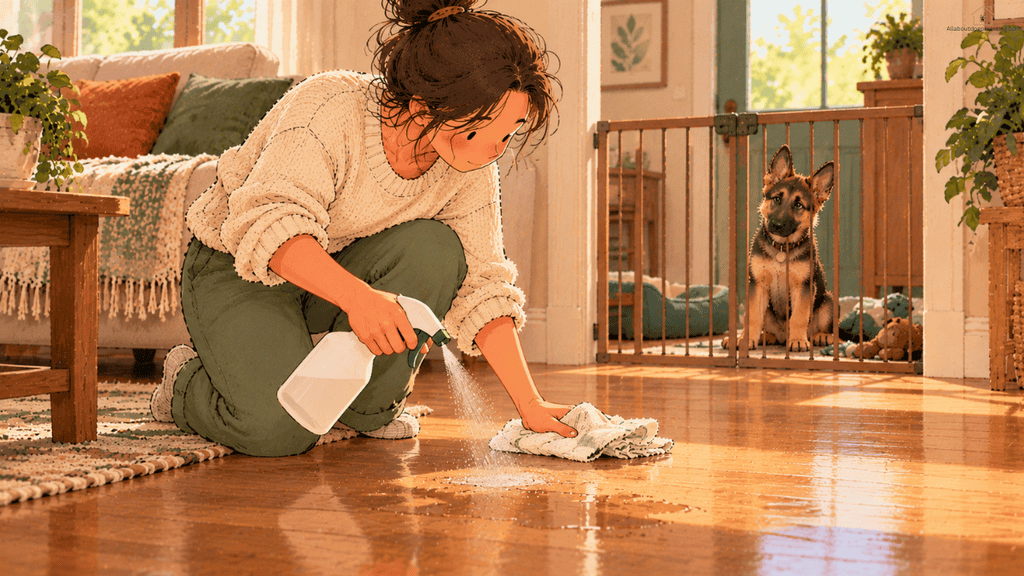
Ordinary cleaners leave traces your puppy can still smell, turning the spot into a repeat toilet. Use an enzymatic cleaner, soak the area, and avoid ammonia, vinegar and steam cleaners.
Cleaning is the part of fixing puppy peeing inside house that most people underestimate. Your puppy’s nose is somewhere between 10,000 and 100,000 times as sensitive as yours, so a spot that looks and smells clean to you can still smell like a toilet to them. An enzymatic cleaner breaks down the waste compounds behind the smell instead of covering them up.
Soak the area instead of just spraying it, because urine soaks into carpet and underlay, and let it air dry fully. The Anti-Cruelty Society advises avoiding ammonia and vinegar, since strong scents can encourage marking, and avoiding steam cleaners, because the heat can make the stain permanent. For a puppy peeing on carpet in the same spot again and again, you may need two or three treatments, and occasionally the underlay itself needs attention.
FAQs
1. Why is my puppy peeing inside again after being house-trained?
If you’re asking why puppy peeing in house has suddenly started again, it’s usually one of three things: puppy regression peeing inside at around 5–8 months, a urinary tract infection, or a big change at home. A sudden change with straining, blood or frequent small amounts means a vet visit and a urine test. Without those signs, tighten the schedule by one age bracket for a few weeks.
2. Should I punish my puppy for peeing inside?
No, punishment teaches your puppy that peeing in front of you is risky, so they start sneaking off behind the sofa or holding it on walks and going once they’re back inside. Reward outdoor success instead, so your puppy learns where to go.
3. How long does it take to stop a puppy from peeing inside?
It depends on the cause. Stress-related accidents often settle within a couple of weeks, adolescent regression within a few weeks of a tighter schedule, and incomplete training over several weeks of consistency. A UTI improves once treated. Puppy accidents in house from incomplete emptying usually stop within days of the double-trip routine. Excitement urination fades with age, and submissive urination depends on how quickly your puppy gains confidence.
4. Why does my puppy keep peeing in the house when I’m not home?
Usually because they can’t hold it for as long as you’re gone, or they have too much space. Puppy peeing when left alone is often a confinement issue: use a properly sized crate or pen, keep absences within their bladder capacity, and arrange a midday visit if needed. If it comes with howling, chewing at doors or panic, it may be separation distress; our guide on crate training a dog with separation anxiety covers that.
5. Why does my puppy pee in the same spot every time?
Because it still smells like a toilet to them, even if it doesn’t to you. Clean it with an enzymatic cleaner, soak it thoroughly, and let it dry, repeating two or three times if needed. Avoid ammonia, vinegar, and steam cleaning, and if it’s carpet, check whether the urine reached the underlay.
The Bottom Line
Most puppy peeing inside house problems look the same from the outside and turn out to be completely different underneath. Rule out the medical side, find your scenario in the diagnostic guide, and apply that one fix consistently for a couple of weeks before you judge it. If your puppy keeps peeing in the house even then, go back to the table, because a second cause may be hiding behind the first. Knowing how to stop puppy peeing inside starts with knowing why it’s happening, and your puppy is already telling you.