How to Potty Train a Puppy: A Day-by-Day Plan That Actually Works
🐾 Overview
Take your puppy outside every 30–60 minutes while awake, and straight after sleeping, eating, drinking and play. Reward every outdoor success with a treat and calm praise. Clean accidents silently. If you are consistent, your puppy will learn in a matter of weeks.
How to potty train a puppy comes down to one thing you can start this morning: a schedule built around your puppy’s bladder, with a trip outside after every meal, nap, drink and play session, and a reward every time they get it right. If you’re reading this with paper towels in one hand, know that it’s as simple as that.
This article, part of our Complete Guide to Puppy Training, lays out how to potty train a puppy day by day, because that’s how you’ll live it. New puppy this week? Start at Day 1. Three months in, still mopping daily and wondering if you got a “difficult” one? Skip to the messy middle. I’ve been at both ends of this with my German Shepherds.
One firm rule before we start: no scolding, no “bad dog,” and no rubbing their nose in it. That last one is still the most common advice passed between dog owners, and it backfires. A board-certified veterinary behaviourist writing for VCA points out that punishing a puppy for a natural act can teach them never to toilet near a person, which is exactly how you end up with puddles behind the sofa.
| Stage | Trips outside per day | Accidents per day (typical) | What you’ll notice |
|---|---|---|---|
| Days 1–3 | 10–15 | 2–5 | Exhaustion, mostly yours |
| Days 4–7 | 10–12 | 1–2 | Puppy drifts towards the door |
| Weeks 2–3 | 8–10 | 0–1 | First signals at the door |
| Weeks 4–8 | 6–8 | Unpredictable | Regression, then a jump forward |
| Months 3–6 | 4–6 | Rare | Reliable, with the odd slip |
The One Rule That Makes Potty Training Work
🐾 Overview
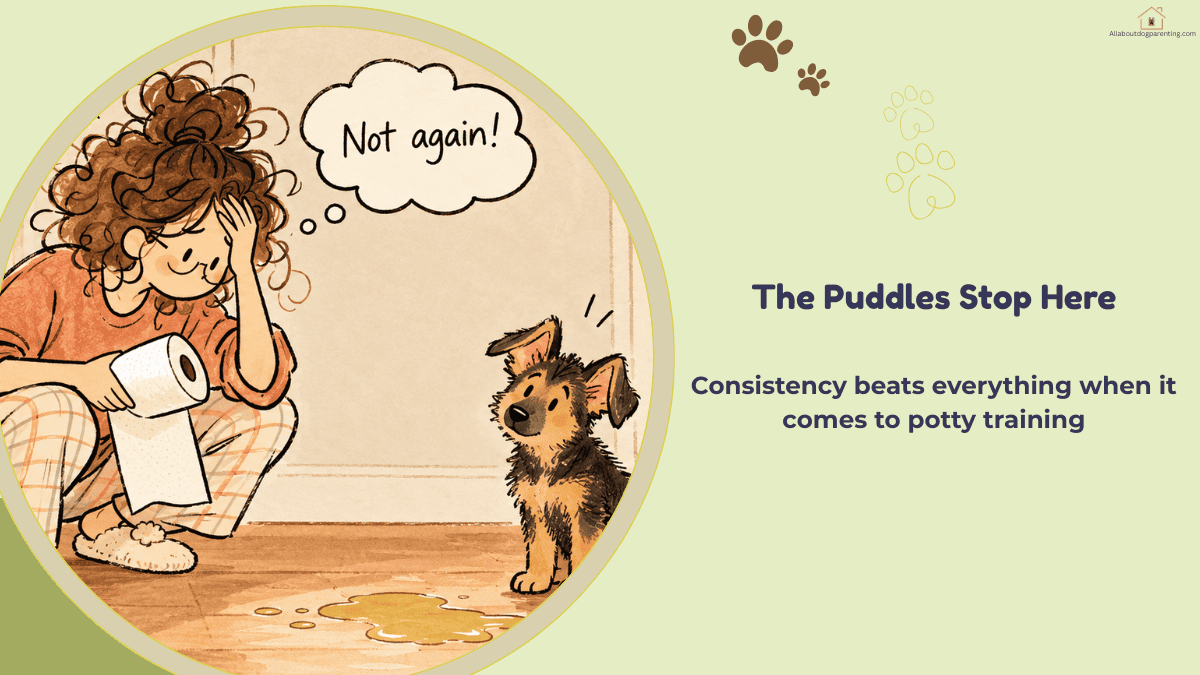
Treat every accident as a timing problem on your side. Your puppy’s bladder is small and still developing, so an indoor pee means they weren’t taken out soon enough. Adjust your schedule.
Your puppy isn’t being stubborn or spiteful. A 10-week-old can’t hold a full bladder for as long as you’d like, and no amount of disapproval changes the plumbing. Once you see accidents as information about your timing, house training a puppy becomes a problem you can actually solve. Here’s roughly what you’re working with:
| Age | Can hold it at rest | Can hold it when active |
|---|---|---|
| 8 weeks | 1–2 hours | 30–45 minutes |
| 12 weeks | 2–3 hours | 1–1.5 hours |
| 16 weeks | 3–4 hours | About 2 hours |
| 6 months | 4–6 hours | 3–4 hours |
You’ll often see the “age in months plus one” rule, which the AKC uses as an upper limit for how many hours a puppy can hold it. Treat that as a ceiling, and plan daytime trips well inside it. Our guide on how long puppies can hold their pee breaks the biology down month by month.
🐾 When to Take Your Puppy Outside: The 7 Potty Triggers
- Immediately after waking up, overnight and after every nap
- 15–20 minutes after every meal
- 10–15 minutes after a good drink of water
- After every play session
- After any excitement: a visitor, a new toy, a round of zoomies
- Right before going into the crate
- Every 30–60 minutes during awake time at 8–12 weeks, stretching as they grow
What You’ll Need Before Day 1
🐾 Overview
You need five things: a properly sized crate, an enzymatic cleaner, high-value treats, a consistent feeding schedule and one designated potty spot outside. If you have outdoor access, skip pee pads, which teach puppies to pee inside.
Sort these out before your puppy comes home, and the rest of how to potty train a puppy gets much simpler.
A crate that fits
Your puppy should be able to stand, turn around and lie down, and that’s all. Too much space lets your puppy pee in one corner and sleep in the other; a divider panel fixes that if you’re buying the adult size. Our round-up of crates for puppies covers sizing, and a positive introduction is what makes crate training potty progress stick.
An enzymatic cleaner
Ordinary floor cleaners leave enough urine behind for your puppy’s nose to find, and a spot that smells like a toilet gets used as one. Of all the supplies, an enzymatic cleaner puppy owners skimp on is the one they regret.
Treats worth working for
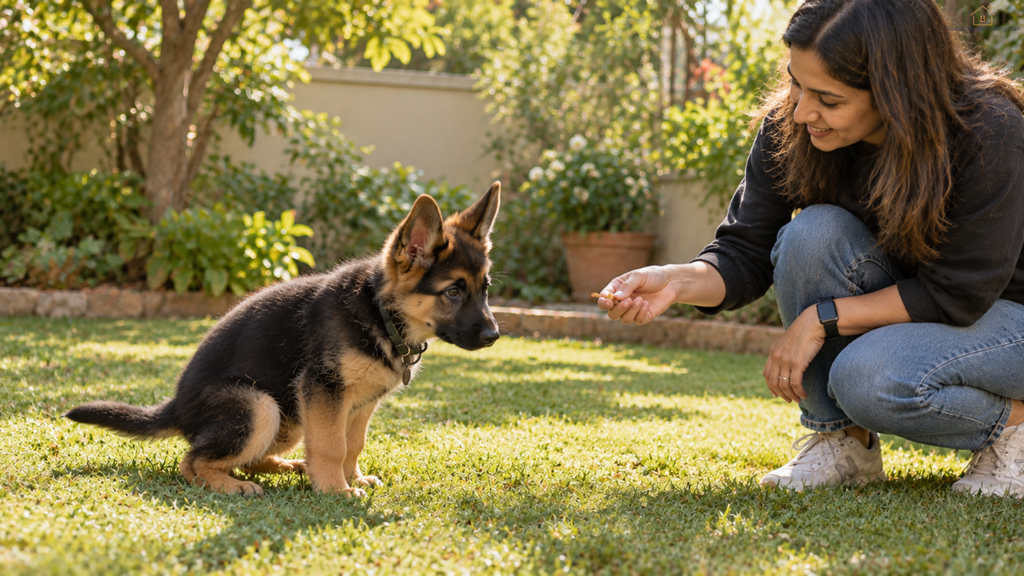
Small, soft and smelly, and kept exclusively for potty success. Kibble won’t cut it here. Pick something low in calories, since you’ll be handing out fifteen a day.
A feeding schedule you can stick to
Same times, same amounts, every day. Predictable meals create predictable potty breaks, as you’ll see below.
One potty spot
Pick a patch of your garden and take your puppy there on leash every single time. The lingering scent tells them what this place is for.
The Day-by-Day Potty Training Plan
🐾 Overview
Days 1–3 set up the routine and days 4–7 build reliability. Weeks 2–3 stretch the gaps between trips, and by weeks 3–4 most puppies start recognising the pattern. Expect setbacks along the way, because they’re normal and temporary.
Most guides on how to housebreak a puppy are organised by topic, which leaves you working out the order yourself at 6 a.m. This plan for how to potty train a puppy runs in the order you’ll need it, give or take a few days depending on your puppy’s age.
What should days 1–3 look like?
Busy. If your puppy only arrived today, what to expect when bringing a puppy home covers the rest of the first-week setup. Here’s a sample day for an 8–10 week old puppy on four meals:
| Time | What to do | Why |
|---|---|---|
| 6:00–6:30 a.m. | Puppy wakes, straight outside to the potty spot | The overnight bladder is full |
| 6:30 a.m. | Back inside for breakfast, same time daily | Consistent meals mean predictable potty times |
| 6:45–6:50 a.m. | Outside to the potty spot | Eating triggers the urge to go |
| 7:00–8:00 a.m. | Supervised play, outside every 30 minutes | Active puppies pee more often |
| 8:00–10:00 a.m. | Crate nap | Bladders hold better during sleep |
| 10:00 a.m. | Wakes from nap, straight outside | Post-nap means full bladder |
| 10:15 a.m. | Water offered, note the time | Tracking intake predicts the next pee |
| 10:30 a.m. | Outside | 15 minutes after drinking |
| 11:00 a.m. | Second meal, outside 15–20 minutes later | Second post-meal trip |
| 3:00 p.m. | Third meal, outside 15–20 minutes later | Third post-meal trip |
| 7:00 p.m. | Dinner, outside 15–20 minutes later | Fourth post-meal trip |
| 9:00–10:00 p.m. | Final potty break, then crate for the night | Last chance before sleep |
| 2:00–3:00 a.m. | Alarm, quiet potty break | Puppies this young can’t hold it all night |
Every nap, drink and play session in between earns its own trip. You’ll go out 10–15 times a day, still clean up two to five accidents, and at some point stand in the garden at dawn wondering what you’ve done. All normal. Your only job is to rack up outdoor successes and shrink the chances for indoor ones.
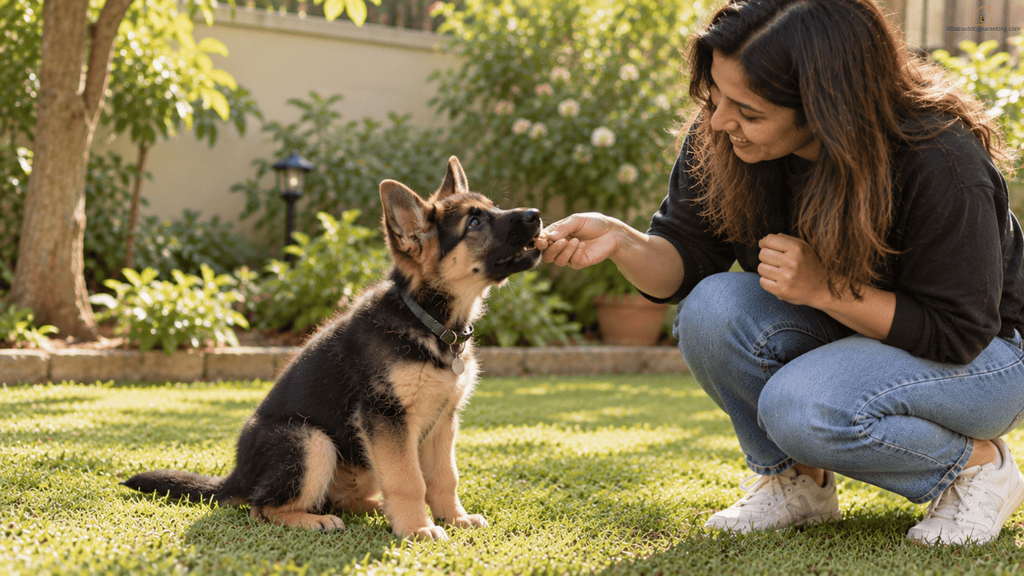
When your puppy squats outside, stay quiet so you don’t interrupt. The moment they finish, a calm, “Yes, good puppy!” and a treat, then two or three minutes to sniff around as a bonus.
When they go inside, say nothing. If you catch them mid-stream, scoop them up and carry them out to finish. Then clean the spot thoroughly with your enzymatic cleaner. A puppy accident inside teaches your puppy nothing about where to go, and a reaction from you only teaches them to go where you can’t see.
What changes on days 4–7?
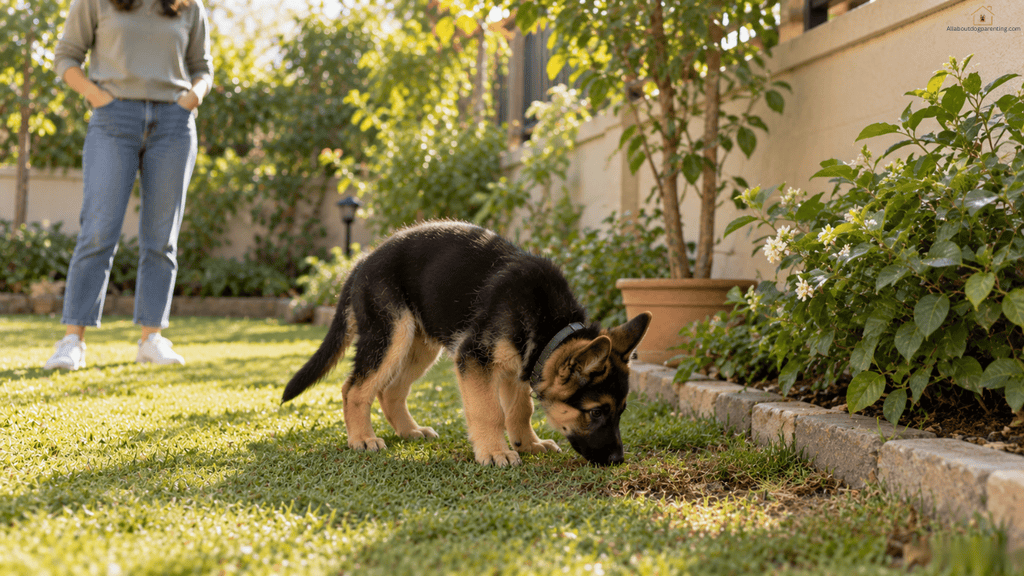
It starts to click. Accidents usually drop to one or two a day, and you’ll get better at reading your puppy’s tells: sniffing in tight circles, a sudden freeze mid-play, a beeline for last time’s corner. Any of those means outside, immediately, whatever the clock says.
If 30-minute gaps have produced zero accidents during calm stretches, try 45 minutes. Keep play periods on the shorter interval. Praise your puppy for going to the spot even when nothing happens; a lot of puppy pee training happens on the walk there.
Overnight potty training puppy progress comes quicker than you’d think: many 8–10 week olds manage four to five hours by the end of week one, and our puppy sleep schedule by age shows how night-time sleep stretches from there. Push the alarm 30 minutes later every two or three nights. Puppy potty training at night has one firm rule: if your puppy cries before the alarm, take them out. Making them wait guarantees an accident in the crate.
How do you stretch the gaps in weeks 2–3?
You’re probably down to eight to ten trips a day. The big milestone here is your puppy signalling at the door with a stare, a whine or a paw. Reward it calmly every time. My GSD’s version was sitting by the back door and staring at the handle as if it might open by itself.
Lengthen intervals by age, since nobody can housebreak puppy bladders faster than they mature. A 10-week-old might manage 45–60 minutes during active periods; a 12-week-old, 60–90. Three habits tend to sink progress at this point, and they’re my most important puppy potty training tips for this stage:
- Too much freedom too soon: Three good days don’t mean a house-trained puppy. After one clean week, open up one more room, with supervision
- Dropping the treats: Keep rewarding every outdoor success for at least four to six weeks. From around week four you can switch to treating every second or third time
- Forgetting the water: Owners get the post-meal trips down and stop tracking drinks, which are just as predictive
Why does everything fall apart in weeks 4–8?
Because progress in potty training a puppy isn’t a straight line, and this is the stretch of toilet training puppy owners find hardest. A flawless week can be followed by three accidents in an afternoon. A bolder puppy gets distracted more, and approaching adolescence, hormones start nudging attention and bladder control too. Our guide to puppy development stages explains what’s shifting at this age.
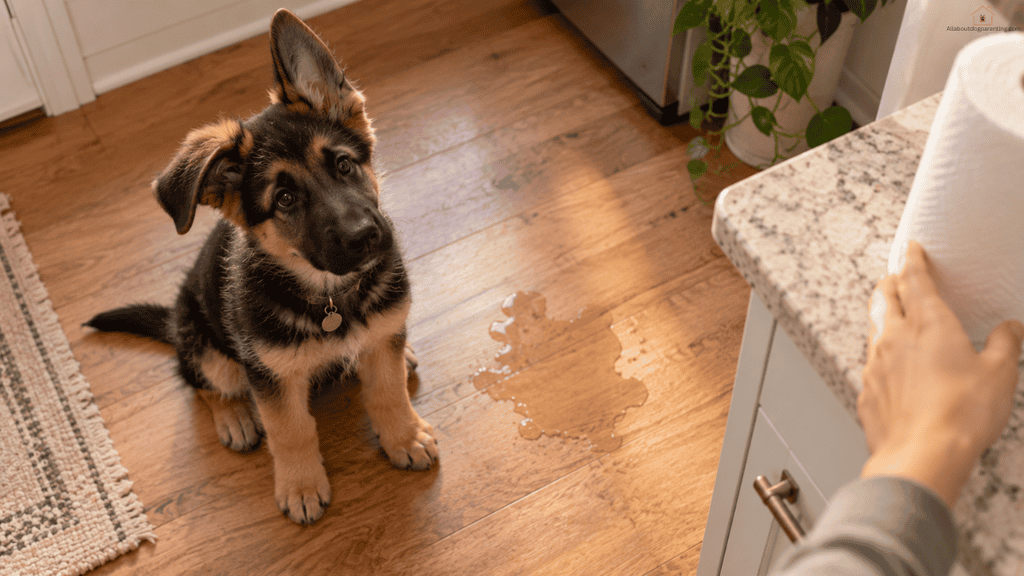
Your puppy is moving from “I pee outside because that’s where I’m taken” to “I hold it because outside is the place,” and that shift comes with wobbles. Puppy potty training regression at this stage is a cognitive hiccup in an otherwise developing system.
When it happens, go back to the week 1 schedule for two or three days, then loosen it again. You’ll usually see the jump forward within the week.
When will my puppy be reliable?
By four months, most puppies can hold it three to four hours in the day and five to six overnight, and the 2 a.m. alarm is gone for most by four to five months. By six months, most are reliably house-trained, with the occasional slip during excitement, illness or a change in routine.
If your puppy is past six months and still having daily accidents despite a consistent schedule, see your vet before assuming it’s behavioural. A urinary tract infection is one of the more common causes of house-soiling in a dog that should know better, and it’s easily missed. If the vet gives the all-clear, go back to basics: tighten the schedule, shrink their space and reward every outdoor success.
The Feeding Schedule Connection (Your Secret Weapon)
🐾 Overview
A consistent feeding schedule is your most powerful potty training tool. Puppies usually need to go 15–20 minutes after eating, so fixed mealtimes let you predict potty times within minutes. Random feeding brings random accidents.
If there’s one part of how to potty train a puppy I’d underline, it’s this. Most toilet training puppy advice says “take them out after meals” and stops there. When food enters the stomach, it sets off the gastrocolic reflex, a wave of contractions that pushes waste along the colon. In puppies, the urge follows within about 15–20 minutes, which is why veterinarians advise taking puppies out 15–20 minutes after eating until they’re house-trained. You can plan a day around that.
| Meals per day | Age | Example feeding times | Post-meal potty windows |
|---|---|---|---|
| 4 | 8–12 weeks | 7 a.m., 11 a.m., 3 p.m., 7 p.m. | 7:15–7:20, 11:15–11:20, 3:15–3:20, 7:15–7:20 |
| 3 | 3–6 months | 7 a.m., 12 p.m., 5 p.m. | 7:15–7:20, 12:15–12:20, 5:15–5:20 |
| 2 | 6–12 months | 7 a.m., 5 p.m. | 7:15–7:20, 5:15–5:20 |
Our puppy feeding schedule by age has the full meal frequencies, and how much to feed a puppy covers portions. Overfeeding means bigger, looser, less predictable output, so portions matter too.
When I was potty training my GSD, this was what changed everything. He ate at 7 a.m., 12 p.m. and 5:30 p.m., and within three days I could predict his post-meal poop to within five minutes. By the second week, he was walking to the door at 7:15 before I’d even reached for the leash.
Water follows the same logic on a shorter cycle. Most puppies need to pee 10–15 minutes after a proper drink. Never restrict water to cut down on accidents, since a growing puppy needs steady hydration. Just note when they drink, and you’ll know when the next trip is due.
Apartment Potty Training—No Garden? No Problem
🐾 Overview
In an apartment, pick one indoor potty spot, pads or an artificial grass patch, and treat it like an outdoor one: on leash, rewarded every time, with the rest of the flat off-limits until they’re reliable.
Learning how to potty train a puppy in a flat uses the same house training puppy system: same schedule, same seven triggers, same rewards. Only the destination changes.
Search for how to toilet train puppy in a flat and you’ll mostly find pads, but if you can, choose a grass patch. Grass teaches your puppy to go on grass, which carries straight over to the park later. Pads teach them that any soft, flat thing on the floor is fair game, which is how bath mats get christened. If pads are your only option, our round-up of the best puppy training pads covers the ones that hold up. A balcony station works well if you have the space.
If you’re working out how to housebreak a puppy for outdoors eventually, mix in outside trips while keeping the indoor spot, then make outdoors the default.
The 5 Biggest Potty Training Mistakes
🐾 Overview
The five most common mistakes are punishing accidents, giving too much freedom too soon, an inconsistent schedule, stopping rewards too early and using pee pads despite having a garden. You can fix all five today.
Most puppy potty training tips cover what to do. These are the habits to stop.
- Punishing accidents: Scolding, yelling and nose-rubbing teach your puppy to fear peeing in front of you. They’ll sneak behind furniture instead of holding it
- Too much freedom, too early: A 10-week-old shouldn’t have the run of the house. Baby gates keep them to one or two rooms, puppy-proofing your home makes those rooms safe, and access expands only after a full week with zero accidents in the current space.
- A schedule that wobbles: Potty training puppy routines fall apart on random mealtimes, skipped trips and Sunday lie-ins. Your puppy’s bladder doesn’t know it’s the weekend.
- Stopping the rewards too soon: For most puppies under four months, praise alone isn’t enough motivation. Keep treating outdoor successes for at least four to six weeks.
- Pads when you have a garden: Every pee on a pad is a missed outdoor rep and a vote for “indoors is fine.” With outdoor access, skip them entirely. Build your puppy potty training schedule around the garden from day one.
FAQs
1. How long does it take to potty train a puppy?
How long potty training takes varies, but most puppies are reliable by four to six months with consistent effort. Potty training a puppy shows real progress in two to three weeks, and accidents usually become rare by month three. Small breeds often take longer because of their tiny bladders and fast metabolisms. Expect some regression in adolescence, around five to eight months, which passes.
2. Should I use pee pads to potty train my puppy?
Only if you live in an apartment without quick outdoor access. With a garden, pads add an extra step and teach your puppy that indoors is an acceptable place to go. If you do use them, keep them in one spot, treat it like an outdoor potty area, and plan to move outdoors as soon as you can.
3. What do I do when my puppy has an accident inside?
Stay calm. If you catch them mid-stream, pick them up and carry them outside to finish. If you find it later, clean it with an enzymatic cleaner, since ordinary products leave behind scent your puppy will return to. Never scold or rub their nose in it, because punishment teaches fear of going in front of you.
4. Why does my puppy pee inside right after being outside?
Usually one of three reasons: they got distracted outside and forgot to go, the trip was too short, or they didn’t fully empty their bladder. Give them five to ten minutes, keep them on leash at the potty spot to cut distractions, and wait for both a pee and a poop before heading back in.
5. Can I potty train a puppy without a crate?
Yes, but house training a puppy without one is harder. The crate uses your puppy’s instinct to keep their bed clean, which builds bladder control during rest. Without it, you’ll need eyes on your puppy whenever they’re awake, or tether them to you on a leash.
Bottom Line
If today was a five-accident day, it doesn’t predict how this ends. Every puppy I’ve raised had a week where nothing seemed to sink in, and every one got there. Keep the meals fixed, keep the treats in your pocket, and keep walking to that same patch of grass. That’s how to potty train a puppy: repetition, a schedule, and the patience to clean up quietly for a few more weeks.